

Scotland registered 1,133 drug-use deaths in 2025, an increase of 116 in a year. The average person who died was 46. The deaths came during a year in which Scotland recorded its lowest number of births since national records began in 1855, while cocaine, nitazenes and combinations of multiple drugs continued to reshape the illicit market. Three weeks before the figures were published, First Minister John Swinney told Parliament that his government would treat drug use as a public-health emergency.
Scotland recorded 1,133 drug-use deaths in 2025.
The average person who died was 46.
In the national statistics they appear together as one annual figure. Outside those tables, the deaths occurred one person at a time: in homes, hospitals and communities, leaving parents without adult children, children without parents, partners without partners, and friends and neighbours without people who had occupied a place in their lives.
The deaths came during another significant year in Scotland’s population history. Only 45,067 babies were born in 2025, the lowest annual number since national records began in 1855. There were 61,726 deaths from all causes, leaving Scotland with 16,659 more deaths than births. It was the eleventh consecutive year in which deaths exceeded births.
The two sets of statistics describe different problems and should not be confused with one another. Drug deaths do not explain Scotland’s falling birth rate, and demographic change does not explain why an individual person dies through drug use. But together they establish part of the national setting in which these deaths are occurring: Scotland is already experiencing natural population decline, while more than a thousand additional lives ended through drug use, many decades before old age.
Migration continues to prevent that natural decrease from becoming an overall population fall. Scotland’s population grew by only about 2,200 in the year to mid-2025 because net migration outweighed a natural decrease of about 16,200 during that particular twelve-month period.
Migration can change a national population total. It cannot replace an individual person in the family or community that has lost them.
Swinney Declares a Public-Health Emergency
On 1 September, three weeks before National Records of Scotland published the 2025 mortality figures, John Swinney used his Programme for Government speech to place drugs within the language of emergency.
“We will treat drug use as a public health emergency,” the First Minister told the Scottish Parliament.
He linked the commitment to an additional £250 million through the National Mission on drugs, further residential rehabilitation provision and additional mental-health support.
The declaration did not begin Scotland’s public-health approach to drugs. The National Mission, naloxone distribution, Medication Assisted Treatment standards, residential rehabilitation investment and other harm-reduction programmes all pre-date Swinney’s September speech. What changed was the prominence of the language: the public-health emergency was placed explicitly within the new five-year Programme for Government.
The statistics published on 23 September now provide the first large mortality measure against which that renewed emphasis will be read.
There were 1,133 drug-use deaths registered in 2025, up 11 per cent from 1,017 in 2024. The total remains below the record 1,339 deaths registered in 2020 and is the sixth-highest annual figure in the series.
The age-standardised mortality rate increased from 19.1 to 21.4 deaths per 100,000 people, although National Records of Scotland cautions that the difference between the two annual rates is not statistically significant because their confidence intervals overlap.
The number of people who died unquestionably rose. The statistical evidence does not support claiming an equally certain increase in the underlying age-adjusted mortality rate.
Lives Ending Among Ages 35 to 54
The age profile tells another part of the story.
In 2000, the average age of a person recorded in Scotland’s drug-use death statistics was 32. By 2025 it had risen to 46. The highest mortality rates are now among people aged 35 to 44 and 45 to 54.
These are not predominantly deaths at the end of ordinary life expectancy. They are concentrated in decades in which people are often raising children, helping older parents, working, maintaining households and sustaining relationships accumulated over many years.
That does not make a person valuable because of their economic output. The worth of somebody’s life cannot be calculated from whether they were employed, paying tax or caring for somebody else. It does mean that premature death removes a person from a web of relationships that public statistics cannot measure.
The increase in 2025 was also overwhelmingly concentrated among men.
There were 830 male drug-use deaths, 131 more than in 2024, an increase of 19 per cent. Female deaths fell by 15 to 303, the lowest female total since 2017. After adjustment for age, the male mortality rate was 32.3 deaths per 100,000, compared with 11.1 among women.
The national increase was therefore not evenly distributed between men and women. It was driven by a sharp rise in male deaths.
One Death Can Leave More Than One Empty Place
The annual National Records of Scotland release can tell us the age, sex, location and toxicology associated with the people who died. It says much less about the lives surrounding them.
For that, Scotland has another dataset.
Public Health Scotland’s National Drug-Related Deaths Database assembles information from health records, pathology, police and other sources. Its newest detailed analysis concerns deaths registered in 2021 and 2022, not the 1,133 deaths registered in 2025, so its personal characteristics cannot simply be transferred onto the latest group.
What the 2022 records show is nevertheless important to understanding the human reach of drug mortality.
Public Health Scotland recorded 387 children who lost a parent or parental figure as a result of a drug-related death in that year alone.
Sixty per cent of the people who died lived alone. More than half lived in Scotland’s most deprived fifth of neighbourhoods. Two thirds had been in contact during the previous six months with a service that had the potential to address problematic drug use or provide harm reduction, including treatment services, prisons, police custody or hospital care.
Around 29 per cent had been discharged from an acute hospital admission during the preceding six months. Fifty-four per cent had a recent medical condition recorded and half had a recent psychiatric condition.
Those findings complicate the idea that people dying through drugs are simply hidden from public services until the day of their death. Many were known somewhere within Scotland’s health, justice or treatment systems.
A person may appear once in the death statistics while their absence appears repeatedly in the lives around them.
The Geography of Loss
Drug-use mortality is also distributed very unevenly across Scotland.
In 2025 the age-standardised death rate in the most deprived fifth of Scottish neighbourhoods was 15 times the rate in the least deprived fifth. For deaths from all causes, the comparable gap is around twofold.
That does not establish deprivation as the sole cause of any individual death. It does establish that the burden of drug mortality is extraordinarily concentrated within poorer communities.
Across the five years from 2021 to 2025, Glasgow City, Dundee City, North Ayrshire, Inverclyde, West Dunbartonshire and East Ayrshire all had drug-use death rates statistically above the Scotland average.
The most recent annual movement was not uniform. Deaths increased in 20 council areas, decreased in ten and were unchanged in two. East Ayrshire recorded the largest numerical increase, with 27 more deaths than in 2024, followed by North Ayrshire with 25 more. North Lanarkshire recorded the largest fall, with 16 fewer.
Scotland’s drug deaths are therefore national in scale but locally concentrated, falling particularly heavily on communities already carrying wider burdens of poor health, lower incomes and earlier mortality.
This Is No Longer Simply a Heroin Story
The substances found in Scotland’s deaths also show that the crisis has changed shape.
Opiates and opioids remain central. They were implicated in 881 deaths, 78 per cent of the 2025 total. Heroin or morphine was implicated in 468 deaths and methadone in 338.
But cocaine was implicated in 589 deaths — 52 per cent of all drug-use deaths.
That was 110 more than in 2024, an increase of 23 per cent and the highest number recorded since the cocaine series began in 2008.
The figure does not mean 589 people died from cocaine alone. Cocaine was the only implicated drug in 101 deaths, or 9 per cent of the total.
Most of the mortality therefore sits inside combinations of substances.
More than one drug was implicated in 78 per cent of all drug-use deaths in Scotland during 2025.
Benzodiazepines were implicated in 433 deaths. Gabapentin or pregabalin was implicated in 330. Street benzodiazepines, which had become one of the defining features of the crisis around the 2020 peak, were implicated in 300 deaths, down substantially from 879 in 2020.
Cocaine has simultaneously moved in the opposite direction.
The change is also visible before death. Among people beginning specialist drug treatment in Scotland during 2024/25, cocaine had become the most commonly reported main drug, accounting for 32 per cent of initial assessments. Heroin accounted for 25 per cent.
Scotland’s treatment system developed over decades around a population in which opioid dependence was dominant. It now faces a drug market in which opioid use remains widespread while cocaine and combinations of several substances have become increasingly prominent.
Then Came the Nitazenes
The greatest new uncertainty comes from synthetic opioids.
Nitazenes were implicated in 247 drug-use deaths registered in 2025 — more than one in five. Etonitazene alone was implicated in 215.
The apparent increase is dramatic: 76 deaths involving nitazenes were recorded in 2024.
But those numbers cannot be read as a clean measure of how much nitazene use increased. Scotland also became better at finding them.
National Records of Scotland says post-mortem testing for nitazenes was limited before 2023 and that additional compounds have progressively been incorporated into routine toxicology. Etonitazene itself was not added to routine testing across Scotland until May 2025.
The rise from 76 to 247 therefore reflects a changing drug supply alongside an improved ability to identify synthetic opioids after death. The available evidence cannot precisely separate those two effects.
Public Health Scotland’s live intelligence nevertheless confirms that nitazenes have become established within the illicit supply. Its RADAR system says the compounds have been detected across Scotland and are commonly found as contaminants in drugs sold as heroin, benzodiazepines and oxycodone.
In March 2025, Public Health Scotland warned of fatal and near-fatal overdoses among people using heroin, including sudden collapses requiring repeated naloxone. Rapid testing found a nitazene-type opioid in some of the samples associated with those events.
The danger is not simply that a more potent drug exists. It is that a person may consume it without intending to buy it.
How the Drugs Reach Scotland
The drugs implicated in Scottish deaths do not all follow one route into the country.
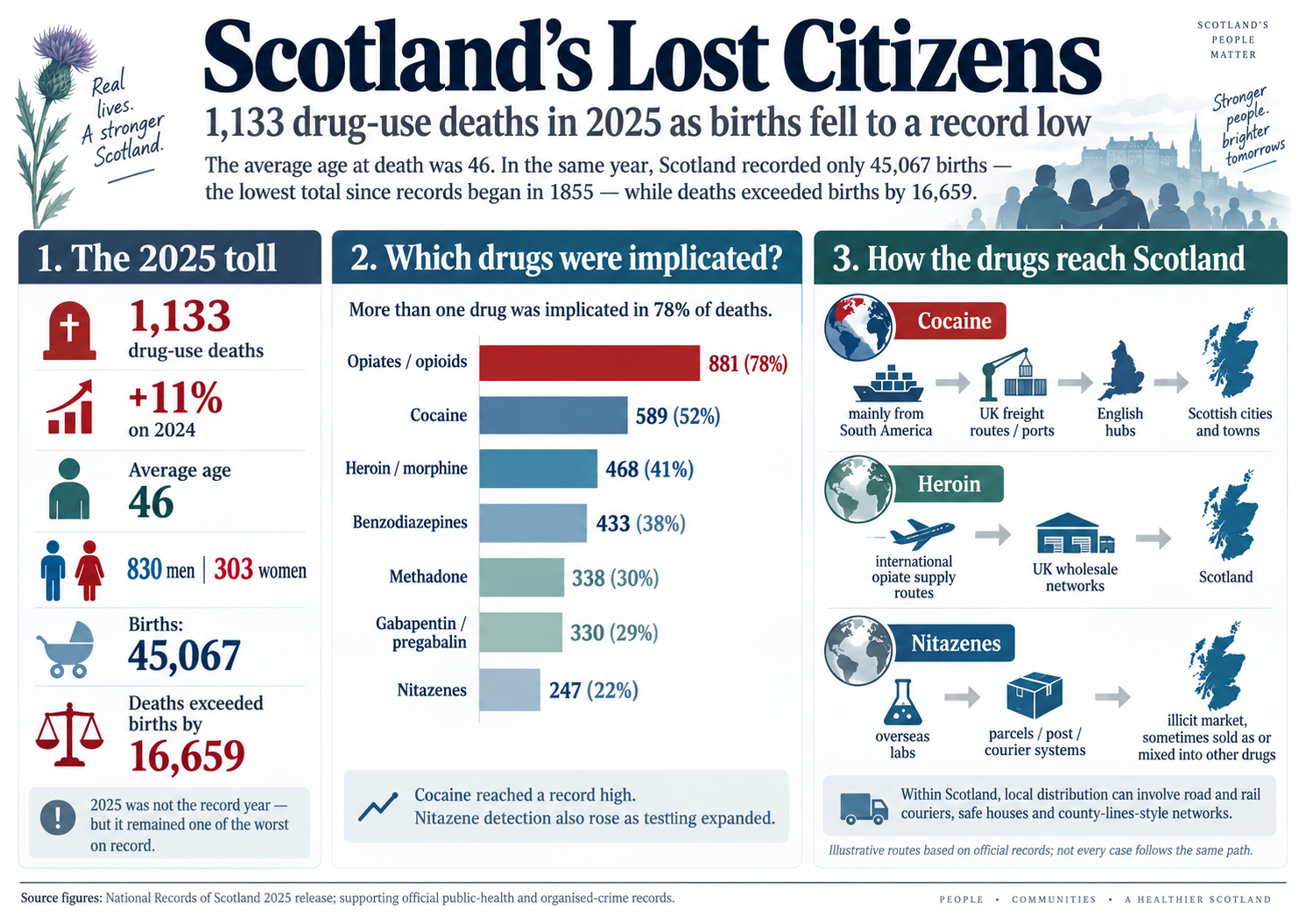
Cocaine begins principally in the international cocaine-producing regions of South America before entering European and British markets through freight, ports, aircraft, passengers and other smuggling routes. From there, wholesale criminal networks redistribute it within the UK and into Scotland.
One Scottish investigation showed that chain with unusual clarity. Police Scotland and the National Crime Agency intercepted about a tonne of cocaine at Dover in 2020, concealed inside a commercial consignment of bananas which had arrived from Ecuador. Six men were later convicted of conspiring to bring around £100 million of cocaine into the Scottish market.
The case does not establish how the cocaine implicated in any particular 2025 death entered Scotland. It demonstrates the scale and international reach of one documented Scottish supply route.
The organised market beneath that trade is extensive. As of March 2025, Scottish authorities had 94 serious organised crime groups mapped as operating in Scotland, involving 1,202 individuals. Seventy per cent of those groups were involved in drug crime, with cocaine and cannabis the most common drug commodities.
Once large consignments enter the UK market, drugs can be divided repeatedly and moved through national and regional networks until they reach individual towns, housing estates and street-level markets.
Nitazenes create a different enforcement problem. The National Crime Agency says the synthetic opioids are manufactured in laboratories in countries including China and can be smuggled into the UK using fast parcels and postal systems. Their potency means that relatively small amounts can be commercially significant.
A UK investigation concluded this year with a supplier admitting conspiracy to distribute nitazenes. The NCA said pills advertised as oxycodone contained isotonitazene and linked the operation to fatal overdoses.
The route from an overseas laboratory or South American producer to somebody consuming a tablet or powder in Scotland can therefore involve international manufacturing, freight or postal systems, UK organised crime, Scottish distribution networks and local dealers.
By the time the substance reaches the person using it, its contents may no longer be what they believe they purchased.
A Market in Which the Buyer May Not Know What They Have Bought
That uncertainty is becoming central to Scotland’s response.
On the same day the 2025 death figures were published, the Scottish Government announced that Scotland’s first local drug-checking service would open in Glasgow in October.
People will be able to submit a sample for rapid testing and receive information about what it contains together with harm-reduction advice. Samples will then be forwarded to a national testing and research laboratory at the Leverhulme Research Centre for Forensic Science in Dundee for more complete analysis.
The Scottish Government has invested more than £1.7 million in the pilot. Aberdeen and Dundee have Home Office licences for similar services, while an Edinburgh facility is preparing an application.
The programme is intended to do two things at once: provide information to the individual person about the sample in front of them, and feed intelligence into Scotland’s national early-warning system about what is moving through the illicit market.
Its effectiveness in reducing deaths remains to be established. Its creation reflects the problem now evident in the toxicology: the identity and potency of a drug can no longer safely be inferred from what it was sold as.
Higher Than Every Country in the Available European Comparison
Scotland’s international position remains exceptional.
National Records of Scotland says that, on the information currently available from the European Union Drugs Agency, Scotland has a higher rate of drug-induced deaths than any of the countries included in the European comparison.
That finding requires qualification.
The countries are not all reporting data from the same year. Death certification, coding practices and access to detailed post-mortem toxicology differ between jurisdictions. The European agency describes its figures as minimum estimates because deaths can be missed or classified differently.
Scotland has detailed toxicology and records all substances considered to have contributed to a death, which National Records of Scotland says may partly explain why its recorded rate is higher.
The methodological differences do not make Scotland’s mortality disappear. They mean that the international figures should not be treated as a perfectly harmonised league table.
Scotland Has Built More Protection
The 1,133 deaths have occurred despite a substantial expansion of Scotland’s harm-reduction and treatment infrastructure.
Take-home naloxone distribution reached 36,955 kits during 2025/26, the highest annual total since Scotland’s national programme began. Public Health Scotland estimated programme reach at 88.9 per cent of people considered at risk of opioid overdose.
Waiting-time performance is also comparatively strong in many community services. Between January and March 2026, 94.2 per cent of drug referrals beginning treatment did so within three weeks, above Scotland’s 90 per cent standard.
Medication Assisted Treatment standards have been introduced and residential rehabilitation capacity has expanded. Glasgow opened the Thistle safer-drug-consumption facility in 2025. Drug checking is now beginning. Public Health Scotland’s RADAR programme provides faster information on emerging substances than the annual death statistics can.
Other measures are less encouraging.
The Scottish Government’s own National Mission monitoring report records an estimated minimum of 28,015 people prescribed opioid substitution therapy in 2024/25, 7 per cent fewer than the 30,058 recorded in 2020/21 immediately before the National Mission began.
The Government says progress has been made in some measures while acknowledging gaps in knowledge about non-opioid and polydrug use.
The Scottish Parliament reached a similar conclusion from a different direction. A cross-committee report published in March identified the need for greater urgency and an “implementation gap” between policy and delivery.
Scotland therefore enters Swinney’s declared public-health emergency with more interventions than it possessed when deaths peaked in 2020, but also with an illicit drug market that is changing around those interventions.
In Glasgow, Specialist Services Are Being Redesigned Under Financial Pressure
The tension between national ambition and local delivery became particularly visible in Glasgow during the same week the mortality figures were released.
On 23 September, Glasgow City Integration Joint Board was asked to approve progression of a redesign of two specialist services — the Enhanced Drug Treatment Service and the Complex Needs Service — and their replacement by a combined successor service.
The proposal is part of a wider financial recovery programme. Glasgow’s health and social care partnership said the new combined service would have a budget of £1.2 million, retain heroin-assisted treatment and seek to preserve the strongest elements of the existing services while creating an intended saving of about £2 million from their current combined budgets.
The Enhanced Drug Treatment Service is particularly unusual.
It was developed following Glasgow’s 2015 HIV outbreak and opened in December 2019 for adults with chronic opioid dependency who had not benefited from conventional opioid-substitution treatment or sustained engagement with mainstream drug services.
Its treatment includes supervised pharmaceutical diamorphine, alongside medical, pharmacy, nursing and social support, housing assistance, overdose prevention, naloxone, blood-borne-virus work and other harm reduction.
By the time of the review, 74 people had been assessed and 53 had begun diamorphine-assisted treatment. Twenty-seven people remained open to the service. Around 70 per cent were men and three quarters were aged between 35 and 54 — the same broad ages in which Scotland’s national drug-use death rates are now highest.
The Glasgow review records a finding that requires both attention and restraint: there had been no deaths among people while they were receiving Enhanced Drug Treatment Service treatment.
The HSCP itself cautions that cause and effect cannot be attributed with confidence. The numbers are small, and the same review says reductions in street heroin use, street benzodiazepine use, emergency-department presentations, homelessness contacts and offending cannot be attributed to the service alone. Cocaine use among the group remained persistently high.
The review also identified substantial problems with the existing model. It described a very small caseload, high cost per patient, limited throughput, expensive medication and constraints in the pharmacy and physical estate. The HSCP calculated the cost at about £300,000 for each person with ongoing attendance across the service’s first six and a half years.
The Complex Needs Service works with a different but overlapping group: adults experiencing combinations of substance use, complex trauma, mental illness, neurodiversity, acquired brain injury, homelessness or unsuitable accommodation, justice involvement and other severe disadvantage.
It was supporting 96 people in early April 2026, including 86 on its active caseload and ten in assessment, with a further six awaiting assessment.
The official paper does not describe the proposed merger as risk-free.
It identifies clinical, equality, public-health, workforce and system risks. It says people may experience harm if care becomes fragmented or transition is poorly managed, and warns of possible additional demand on emergency and acute services and the potential loss of specialist expertise.
The proposed mitigations include individual transition plans, overdose-prevention arrangements, safe prescribing and dispensing, clinical governance, service-user engagement and a fully costed successor model before implementation.
The same paper argues that Glasgow’s wider response has changed since the specialist services were established, citing broader naloxone availability, proactive outreach, long-acting injectable buprenorphine, crisis outreach, the Thistle facility and other services as part of the system around the proposed successor model.
The Glasgow decision therefore captures the pressure beneath Scotland’s national response. A government can promise more treatment and harm reduction nationally while a local health and social care partnership, facing its own financial position, simultaneously attempts to reorganise highly specialised services around a smaller budget.
Those positions are not necessarily contradictory. They do mean that the practical meaning of a public-health emergency will ultimately be determined through hundreds of decisions about which services remain available, in what form, and to whom.
The People Behind Next Year’s Number Are Alive Right Now
The annual death statistics necessarily look backwards.
They tell Scotland what was registered in 2025 only after the people concerned have died, toxicology has been completed, causes have been established and the records have been assembled into a national release.
The drug market moves faster.
Cocaine’s involvement has risen. Heroin and morphine involvement increased in 2025 for the first time since 2019. Street-benzodiazepine involvement has fallen substantially from its 2020 peak. Nitazenes have entered the supply, while toxicology has simultaneously become better at detecting them. More than three quarters of deaths now involve combinations of drugs.
The challenge for a public-health system is therefore not simply to repeat the interventions designed for the last version of Scotland’s drug crisis. It is to identify what is changing while people are still alive.
Scotland cannot know what each of the 1,133 people who died through drug use in 2025 would otherwise have done with the years ahead of them. Statistics cannot record the birthdays they would have attended, the children they might have raised, the relatives they might have cared for, the work they might have done or the friendships that would have continued.
They can establish how early many of those lives ended. The average age was 46.
In the same year, Scotland registered 45,067 births, the fewest since records began in 1855, and 61,726 deaths from all causes. Migration continues to prevent the resulting natural decrease from becoming an overall population fall.
Migration can alter Scotland’s population total. It cannot replace an individual person in the family or community that has lost them.
John Swinney has said Scotland will treat drug use as a public-health emergency. The next mortality figures will arrive after another year of naloxone distribution, treatment, rehabilitation, drug checking, synthetic-opioid surveillance and decisions over specialist services such as those now being redesigned in Glasgow.
Scotland recorded 1,133 drug-use deaths in 2025. Each appears once in the national statistics.
The space each person leaves behind cannot be counted so easily.
Sources
Drug-related deaths in Scotland, 2025
National Records of Scotland, 23 September 2026
https://www.nrscotland.gov.uk/publications/drug-related-deaths-in-scotland-2025/
Drug use deaths increase by 11%
National Records of Scotland, 23 September 2026
https://www.nrscotland.gov.uk/latest-news/drug-use-deaths-increase-by-11/
Adoptions, Births, Deaths, Marriages and Civil Partnerships in Scotland, 2025
National Records of Scotland, 25 August 2026
https://www.nrscotland.gov.uk/publications/adoptions-births-deaths-marriages-and-civil-partnerships-in-scotland-2025-registrar-generals-annual-statistical-tables-of-vital-events/
Mid-2025 Population Estimates
National Records of Scotland, 14 July 2026
https://www.nrscotland.gov.uk/publications/mid-2025-population-estimates/
Programme for Government 2026 to 2031: First Minister’s Speech
Scottish Government, 1 September 2026
https://www.gov.scot/publications/programme-for-government-2026-to-2031-first-ministers-speech/
The National Drug-Related Deaths Database (Scotland): Analysis of Deaths Registered in 2021 and 2022
Public Health Scotland, 17 March 2026
https://www.publichealthscotland.scot/publications/national-drug-related-death-database-scotland/the-national-drug-related-deaths-database-scotland-report-analysis-of-deaths-registered-in-2021-and-2022/
Drug and Alcohol Information System: Overview of Initial Assessments for Specialist Drug and Alcohol Treatment 2024/25
Public Health Scotland, 27 January 2026
https://publichealthscotland.scot/publications/drug-and-alcohol-information-system-daisy/drug-and-alcohol-information-system-daisy-overview-of-initial-assessments-for-specialist-drug-and-alcohol-treatment-202425/
RADAR Alert: Nitazene-Type Drugs in Scotland
Public Health Scotland, 12 August 2025; updated 2 September 2026
https://publichealthscotland.scot/publications/rapid-action-drug-alerts-and-response-radar-alert-nitazenes/
National Naloxone Programme Scotland — Quarterly Monitoring Bulletin January to March 2025/26
Public Health Scotland, 8 September 2026
https://www.publichealthscotland.scot/publications/national-naloxone-programme-scotland-quarterly-monitoring-bulletin/national-naloxone-programme-scotland-quarterly-monitoring-bulletin-january-to-march-q4-202526/
National Drug and Alcohol Treatment Waiting Times: 1 January 2026 to 31 March 2026
Public Health Scotland, 30 June 2026
https://publichealthscotland.scot/publications/national-drug-and-alcohol-treatment-waiting-times/national-drug-and-alcohol-treatment-waiting-times-1-january-2026-to-31-march-2026/
National Mission on Drugs: Annual Monitoring Report 2024–2025
Scottish Government, 28 July 2026
https://www.gov.scot/publications/national-mission-drugs-annual-monitoring-report-2024-2025/
Cross-Committee on Tackling Drug Deaths and Drug Harm: Session 6 Legacy Report
Scottish Parliament, 6 March 2026
https://www.parliament.scot/chamber-and-committees/committees/committee-reports/hscs/2026/3/6/hscss062026r13
Drug-Checking Service
Scottish Government, 23 September 2026
https://www.gov.scot/news/drug-checking-service/
Serious Organised Crime Taskforce: Progress Report 2025
Scottish Government, 25 March 2026
https://www.gov.scot/publications/serious-organised-crime-taskforce-progress-report-2025/
Six Men Convicted Following £100 Million Cocaine Seizure
Police Scotland, 29 August 2024
https://www.scotland.police.uk/what-s-happening/news/2024/august/six-men-convicted-following-100-million-cocaine-seizure/
Drug Supplier Linked to Nitazene Deaths Admits Supply Offences
National Crime Agency, 29 May 2026
https://www.nationalcrimeagency.gov.uk/news/drug-supplier-linked-to-nitazene-deaths-admits-also-making-more-than-5-000-indecent-images-of-children
STEP Forward Programme Reviews — Item 13
Glasgow City Integration Joint Board, 23 September 2026
https://glasgowcity.hscp.scot/sites/default/files/publications/Item%20No%2013%20-%20STEP%20Forward%20Programme%20Reviews%20-%20REVISED_0.pdf