
A little-known piece of electrical infrastructure in Moray changed hands this week. Foresight Group says it has acquired the Blackhillock Synchronous Condenser, a machine whose purpose is not principally to generate electricity but to provide some of the physical properties that coal, gas and nuclear generators once supplied automatically. Scotland’s transition to renewable electricity is creating a second infrastructure programme behind the wind farms and transmission lines: replacing the invisible services lost as large conventional generators leave the system.
On 7 September, Foresight Group announced that one of its funds had completed the acquisition of what it describes as the Blackhillock Synchronous Condenser from funds managed by Global Infrastructure Partners, the infrastructure investment business now owned by BlackRock. No purchase price was disclosed.
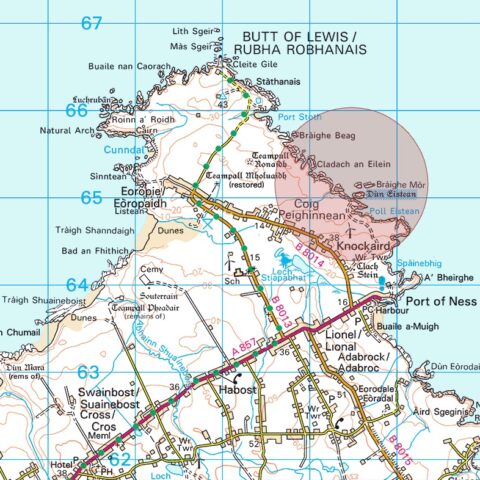
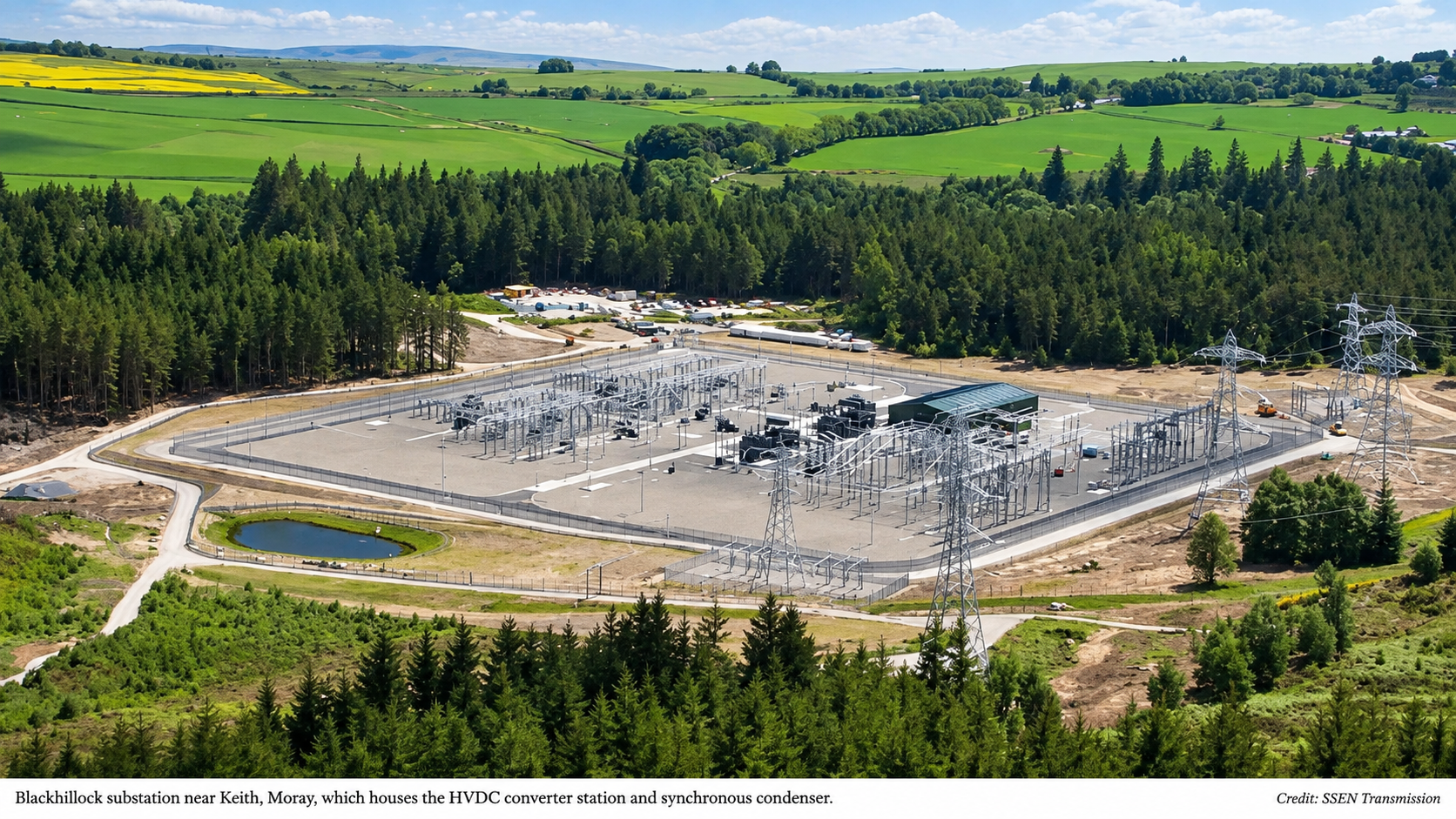
The asset is located near the Blackhillock transmission substation in Moray and, according to Foresight, has been operating since July 2025. It provides approximately 2 GVA of short-circuit level to the electricity network, supporting voltage recovery when disturbances occur. Foresight describes Blackhillock as one of only two synchronous-condenser facilities in north-east Scotland and says the substation beside it is one of the most constrained and strategically significant transmission nodes in Britain.
It is an unusual kind of energy asset. A synchronous condenser consumes a relatively small amount of electricity to keep a large electrical machine rotating in synchronism with the grid. It does not exist primarily to sell megawatt-hours to homes and businesses. Its value lies in what happens to the electricity system around it.
For most of the history of the national grid, many of those services arrived as a consequence of the way electricity was generated. Coal, gas and nuclear power stations contained enormous turbines connected to synchronous generators. Their rotating mass stored kinetic energy. When a large generator or transmission circuit suddenly failed, that stored energy resisted the immediate change in frequency while other parts of the system responded. The generators also contributed fault current and supported voltage across the network.
Scotland is replacing much of the generation fleet that supplied those properties. Wind turbines and solar installations generally connect through power electronics rather than behaving like the large synchronous machines around which the electricity system developed. High-voltage direct-current links also use converters to connect different parts of the network. Electricity can still be generated in enormous quantities, but the physical characteristics of the system change as the machines producing it change.
The old power stations did several jobs at once
Electricity generation is usually measured in megawatts and megawatt-hours, but operating a national power system requires more than producing enough energy to equal demand. Frequency must remain close to 50 hertz. Voltage must be controlled. Faults must be detected and cleared. The system must remain sufficiently strong for protective equipment and other electrical plant to behave as expected when something goes wrong.
Traditional synchronous generators contributed to several of those requirements simply by being connected. The inertia contained in their rotating machinery slowed the rate at which frequency changed after a sudden imbalance between generation and demand. Their electrical characteristics also supplied short-circuit current when faults occurred.
As coal stations closed and nuclear generation declined, the National Energy System Operator began procuring those characteristics separately rather than relying upon them as by-products of electricity generation.
Scotland became an early test of that new system because its generation mix changed quickly. Large quantities of onshore and offshore wind were connecting to a network from which conventional synchronous generation was disappearing. In 2022, the system operator awarded ten long-term contracts under the second phase of its Stability Pathfinder programme specifically to increase inertia and short-circuit level in Scotland.
The procurement sought 6 GVA seconds of inertia and 8.4 GVA of short-circuit level. The ten successful projects were contracted to provide approximately 6.75 GVA seconds of inertia and 11.55 GVA of short-circuit level. The forecast cost of those contracts was £323 million.
Five successful projects used synchronous condensers. Five used grid-forming battery technology.
The result was an electricity system beginning to purchase explicitly what conventional power stations had once supplied as part of their ordinary operation.
A synchronous condenser resembles a generator with the generation removed
The technology itself is old. Synchronous condensers have existed for more than a century. In mechanical terms they resemble synchronous motors or generators. A large rotor spins at a speed tied directly to the electrical frequency of the grid, but there is no steam turbine, gas turbine or other prime mover continually driving it to produce electricity for sale.
The machine can instead provide reactive power and voltage support. When fitted with sufficient rotating mass, it can contribute inertia. It can also increase the short-circuit strength of the network around it.
The absence of conventional generation is precisely the point. A grid can retain some of the electrical behaviour of large rotating power stations without burning fuel simply to keep those stations online for stability purposes.
This changes the economics of the electricity system. Services that were once bundled together inside a generating station can increasingly be separated. One company can own wind generation. Another can own a battery. A transmission company owns the wires. A separate infrastructure investor can own a machine whose commercial purpose is grid stability.
The Foresight acquisition places that final category into particularly clear view.
Blackhillock is becoming an electrical crossroads
The Blackhillock area near Keith already occupies an important position in Scotland’s transmission system. The substation has been extensively developed as renewable generation in northern Scotland and offshore projects have connected into the network.
It is also becoming a concentration of new stability technologies. Zenobē operates a separate 200 MW battery at Blackhillock using grid-forming inverters. That project began commercial operation in March 2025 and was developed specifically to provide stability services as well as conventional battery functions.
The existence of several technologies at the same transmission node also creates a point of potential confusion in the public record.
Foresight’s September 2026 announcement identifies its newly acquired asset as the Blackhillock Synchronous Condenser and states that it has operated since July 2025. NESO’s published results for Stability Pathfinder Phase 2, however, identify the project named Blackhillock in that procurement as Zenobē Energy’s grid-forming battery. The synchronous-condenser project listed separately in the same north-east Scottish area is identified as Beatrice.
Foresight says the asset it has acquired receives long-term grid-stability revenues, while specialist infrastructure reporting describes those revenues as availability-based and contracted through to 2034. The transaction price and detailed financial terms have not been published.
The naming does not alter the wider engineering development taking place at Blackhillock, but it demonstrates how difficult the emerging stability market can be to reconstruct from public information. A single transmission location can contain a substation, HVDC infrastructure, batteries, synchronous equipment and projects owned by different companies under different contracts.
Scotland became the laboratory because its electricity changed first
The Stability Pathfinder programme was created in response to declining levels of transmission-connected synchronous generation. Scotland presented the problem earlier and more intensely than many other parts of Britain because wind generation was expanding rapidly while large conventional generating units were retiring.
Hunterston B nuclear station stopped generating in 2022. Longannet, once Scotland’s largest coal-fired power station, had closed in 2016. Torness remains operational but is approaching the end of its generating life. At the same time, Scotland has continued adding renewable capacity and has an exceptionally large pipeline of further wind development.
The electricity produced by a wind farm is no less real than electricity produced by a thermal station. The engineering difference lies in the way much modern renewable generation interfaces with the alternating-current network.
Power electronics can now reproduce some characteristics previously associated with rotating machines. Grid-forming batteries are one example. They can respond extremely rapidly and can help establish or support electrical frequency rather than simply following a signal already present on the network.
Synchronous condensers solve part of the same problem mechanically. The Scottish Pathfinder procurement deliberately contracted both approaches.
That means Scotland is not simply replacing fossil electricity with renewable electricity. It is redesigning the machinery required to make a power system dominated by renewable generation behave reliably.
Stability has become a market
The institutional change is as significant as the engineering one. NESO can identify a requirement for inertia, short-circuit level or other stability characteristics in a particular part of the network and procure those services under contract. Investors can then finance infrastructure whose revenues depend upon supplying them.
Foresight’s acquisition shows the next stage of that process. Once built and contracted, a stability asset can become an investable piece of infrastructure capable of being bought and sold.
Foresight is a FTSE 250 investment manager operating across infrastructure and private capital. The seller, Global Infrastructure Partners, became part of BlackRock following BlackRock’s acquisition of GIP in 2024. The Blackhillock transaction therefore moves an operational component of Scotland’s electricity-stability infrastructure between funds managed by two large investment groups.
The underlying service remains contracted to the electricity system. Ownership of the asset and responsibility for operating it can change while the machine continues performing the same physical function.
That model is already familiar elsewhere in infrastructure. Wind farms, transmission interests, renewable portfolios and battery projects regularly change hands after development or construction. Stability equipment is now entering the same investment market.
The cost of renewable electricity extends beyond the generator
The transformation also changes how the cost of the electricity system should be understood. The price of generating a megawatt-hour from wind does not encompass every investment required to operate a grid containing large quantities of wind.
Transmission has to be expanded to move electricity from where it is generated to where it is consumed. Storage and flexible demand can move consumption across time. Interconnectors move power between regions and countries. Constraint payments arise when the network cannot accommodate all available generation. Stability services maintain the electrical conditions in which the system can operate.
None of those costs establishes that renewable generation is uneconomic. They describe the infrastructure of the system into which it is being integrated.
The older electricity system also contained extensive supporting infrastructure, from coal transport and fuel storage to reserve generation and transmission reinforcement. Much of the difference is that services once embedded inside large power stations are becoming visible as separate contracts and separate assets.
Scotland’s energy transition can therefore be seen increasingly in places where no additional electricity is being produced. It is visible in substations, converter stations, grid-forming batteries, synchronous condensers and new transmission lines whose function is to make the generation already being built usable and secure.
The machine Foresight says it has acquired at Blackhillock belongs to that less visible system. It can be valuable while producing almost none of the commodity around which the electricity industry appears to revolve.
For more than a century, large rotating generators stabilised Britain’s electricity network while producing its power. Scotland is now separating those two functions. Wind farms can produce the electricity. Other machines are being paid to provide some of the physics that disappeared with the power stations they replaced.
Sources
Foresight Group Announces Acquisition of Blackhillock Synchronous Condenser
Foresight Group — 7 September 2026
https://foresight.group/news-insights/news/2026/foresight-group-announces-acquisition-of-blackhillock-synchronous-condenser/
Foresight Acquires Scottish Grid Stability Asset from BlackRock’s GIP
IPE Real Assets — 7 September 2026
https://realassets.ipe.com/news/foresight-acquires-scottish-grid-stability-asset-from-blackrocks-gip/10138357.article
Scotland’s Wind Success Story Bolstered by £323m Stability Investment
National Energy System Operator — 6 April 2022
https://www.neso.energy/news/scotlands-wind-success-story-bolstered-ps323m-stability-investment
Stability Pathfinder Phase 2 Results
National Energy System Operator — 2022
https://www.neso.energy/document/267006/download
Stability Pathfinder Service Information
National Energy System Operator — accessed September 2026
https://www.neso.energy/data-portal/stability-pathfinder-service-information
Zenobē Powers Up Blackhillock, Europe’s Largest Battery
Zenobē — 2025