
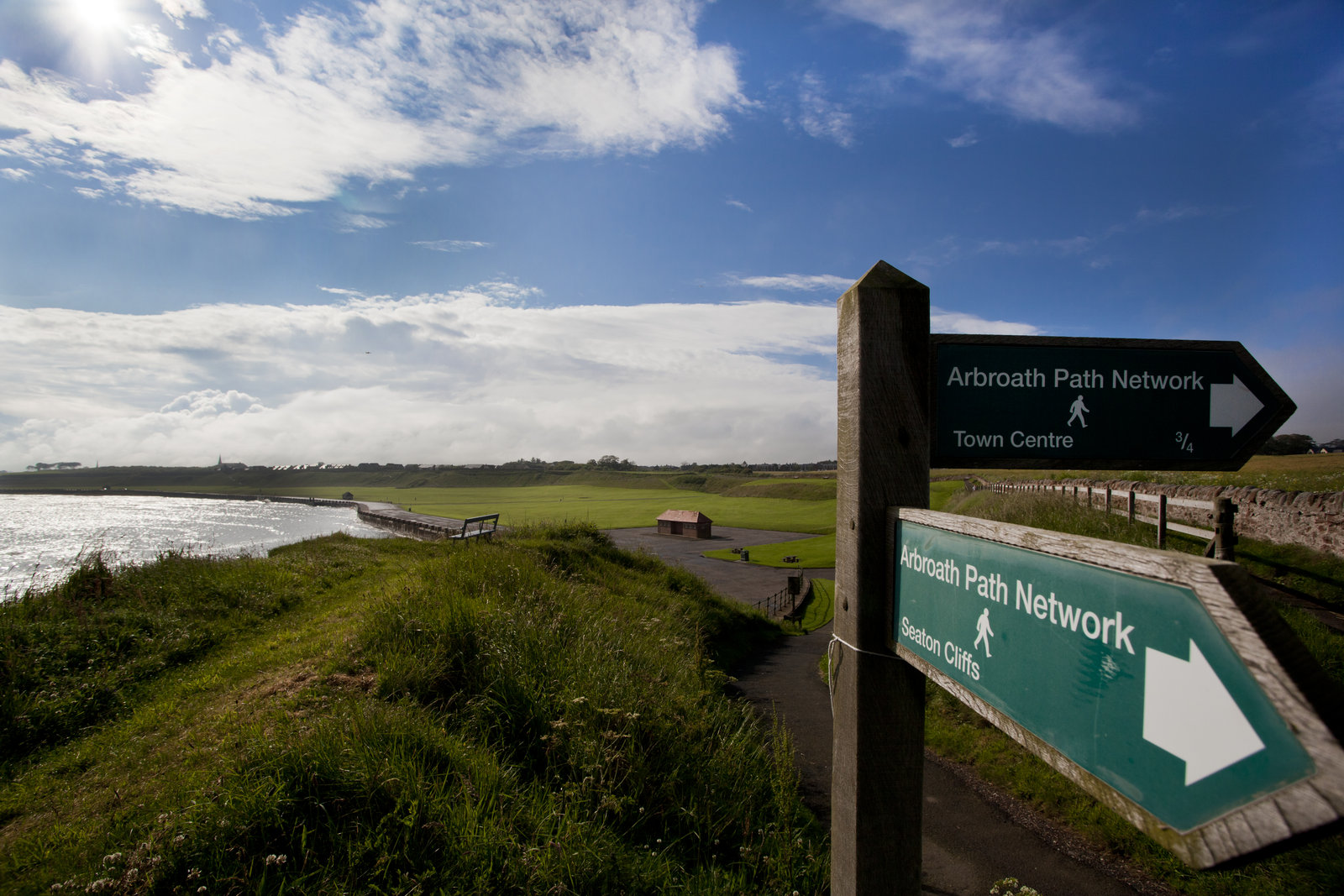
Angus Council has officially opened the Arbroath A Place for Everyone project, completing a major redesign of routes between the town centre, transport links, seafront and visitor destinations. The £15 million scheme has taken more than a decade to move from early consultation to formal opening, reshaping part of the A92 corridor through one of Angus’s most recognisable coastal towns.
Angus Council has formally opened the Arbroath A Place for Everyone project, marking the end of a long-running active travel scheme intended to reconnect the High Street, public transport links, the seafront and key visitor areas.
The project has delivered new and upgraded walking, wheeling and cycling routes, redesigned crossings, public space improvements and changes to a section of road that had long divided parts of the town. The council said the work was shaped by public consultation that began in 2015, when residents identified the former dual carriageway as a barrier between the town centre, transport hubs and the seafront.
The opening brings to a close one of Scotland’s more closely watched active travel projects. Arbroath became the first Scottish town to receive the highest level of funding through the Scottish Government-backed Places for Everyone programme, then administered by Sustrans and now under the Walk Wheel Cycle Trust. Funding support was confirmed in 2019, with construction beginning in April 2024.
By the time work started, the project had become a large intervention in a town of around 23,500 people. Local data for 2022 put Arbroath’s population at 23,487, down 3.7 per cent from 2011, in contrast with population growth across Scotland over the same period. The town’s age profile was also slightly older than the national average, with 22 per cent aged 65 and over. Those figures give the accessibility part of the scheme more weight than the usual active travel language sometimes suggests.
The physical works centre on a 1.5km route along the A92 corridor, including segregated cycle provision, redesigned junctions and crossings, and new seating and landscaping. Earlier project documents described the scheme as the first of its kind in Scotland to redesign the A92 dual carriageway in Arbroath to make it more accessible and promote active travel. The route was intended to improve north-south movement as well as east-west crossings, restoring links between areas that had been separated by the road.
The cost has shifted during the project’s life. When construction began, Walk Wheel Cycle Trust described it as a £14 million scheme, with £10.7 million awarded through Places for Everyone. Monitoring material later recorded a total grant award of £10,655,771 and a forecast scheme cost of £14,840,467. Angus Council’s formal opening statement refers to more than £10 million of Scottish Government funding as part of a wider £15 million investment.
The council also said the project contributed more than £5.6 million to the local economy during delivery, supporting local businesses and suppliers. Balfour Beatty, Arcadis, Angus Council roads and parks teams, Walk Wheel Cycle Trust representatives and local suppliers including Denfind Stone and Monikie Rock Art were recognised at the opening.
The scheme has not arrived quietly. Road restrictions were lifted in August 2025, six weeks ahead of the originally planned 77-week construction timeline. Earlier reporting and local reaction showed frustration over disruption, cost and changes to road space. That tension is familiar in active travel projects across Scotland, where the promised long-term benefits often arrive after months of cones, diversions and argument.
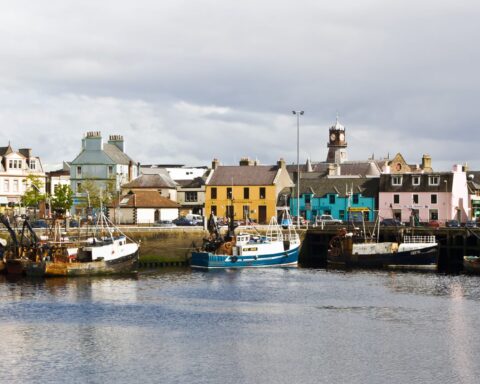
Arbroath’s case carries additional sensitivity because the altered road does more than move traffic. It sits between the civic centre of the town and the seafront, harbour and visitor economy. Visit Angus describes Arbroath as the largest town in Angus, known for Arbroath Abbey, where the Declaration of Arbroath was signed in 1320, and for the Arbroath Smokie. The harbour, Signal Tower Museum, seafront and Abbey all form part of the town’s identity and visitor draw.
The Signal Tower Museum itself occupies buildings originally used as the shore station and accommodation for the Bell Rock Lighthouse. Built in 1813, the tower served the lighthouse until 1955 and became a museum in 1974. For a town with that depth of maritime and civic history, the condition of the links between harbour, centre, public transport and seafront carries more than cosmetic importance.
The project also sits within Angus Council’s wider active travel strategy for 2025 to 2030. That strategy links future work to the Arbroath scheme, including proposals around the National Cycle Network Route 1 alignment through the town, Westway, Keptie Road and Cairnie Road improvements, the Friockheim to Arbroath route, Muirfield Bike Bus and access to bikes. In the council’s planning, A Place for Everyone is intended to act as a piece of a wider network rather than a finished object standing alone.
That network approach is key. A high-quality route can disappoint if it ends abruptly, fails to connect to schools, housing, shops, railway stations or visitor destinations, or feels unsafe at the points where users most need confidence. The council’s active travel strategy identifies further work that would improve connections to the Arbroath project, including safer physically separated cycling provision on nearby roads and changes to the NCN1 route through the town.
Monitoring will now become more useful than launch language. The Sustrans Research and Monitoring Unit baseline report recorded planned follow-up monitoring in summer 2026, including automatic counters, manual counts, route user surveys and video counts at locations including Burnside Drive, Ladyloan, the harbour, Brothock Bridge and Market Place. That should give Arbroath evidence of how people use the route after construction and ceremony have passed.