John Swinney’s government plans to replace Scotland’s 14 territorial NHS boards with two strategic authorities, but has yet to publish the cost of the restructuring or the savings it expects to achieve. Previously withheld government briefings reveal that east–west NHS planning arrangements were being developed in 2025, including advice on ministerial enforcement powers and changes to regional decision-making.
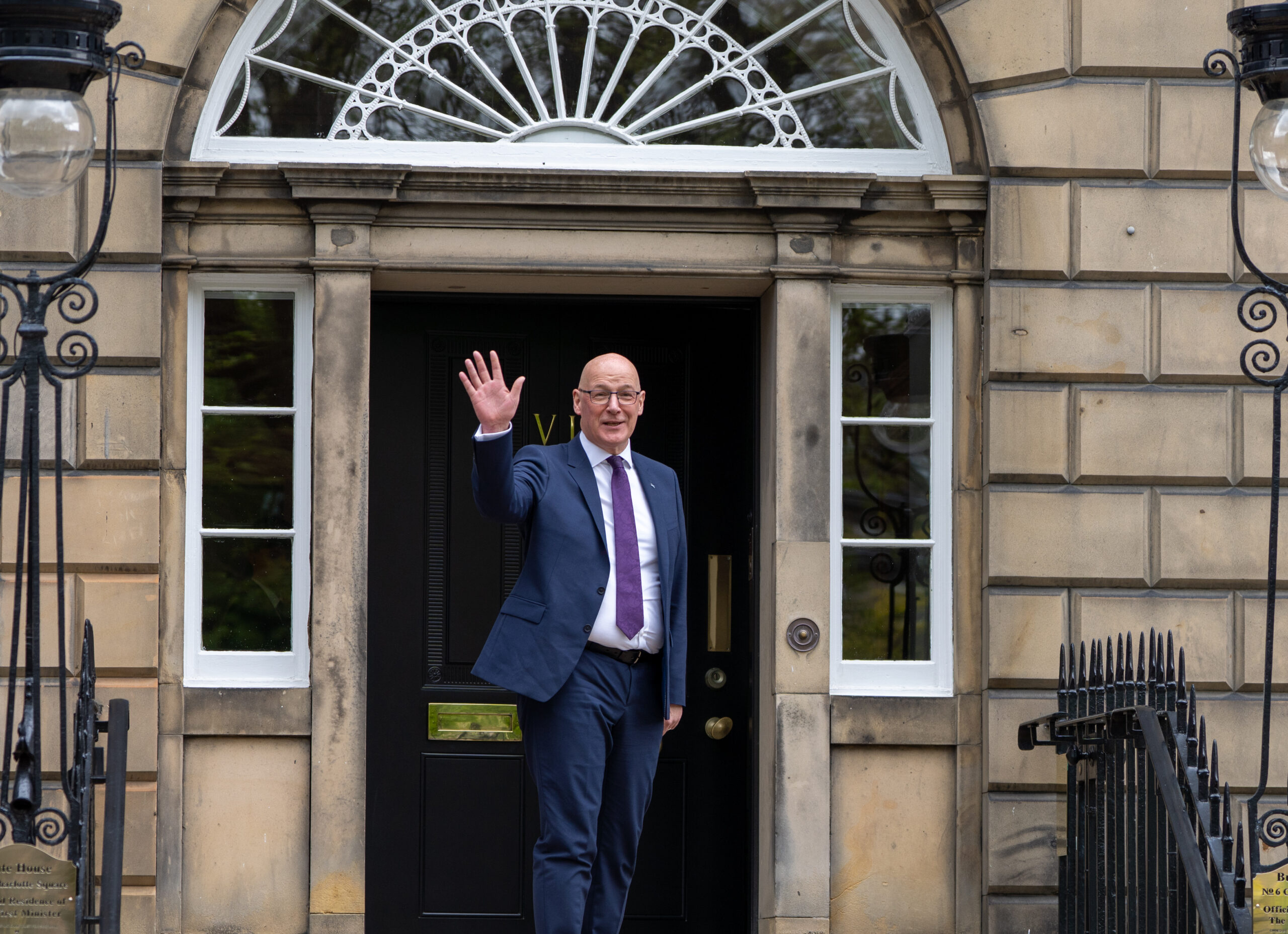
The Scottish Government has confirmed that its proposal to replace Scotland’s 14 territorial NHS boards with two larger authorities remains in the design stage, more than six weeks after First Minister John Swinney announced what he described as the most significant structural reform of the NHS since devolution.
An official reform statement published on 14 October confirms that detailed arrangements are still being developed, with consultations involving NHS staff, trade unions, local government and communities planned before the new structure is finalised.
The government has not published a completed business case establishing how much the reorganisation will cost, what savings it will produce or when the existing boards will cease operating.
Scottish Parliament records show that Health Secretary Angela Constance was asked directly in September about the expected annual savings, staffing reductions, information technology costs and property savings. Her responses confirmed that the financial assessment would form part of a future business case.
Meanwhile, previously withheld Scottish Government documents reveal that officials had developed plans for eastern and western NHS planning structures during 2025. The ministerial briefings were initially withheld under freedom of information exemptions before being partially released following a review.
The records provide an account of how the government’s earlier regional planning arrangements developed before Swinney announced the more extensive proposal to replace the existing boards altogether.
NHS Restructuring Was Being Planned in 2025
On 1 September 2026, Swinney announced that Scotland’s existing territorial health boards would be replaced by two strategic boards covering eastern and western Scotland.
The proposal would fundamentally change the administrative structure through which NHS services are planned, funded and overseen.
However, the origins of the east–west approach can be traced to government documents prepared almost a year earlier.
A ministerial briefing prepared by Christine McLaughlin, Chief Operating Officer and Deputy Chief Executive of NHS Scotland, in October 2025 recommended establishing Sub-National Planning and Delivery Committees for the east and west of Scotland.
NHS Lothian was proposed as the host organisation for the eastern arrangements, with NHS Greater Glasgow and Clyde performing the equivalent role in the west.
The briefing also recommended that ministers use existing statutory powers to require health boards to plan certain services jointly across regional boundaries.
The proposed arrangements were intended to address problems associated with separate health boards planning services independently, including inconsistent patient pathways, duplication and difficulties coordinating specialist care.
The document estimated that the western planning region would serve approximately 3.2 million people, compared with 2.5 million in the east.
Officials argued that the geographical division reflected population distribution, transport infrastructure and existing patterns of patient travel for specialist treatment.
These earlier proposals concerned joint planning between existing NHS boards. They did not themselves provide for the abolition of the territorial boards, which was announced separately in September 2026.
Nevertheless, they establish that the government had been working towards a more centralised regional planning system well before the latest restructuring proposal became public.
Ministerial Briefings Were Initially Withheld
The extent of the earlier planning emerged through a Scottish Government freedom of information request seeking details of discussions involving ministers, NHS Lothian and NHS Greater Glasgow and Clyde.
The original response confirmed that senior NHS Scotland officials held routine meetings with the chief executives of those two boards.
The meetings covered several aspects of NHS reform, including sub-national planning, but were not convened specifically for that purpose and were not minuted.
The government also confirmed that three ministerial briefings concerning sub-national planning existed.
These were initially withheld under provisions of the Freedom of Information (Scotland) Act 2002 intended to protect policy development and confidential discussions.
Following an internal review, the government released partially redacted versions of the documents on 30 March 2026.
The released material includes an October 2025 briefing on regional planning, a November submission concerning ministerial directions, and a further November briefing dealing with trade union engagement.
Substantial passages remain redacted, including sections addressing financial considerations, risks, policy advice and discussions with stakeholders.
The government’s review upheld the need to protect parts of the advice, arguing that premature disclosure could inhibit frank discussions between officials, ministers and external organisations.
The existence of confidential policy advice is not evidence of wrongdoing. However, the documents establish that government officials had considered significant changes to NHS planning and accountability before the later announcement of the two-board proposal.
Officials Identified Powers to Remove NHS Board Members
One of the more consequential passages in the released October 2025 briefing concerns how ministers could enforce the proposed regional planning arrangements.
The document recommended that ministers note existing escalation and enforcement powers available where health boards failed to comply with directions.
These included the potential removal of board members and the use of emergency powers.
The advice concerned enforcement of joint-planning obligations under existing legislation. It was not a recommendation to remove board members as part of the subsequent proposal to replace the 14 territorial boards.
The legal framework identified in the briefing included the National Health Service (Scotland) Act 1978 and the Public Bodies (Joint Working) (Scotland) Act 2014.
Officials proposed using ministerial directions to require cooperation between boards rather than relying entirely on voluntary agreements.
By November 2025, the government had put part of that approach into operation.
The Co-operation and Planning Directions 2025 required NHS boards to work together on planning and delivering services across regional boundaries.
In a letter to the Scottish Parliament’s Public Audit Committee dated 18 November 2025, NHS Scotland Chief Executive Caroline Lamb explained that the arrangements would establish eastern and western planning committees.
She also confirmed that the existing boards would remain legally accountable for delivering services and that no new public bodies were being created under those arrangements.
That position changed with Swinney’s September 2026 announcement, which proposed replacing the boards themselves.
Government Cannot Yet Put a Figure on Costs or Savings
The financial consequences of the proposed restructuring remain unresolved in published government records.
In September, Scottish Liberal Democrat MSP Adam Harley submitted a series of parliamentary questions seeking details of the expected savings and costs.
One question asked how much money would be saved annually by replacing 14 territorial NHS boards with two strategic authorities.
Another sought a breakdown of potential savings arising from staff redeployment, severance, information technology, property and other expenditure.
Constance responded that the costs and benefits would be established through a business case developed in partnership with NHS boards.
She said the greatest benefits were expected to come from redesigned services, improved planning and reduced variation in healthcare provision.
The answers did not provide a monetary estimate for the reorganisation or quantify savings in the expenditure categories identified by the MSP.
Further questions about the proportion of savings expected from staffing changes and the amount that might be reinvested in frontline clinical services received similar responses.
The distinction between financial savings and improvements in service delivery is relevant to the government’s stated case for reform. A system could potentially improve coordination without reducing overall expenditure, while changes intended to save money may require substantial initial investment.
Replacing existing NHS authorities could involve changes to management structures, finance and administrative systems, governance arrangements, property responsibilities and employment administration.
The extent of those changes has not yet been published in sufficient detail to establish their financial consequences.
As of 19 October, the government has not published a completed business case specifying the implementation cost, projected annual savings or a timetable for recovering any initial expenditure.
What Happens to NHS Staff?
The proposed changes also raise questions about the future employment arrangements of NHS Scotland’s workforce.
In a parliamentary answer on 21 September, Constance stated that the principal change for employees would eventually be the transfer of their employment from their existing health board to one of the new organisations.
She said NHS pay, terms and conditions would remain unchanged and reiterated the government’s commitment to no compulsory redundancies.
The government also promised that future workforce changes would be developed in partnership with trade unions.
However, the final management structures, staffing arrangements and administrative responsibilities of the proposed authorities have not been published.
The government’s 14 October statement says that detailed design work began in September and that staff and their representatives will be involved before future decisions are made.
The number of posts that might be reorganised, transferred or eliminated through natural turnover has not been quantified in a published business case.
Doctors Warn of Greater Centralisation
The British Medical Association has formally opposed the proposed reduction in health boards.
On 1 October, BMA Scotland announced that its Scottish Council had voted to urge ministers to withdraw and reconsider the plans.
Dr Nóra Murray-Cavanagh, chair of BMA Scotland, argued that the government had not demonstrated how the new structure would improve patient care.
The association warned that a major reorganisation could consume time and resources while NHS services continue to face staffing shortages, long waiting times and financial pressure.
It also expressed concern that concentrating strategic decisions within two authorities could weaken local accountability.
The BMA identified potential consequences for rural patients, older people, lower-income households and those without access to private transport if the restructuring ultimately resulted in services being concentrated farther from home.
Those concerns represent the professional association’s assessment of the proposed changes. The government has not announced that hospitals will close or that particular clinical services will be transferred as a consequence of the two-board plan.
Ministers maintain that regional planning can improve access to specialist services and make better use of existing NHS capacity.
The government’s position is that changes to strategic administration should support local treatment rather than replace it.
Highlands and Islands Face Unanswered Questions
The future administrative arrangements have particular implications for Scotland’s remote and island communities.
NHS Highland operates across an extensive geographical area, while NHS Western Isles, NHS Orkney and NHS Shetland serve island populations whose healthcare requirements include specialist travel, emergency transport and coordination with mainland hospitals.
A two-board administrative system would need arrangements capable of accommodating those geographical circumstances.
The Scottish Government has acknowledged the particular requirements of rural and island communities and has referred to the possibility of locally adapted governance arrangements, including its Single Authority Model.
That model involves bringing public-service responsibilities together under arrangements intended to reflect local conditions.
However, the government has not yet published a final structure establishing precisely how the island boards would operate under the proposed east–west system.
Nor has it published the geographical boundaries, headquarters or detailed local decision-making arrangements for the two new authorities.
In a parliamentary answer on 28 September, Constance said that local, regional and national governance arrangements would be established and that detailed impact assessments would form part of the next phase.
Those assessments have not yet resolved the questions surrounding the distribution of decision-making powers, local representation or the relationship between strategic planning and individual hospitals.
The Government’s Next Decisions
Swinney has presented the restructuring as part of a wider programme intended to reduce duplication, improve NHS performance and make public services more financially sustainable.
The government argues that separate administrative structures can obstruct cooperation between hospitals and health boards, particularly where patients need specialist services unavailable in their immediate area.
Its October reform statement maintains that patients should continue to receive most care through local GP practices, community services and hospitals.
The administration also says the restructuring will be developed with NHS organisations, staff, local authorities, professional bodies and the public.
The published record now establishes three stages in the government’s approach: proposals for east–west planning in 2025, ministerial directions requiring cooperation between existing boards, and Swinney’s September 2026 decision to pursue their replacement with two strategic authorities.
The latest proposal goes substantially further than the original regional planning arrangements.
It would change the organisations legally responsible for NHS services, their governance structures and the administrative relationships through which healthcare is managed.
The Scottish Government must still establish the implementation costs, projected financial benefits, future workforce arrangements and mechanisms for local accountability.
Until the business case and detailed design are published, the financial consequences of replacing Scotland’s 14 NHS boards with two remain unquantified in the public record.
Sources
Health and Care Reform: Overview
Scottish Government, 14 October 2026
https://www.gov.scot/publications/health-and-care-reform-overview/
Programme for Government 2026 to 2031: First Minister’s Speech
Scottish Government, 1 September 2026
https://www.gov.scot/publications/programme-for-government-2026-to-2031-first-ministers-speech/
Programme for Government 2026 to 2031 — Delivering a Stronger NHS and Public Services
Scottish Government, 1 September 2026
https://www.gov.scot/publications/programme-government-2026-2031/pages/5/
Scottish Government and NHS Lothian and/or NHS Greater Glasgow and Clyde Regarding the New NHS East and NHS West Structure: FOI Review
Scottish Government, 30 March 2026
https://www.gov.scot/publications/foi-202600401485/
Scottish Government and NHS Lothian and/or NHS Greater Glasgow and Clyde Regarding the New NHS East and NHS West Structure: FOI Release
Scottish Government, 24 February 2026
https://www.gov.scot/publications/foi-202500497219/
NHS Sub-National Planning Approach: Letter to the Public Audit Committee
NHS Scotland, 18 November 2025
https://www.parliament.scot/-/media/files/committees/public-audit-committee/correspondence/2025/nhs-subnational-planning-dghsc-to-pac-18-nov-2025.pdf
Written Parliamentary Questions and Answers: NHS Board Reorganisation, S7W-03223 to S7W-03243
Scottish Parliament, September 2026
https://www.parliament.scot/chamber-and-committees/questions-and-answers?msp=20978&page=4
BMA Scotland Urges the Scottish Government to Withdraw and Rethink Plans to Reduce Health Boards
British Medical Association, 1 October 2026
https://www.bma.org.uk/bma-media-centre/bma-scotland-urges-the-scottish-government-to-withdraw-and-rethink-plans-to-reduce-health-boards