
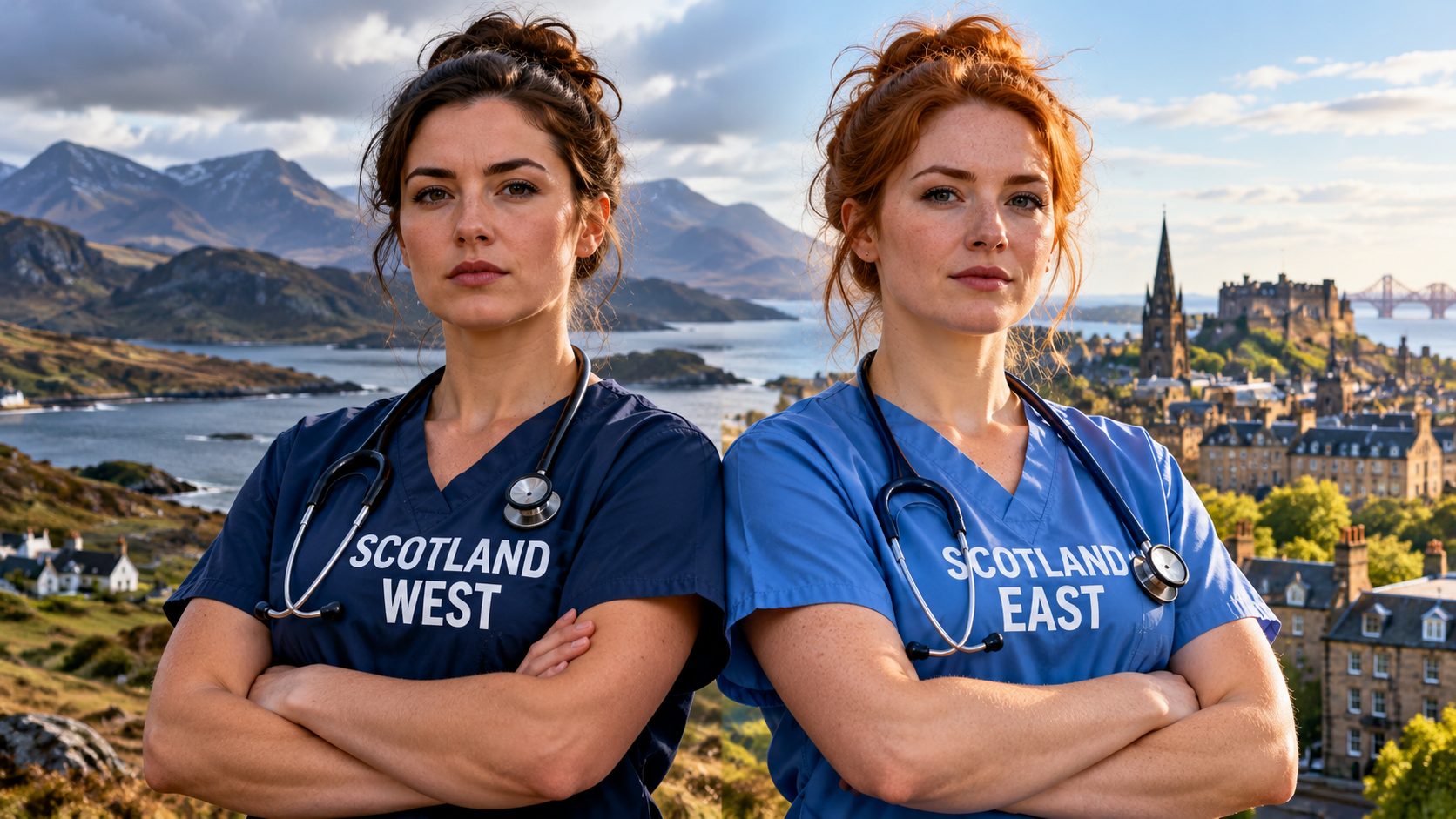
Scotland’s proposed NHS reorganisation would place a disproportionate share of concentrated deprivation within a western health board if ministers retain the East–West boundaries already used for regional planning.
Modern Scot’s analysis of official population estimates and the Scottish Index of Multiple Deprivation finds that the West planning area contains 1,030 of the 1,395 neighbourhoods ranked in Scotland’s most deprived fifth. East contains 365. The comparison uses SIMD 2020v2, rather than a new measure of deprivation in 2026.[1][2][3]
The imbalance does not establish that the reform would worsen inequalities. It establishes a substantial difference in the needs that the proposed organisations would have to address. Alongside urban deprivation, the western grouping includes remote Highland and island communities where distance, staffing and the cost of providing local services create different pressures.
What has been decided?
The policy has developed in two stages. Guidance issued in November 2025 grouped the 14 territorial health boards into East and West for joint planning, while retaining the individual boards’ statutory responsibilities. The SNP government’s Programme for Government, published on 1 September 2026, went further: it announced an intention to replace those 14 boards with two Strategic Health Boards.[1][4]
In parliamentary answers on 28 September, ministers said the reform remained in its design phase, including development of a business case. Final service models, locations and implementation timescales were still to be worked through. The wider programme also envisages bespoke island arrangements, including exploration of a Single Authority Model.[4][5][6][7]
The existing map is therefore a basis for examining the proposal. It is not confirmation of the final legal boundaries or of where every patient would receive treatment.
Where the division falls
| Group | NHS board | Council areas |
|---|---|---|
| West | Ayrshire and Arran | East Ayrshire; North Ayrshire; South Ayrshire |
| West | Dumfries and Galloway | Dumfries and Galloway |
| West | Forth Valley | Clackmannanshire; Falkirk; Stirling |
| West | Greater Glasgow and Clyde | East Dunbartonshire; East Renfrewshire; Glasgow City; Inverclyde; Renfrewshire; West Dunbartonshire |
| West | Highland | Argyll and Bute; Highland |
| West | Lanarkshire | North Lanarkshire; South Lanarkshire |
| West | Western Isles | Na h-Eileanan Siar |
| East | Borders | Scottish Borders |
| East | Fife | Fife |
| East | Grampian | Aberdeen City; Aberdeenshire; Moray |
| East | Lothian | City of Edinburgh; East Lothian; Midlothian; West Lothian |
| East | Orkney | Orkney Islands |
| East | Shetland | Shetland Islands |
| East | Tayside | Angus; Dundee City; Perth and Kinross |
Source: November 2025 planning guidance and official population geography.[1][2]
All four Lothian council areas, including West Lothian, fall within East. Forth Valley and Highland fall within West, despite including communities on the eastern side of Scotland. These are administrative groupings, not a simple geographical division.
A larger population and a greater concentration of deprivation
| Measure | West | East |
|---|---|---|
| Population, 30 June 2025 | 3,067,140 | 2,478,360 |
| Share of Scotland’s population | 55.3% | 44.7% |
| Neighbourhoods in Scotland’s most deprived 20% | 1,030 | 365 |
| Share of those 1,395 neighbourhoods | 73.8% | 26.2% |
| Proportion of each region’s own neighbourhoods in the national most deprived 20% | 26.3% | 11.9% |
Source: Modern Scot calculations from NRS mid-2025 population estimates and SIMD 2020v2. “Neighbourhoods” refers to statistical data zones. Percentages are rounded.[2][3]
The 73.8% figure describes the West’s share of Scotland’s most deprived fifth of neighbourhoods. It does not mean that 73.8% of western residents are poor. SIMD measures relative deprivation across several domains at area level; it cannot describe every resident’s circumstances and can miss dispersed rural hardship.[3]
Nor is East uniformly affluent. Fife contains 97 neighbourhoods in the most deprived fifth, Edinburgh 71 and Dundee 70. Within West, Glasgow contains 339 and North Lanarkshire 153. Regional averages can obscure these local concentrations.[8]
Health inequalities also exist within the proposed regions. In 2022–2024, life expectancy at birth ranged from 74.3 years for males and 78.7 for females in Glasgow to 81.5 and 84.9 respectively in East Renfrewshire. Both council areas are in West.[9]
Rural hardship requires additional measures. The Scottish House Condition Survey’s pooled 2022–2024 estimates put fuel poverty at 40% in the Western Isles, 51% in Orkney and 40% in Shetland, compared with 31% nationally. None of those island council areas has a data zone in SIMD’s most deprived fifth. The measures describe different aspects of disadvantage.[3][8][10]
Why East and West?
The government has published a rationale for the planning map. Briefings released following a freedom-of-information review identify geography, population distribution, patient flows and transport links as reasons for the alignment. The October 2025 submission proposed planning arrangements hosted by NHS Greater Glasgow and Clyde and NHS Lothian.[11]
That explanation leaves a further question: what comparative evidence shows that two replacement boards would perform better than other structures?
In a September interview, First Minister John Swinney defended two boards when asked about a three-board alternative with a separate northern organisation. He pointed to staffing difficulties in the north, including oncology in Inverness, and argued that stronger connections across a wider system could support local care.[12]
Existing clinical networks demonstrate why the answer cannot rest on the administrative map alone. The North Cancer Alliance connects Highland, Grampian, Tayside, the Western Isles, Orkney and Shetland, with cancer centres in Inverness, Aberdeen and Dundee. The East–West line divides that network between the two planning areas. This does not mean the network would end; it makes the preservation of cross-boundary working an explicit design issue.[13]
A Highland review has already been paused
There is a documented local consequence of the national reform announcement. In March 2026, Highland Council agreed the next stage of a joint review with NHS Highland of how health and social care should be integrated. Options included an enhanced Lead Agency arrangement and a Body Corporate model with a formal partnership board. A final recommendation was intended for September.[14]
On 17 September, the council announced that the review had been paused pending clarity about the Scottish Government’s wider reforms. Council convener Bill Lobban said the national announcement meant the authority needed to understand the available options before further consultation. The council sought a meeting with the First Minister.[15]
The pause interrupted consultation over locally developed integration options. Its longer-term consequences for clinical services remain to be established.
For patients, the question is where care will be available
A Scottish Government evaluation published in June 2026 describes most specialist cancer treatment for Highland patients taking place at Raigmore Hospital in Inverness, with some highly specialised care provided in Aberdeen, Glasgow or Edinburgh. It also records cancer referrals from Dumfries and Galloway to Edinburgh, across the proposed East–West boundary.[16]
Being placed in West therefore does not, by itself, mean that someone in Caithness would be sent to Glasgow. The relevant questions concern individual services: what will remain locally available, which patients will need specialist referrals, and whether reorganisation will alter those routes.
The travel burden is already documented. The same evaluation describes long journeys, overnight stays, time away from family, fatigue and financial pressures. Some participants described travel contributing to decisions to decline or stop treatment. This was qualitative research, not a population-wide estimate of how often that happens, and it examined existing experiences rather than the effects of an implemented merger.[17]
Any assessment of a proposed service move consequently needs to include the whole journey: transport availability, appointment times, accommodation, escorts, reimbursement and disruption to work or caring responsibilities. A shorter waiting list and a longer, less manageable journey can affect the same patient.
Health Secretary Angela Constance has said simpler governance need not mean physically centralising services, and that care should be delivered locally where that is best. The outstanding issue is how that commitment will translate into decisions about staffing, facilities and particular treatment pathways.[18]
Highland investment: completed projects, delays and unfinished decisions
The investment record contains both delivery and delay. New community hospitals became operational in Aviemore in September 2021 and Broadford in March 2022. Those projects demonstrate investment, although completed buildings alone do not establish whether local services and staffing are sufficient.[19]
NHS Highland’s 2024–2025 annual audit reported that a Scottish Government pause on new NHS capital projects had held up the Caithness Health and Care Hubs and Raigmore maternity refurbishment. Other capital spending continued. The audit documents the position at that time; it does not establish the current status of every project.[20]
There has also been more recent progress in Lochaber. On 15 October 2026, NHS Highland announced approval of the outline business case for the replacement Belford Hospital, allowing work to proceed to a full business case. That is a planning milestone, with further work remaining before delivery.[21]
These distinctions matter when assessing reform: an administrative change, an approved business case, a completed building and a staffed clinical service are separate developments.
Gaelic-speaking communities and representation
Modern Scot’s aggregation of 2022 census council figures indicates that approximately 50,400 people aged three and over who reported being able to speak Gaelic lived within the West planning area, compared with approximately 19,300 in East. That places about 72% in West and 28% in East.[22][23]
West includes the Western Isles, Highland and Argyll and Bute, the three council areas with the highest proportions of Gaelic speakers. Gaelic-speaking communities also exist throughout East. The census distribution predates the proposed reform and does not establish that language determined the boundary.[22]
The practical governance question is how a western organisation serving more than three million people would ensure that smaller linguistic, rural and island communities retain influence over services and communication.
How would money follow need?
The existing NHS Scotland Resource Allocation Committee formula, known as NRAC, already considers more than population size. Public Health Scotland says it informs distribution of approximately 70% of the NHS budget, covering hospital and community health services and GP prescribing.[24]
Its adjustments include age and sex, illness and life circumstances, and unavoidable additional costs of hospital and community provision in remote and rural areas. The formula produces target shares, rather than describing each board’s entire actual budget.[24]
The West’s 73.8% share of the most deprived neighbourhoods therefore cannot be converted directly into the same percentage of NHS spending. But allocating funds solely by population would also provide an incomplete account of need. The design must explain both the division between the two organisations and how resources would reach different communities within each.
Asked about savings in September, the government said costs and benefits would be developed through the business case. Its answer did not provide a quantified saving or a proportion guaranteed for reinvestment in frontline care.[7]
Analysis: possible explanations and unanswered questions
The following examines plausible institutional incentives and effects. These are hypotheses to test against published decisions, contracts and outcomes; unanswered questions do not, on their own, establish an undisclosed motive.
Would two boards make central direction easier?
Reducing the number of organisations could make it easier to agree and apply service plans, financial decisions and common standards across larger populations. This fits the government’s stated objective of simpler governance and faster decisions. It could also reduce the number of separate institutions through which local priorities are represented.[18]
The released October 2025 briefing is relevant here: it discusses ministerial directions and existing enforcement powers, including action against board members, to secure compliance with joint planning. Those powers predate the proposed two-board merger. They show that securing cooperation was an explicit administrative concern, rather than evidence of a newly discovered power.[11]
A related possibility is institutional momentum. The commitment to two boards has been announced while the business case remains in development. Scrutiny should establish how alternatives will be assessed and whether the evidence could still change the chosen structure.[4][6][7]
Could it make greater private provision easier?
Potentially, larger organisations could find it easier to agree contracts covering wider areas. That is an inference about administration, not evidence that privatisation is the purpose of the reform. A larger public purchaser could also strengthen bargaining power or coordinate NHS capacity more effectively.
Private clinical provision already exists without this merger. A published procurement notice records NHS Highland awarding Sirona Medical Limited a general-surgery insourcing contract in September 2025, providing clinical services within NHS hospitals to help reduce waiting lists. NHS National Services Scotland also confirms existing national systems for insourcing and outsourcing.[25][26]
Those arrangements distinguish the purchase of privately supplied clinical work from selling hospitals or charging patients for NHS treatment. The Health Secretary has stated that the NHS is not for sale. Whether reform expands private provision would need to be demonstrated through procurement plans, contract awards, spending and changes to public capacity.[18]
Would it give greater control over patients’ health choices?
It could concentrate decisions about which services are available, eligibility and where treatment takes place. Depending on the eventual powers and safeguards, common policies could improve consistency or reduce flexibility for local circumstances.
That is separate from consent. Scotland’s Patient Charter provides for informed involvement in care and for patients capable of making the decision to accept or refuse offered treatment, subject to existing legal exceptions. It also makes clear that preferences sit alongside clinical judgement, other patients’ rights and responsible use of resources; it does not promise unrestricted choice of any treatment or hospital.[27]
Medicine access already combines national assessment and local implementation. The Scottish Medicines Consortium assesses new medicines’ clinical and cost effectiveness independently of ministers, while arrangements also exist for individual requests outside routine recommendations. A two-board structure would not introduce national assessment for the first time.[28]
The concern to investigate is practical: a patient may retain the right to refuse treatment while facing fewer realistically accessible alternatives. The merger proposal itself is not evidence of a new power to compel treatment.
Could weaker local provision affect the Highlands’ future?
A further hypothesis is that reduced access to dependable local care could make it harder for people to remain in, or move to, remote communities. Testing that would require evidence about service changes, recruitment, travel, patient experience and population movement, rather than the administrative boundary alone.
The documented pause to Highland’s integration review and the record of capital delays justify scrutiny of local influence and investment. They do not establish a deliberate policy of depopulation. The measurable question is whether reform strengthens the services that allow people to live in the Highlands throughout their lives.
What remains to be demonstrated
BMA Scotland announced on 1 October that its Scottish Council had voted to oppose the reduction to two boards. It raised concerns about local accountability, workforce pressures, longer journeys and widening inequalities. These are the union’s assessment of possible consequences.[29]
The government has committed to engagement and further impact assessments, including consideration of rural and island communities. Its design work will need to make the consequences clear below the level of two regional totals.[6]
The unresolved questions include:
- What evidence supports two boards over three or other arrangements, and what findings could change the design?
- What boundaries, budgets and decision-making powers would each organisation have, including any separate island arrangements?
- Which services would remain local, which might move, and how would travel, accommodation and escort support be protected?
- How would funding reflect deprivation, ageing, rural costs and patients treated across regional boundaries?
- What powers would local communities, clinicians and elected representatives retain to challenge service changes?
- Would the reform change private-sector purchasing, and how would contracts and changes to public capacity be reported?
- What published measures would show improvements in access, waiting times and health inequalities?
The government has set out its intention to change the organisations running territorial NHS services. The evidence still needed concerns the consequences for particular communities: the staff and facilities they can rely on, the journeys they must make, and their influence over decisions about care.
Methodology
Regional figures use the November 2025 planning alignment, conditional on its retention in the proposed replacement structure. Population totals use NRS estimates for 30 June 2025, published in July 2026, checked by both council and health-board groupings. Deprivation counts use SIMD 2020v2 overall ranks 1–1,395 among 6,976 data zones. These datasets describe different periods and do not provide a new 2026 deprivation ranking.
Gaelic totals combine the three census categories explicitly identifying an ability to speak Gaelic, for people aged three and over, aggregated by council area. They measure self-reported ability, not fluency or language normally used. Published census counts are subject to disclosure-control adjustments, so council sums can differ slightly from the national total; regional numbers are rounded. Regional calculations are Modern Scot’s analysis. Policy and source material were checked for this revision on 20 October 2026.
Sources
- Scottish Government: DL(2025)25, sub-national planning guidance, November 2025 (Word document).
- National Records of Scotland: mid-2025 population estimates and council and health-board tables (Excel workbook).
- Scottish Government: SIMD 2020v2 data and guidance.
- Scottish Government: Programme for Government 2026–2031, NHS and public services.
- Scottish Parliament: S7W-03231, implementation timetable, answered 28 September 2026.
- Scottish Parliament: S7W-03241, design, governance and engagement, answered 28 September 2026.
- Scottish Parliament: S7W-03242, business case, savings and service models, answered 28 September 2026.
- Scottish Government: council counts of data zones in the most deprived 20%, Annex G.
- National Records of Scotland: life expectancy, 2022–2024.
- Scottish Government: local authority fuel-poverty estimates, 2022–2024.
- Scottish Government: freedom-of-information review releasing briefings on sub-national NHS planning, including the October 2025 submission.
- The Press and Journal: interview with John Swinney on two boards and northern NHS services, 7 September 2026.
- North Cancer Alliance: participating boards and cancer centres.
- Highland Council: next phase of health and social care integration review, 26 March 2026.
- Highland Council: review paused and meeting sought with First Minister, 17 September 2026.
- Scottish Government: cancer access evaluation, regional services and referral pathways, June 2026.
- Scottish Government: cancer access evaluation, travel and accommodation experiences.
- Scottish Government: Health Secretary’s statement on NHS reform, 2 September 2026.
- Scottish Government: capital-project progress report, including Aviemore and Broadford hospitals, March 2022.
- NHS Highland: 2024–2025 annual audit report, capital projects, paragraphs 49–50 (PDF).
- West Coast Today: replacement Belford Hospital advances to full business case, 15 October 2026.
- Scottish Government: 2022 census Gaelic-language categories by council area, FOI annex (PDF).
- Scotland’s Census: Gaelic-language skills, nine-way classification.
- Public Health Scotland: NRAC resource-allocation target shares, 2026–2027.
- Public Contracts Scotland: NHS Highland general-surgery insourcing award, published 23 October 2025.
- NHS National Services Scotland: national insourcing and outsourcing systems, FOI response, November 2025.
- Scottish Government: Charter of Patient Rights and Responsibilities, access and involvement in care.
- Scottish Government: medicines policy, assessment and individual access arrangements.
- BMA Scotland: statement opposing the proposed reduction to two boards, 1 October 2026.