
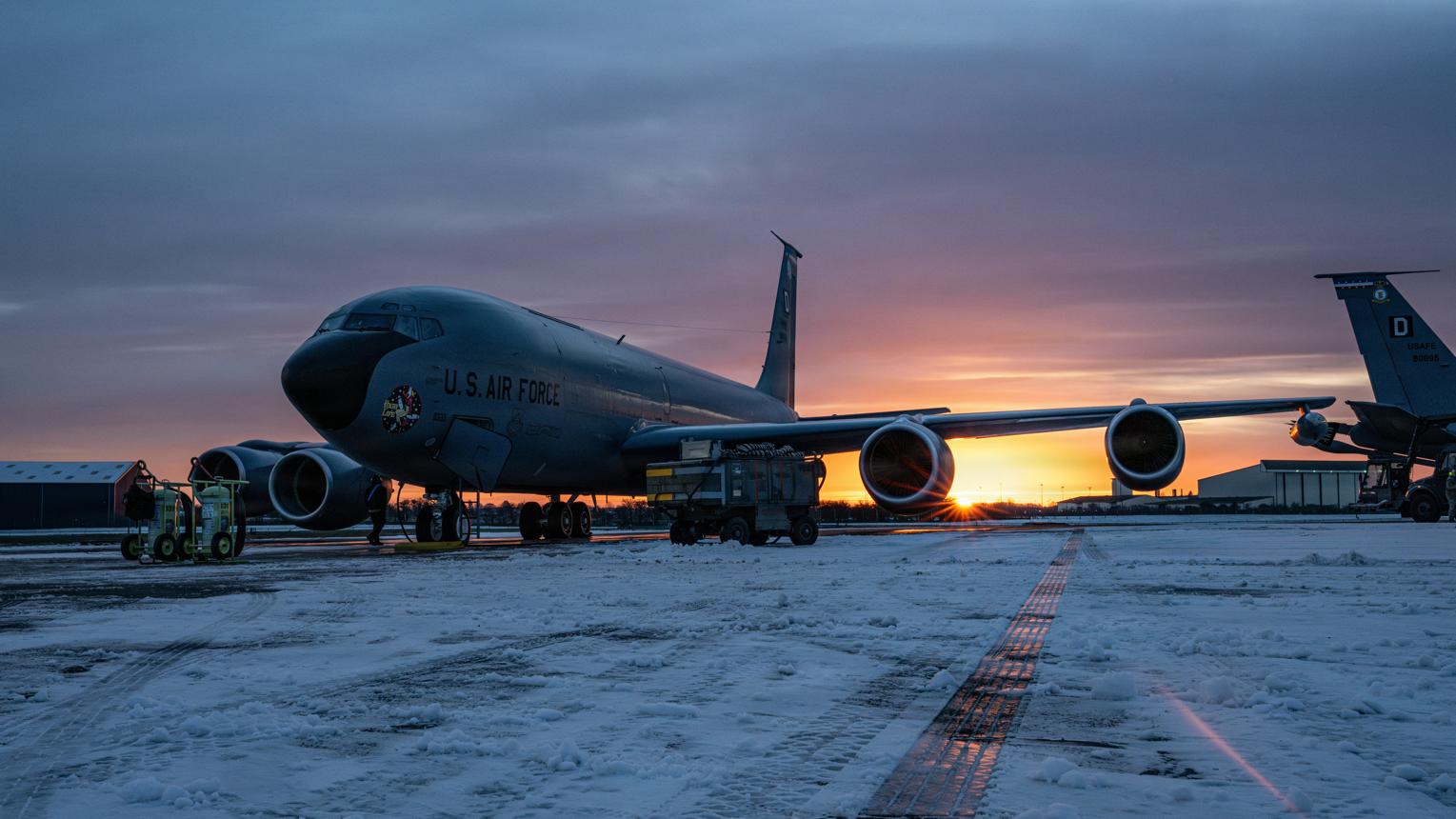
American military aircraft have been moved from RAF Mildenhall to airfields across Europe following reports of a possible Iranian security threat. A refuelling tanker landed at Scotland’s publicly owned Glasgow Prestwick Airport, renewing questions about American military operations at a site with more than 80 years of transatlantic military history.
A US Air Force refuelling aircraft landed at Glasgow Prestwick Airport in Ayrshire on Monday, 9 November 2026, during an unusually large redistribution of American military aircraft from RAF Mildenhall in Suffolk.
Flight-tracking investigations identified ten Boeing KC-135 Stratotankers departing Mildenhall for destinations in Scotland, Germany and Spain. Three CV-22 Osprey aircraft were also transferred to nearby RAF Lakenheath in England.
A further KC-135 departed Mildenhall on Tuesday afternoon, heading towards Germany.
The movements followed information concerning a potential security threat against American aircraft and personnel stationed in Britain. US officials acknowledged precautionary military activity but have not publicly disclosed the intelligence behind the decision.
The Wall Street Journal reported that the threat originated from Iran, citing people familiar with the matter. Subsequent reporting confirmed that American military authorities had received credible threat information, although the nature of the threat and its precise origin remained undisclosed.
US European Command said military aircraft regularly move between installations for training and operational requirements. It declined to comment on specific security arrangements.
The command confirmed that it was taking coordinated precautions with British authorities to protect American service personnel, installations, civilian employees, contractors and their families.
The British Ministry of Defence said aircraft belonging to allied nations routinely move between military facilities according to operational requirements and that it would not comment on individual movements.
Downing Street insisted that Britain’s military bases remained safe and said the protection of installations used by allied forces was a continuing priority.
The arrival at Prestwick was particularly notable because the airport is owned by the Scottish Government and has already been the subject of political controversy concerning American military operations.
There is, however, an important qualification.
Only one KC-135 has been independently identified as landing at Prestwick during the movements reported on Monday. That aircraft belonged to the Nebraska Air National Guard, rather than necessarily being permanently stationed with the American refuelling wing at Mildenhall.
Its Scottish arrival coincided with the wider redistribution, but investigators have not established whether it was part of the precautionary operation or an already scheduled stopover during a transatlantic flight.
The aircraft’s intended destination after Prestwick, the duration of its stay and the specific reason for its arrival have not been publicly confirmed.
There is no verified evidence that Prestwick itself was threatened or that American combat aircraft have been permanently redeployed to Scotland.
Nevertheless, the arrival has brought renewed attention to the airport’s longstanding American military connections and to questions about the authority exercised by Scottish ministers over a publicly owned aviation facility.
In February, the Scottish Parliament debated a motion calling for American military forces to be excluded from Scottish Government-owned airports.
The motion, introduced by Scottish Green MSP Gillian Mackay, cited flight-tracking information indicating that American military aircraft had landed at Prestwick more than 560 times since 1 April 2025.
During the debate on 18 February, Mackay specified 565 landings between 1 April 2025 and 12 February 2026.
The figures were compiled from publicly available flight-tracking information by the Scottish Greens. They were presented to Parliament as evidence of the scale of American military activity, rather than as an independently audited government count.
The Greens argued that allowing continued American military access risked involving Scotland in operations over which the Scottish Government exercised little direct control.
Other parties took a different position.
Conservative representatives emphasised Scotland’s NATO commitments, longstanding cooperation with American forces and the commercial benefits of military aviation. Labour representatives also defended NATO cooperation, while maintaining that foreign military activity must comply with domestic and international law.
The original Green motion was not adopted. Parliament instead approved an amended motion addressing international law, Ukraine, Greenland and international sanctions against Russia.
The debate nevertheless established that American military aviation was already a significant and contested part of Prestwick’s business, months before the latest aircraft movement.
On 5 March, Scottish Green MSP Ross Greer raised the issue again during First Minister’s Questions.
Greer told Parliament that flight data showed 24 American military aircraft had landed at Prestwick in the week preceding US and Israeli military strikes against Iran, with some arriving directly from Israel.
He argued that the movements demonstrated a connection between the airport and American military preparations.
First Minister John Swinney responded that the Scottish Government was seeking further information about the use of Prestwick by American forces.
He also reiterated his view that the US and Israeli intervention was incompatible with the international rules-based system.
Greer’s account of the flights was presented as part of his parliamentary questioning. It did not establish independently that the aircraft had been used to conduct bombing operations.
The constitutional difficulty became clearer on 19 March.
Swinney told Parliament that the Scottish Government had acquired Prestwick using its economic development powers, principally to preserve employment and aviation infrastructure.
He explained that preventing foreign military aircraft from entering Scotland would require the exercise of powers over defence, national security, aviation, air transport and foreign affairs.
Those responsibilities are reserved to the UK Government.
Swinney said he would exceed his constitutional authority if he attempted to exercise those powers directly, although he continued to pursue discussions with Westminster.
On the same day, Defence Secretary John Healey addressed the matter during a visit to Edinburgh.
Healey said Prestwick was a civilian airport owned by the Scottish Government and stated that it was not being used for American strike operations against Iran.
He also confirmed that UK ministers had offered Swinney a briefing and would meet him to discuss the airport’s military use.
During a House of Commons debate on 23 March, Healey again stated that Prestwick had not been used for American bombing strikes.
That followed a question from Scottish Labour MP Brian Leishman, who referred to as many as 32 US military departures from Prestwick during the ten days preceding the strikes on Iran.
These statements established the UK Government’s public position at the time. They did not amount to a detailed disclosure of every aircraft movement or its operational purpose.
Prestwick’s ownership creates an unusual arrangement in which the Scottish Government controls a commercial aviation asset but does not possess all the constitutional powers governing the foreign military aircraft using it.
The airport operates commercially through an arm’s-length company. Its management makes ordinary business decisions, while military access takes place within the applicable aviation rules, defence arrangements and international agreements.
The Scottish Government acquired Prestwick in November 2013 for a nominal £1 after concerns about its commercial future.
The purchase was intended to protect employment, preserve aviation infrastructure and maintain a strategic economic asset for Scotland.
Since then, the airport has continued operating passenger, cargo, aircraft maintenance, refuelling and military aviation services.
A Scottish Government-commissioned economic assessment, published in December 2025, identified Prestwick’s long runway, continuous operating capability and specialist services as important commercial advantages.
The airport supports a substantial aerospace manufacturing and engineering industry, alongside its aviation operations.
The assessment identified hundreds of jobs directly associated with the airport and thousands more across the surrounding aerospace cluster, tourism and related businesses.
Military aviation is therefore not an occasional activity entirely separate from the airport’s commercial identity. It forms part of an established business involving refuelling, ground handling and specialist aircraft services.
The airport also occupies an important position in the wider history of American military aviation in Britain.
Its relationship with American forces predates NATO and extends back to the Second World War.
Before examining that history, the scale and nature of the latest American aircraft movements are worth considering.
The KC-135 Stratotanker is a large military aircraft developed primarily to refuel other aircraft while they are flying.
Designed by Boeing during the 1950s, the type first flew in August 1956. The first production aircraft was delivered to the United States Air Force in June 1957.
Almost seven decades later, extensively modernised versions remain a central component of American military operations.
The aircraft can carry a maximum transferable fuel load of approximately 200,000 pounds, equivalent to 90,700 kilograms, although the quantity available during an individual mission depends on aircraft configuration, fuel requirements and operating conditions.
Its principal equipment is a refuelling boom extending from the rear fuselage. A specialist operator controls the boom during flight, allowing fuel to be transferred to compatible aircraft.
Other configurations can accommodate aircraft using probe-and-drogue refuelling equipment.
The capability allows American and allied aircraft to travel considerably greater distances without landing.
It is particularly valuable for long-range bomber deployments, fighter aircraft operations and the movement of military aircraft between continents.
KC-135 aircraft can also carry passengers and cargo and can be configured for medical evacuation missions.
Their importance therefore extends beyond combat operations to military logistics, transport and emergency support.
The aircraft identified at Prestwick was associated with the Nebraska Air National Guard’s 155th Air Refueling Wing, based in Lincoln, Nebraska.
The unit traces its history to the Second World War, when its predecessor operated fighter aircraft in Europe.
The Nebraska Air National Guard subsequently operated several fighter and reconnaissance aircraft before converting to the KC-135 refuelling mission in 1993.
The organisation was redesignated the 155th Air Refueling Wing in October 1995.
Since adopting the tanker mission, its aircraft and personnel have supported American and NATO operations in Europe, the Middle East and other regions.
Its operational history includes deployments supporting missions in Turkey, Saudi Arabia and southern Europe.
The wing also supported NATO operations during the conflict in Kosovo and subsequently contributed to American military operations following the attacks of September 2001.
That background makes a transatlantic stop at Prestwick consistent with the unit’s established operational activities, even without evidence that the aircraft was part of the security-related redistribution.
The wider movement from RAF Mildenhall involved several established American military installations.
Flight-tracking analysis identified four KC-135 tankers arriving at Spangdahlem Air Base in western Germany, one at Ramstein Air Base, also in Germany, and four at Morón Air Base in southern Spain.
One tanker landed at Prestwick.
Three American CV-22 Osprey aircraft were also moved to RAF Lakenheath in Suffolk.
The Osprey is a tiltrotor aircraft combining the ability to take off and land vertically, like a helicopter, with the greater cruising speed and range of a fixed-wing aircraft.
American special operations forces use the type to transport personnel and equipment during missions requiring flexible access to difficult locations.
The transfer of Ospreys to Lakenheath was therefore distinct from the longer-distance movement of aerial refuelling aircraft to mainland Europe.
Additional aircraft movements were reported on Tuesday, but the complete duration and final disposition of the redistribution have not been made public.
The European destinations are important because they provide established facilities for American aircraft rather than newly created operating bases.
Spangdahlem Air Base, in the German state of Rhineland-Palatinate, became operational in May 1953.
Established during the early Cold War, it developed into an important American tactical aviation installation.
The 52nd Fighter Wing has been associated with Spangdahlem since December 1971, when it was activated there as the 52nd Tactical Fighter Wing.
Its aircraft have undertaken NATO missions and participated in major operations, including the 1991 Gulf War and later military campaigns in the Balkans.
The base has continued to support American combat aviation and allied exercises, with facilities capable of accommodating visiting aircraft.
Ramstein Air Base, near Kaiserslautern, also emerged during the early Cold War.
American military aviation facilities were established in the area in 1952, with separate installations at Ramstein and Landstuhl.
They were combined in December 1957, and the installation received its formal designation as Ramstein Air Base in August 1958.
Ramstein subsequently developed into one of the principal centres of American military aviation in Europe.
It supports airlift operations, military transport and wider command functions.
The installation hosts important American military headquarters, including US Air Forces in Europe–Air Forces Africa, and has longstanding NATO command connections.
Morón Air Base, near Seville in southern Spain, has a different history.
Its role in American military operations developed following the 1953 Madrid agreements between Spain and the United States.
Those arrangements permitted American access to designated Spanish air and naval facilities during the Cold War.
Spain did not become a member of NATO until 1982.
Morón nevertheless operated as an important American military transit and support installation during the preceding decades.
Its location in southern Spain makes it suitable for aircraft travelling between North America, Europe, the Mediterranean and destinations farther east.
The base has supported American fighters, bombers and aerial refuelling aircraft, as well as transport and logistical operations.
RAF Lakenheath, the destination of the three Ospreys, shares a particularly close historical relationship with RAF Mildenhall.
Lakenheath originally served as a military aviation area during the First World War, before its development during the Second World War.
In 1940, the Air Ministry selected the site as an alternative airfield for Mildenhall.
It initially operated as a decoy installation, with false lighting, runways and aircraft intended to divert German air attacks from the main base.
Lakenheath subsequently became an operational bomber airfield.
American aircraft began using it extensively in 1948, and operational control was transferred to the United States Air Forces in Europe in November of that year.
Since 1960, Lakenheath has been associated with the 48th Fighter Wing, known as the Liberty Wing.
The base now supports American combat aircraft and occupies a central place in the US military’s European aviation network.
RAF Mildenhall itself opened in October 1934.
Originally developed for the Royal Air Force’s bomber operations, it became an increasingly important American aviation facility during the early Cold War.
American forces used Mildenhall for bomber, reconnaissance, transport and refuelling missions.
The installation subsequently became associated with specialised reconnaissance aircraft and other operations requiring access to European airspace.
The 100th Air Refueling Wing was activated at Mildenhall on 1 February 1992, following a reorganisation of American military aviation in Europe.
Its first permanently assigned KC-135 arrived in May 1992.
The wing assumed responsibility for aerial refuelling operations and developed into the only permanently stationed American aerial refuelling wing in the European theatre.
Its mission involves supporting American and allied aircraft operating across Europe and Africa.
Removing a significant number of tankers from Mildenhall therefore disperses aircraft belonging to, or operating through, an installation central to the American refuelling network.
The reported redistribution also coincided with increased security at Mildenhall and Lakenheath.
Military aviation reporting indicated that the American force protection level at both bases had been raised to Force Protection Condition Charlie, commonly abbreviated to FPCON Charlie.
Charlie is the second-highest level in the American military’s defensive security system.
Under Department of Defense guidance, it applies when intelligence indicates that terrorist or hostile action against military personnel or facilities is likely, or when a relevant incident has occurred.
The reported security increase was attributed to military sources and specialist aviation observers.
US European Command has not publicly confirmed the precise intelligence assessment or issued a detailed explanation of the threat.
An elevated security condition does not necessarily mean an attack is imminent.
It indicates that authorities believe additional precautions are justified.
The distinction is particularly important because the reported movements followed another security investigation involving an American military installation in Britain.
On 27 September, armed police stopped three vehicles near RAF Fairford in Gloucestershire and arrested five men following reports of suspicious activity.
Counter Terrorism Policing subsequently launched an investigation.
Fairford had been used by American long-range bombers during military operations involving Iran.
American B-1 bombers were withdrawn from the airfield following the security concerns.
On 27 October, Counter Terrorism Policing announced charges against two men under the National Security Act 2023.
Nouman Essghir, a 24-year-old British national, was charged under Section 4 of the Act in relation to suspected activity concerning a prohibited place.
A second man, Mohmed Ahmad Abdulkarim, also 24, was charged under Section 3, which concerns assisting a foreign intelligence service.
Investigators said they believed the foreign country involved in the second allegation was Iran.
The charges remain allegations, and neither man’s guilt has been established.
The investigation also involved a third suspect, a dual British-Iranian national, who was subsequently released without charge in relation to the foreign intelligence allegation but remained on police bail in connection with a separate investigation.
There has been no public finding connecting the Fairford investigation directly to the November aircraft movement at Mildenhall or the arrival at Prestwick.
The incidents nevertheless occurred during a period of heightened concern about suspected Iranian activity in Britain.
On 13 October, MI5 Director General Sir Ken McCallum delivered his annual threat assessment.
He warned that Iranian-linked operations in Britain had expanded beyond intimidation of dissidents, Iranian media organisations and Israeli-linked targets.
McCallum said the intelligence service had observed attempts to target more difficult objectives, including military installations.
He reported that Iran-linked investigations had resulted in more than 50 arrests in the United Kingdom during the preceding twelve months.
The figure covered a range of investigations and did not mean that all the arrests involved attacks on military facilities.
McCallum also referred to criminal intermediaries, sabotage operations and the use of proxy organisations to undertake hostile activity.
His statement provided a broader context for the British security response, although it did not identify the cause of the November aircraft redistribution.
For Prestwick, the events are the latest chapter in a much longer military aviation history.
The airport’s origins lie in the 1930s and the work of Scottish aviators David McIntyre and the Duke of Hamilton.
Both men were involved in the historic 1933 expedition that achieved the first flight over Mount Everest.
Their subsequent aviation activities contributed to the establishment of the airfield and the development of Scottish Aviation, which became an important aircraft manufacturing enterprise.
During the Second World War, Prestwick emerged as a major transatlantic aviation centre.
Its geographical position on Scotland’s west coast made it well suited to aircraft arriving from North America.
As Britain expanded its wartime aircraft supply arrangements, Prestwick became an important destination for aircraft delivered from American and Canadian factories.
The Atlantic Ferry Organisation used the airfield to receive military aircraft travelling across the ocean.
Among the types passing through were American-built Boeing B-17 Flying Fortress bombers.
Aircraft arriving at Prestwick could undergo inspection, maintenance and preparation before continuing to their operational destinations.
The airport’s role required extensive development of navigation, maintenance, training and ground-support facilities.
According to the Airfields of Britain Conservation Trust, more than 37,000 aircraft passed through Prestwick by the end of the war.
The scale of that movement established the airfield as an important connection between North American aircraft production and Britain’s wartime aviation requirements.
Prestwick was returned to civilian control on 1 April 1946.
Commercial passenger services expanded, and for a period the airport held an important position in Scotland’s transatlantic aviation network.
Military activity did not disappear.
In 1952, the United States Air Force established a renewed presence through the Military Air Transport Service.
American military transport operations continued at Prestwick until 1966.
During the 1960s and 1970s, the airport underwent substantial redevelopment.
New facilities included a passenger terminal, freight buildings, a control tower, revised road infrastructure and an extended runway.
Prestwick Airport’s own historical account confirms that the runway extension was designed to accommodate American military requirements.
It was built to the standard US military specification of the period, a distinction shared by relatively few British runways.
The development also accommodated increasingly large commercial aircraft, allowing the airport to continue participating in international passenger and cargo aviation.
Prestwick’s aerospace industry expanded alongside the airfield.
Scottish Aviation developed and manufactured aircraft, including the Pioneer and Twin Pioneer transport types.
Later aircraft manufacturing and engineering operations included work associated with the Bulldog trainer and Jetstream airliner.
The industrial activity eventually became part of the wider British Aerospace organisation and helped establish the aerospace engineering concentration that remains an important part of Ayrshire’s economy.
The airport also hosted significant aviation events and training activities, including appearances by Concorde and the development of facilities supporting large commercial aircraft.
Military aviation remained an established presence.
In 1971, HMS Gannet, also known as Royal Naval Air Station Prestwick, became part of the site’s military infrastructure.
Royal Navy helicopters operated from the installation for maritime duties and search-and-rescue work.
For many years, military Sea King helicopters provided emergency assistance to vessels, aircraft and communities across western Scotland and the surrounding waters.
The military-operated search-and-rescue service ended in 2016 as the United Kingdom transferred those responsibilities to a civilian coastguard helicopter service.
However, HMS Gannet did not cease to have a defence role.
The Ministry of Defence-owned installation remains a military forward operating location.
A Scottish Government economic assessment published in December 2025 confirmed that the Gannet site continues to support British military operations and can provide facilities to visiting allied forces, including American and Canadian personnel.
The report also identified the site’s role in supporting the protection of Britain’s nuclear deterrent.
Civilian search-and-rescue operations continue separately at Prestwick through facilities operated by Bristow Helicopters.
The combination of military facilities, civilian emergency aviation, manufacturing, maintenance, cargo handling and passenger operations illustrates the unusually diverse functions associated with the airport.
It also helps explain why Prestwick remains attractive to visiting military operators.
The location offers a lengthy runway suitable for large aircraft, specialist ground-handling services, maintenance facilities, fuel supplies and round-the-clock operations.
Those characteristics make the airport useful for aircraft crossing the Atlantic or travelling between North America and European military installations.
They also contribute to its commercial value.
The Scottish Government’s December 2025 economic assessment estimated that the airport and its wider aviation activities supported substantial economic activity across Ayrshire and Scotland.
The assessment identified the aerospace engineering and maintenance cluster as a particularly important contributor to employment, skills development and industrial investment.
For policymakers, that commercial significance forms part of the debate over the airport’s military customers.
The Scottish Greens have questioned whether a publicly owned airport should provide facilities for American military operations associated with conflicts that Scottish ministers oppose.
Other parliamentary representatives have argued that the military business supports employment, contributes to the airport’s financial sustainability and reflects Scotland’s obligations and interests as part of the United Kingdom and NATO.
The airport’s management operates within the existing constitutional settlement, under which responsibility for defence and international military arrangements rests principally with Westminster.
The legal position is therefore not determined by Scottish Government ownership alone.
A freedom-of-information release published by the Scottish Government on 25 August 2026 provides further evidence of the official attention given to the issue.
The release concerned correspondence between Scottish Government representatives and Prestwick Airport officials about American military flights between February and April.
Some correspondence was disclosed, while other information was withheld under exemptions relating to the effective conduct of public affairs and personal information.
The Government explained that confidential discussions concerning operational and commercial matters could be affected by disclosure.
The release confirmed the existence of official communications about American military activity but did not establish that the Scottish Government possessed unrestricted authority to prevent individual flights.
That is the administrative and political background against which the latest American tanker arrived.
The wider redistribution from Mildenhall illustrates the value of having numerous airfields available across Europe.
Prestwick, Spangdahlem, Ramstein, Morón and Lakenheath all have histories extending back to the Second World War or the early Cold War.
They serve different operational purposes, but each forms part of the network of aviation facilities available to American forces and their allies.
Distributing aircraft among several locations can reduce the vulnerability associated with concentrating valuable equipment at a single installation.
That is a recognised military precaution.
However, American authorities have not publicly confirmed that every flight on 9 November was ordered as part of a single protective operation.
Some aircraft were permanently stationed at Mildenhall, while others were visiting the base.
The movement of the Nebraska aircraft to Prestwick must therefore be distinguished from the confirmed redistribution of the wider tanker fleet.
Its arrival is established. Its purpose is not.
There is also no public evidence that the Ayrshire airport faced an immediate threat or that the United States intends to establish a new permanent military deployment there.
What remains unclear is whether the Prestwick stop was scheduled before the security alert, whether the aircraft was intended to remain in Scotland temporarily, and whether additional American military aircraft will use the airport as part of the same operation.
The American authorities have not publicly provided those details.
For Scotland, the questions extend beyond a single aircraft.
Prestwick is a publicly owned commercial airport with established military customers, a specialist aerospace economy and a history of supporting transatlantic defence operations.
Its services are commercially valuable, while the political authority governing foreign military activity remains divided between Edinburgh and London.
Those arrangements have already been debated repeatedly in the Scottish Parliament.
The latest arrival brings that debate back into focus at a time when American military commanders are taking additional precautions across parts of Britain and Europe.
More than 80 years after Prestwick began receiving American-built military aircraft during the Second World War, the airport remains part of the transatlantic aviation network.
Its wartime ferrying operations, Cold War transport missions, naval facilities and modern refuelling business explain why American military aircraft continue to use the Ayrshire site.
The immediate question is narrower, and more consequential for understanding the present development: whether the aircraft that landed on 9 November was making an ordinary stop on an established military route or had been directed to Scotland because American commanders considered their aircraft at Mildenhall to be at risk.
Until the relevant authorities clarify that distinction, the Prestwick landing is confirmed, but its precise place within the reported security operation remains unresolved.
Sources
US Air Force Relocates Aircraft From a Base in England Because of a Threat, US Official Says. Associated Press, 10 November 2026.
https://apnews.com/article/18294a0abfe39c04c2e4f5b520ea8586
Britain Says Its Bases Are Safe After US Refuelling Planes Evacuated. Reuters, 10 November 2026.
https://www.reuters.com/world/europe/us-aircraft-evacuated-second-uk-base-due-iran-threat-wsj-reports-2026-11-10/
US Taking ‘Appropriate’ Steps After Planes Leave UK Base. Agence France-Presse, 10 November 2026.
https://www.afp.com/en/us-taking-appropriate-steps-after-planes-leave-uk-base
US Military Moves Aircraft From RAF Mildenhall Base in UK to Germany, Spain, Reportedly Due to Iran Threat. CBS News, 10 November 2026.
https://www.cbsnews.com/news/raf-mildenhall-us-tanker-relocation-iran-threat-military-aircraft-moved/
‘Iranian Threat’ Leads to Mass Dispersal of Aircraft Away From RAF Mildenhall. The Aviationist, 10 November 2026.
https://theaviationist.com/2026/11/10/raf-mildenhall-security-threat-dispersal/
US Moves Refuelling Aircraft From Britain to Germany Amid Reported Iran Threat. Stars and Stripes, 10 November 2026.
https://www.stripes.com/theaters/europe/2026-11-10/us-relocates-aircraft-mildenhall-iran-threat-23420098.html
Ending US Military Use of Scottish Airports, Motion S6M-20819. Scottish Parliament, lodged 16 February 2026.
https://www.parliament.scot/chamber-and-committees/votes-and-motions/S6M-20819
Meeting of the Parliament: Airports (US Military Use). Scottish Parliament, Official Report, 18 February 2026.
https://www.parliament.scot/chamber-and-committees/official-report/search-what-was-said-in-parliament/meeting-of-parliament-18-02-2026?iob=224545&meeting=20080
Meeting of the Parliament: Prestwick Airport (Military Use). Scottish Parliament, Official Report, 5 March 2026.
https://www.parliament.scot/chamber-and-committees/official-report/search-what-was-said-in-parliament/meeting-of-parliament-05-03-2026?iob=213026&meeting=20117
Meeting of the Parliament: First Minister’s Question Time. Scottish Parliament, Official Report, 19 March 2026.
https://www.parliament.scot/chamber-and-committees/official-report/search-what-was-said-in-parliament/meeting-of-parliament-19-03-2026?iob=217316&meeting=20149
Middle East: House of Commons Debate. UK Parliament, Hansard, 23 March 2026.
https://hansard.parliament.uk/commons/2026-03-23/debates/CAA5A854-4F50-4227-83A7-1E285DFF6BCE/MiddleEast
Ministers Will Meet Swinney on US Military Use of Prestwick Airport, Says Healey. Press Association, 19 March 2026.
https://news.stv.tv/west-central/ministers-will-meet-swinney-on-us-military-use-of-prestwick-airport-says-healey
US Military Flights Related Correspondence Between Scottish Government and Glasgow Prestwick Representatives: FOI Release. Scottish Government, 25 August 2026.
https://www.gov.scot/publications/foi-202600515377/
Glasgow Prestwick Airport: Economic Impact Assessment. Scottish Government, 16 December 2025.
https://www.gov.scot/publications/glasgow-prestwick-airport-economic-impact-assessment/
Strategic Asset Management. Scottish Government, 2026.
https://www.gov.scot/publications/strategic-commercial-assets/pages/strategic-asset-management/
History. Glasgow Prestwick Airport, official airport history.
https://www.glasgowprestwick.com/corporate/about-us/history/
Prestwick. Airfields of Britain Conservation Trust, historical airfield record.
https://www.abct.org.uk/airfields/prestwick/
History of the Nebraska Air National Guard. 155th Air Refueling Wing, United States Air National Guard.
https://www.155arw.ang.af.mil/Resources/Fact-Sheets/Display/Article/437930/history-of-the-nebraska-air-national-guard/
Nebraska Air National Guard Celebrates 80 Years of Service. 155th Air Refueling Wing, October 2026.
https://www.155arw.ang.af.mil/News/Article-Display/Article/4601450/nebraska-air-national-guard-celebrates-80-years-of-service/
KC-135 Stratotanker. United States Air Force, official aircraft fact sheet.
https://www.af.mil/About-Us/Fact-Sheets/Display/Article/977523/kc-135-stratotanker/
100th Air Refueling Wing History. United States Air Force, RAF Mildenhall.
https://www.mildenhall.af.mil/About-Us/Fact-Sheets/Display/Article/270390/100th-air-refueling-wing-history/
RAF Mildenhall History. United States Air Force, RAF Mildenhall.
https://www.mildenhall.af.mil/About-Us/Fact-Sheets/Display/Article/270389/raf-mildenhall-history/
65 Years of USAFE and RAF Lakenheath: Heritage to Horizons. United States Air Force, RAF Lakenheath.
https://www.lakenheath.af.mil/News/Commentaries/Display/Article/300609/65-years-of-usafe-and-raf-lakenheath-heritage-to-horizons/
Wing History. United States Air Force, Spangdahlem Air Base.
https://www.spangdahlem.af.mil/About-Us/Fact-Sheets/Article/293639/wing-history/
Spangdahlem Celebrates 60th US–German Anniversary. United States Air Force, 2013.
https://www.spangdahlem.af.mil/News/Article/293711/spangdahlem-celebrates-60th-us-german-anniversary/
Celebrating 70 Years of Ramstein Air Base History. United States Air Force, 5 August 2022.
https://www.ramstein.af.mil/News/Features/Display/Article/3119385/celebrating-70-years-of-rab-rheinland-palatinate-history/
496th Air Base Squadron — Morón Air Base. United States Air Force, Ramstein Air Base.
https://www.ramstein.af.mil/About/Units/496-ABS-Moron/
496th Air Base Squadron Projects Airpower From Morón. United States Air Force, 2024.
https://www.ramstein.af.mil/News/Features/Display/Article/3755451/496-abs-projects-airpower-from-morn/
Spain and NATO. North Atlantic Treaty Organization, historical account.
https://www.nato.int/en/about-us/nato-history/history-by-theme/my-country-and-nato/spain-and-nato
Two Men Charged Under the National Security Act in RAF Fairford Investigation. Counter Terrorism Policing, 27 October 2026.
https://www.counterterrorism.police.uk/news/raf-fairford-investigation/
MI5 Director General Delivers Annual Threat Update. MI5, 13 October 2026.
https://www.mi5.gov.uk/mi5-director-general-delivers-annual-threat-update
DOD Force Protection Conditions Employed to Protect People, Assets. United States Air Force, Edwards Air Force Base.
https://www.edwards.af.mil/News/Commentaries/Display/Article/396683/dod-force-protection-conditions-employed-to-protect-people-assets/