
The National Trust for Scotland is commissioning a detailed survey of Charles Rennie Mackintosh’s Hill House as it prepares to replace the building’s failed cement exterior and remove its protective Box by 2028.
The National Trust for Scotland has begun another stage of work to tackle the chronic damp which has affected Charles Rennie Mackintosh’s Hill House in Helensburgh since shortly after it was built.
A contract notice published on 14 August seeks an archaeological consultant to carry out a detailed Standing Building Survey of the Category A-listed house before a future conservation and repair programme.
The Trust says that programme will include a new roughcast exterior being developed to replace the Portland-cement coating which has contributed to more than a century of water problems.
The survey is intended to record and improve understanding of the building before repairs which may involve alterations. Tenders close on 7 September and the survey contract is scheduled to run from 12 September until 30 November. Quality will account for 75% of the tender assessment and price 25%.
Cement exterior to be replaced
The Hill House was designed by Mackintosh between 1902 and 1904 for Glasgow publisher Walter Blackie.
Mackintosh and his wife, artist and designer Margaret Macdonald Mackintosh, also designed much of its interior, including furniture, fittings and decorative work. Historic Environment Scotland describes it as the most complete and finest example of Mackintosh’s domestic architecture.
Its exterior proved less successful.
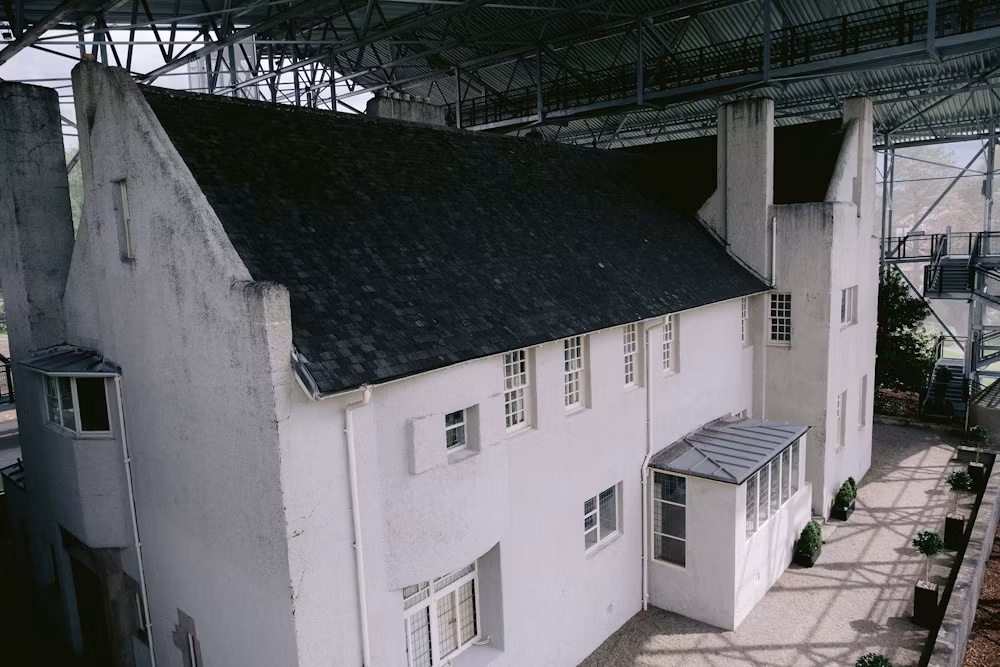
Mackintosh used Portland-cement roughcast to produce the plain, largely unornamented walls he wanted. The material was regarded as innovative at the time, but water began penetrating the building within years of its completion.
Historic Environment Scotland says the problems resulted largely from inadequate weathering details at walls and window sills, together with reliance on the cement harl.
Unlike more traditional breathable lime finishes, the Portland-cement covering contributed to moisture becoming trapped within the walls.
The National Trust for Scotland, which has owned the house since 1982, eventually concluded that repeatedly repairing the existing render would not provide a long-term answer.
It said earlier this year that expert analysis had established that complete replacement of the Portland-cement render was the only tenable option. Work to remove it is now under way.
The Trust is working with specialists to develop a replacement surface which will preserve Mackintosh’s intended appearance while allowing moisture to escape rather than remain trapped inside the structure.
House has been drying inside protective Box
The Hill House has been protected since 2019 by the Hill House Box, a large steel structure covered in chainmail mesh.
It reduces the amount of rain reaching the building while allowing air to circulate around it, enabling saturated walls to dry gradually.
Tests carried out beneath sections of roughcast found that the walls were steadily drying and regaining strength inside the protected environment. Specialists removed the cement coating at six locations and examined sandstone, brickwork and other parts of the original construction.
Samples, including material believed to be part of Mackintosh’s original roughcast, were analysed by researchers at the University of Dundee.
More recent removal work has also exposed previously unknown details in the structure, including an unused entrance and a window opening.
The newly commissioned building survey will create a formal record of the house as that work continues and will inform the design of the permanent repairs.
Box expected to go in 2028
The conservation work forms part of the National Trust for Scotland’s wider Mackintosh Illuminated project, covering the Hill House and the Mackintosh Tearooms in Glasgow.
The National Lottery Heritage Fund has provided £1.1m in development support towards the project, which was described when announced as the first stage towards a possible wider £7.3m award.
The Trust says it currently has planning permission for the Hill House Box to remain until 2028 and intends the building to be sufficiently repaired that the structure will no longer be required after that point.
The new roughcast has not yet been finally specified, and the contract advertised this month is for the archaeological survey rather than installation of the replacement exterior.
The work now under way is intended to establish precisely what survives beneath Mackintosh’s cement coating before a new one is put in its place.
Sources
Public Contracts Scotland — Mackintosh Illuminated: Standing Building Survey, contract notice published 14 August 2026
https://www.publiccontractsscotland.gov.uk/search/show/search_view.aspx?ID=AUG562347
National Trust for Scotland — Taking Mackintosh’s coat off, 23 February 2026
https://www.nts.org.uk/stories/taking-mackintoshs-coat-off
National Trust for Scotland — Mackintosh Illuminated
https://www.nts.org.uk/campaigns/mackintosh-illuminated
National Trust for Scotland — Digging deep into the condition of the Hill House
https://www.nts.org.uk/stories/digging-deep-into-the-condition-of-the-hill-house
National Trust for Scotland — Funding win marks anniversary of Mackintosh acquisition
https://www.nts.org.uk/stories/funding-win-marks-anniversary-of-mackintosh-acquisition
Historic Environment Scotland — Hill House, Helensburgh, Category A Listed Building LB34761
https://portal.historicenvironment.scot/apex/f?p=1505:300:::::VIEWTYPE,VIEWREF:designation,LB34761