
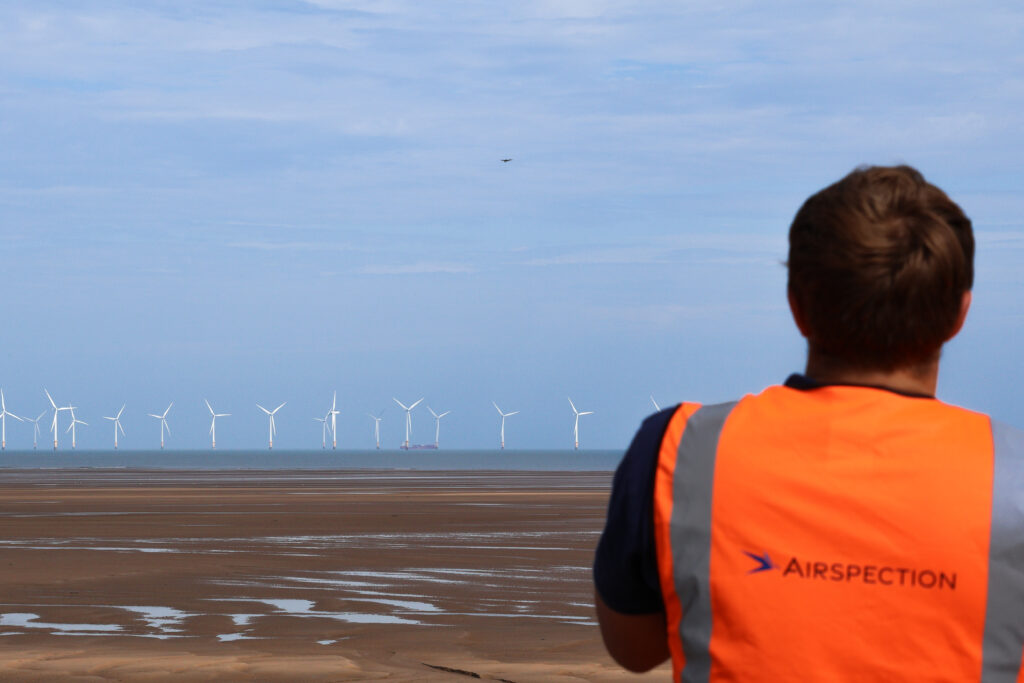
A Glasgow aviation technology company has completed a series of drone flights from the coastline to an operational offshore wind farm and back, demonstrating how turbines miles out at sea could be inspected without sending a boat to carry the aircraft and its operators.
Airspection announced the completion of its Liverpool Bay flight programme in October 2026, following two years of work involving aircraft development, communications systems, safety testing and regulatory approvals.
The company’s aircraft completed shore-launched round trips of approximately 14 kilometres over open water, operating entirely beyond the pilot’s visual line of sight. Instead of travelling aboard a vessel to reach the turbines, the flight team remained on land while the aircraft travelled offshore.
The demonstration formed part of a UK Civil Aviation Authority programme examining how remotely piloted aircraft might eventually undertake routine long-distance operations in British airspace.
Although drones are already used extensively for industrial photography and inspections, operating them far beyond the pilot’s sight introduces more demanding requirements for navigation, communications and aviation safety.
Airspection’s achievement was to demonstrate that the complete operation could be conducted from shore, with the aircraft travelling to working offshore infrastructure and returning safely.
Why Offshore Wind Turbines Need Inspecting
Offshore wind turbines operate in demanding conditions. Their blades are exposed to changing winds, rain, salt spray and the mechanical stresses of continuous operation.
Operators must inspect blades and other components to identify damage, assess wear and determine whether maintenance is required. Detecting a developing defect can allow engineers to arrange repairs before further deterioration affects the turbine’s performance.
Carrying out those inspections at sea can be considerably more complicated than examining a turbine on land.
Maintenance personnel, inspection equipment and specialist contractors may have to travel from port aboard crew transfer vessels. Weather and sea conditions can delay access, while the journeys require time, fuel and personnel.
Some inspections involve technicians examining equipment directly, while others use cameras, remotely operated systems or drones launched from vessels.
Airspection’s proposed alternative is to deploy an aircraft from the coast, fly it to the offshore installation, collect inspection information and return without requiring a dedicated vessel for that particular task.
It would not eliminate the need for boats or offshore maintenance crews. Physical repairs, equipment replacement and many other tasks would still require personnel to reach the turbines.
However, removing some inspection journeys could change how operators monitor the condition of their offshore equipment.
A Drone Designed to Work in Strong Winds
The technology developed by Airspection addresses a particular difficulty associated with offshore drone operations: the aircraft must travel significant distances while retaining enough energy to carry out its inspection and return safely.
It must also be capable of holding a stable position near large structures in windy conditions.
The company has developed a hovering system inspired by the kestrel, a bird capable of maintaining its position in strong winds while searching for prey.
Rather than relying entirely on increased motor power to resist the wind, the aircraft is designed to use aerodynamic forces to help maintain its position.
Airspection reports that testing in winds of 10 to 12 metres per second produced a reduction of approximately 40% in hovering power consumption, extending available flight time by roughly two-thirds under those test conditions.
These are company-reported test results rather than independently verified performance figures for every operating environment. Actual endurance will depend on wind conditions, aircraft configuration, flight distance and the work being undertaken.
Nevertheless, the engineering principle is significant. A drone that uses less energy while hovering may have more capacity available for travelling, gathering inspection data and returning to its launch point.
That becomes especially relevant when the destination is a wind farm situated several kilometres offshore.
From a University Engineering Project to Offshore Flights
Airspection was established in 2022 by Matthew McLean, who studied Aero-Mechanical Engineering at the University of Strathclyde.
The business developed from work undertaken during his studies and received early support from Strathclyde Inspire, the university’s entrepreneurship programme, which helped finance its first prototype.
The company has since developed aircraft and operating systems intended for inspecting difficult-to-reach infrastructure, concentrating particularly on offshore wind turbines.
Its development has involved more than manufacturing the drone itself. Long-range operations require systems capable of maintaining communications, controlling the aircraft, monitoring its position and responding to unexpected circumstances.
Airspection previously demonstrated its inspection technology at the Offshore Renewable Energy Catapult’s facilities in Blyth, Northumberland, where it tested methods for collecting information from wind turbine blades.
The Liverpool Bay programme represented another stage of development, moving from demonstrations around accessible infrastructure to flights over open water towards an operational offshore wind farm.
The work received support from the Offshore Wind Growth Partnership, which provided funding to help the company develop and demonstrate its shore-launched inspection capability.
The Aviation Challenge: Flying Beyond the Pilot’s Sight
Under ordinary drone operating rules, pilots are generally required to maintain direct visual contact with their aircraft.
Flying beyond visual line of sight, commonly abbreviated to BVLOS, requires specific regulatory authorisation because the pilot cannot rely on directly seeing the aircraft and its surroundings.
The Civil Aviation Authority selected Airspection in August 2024 as one of six projects in an innovation programme designed to gather evidence about the safe integration of long-range drones into British airspace.
The other selected projects included Amazon’s drone delivery programme, the National Police Air Service, NATS and initiatives examining flights to remote locations and medical deliveries.
For the Liverpool Bay work, Airspection secured approval for a defined airspace arrangement and obtained the necessary operational permissions.
The published aeronautical notice established temporary danger areas for the trials between February and August 2026, covering the offshore inspection area and a corridor connecting it with the coast.
The notice also recorded that the aircraft did not have a full detect-and-avoid capability. The designated airspace arrangements were therefore an important part of managing the risk to other aircraft.
This is a distinction between a successful authorised trial and unrestricted routine drone operations.
The Liverpool Bay flights demonstrate that Airspection can undertake the offshore mission under the conditions approved for its programme. They do not establish that the aircraft can yet operate anywhere in shared airspace without additional restrictions.
The Civil Aviation Authority is using evidence from such projects to develop a regulatory framework that would allow more routine long-range drone flights while protecting other airspace users.
Could the Technology Reduce Offshore Inspection Costs?
Airspection estimates that its approach could reduce the cost of certain standalone inspection campaigns by as much as 50% compared with conventional methods.
The company also estimates potential savings of approximately one tonne of carbon dioxide equivalent per turbine inspected, depending on the transport and inspection arrangements being replaced.
Those figures are projected benefits, not measured savings demonstrated across a large commercial fleet.
The Offshore Renewable Energy Catapult has assessed the commercial potential of shore-launched drone inspections against established inspection methods, according to the company’s project announcement.
The wider economic case will depend on whether the aircraft can operate frequently enough, collect inspection data of the required quality and maintain dependable service in the conditions encountered offshore.
For operators managing large numbers of turbines, avoiding even some vessel journeys could potentially produce significant logistical savings. However, the benefit will vary according to the distance from shore, the accessibility of each wind farm and the type of inspection required.
Other Industries Could Use the Same Technology
Although the Liverpool Bay programme concentrated on offshore wind, Airspection is also examining applications involving railway lines, electricity networks and other remote infrastructure.
Following severe weather, railway operators may need to inspect long stretches of track for fallen trees, damaged structures or other obstructions before services can safely resume.
Electricity network operators face similar challenges when assessing remote power lines and equipment after storms.
Long-range drones capable of reaching those locations could potentially reduce the time required for initial inspections, particularly where ordinary road access is difficult.
Matthew McLean, Airspection’s co-founder and managing director, has said that proving the technology around offshore wind provides a foundation for wider infrastructure applications.
For the Glasgow company, the next commercial challenge is to turn successful controlled demonstrations into repeatable services that customers can use within the developing aviation regulatory framework.
The completed flights across Liverpool Bay establish a practical milestone. A Scottish-designed aircraft has travelled from shore to an operational offshore wind farm and returned without its operators making the sea journey.
If that capability can be deployed routinely, some of the work now requiring people and equipment to travel offshore could instead begin at a control station on land.
Sources
Glasgow Drone Start-up Flies Out to Offshore Wind Farm and Back in UK Civil Aviation Authority Programme — Airspection company announcement distributed by Hot Tin Roof, 8 October 2026.
New Trials Set to Help Unlock Drone Deliveries and Inspections in the UK — UK Civil Aviation Authority, 15 August 2024.
AIP Supplement 008/2026: Temporary Danger Area (Liverpool Bay) BVLOS RPAS Trials — UK Aeronautical Information Services, 8 January 2026.
About Airspection — Airspection, accessed 15 October 2026.
Demonstrating Our Advanced Drone Inspection at Blyth with ORE Catapult — Airspection, 27 August 2024.
Beyond Visual Line of Sight: Operating Rules — UK Civil Aviation Authority, accessed 15 October 2026.