
Four enormous floating tidal turbines could soon operate together in the powerful currents surrounding Orkney, generating enough electricity to meet the equivalent annual demand of approximately 9,200 homes under a project that has received approval from the European Commission to proceed towards construction.
Orbital Marine Power announced on 12 October that its EURO-TIDES project had passed a formal European review of its engineering, permits and financing arrangements. The decision clears the next stage of a development intended to establish one of the world’s most significant floating tidal energy arrays.
The project will bring together three next-generation O2-X turbines and the company’s existing O2 machine, which has been generating electricity off Orkney since July 2021.
Rather than operating as separate demonstration devices, the turbines will be connected and managed as a single generating array at the European Marine Energy Centre’s Fall of Warness tidal test site, near Eday.
Orbital estimates that the completed installation could generate electricity equivalent to the annual requirements of around 85% of Orkney’s households. This is a comparison of projected generation and household consumption, rather than a commitment to supply those particular homes directly.
Deployment is currently targeted for 2028, subject to Orbital completing its investment round. The approval does not mean that construction has already begun.
Giant Machines Harnessing the Power of the Tide
The turbines developed by Orbital Marine Power look very different from conventional offshore wind turbines or hydroelectric installations.
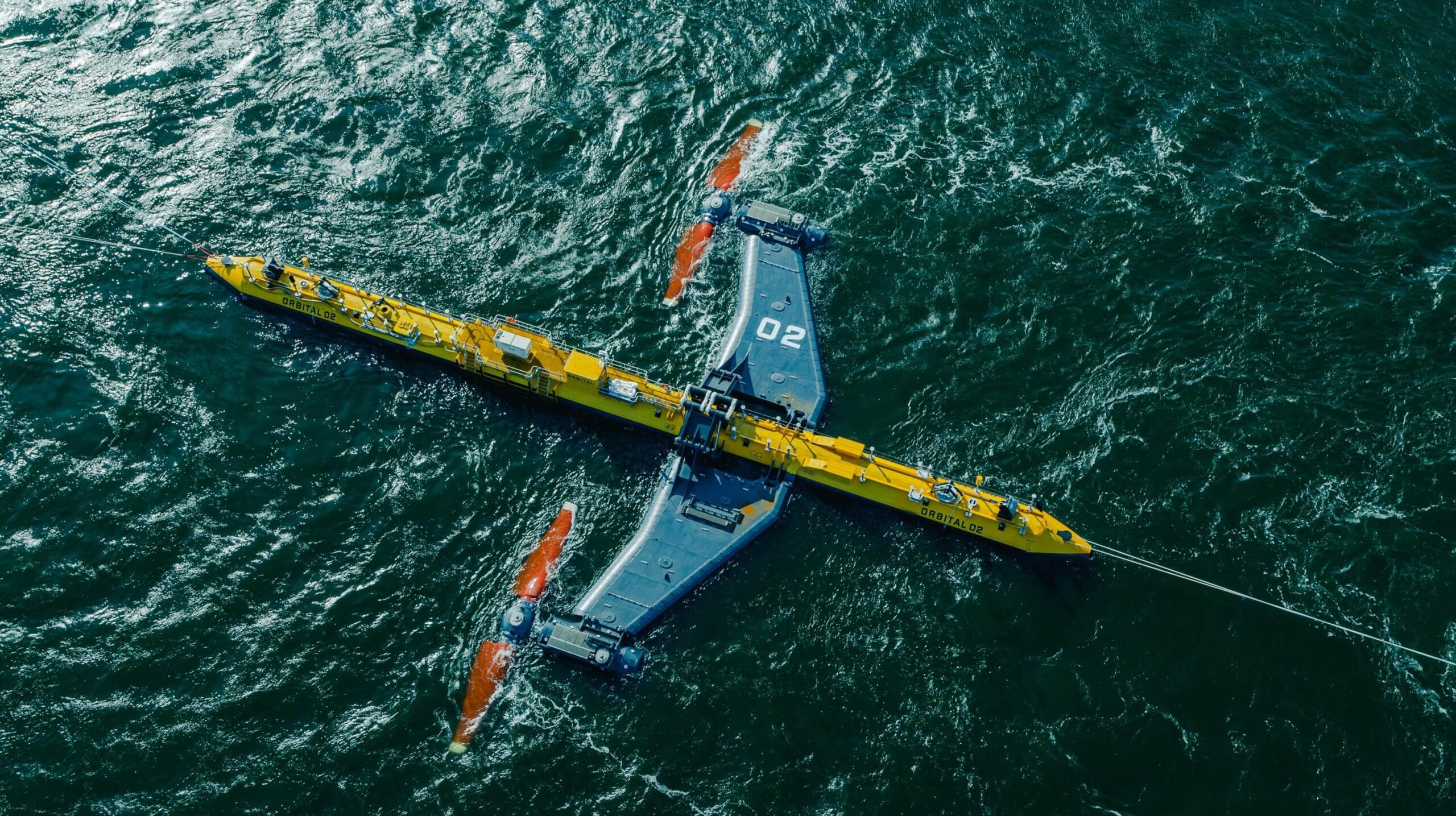
Instead of standing on towers above the sea, they operate from elongated floating structures anchored in fast-moving tidal waters. Beneath the floating platform, powerful turbines are suspended on retractable arms, allowing their blades to turn in the passing current.
The company’s existing O2 machine is 74 metres long and supports two one-megawatt turbines, giving it a combined rated generating capacity of two megawatts.
Each turbine is fitted with blades measuring approximately ten metres in length. The movement of water across the blades drives generating equipment that converts the mechanical energy into electricity.
Unlike wind, which can vary unpredictably over short periods, tidal movements can be calculated far in advance. The timing and strength of the currents change throughout the tidal cycle, but their general pattern is governed by the gravitational interaction of the Earth, Moon and Sun.
This predictability is one of tidal energy’s principal advantages, although generation still rises and falls as the current accelerates, slows and changes direction.
Orbital’s floating design is also intended to make maintenance more practical. The turbine arms can be raised towards the surface, allowing engineers to access major components without routinely removing the entire structure from its moorings.
Electricity is carried ashore through subsea cables connecting the installation to the electricity network.
Why Orkney Is Particularly Suitable
Orkney’s geography provides unusually favourable conditions for tidal electricity generation.
Water moving between the Atlantic Ocean and the North Sea is channelled through passages separating the islands. In certain locations, this produces exceptionally strong currents.
The Fall of Warness, west of Eday, was selected by the European Marine Energy Centre because its tidal flows can reach almost four metres per second during spring tides, equivalent to approximately 7.8 knots.
The site has established marine-energy testing infrastructure, including offshore berths, underwater electricity cables, monitoring equipment and a substation on Eday.
The existing cables also carry communications data, allowing engineers to monitor the performance of generating devices and their operating conditions remotely.
Orkney has consequently become an important international testing location for technologies intended to extract electricity from moving seawater.
The European Marine Energy Centre has supported multiple wave and tidal energy developers, giving companies access to demanding real-world conditions without requiring each developer to establish an entirely independent testing network.
From One Working Turbine to a Tidal Power Station
Orbital’s O2 turbine was manufactured and launched in Dundee in 2021 before being towed north to Orkney and installed at the Fall of Warness.
Its arrival represented the culmination of years of engineering development by a Scottish company founded in 2002.
The turbine began exporting electricity to the grid in July 2021, demonstrating that a large floating machine could operate in strong tidal currents and deliver power through a commercial-scale connection.
The next challenge is different. Operating one turbine successfully does not automatically establish that several machines can be manufactured, installed, connected and maintained economically as a single generating farm.
A multi-turbine installation requires coordination between generating equipment, electrical connections, moorings, maintenance schedules and monitoring systems.
It also allows developers to collect information about the practical costs and operational requirements of managing several devices together.
EURO-TIDES is intended to demonstrate that transition.
The planned array will include three O2-X machines, the next generation of Orbital’s floating technology. Each is expected to generate enough electricity to meet the equivalent annual demand of approximately 2,400 homes.
Orbital’s existing O2 will form the fourth device in the coordinated installation.
The company says this will be its first deployment in which multiple Orbital turbines are connected and operated together as one array.
European Approval Does Not Complete the Financing
The project was originally selected in October 2023 under the European Union’s Horizon Europe research and innovation programme.
It brings together Orbital Marine Power, the European Marine Energy Centre, the University of Edinburgh and several European engineering, technology and energy organisations.
In approving the project to progress, the European Commission reviewed the technical development, permitting position and financing arrangements.
However, Orbital has made clear that the proposed 2028 deployment remains dependent on completing its current investment round.
That distinction is significant for a technology still moving from individual demonstration machines towards larger commercial installations.
The technical ability to generate electricity from tidal currents has already been demonstrated. The remaining commercial challenge includes manufacturing equipment at scale, reducing construction and maintenance expenditure, and establishing the reliability needed to attract long-term investment.
The project is also intended to provide evidence about operational performance and environmental impacts, which could help inform future developments.
Although the European Commission’s approval is an important milestone, the ultimate test will come when the four-turbine array is installed, connected and operating together.
An Industrial Opportunity Beyond Electricity Generation
The potential importance of tidal energy extends beyond the power produced at sea.
Large tidal turbines require specialist fabrication, marine engineering, mooring systems, electrical equipment, underwater cabling and maintenance services.
Orbital’s existing O2 demonstrated that a substantial proportion of the work could be undertaken within the UK. The company reported that approximately 80% of the turbine’s construction expenditure went through UK suppliers.
The EURO-TIDES programme includes work intended to establish more efficient manufacturing processes and strengthen the supply chain needed to produce multiple turbines.
For Scotland, a successful transition to connected tidal farms could create further opportunities for engineering businesses, fabrication yards and marine contractors with experience in offshore operations.
Those opportunities remain dependent on future orders and investment. The latest announcement does not establish the number of jobs that will be created by the proposed four-turbine array.
The project is nevertheless moving beyond the installation of individual experimental machines towards the practical requirements of repeatable industrial production.
The Next Stage for Orkney’s Tidal Industry
The European Marine Energy Centre has spent more than two decades helping developers test technologies in Orkney’s challenging seas.
Orbital’s proposed four-turbine array represents another stage in that work, with the emphasis shifting from proving that an individual machine can generate electricity to establishing whether several can operate reliably together over an extended period.
The company’s present timetable places deployment in 2028, provided the remaining investment is secured.
If the project proceeds as planned, Orkney will host a connected floating tidal installation with projected annual generation equivalent to the electricity requirements of approximately 9,200 homes.
For an island group whose narrow sea passages contain some of Europe’s most powerful tidal currents, the project could mark an important change in how that natural resource is used: from testing individual machines to operating a coordinated tidal generating farm.
Sources
Orbital Marine Power Secures European Commission Approval for Landmark Tidal Energy Array — Orbital Marine Power, 12 October 2026.
World’s Most Powerful Tidal Turbine, the O2, Starts Exporting Clean Power — Orbital Marine Power, 28 July 2021.
Orbital Marine Power: Technology — Orbital Marine Power, accessed 15 October 2026.
Grid-Connected Tidal Test Site: Fall of Warness — European Marine Energy Centre, accessed 15 October 2026.
EURO-TIDES: European Tidal Energy Pilot Farm — European Commission, CORDIS project record, accessed 15 October 2026.
EURO-TIDES Project Overview — EURO-TIDES consortium, accessed 15 October 2026.