
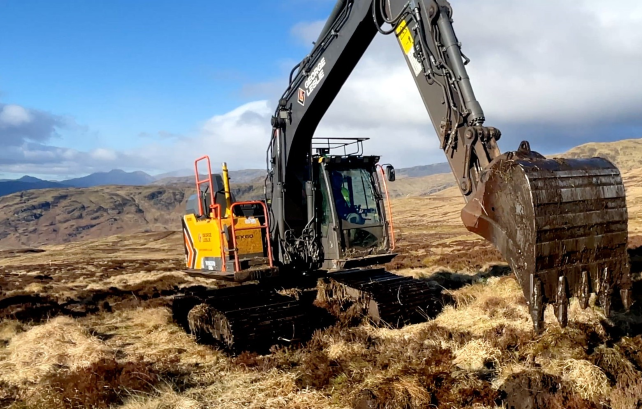
Excavators have been working across the hills surrounding some of Scotland’s most important drinking water reservoirs, filling old drainage channels, reshaping damaged peatland and restoring natural habitats in an effort to protect the water flowing into the country’s public supply.
Scottish Water’s latest environmental report, published on 1 October 2026, records improvements across 733 hectares of land during 2025–26 through restoration and woodland projects associated with its wider net-zero programme. That is an area equivalent to more than 1,000 football pitches.
The work includes projects around Loch Katrine, which supplies drinking water to Glasgow and surrounding communities, and Backwater Reservoir in Angus, which serves approximately 90,000 people.
Although peatland restoration is often discussed in terms of carbon emissions, the work has another practical purpose. The condition of the land surrounding a reservoir can influence the quality, quantity and movement of the water reaching it.
Scottish Water is attempting to improve that landscape before the water enters its treatment and distribution network.
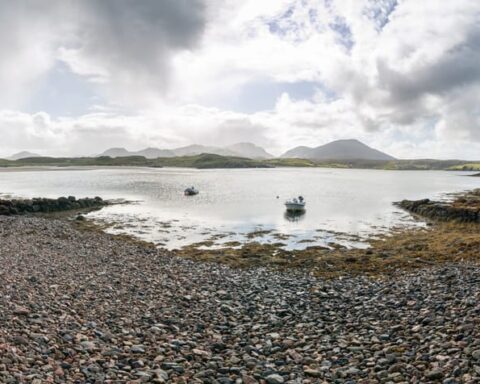
Repairing the Peatlands Above Loch Katrine
At Loch Katrine, a project extending over approximately a decade is intended to restore up to 400 hectares of damaged peatland in the surrounding catchment.
The second phase, completed in May 2026, restored a further 94 hectares following work that began in October 2025.
Contractor George Leslie used excavators to block artificial drainage ditches and reshape damaged peat formations known as peat hags. These exposed banks can develop where peat erodes, leaving bare surfaces vulnerable to further deterioration.
Healthy peatland functions as a water-retaining landscape. Layers of partially decomposed vegetation hold moisture, while the surrounding plant communities help regulate the movement of water through the catchment.
When peatlands are drained or damaged, water can move differently across the ground, exposed peat can erode and organic material can enter streams feeding reservoirs.
Restoration is intended to reverse some of those changes by slowing drainage, encouraging vegetation to recover and reducing the extent of exposed peat.
At Loch Katrine, the work has a direct connection with the drinking water supply. The loch has served Glasgow since the opening of its historic water supply scheme in 1859 and remains an important part of the region’s water infrastructure.
The project therefore combines modern environmental restoration with the maintenance of a water source that has been central to Glasgow’s development for more than a century and a half.
A Larger Project in the Angus Hills
Scottish Water is undertaking another extensive programme in the catchment surrounding Backwater Reservoir, near Glenhead in Angus.
By May 2026, two phases of work had restored 338 hectares of peatland in the surrounding uplands.
A third phase, planned for later in 2026, is intended to address a further 192 hectares. If completed, the three phases would cover approximately 530 hectares.
The utility is also developing plans for a substantially different project on nearby land: the creation of 600 hectares of native woodland under the name Glenhead Water Woods.
Planting is provisionally intended to begin in 2027, subject to the necessary development and approval processes. The woodland proposals should not be confused with work that has already been completed.
Scottish Water held a community information event at Kilry Village Hall in May, allowing residents to examine the proposals and raise questions with the project team.
The woodland scheme is intended to improve habitat, biodiversity and the long-term resilience of the reservoir catchment. Trees and other vegetation can influence surface runoff, soil stability and the way water moves through a landscape.
However, woodland creation requires careful design. The species selected, their location and the relationship between planted areas and existing open habitats can affect the environmental outcome.
The proposed development remains a project under preparation rather than an established new forest.
Why the Land Above a Reservoir Matters
Reservoirs are usually associated with dams, treatment works, pipelines and pumping stations. Yet their operation also depends on the much larger areas of land from which water drains into them.
Rain falling on hillsides, peatlands, woodland and farmland eventually reaches burns and rivers that carry water towards the reservoir.
During that journey, water may collect sediment, dissolved organic matter and other substances from the surrounding landscape.
Land management can therefore influence conditions within the reservoir and the treatment required before water is supplied to customers.
Scottish Water describes its peatland and woodland projects as nature-based approaches to strengthening catchment resilience. Rather than relying exclusively on treatment infrastructure after water has reached a reservoir, the work seeks to improve conditions at the source.
The company expects benefits for water quality, biodiversity, carbon storage and the management of water flows.
Those are intended environmental benefits. The October report does not provide a separate quantified improvement in drinking water quality attributable to the 733 hectares of work, and such an outcome should not be assumed solely from the area restored.
Environmental Work Across Scottish Water’s Estate
The restoration programme forms part of Scottish Water’s broader management of the land and infrastructure associated with its operations.
The publicly owned utility manages an extensive estate, including reservoir catchments, treatment sites and operational land across Scotland.
Its latest Net Zero Routemap update records that peatland restoration, woodland creation and renewable energy projects contributed to an assessed carbon benefit of approximately 10,397 tonnes of carbon dioxide equivalent during 2025–26.
That figure covers several different types of activity. It should not be attributed entirely to the peatland and woodland projects.
During the same period, the company delivered approximately 4.5 gigawatt-hours of electricity savings through efficiency improvements and added renewable electricity generation capacity estimated at 3.88 gigawatt-hours annually.
Scottish Water reported annual operational greenhouse gas emissions of approximately 207,243 tonnes of carbon dioxide equivalent, compared with 223,214 tonnes in the previous year.
The company also acknowledges that further reductions will be more complicated, particularly those associated with wastewater treatment processes, chemicals and its supply chain.
For the restoration projects around Loch Katrine and Backwater, however, the immediate work is physical and visible: drainage ditches being blocked, exposed peat reshaped, damaged ground stabilised and new woodland being planned.
Work That Will Take Years to Show Its Full Effects
Restoring a damaged peatland is not complete simply because an excavator has finished its work.
The longer process depends on vegetation recovering, water levels remaining suitable and the restored ground becoming more stable over time.
Likewise, newly planted woodland will require years of establishment and management before reaching maturity.
The projects around Scotland’s reservoirs are therefore long-term changes to the landscape rather than one-off construction schemes.
At Loch Katrine, another 94 hectares of peatland have already been restored. At Backwater, more than 300 hectares of completed work could be followed by further peatland restoration and a substantial new native woodland.
Scottish Water’s latest figures place those local projects within a wider programme of land improvement covering 733 hectares during 2025–26.
The continuing work illustrates an important part of Scotland’s drinking water system that is rarely visible to the people using it: protecting a public water supply can begin many miles from the household tap, on the hillsides and peatlands where the rain first falls.
Sources
From Peatlands to Power: Net Zero Projects Deliver Benefits Beyond Carbon — Scottish Water, 1 October 2026.
Second Phase of Peatland Restoration Project Completed at Loch Katrine — Scottish Water, 14 May 2026.
Glenhead Woodland Creation and Peatland Restoration — Scottish Water, 2026.
Community Invited to Share Views on Glenhead Woodland Creation Proposals — Scottish Water, 13 May 2026.
Net Zero Emissions Routemap: Year Six Annual Update 2025–26 — Scottish Water, 2026.