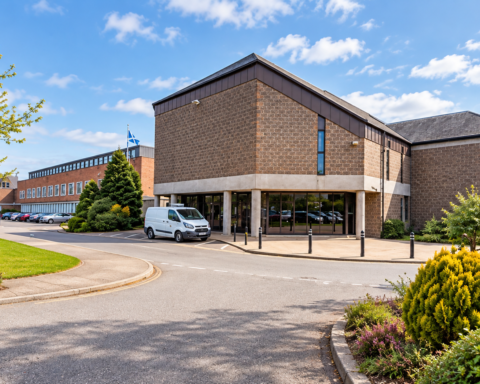

A rat infestation has forced the closure of one of Orkney’s historic public buildings, with damaged pipework, suspected damage inside walls and disrupted wedding bookings leaving Stromness Town Hall facing a possible closure until January 2027.
Orkney Islands Council confirmed the problem on Wednesday, 14 October, after a member of the cleaning staff spotted a rat inside the building last week. Pest-control specialists and building inspectors were called in immediately, but the initial inspection revealed damage requiring more extensive investigation.
The council believes the rodents entered the building relatively recently. However, the discovery has prompted plans to remove kitchen fittings and inspect concealed areas to establish how far the damage extends.
Garry Burton, the council’s Head of Active Communities, said even a small number of rats can cause extensive damage over a short period.
“Initial investigations have found damage to pipework in the kitchen and we suspect there may be some internal damage to the walls as well.”
Pest-control monitoring will continue while council staff examine the building and arrange repairs.
Weddings and Community Events Affected
The closure has immediate consequences for people who use the hall for concerts, celebrations and other local events.
The council has contacted organisations and individuals with existing bookings, including couples planning to marry at the venue. Those affected by upcoming weddings have been offered alternative accommodation at Stromness Academy.
The extent of the disruption will depend on what further investigations uncover. The council has not yet announced a final repair cost or a confirmed reopening date.
Burton said the authority intends to take the opportunity to carry out other minor building work during the closure, with the aim of returning the hall to use in January.
Investigators Must Establish the Extent of the Damage
Although the infestation is thought to be recent, the discovery of damage to pipework has raised concerns about areas of the building that cannot be inspected without removing fittings or opening concealed spaces.
The council has not established how the rodents gained access to the hall or whether the damage extends beyond the kitchen and suspected affected wall areas.
That uncertainty is an important factor in the closure. Removing the immediate infestation will not necessarily resolve the problem if damaged pipework or other affected parts of the building also require repairs.
Staff will continue pest-control monitoring while further investigations are carried out. The council has indicated that the closure also provides an opportunity to undertake other minor maintenance work that might otherwise have caused additional disruption.
For those with events already arranged, the practical issue is the absence of a definite reopening date. January 2027 remains the council’s intended timescale rather than a confirmed date on which the building will be available again.
A Historic Building at the Heart of Stromness
Stromness Town Hall is much more than a municipal building. Its history stretches back to one of the most consequential religious upheavals in nineteenth-century Scotland, and its surviving architecture tells the story of a congregation that established its own place of worship before the building eventually became a centre of public life.
That history begins in 1843, when the Disruption divided the Church of Scotland. The dispute concerned the independence of the church in spiritual matters and the influence exercised over the appointment of ministers. Hundreds of ministers left the established church to form the Free Church of Scotland, accompanied by congregations determined to maintain their chosen religious arrangements.
In Stromness, the Reverend Peter Learmonth, formerly minister of St Peter’s, led approximately 600 members of his congregation into the new Free Church. Their departure was followed by the practical necessity of creating somewhere to worship. By 1844, the congregation had erected a meeting house on the ground now occupied by Stromness Town Hall.
For almost half a century, that earlier building served the congregation. As the nineteenth century drew towards its close, it was replaced by a much more substantial church. The present structure was designed by architect William Robertson and built by Samuel Baikie between 1890 and 1892, becoming known as the North Kirk.
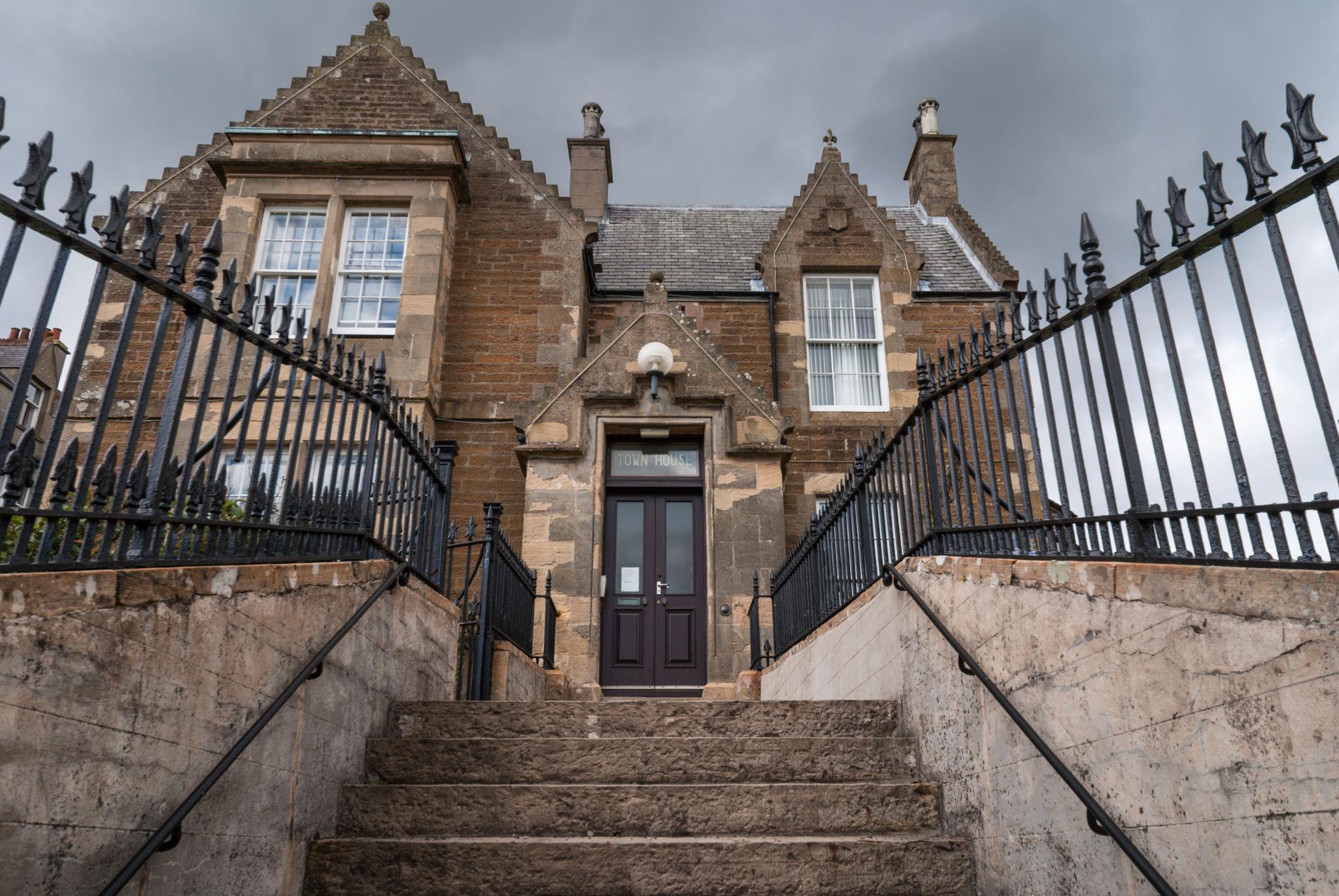
The new church was constructed on ground rising steeply towards the west, giving its architecture a commanding position. Its Gothic design incorporated pointed windows, carved stonework and an imposing three-stage square tower surmounted by an octagonal spire. Battlements and ornamental detailing gave the building a distinctive appearance, while its stone boundary walls and decorative iron railings helped establish its presence within the surrounding streets.
Inside, the church was arranged for a substantial congregation. A U-shaped timber gallery, supported on cast-iron columns, overlooked the main floor. Decorative iron balustrades, carved Gothic woodwork and twin staircases formed part of the interior, while stained-glass windows brought colour into the worship space. The gallery retained high-backed wooden pews, and the building’s architectural record also identifies surviving features associated with the former pulpit and organ arrangements.
These details are particularly significant because the building was not stripped of its entire religious character when its use changed. The removal of ground-floor pews allowed the principal space to accommodate different activities, but the galleries, ornamental features and much of the Victorian craftsmanship remained. The building therefore continued to carry the physical evidence of its original purpose even as new generations began using it for entirely different occasions.
During the twentieth century, the former North Kirk passed from religious use into the civic life of Stromness, becoming the town hall familiar to residents today. Stromness had previously maintained a town hall on Alfred Street, in premises that subsequently became part of Stromness Museum. The town hall’s relocation during the 1920s enabled the Orkney Natural History Society to acquire the former municipal accommodation, helping the museum expand its collections and exhibition space. Its additional gallery opened in February 1931.
The precise date on which the North Kirk itself became the present town hall is not established by the historical accounts consulted, but the transition reflects the changing use of prominent public buildings as Stromness developed. A structure originally raised by a congregation seeking religious independence became a place in which the wider community could gather for concerts, celebrations, ceremonies and public events.
The architectural importance of the former church was formally recognised on 24 March 1998, when it was added to Scotland’s statutory list of buildings of special architectural or historic interest. The Category C designation, recorded by Historic Environment Scotland under reference LB45353, includes the former North Kirk, its outbuilding, boundary walls and railings.
Its role as a public venue continued into the twenty-first century. The hall became associated with musical performances and community celebrations, accommodating audiences of approximately 300 people and providing a setting for weddings and other important occasions. Its Fazioli grand piano and the building’s surviving church interior made it a distinctive venue rather than an ordinary modern assembly hall.
Maintaining a nineteenth-century building for contemporary public use has required continuing investment. Stromness’s 2019 Place Plan identified improvements to facilities and accessibility among local priorities, reflecting the need to preserve the building while ensuring it remained practical for the community.
More substantial refurbishment followed. Work on the hall’s windows and external doors was completed in December 2022. The building subsequently welcomed concerts associated with the Orkney Folk Festival, St Magnus International Festival and Orkney Blues Festival, continuing its longstanding role in the islands’ cultural life.
Further improvements began in October 2023, including the installation of a replacement boiler and heating system, resurfacing of the oak flooring and new carpeting. The work was intended to provide a warmer and more comfortable environment while retaining the hall’s distinctive character.
More than 180 years have now passed since Learmonth’s congregation established its first meeting house, and 134 years since the present North Kirk was completed. Over that period, the building has changed from a place of worship into a centre of Stromness’s civic and cultural life, while retaining much of the craftsmanship and architectural character of its Victorian origins.
The present rat infestation is a very different challenge from those faced by the congregation that built the church, but the repairs will once again form part of the long history of adapting and maintaining the structure for continued public use.
Council Aims for January Reopening
Orkney Islands Council has not confirmed the full extent of the damage or the eventual cost of repairs. Further inspection of concealed areas will be needed before the necessary building work can be fully established.
The immediate priorities remain eliminating the infestation, repairing damaged infrastructure and ensuring the hall is suitable for public use before bookings resume.
For Stromness, the temporary loss of the building means more than the closure of an events venue. It removes access to a gathering place that has occupied an important position in the town for generations, first as the North Kirk and later as a setting for weddings, music and community occasions.
The council hopes the doors will reopen in January 2027, returning the former church to the public life it has served for so long.
Sources
Stromness Town Hall Update — Orkney Islands Council, 14 October 2026.
Church Road, Town Hall, Former North Kirk, Including Outbuilding, Boundary Walls and Railings (LB45353) — Historic Environment Scotland, listed 24 March 1998.
A History of Stromness Museum — Stromness Museum, undated.
Stromness’s Place Plan — Orkney Islands Council, 2019.
Leisure and Culture Annual Impact Reports — Orkney Islands Council.
Stromness Town Hall: Venue Information — Orkney Islands Council, undated.