
A programme intended to replace ageing passenger ferries and rebuild three Clyde harbours has reached an unusual stage. The original strategic case considered three new vessels. The Scottish Government has now confirmed that the number required for Gourock–Dunoon remains under examination.
Scotland is developing a new generation of passenger ferries for one of the busiest and most unusual transport corridors in the country.
The programme covers Gourock, Dunoon and Kilcreggan. It brings together the redevelopment of Gourock harbour, alterations at Dunoon and Kilcreggan and replacement passenger vessels for the two routes crossing the Clyde.
On 2 September 2026, the Scottish Government confirmed that its Outline Business Case has still not determined whether the Gourock–Dunoon passenger service should receive one replacement vessel or two.
The answer followed a parliamentary question from Highlands and Islands MSP Tim Eagle asking directly whether the business case related to construction of one or two vessels for Dunoon.
Connectivity Minister Stephen Flynn said the number of replacement vessels was being considered as part of the overall Outline Business Case and would be reported in due course.
A second answer confirmed that the business case remains under development. Once complete, it will go to Transport Scotland’s Investment Decision Making Board and then to ministers.
There is no confirmed delivery date for the new vessels.
The Government says a timetable will follow approval of the Outline Business Case and Final Business Case.
CalMac is carrying out life-extension work on the existing vessels to maintain operations in the meantime.
The earlier plan assumed three new ferries
Documents released by the Scottish Government in 2025 show how the programme has developed.
The original Strategic Business Case considered upgrades at Gourock, Dunoon and Kilcreggan alongside three new passenger vessels.
Two would replace the vessels operating between Gourock and Dunoon. A third would replace the vessel serving Kilcreggan.
Two procurement approaches were examined.
One involved buying three sister ships through a single procurement, reducing design costs and creating vessels with common characteristics.
The other considered a bespoke vessel for Kilcreggan, potentially reducing operating costs on that shorter route.
When Transport Scotland’s Investment Decision Making Board approved progression from the Strategic Business Case to the Outline Business Case, it required the underlying policy on routes and vessel provision to be confirmed.
A new Community Needs Assessment followed.
That assessment has altered the assumptions around the future service.
The Government reduced the planned Dunoon timetable
The Community Needs Assessment for Cowal and Rosneath was published in September 2024.
Transport Scotland commissioned Stantec to examine what level of service was required on the Gourock–Dunoon and Gourock–Kilcreggan passenger routes.
The work included community engagement, passenger surveys and consideration of future timetables.
Ministers subsequently decided that the Gourock–Dunoon service should operate 27 daily return sailings rather than the 30 previously timetabled.
The reduction was intended to align the service more closely with identified community need while allowing the replacement-vessel programme to concentrate on reliability.
The decision also changed one of the assumptions feeding into the business case.
A ferry fleet is designed around a timetable.
The number of vessels required depends on crossing time, turnaround, operating hours, maintenance requirements, resilience and the frequency the operator is expected to provide.
Transport Scotland is now determining that relationship through the Outline Business Case.
The present Dunoon ferries were bought second-hand
The reliability problem has a specific history.
The existing Gourock–Dunoon vessels were purchased second-hand by David MacBrayne for the passenger ferry contract that began in 2011.
Scottish Government documents state that they were not designed specifically for the route and have proved susceptible to weather disruption.
The Strategic Business Case identified their condition and reliability as the principal reason for replacement.
This differs from parts of Scotland’s wider ferry replacement programme, where vessel age itself is a major driver.
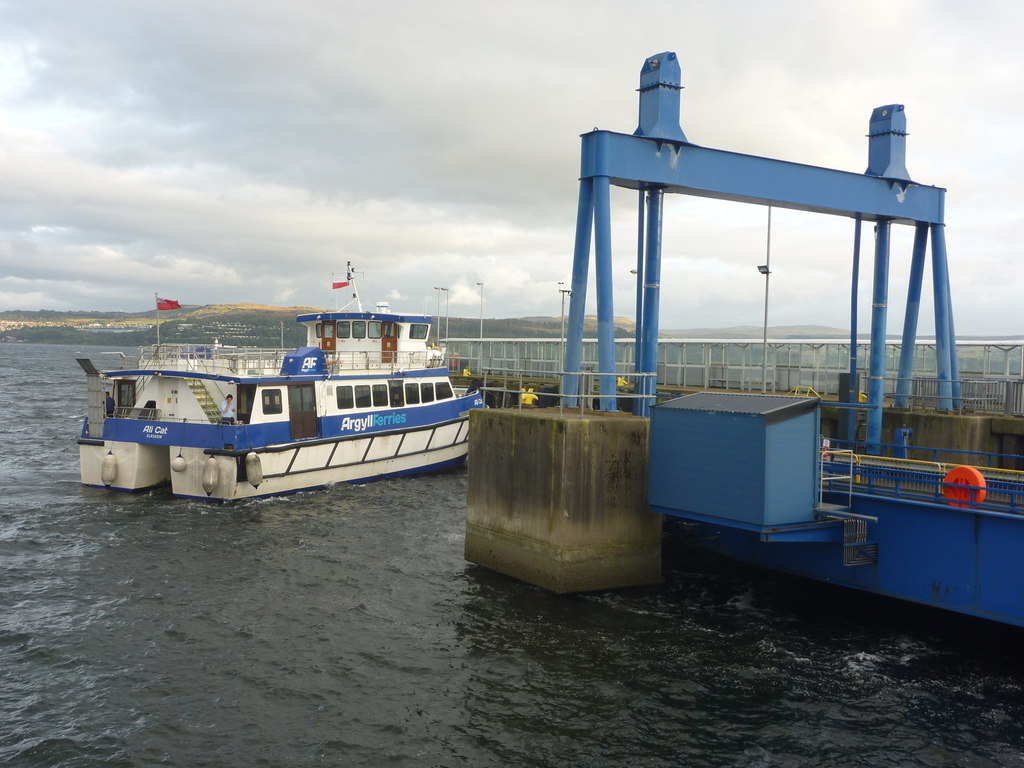
The current Dunoon service operates with MV Ali Cat and MV Argyll Flyer.
Both are passenger-only vessels.
Their replacement is being considered alongside harbour design because vessels and ports have to function as one transport system. Vessel dimensions affect berths, pontoons, passenger access, dredging, breakwaters and manoeuvring requirements.
Gourock–Dunoon was once a car ferry
The present passenger-only service is the result of several decades of competition, subsidy policy and European regulation.
Gourock–Dunoon was historically a passenger and vehicle route within the Caledonian MacBrayne network.
That changed after Western Ferries began operating between McInroy’s Point, near Gourock, and Hunters Quay, north of Dunoon, in 1974.
Western Ferries demonstrated that a vehicle service across the Clyde could operate commercially without public subsidy.
The private operator subsequently expanded its fleet and timetable.
Government policy then encountered an unusual problem.
The state was subsidising a ferry carrying vehicles between Gourock and Dunoon while a private company was carrying vehicles commercially on a broadly equivalent crossing nearby.
During the early 1980s, government concluded that the principal public-service case for subsidy related to foot passengers.
The vehicle element of the town-centre service was expected to operate commercially.
Restrictions were also placed on the subsidised service’s timetable to limit its effect on the private operator.
The arrangement continued through prolonged discussion with the European Commission over state-aid and competition issues.
In 2005, Gourock–Dunoon was separated from the main Clyde and Hebrides ferry contract and tendered as a single route.
The vehicle-carrying town-centre service continued until July 2011.
Since then, the publicly supported route has carried foot passengers only.
Two ferry systems now cross the same stretch of Clyde
The result is a transport arrangement unlike most of Scotland’s ferry network.
CalMac operates the publicly supported passenger service between the town centres of Gourock and Dunoon.
Western Ferries operates commercially between McInroy’s Point and Hunters Quay.
The services do not perform identical functions.
The town-centre passenger ferry connects directly into Gourock railway station, giving Dunoon passengers access to trains towards Glasgow.
Western Ferries carries cars, commercial vehicles, buses, cyclists and foot passengers between terminals outside the two town centres.
For a passenger travelling without a car, the Gourock town-centre terminal provides a direct interchange with the railway.
For vehicles, Western Ferries provides the principal Clyde crossing.
Transport Scotland’s latest published statistics show the scale of the corridor.
Western Ferries carried approximately 1.3 million passengers in 2024.
It also carried around 617,000 cars and 28,000 commercial vehicles and buses.
Transport Scotland records it as the busiest ferry route within Scotland by passenger and vehicle numbers.
The public investment now being designed therefore sits alongside an established privately operated transport business carrying much of Cowal’s road traffic.
The town-centre ferry performs a rail function as well as a maritime one
Gourock station stands immediately beside the ferry terminal.
The railway runs through Inverclyde towards Glasgow Central.
The passenger ferry therefore acts as the missing section of a public-transport journey between Cowal and the central belt.
A resident can travel from Dunoon town centre across the Clyde and continue by rail without using a car.
That relationship has influenced government policy for decades.
A Transport Scotland feasibility study commissioned in 2012 described the policy objective as maintaining a safe, reliable, frequent commuter ferry between Dunoon town centre and the rail terminal at Gourock.
The physical condition of Gourock harbour now forms part of the replacement programme.
Transport Scotland, Caledonian Maritime Assets Limited, CalMac and Argyll and Bute Council are working through a joint Gourock, Dunoon and Kilcreggan programme.
CMAL is responsible for developing the Gourock harbour masterplan and vessel replacement work.
Argyll and Bute Council controls the harbour infrastructure at Dunoon and Kilcreggan.
The programme therefore requires several public bodies to design vessels, terminals and service levels together.
Dunoon harbour itself has to change
Argyll and Bute Council has been developing proposals for Dunoon ferry terminal to accommodate the future passenger vessels.
The preferred concept includes removing the existing linkspan and replacing it with passenger access through a covered gangway to a pontoon.
The harbour would also require dredging.
The existing breakwater is proposed to be extended northwards to provide greater shelter at the ferry berth.
The council says improved shelter should reduce vessel movement at the berth and improve reliability.
The breakwater extension would also provide a berth for the paddle steamer Waverley.
The harbour design is intended to accommodate both existing and future ferries during the transition.
Kilcreggan requires its own infrastructure adjustments for the replacement programme.
The current Kilcreggan vessel, MV Chieftain, is considerably newer than the Dunoon vessels, having been delivered in 2007.
Government documents show that its proposed replacement was driven primarily by accessibility and the possibility of creating greater resilience through interoperability with the Dunoon service.
A common or compatible fleet could allow vessels to substitute for each other when one is unavailable.
One vessel and two vessels create different forms of resilience
The current Outline Business Case is therefore dealing with more than the cost of purchasing another ferry.
A one-vessel Dunoon service would require a different resilience model from a two-vessel service.
Scheduled maintenance, mechanical failure and unplanned repair all remove vessels from operation.
Where a route depends on a single dedicated vessel, another ship must be available elsewhere or the service must be reduced or suspended when that vessel cannot operate.
Two vessels create additional operating capacity but also create additional capital, crewing, maintenance and lifecycle costs.
Interoperability with Kilcreggan could provide another approach if the new vessels are designed to operate across both routes.
The original Strategic Business Case’s consideration of three sister ships reflected that possibility.
The revised timetable and Community Needs Assessment have since altered the parameters being tested.
The Government has not yet published the resulting fleet recommendation.
Scotland is already extending the life of the existing vessels
The absence of a confirmed delivery date means the existing ferries must continue operating while the business-case process proceeds.
CalMac is carrying out life-extension work.
The sequence still includes approval of the Outline Business Case, development and approval of the Final Business Case, procurement, vessel construction, harbour works, trials and entry into service.
New ferries cannot simply be ordered independently of the shore infrastructure because the final vessel design and harbour arrangements have to be compatible.
The same issue has appeared repeatedly across Scotland’s ferry investment programme.
Vessel procurement and port investment operate on different construction timetables but eventually have to meet at the same berth.
Gourock is part of a wider twenty-year ferry investment plan
The Scottish Government’s Vessels and Ports Plan for 2025–2045 sets out a long-term programme for the Clyde and Hebrides and Northern Isles networks.
It includes major vessel replacement, port works and measures intended to increase fleet resilience.
Gourock–Dunoon and Kilcreggan sit partly outside the conventional island-ferry narrative.
Dunoon is connected to mainland Scotland by road through Cowal, and Western Ferries already provides a high-frequency commercial vehicle crossing.
The public passenger route nevertheless performs a specific transport function by connecting the town directly with Gourock and its railway.
The investment decision is therefore being made around the value of that public-transport connection rather than around the absence of any alternative route.
The Community Needs Assessment was commissioned to establish the scale of that requirement before new vessels and harbour infrastructure were committed.
The next document should put a number on the future service
The Outline Business Case remains the point at which the programme’s principal options are being compared.
It will have to bring together future passenger demand, timetable requirements, vessel reliability, resilience, harbour works, capital cost and operating cost.
It will also determine whether the original concept of two Dunoon replacement vessels survives the revised service assessment.
Once the Outline Business Case is complete, it is scheduled to go first to Transport Scotland’s Investment Decision Making Board and then to ministers.
A Final Business Case will still be required before the programme reaches its later delivery stages.
The Government has not given a date for the arrival of new tonnage.
For the moment, Scotland has committed to rebuilding the infrastructure and replacing the vessels, has reduced the future Dunoon timetable, and is extending the life of the existing fleet while the business case determines how many new ferries the route should ultimately receive.
SOURCES
Question S7W-02369: Gourock to Dunoon Ferry Service — Scottish Parliament — Scottish Parliament — answered 2 September 2026 — https://www.parliament.scot/chamber-and-committees/questions-and-answers?msp=17689&page=1
Question S7W-02370: Gourock to Dunoon Ferry Service — Scottish Parliament — Scottish Parliament — answered 2 September 2026 — https://www.parliament.scot/chamber-and-committees/questions-and-answers?msp=17689&page=1
Infrastructure Projects: Gourock, Dunoon, Kilcreggan Programme — Transport Scotland — accessed 3 September 2026 — https://www.transport.gov.scot/public-transport/ferries/infrastructure-projects/
Cowal and Rosneath Community Needs Assessment: Route Baselines — Transport Scotland — 11 September 2024 — https://www.transport.gov.scot/publication/cowal-and-rosneath-community-needs-assessment/route-baselines/
Gourock-Dunoon / Kilcreggan Passenger Ferry Services: Additional Policy Background and Consideration — Scottish Government / Transport Scotland — 2025 — https://www.gov.scot/binaries/content/documents/govscot/publications/foi-eir-release/2025/07-b/foi-202500461009/documents/foi-202500461009—information-released—annex/foi-202500461009—information-released—annex/govscot%3Adocument/Doc%2B001.pdf
The Vessels and Ports Plan for the Clyde & Hebrides and Northern Isles Networks 2025–2045: Investment Plans — Transport Scotland — 2025 — https://www.transport.gov.scot/publication/the-vessels-and-ports-plan-for-the-clyde-and-hebrides-and-northern-isles-networks-2025-2045-islands-connectivity-plan/investment-plans/
Scottish Transport Statistics 2025: Chapter 9 — Water Transport — Transport Scotland