
Transport Scotland’s new Biodiversity Strategy commits the national transport agency to reducing ecosystem loss, increasing habitat connectivity and helping Scotland become nature-positive by 2030. The same organisation remains committed to completing A9 dualling and progressing the A96 towards full dualling — projects whose own environmental assessments record habitat loss, fragmentation, ancient woodland impacts and, in the case of the A96, potential major negative effects on biodiversity.
Transport Scotland published a new Biodiversity Strategy on 2 October with a commitment to place nature more firmly inside the way Scotland’s national transport network is designed, built and maintained.
The strategy says Transport Scotland must reduce ecosystem degradation, protect and restore natural habitats, increase landscape connectivity and avoid approaches that produce negative outcomes for biodiversity.
It acknowledges that transport infrastructure has historically contributed to nature loss through land take, habitat fragmentation, pollution and wildlife collisions.
It also states plainly that new construction and modifications to existing infrastructure can cause habitat loss and severance.
The strategy arrives while Transport Scotland is advancing some of the largest road-building projects in the country.
The Scottish Government remains committed to completing the A9 dual carriageway between Perth and Inverness by the end of 2035. In February it also reaffirmed its intention to continue dualling the A96 between Inverness and Aberdeen, beginning with the Nairn Bypass and further sections east of Inverness as funding permits.
The environmental tension is recorded not by opponents of those roads but by Transport Scotland’s own assessments.
The A96 Assessment Predicts Major Negative Effects From Full Dualling
The Strategic Environmental Assessment prepared for the A96 Corridor Review considered a range of alternatives to full dualling.
For biodiversity, the conclusion on full dualling was severe.
Transport Scotland’s assessment found that the scale of the infrastructure could produce major negative effects on biodiversity, habitats and forestry.
Potential effects include direct habitat loss, land take and fragmentation, as well as indirect effects associated with the location and setting of new infrastructure.
The A96 corridor contains a dense concentration of protected and ecologically sensitive sites.
The environmental assessment identified 43 Sites of Special Scientific Interest, eight Special Protection Areas, seven Special Areas of Conservation, four Ramsar wetland sites, two RSPB reserves, extensive long-established plantation woodland, pockets of semi-natural ancient woodland and areas protected by Tree Preservation Orders within the wider study area.
The assessment warns that some effects could be significant and irreversible, depending upon the final alignment.
It rates the cumulative biodiversity effect of full dualling as major negative.
The Preferred Policy Still Includes A96 Dualling
Those findings did not result in abandonment of the dualling programme.
In February, Transport Scotland confirmed that the Scottish Government remained committed to dualling the A96.
The approach is now phased.
The Government’s preference is to deliver the Inverness-to-Nairn section including the Nairn Bypass, but fiscal constraints mean the bypass is intended to begin first.
The current capital programme allows construction of the A9/A96 Inshes-to-Smithton link road from 2028–29 and the Nairn Bypass from 2029–30, subject to business-case approval and funding beyond the present spending-review period.
Further work is intended between Seafield and Balloch, followed by continued progress eastwards, including development work towards an Elgin bypass.
The policy therefore requires Transport Scotland to pursue road expansion whose own strategic assessment records potentially major biodiversity effects while simultaneously implementing a new agency strategy intended to halt and reverse biodiversity loss.
The Strategy Does Not Make Road Building Illegal
The new Biodiversity Strategy does not create an absolute legal prohibition on infrastructure that damages habitat.
Its Delivery Plan is expressly described as rolling and pragmatic.
Transport Scotland says some actions will depend upon available budgets, partnership working and future policy. Targets can be reviewed and refined as the plan develops.
There is no provision stating that the A9 or A96 must be cancelled if habitat is lost.
The legal framework operates differently.
Under the Nature Conservation (Scotland) Act 2004, every public body exercising functions in Scotland has a duty to further the conservation of biodiversity so far as that is consistent with the proper exercise of its functions.
Transport Scotland is already subject to that duty.
The Natural Environment (Scotland) Act 2026 adds a framework requiring Scottish ministers to set legally binding nature-restoration targets, including targets relating to habitats, species and conditions for nature regeneration.
Those duties sit alongside environmental assessment, protected-site legislation, species protection, planning policy and other statutory requirements applying to individual projects.
The result is not a simple rule under which biodiversity automatically overrides transport policy. It is a growing set of obligations requiring the agency to demonstrate how biodiversity has been considered, avoided, mitigated, restored and, increasingly, improved.
NPF4 Raised the Standard From Mitigation Towards Positive Effects
National Planning Framework 4 changed the policy language surrounding development and biodiversity.
Policy 3 is designed not only to protect biodiversity but to reverse biodiversity loss, strengthen nature networks and secure positive effects from development.
For major developments and projects requiring Environmental Impact Assessment, the policy expects proposals to conserve, restore and enhance biodiversity so that nature is left in a demonstrably better state than without intervention.
Transport Scotland’s new strategy adopts that approach directly.
It says new schemes are now expected to achieve positive effects for biodiversity and that future infrastructure design must go beyond reducing damage where opportunities exist to improve habitat and connectivity.
A Scottish biodiversity metric is being developed to provide a more consistent means of measuring those effects and is expected in 2027.
The A96 Assessment Already Anticipates the New Requirement
The A96 Corridor Review does not treat mitigation as sufficient on its own.
Its environmental recommendations say further project-level assessment should seek to avoid or minimise land take, avoid biologically important sites where possible, maintain wildlife permeability, replace woodland and other notable habitats and integrate nature into new transport infrastructure.
The assessment specifically calls for positive effects for biodiversity and nature-based solutions to be considered as projects move forward.
That creates a design problem rather than a purely legal one.
A road corridor may have an overall strategic assessment of major negative biodiversity effects while individual sections are redesigned, rerouted or accompanied by enough restoration and habitat creation to change their project-level outcome.
The environmental case will therefore be tested section by section rather than through the strategic rating alone.
The A9 Has Been Confronting the Same Problem for More Than a Decade
Environmental constraints have been built into the A9 dualling programme since its earliest design stages.
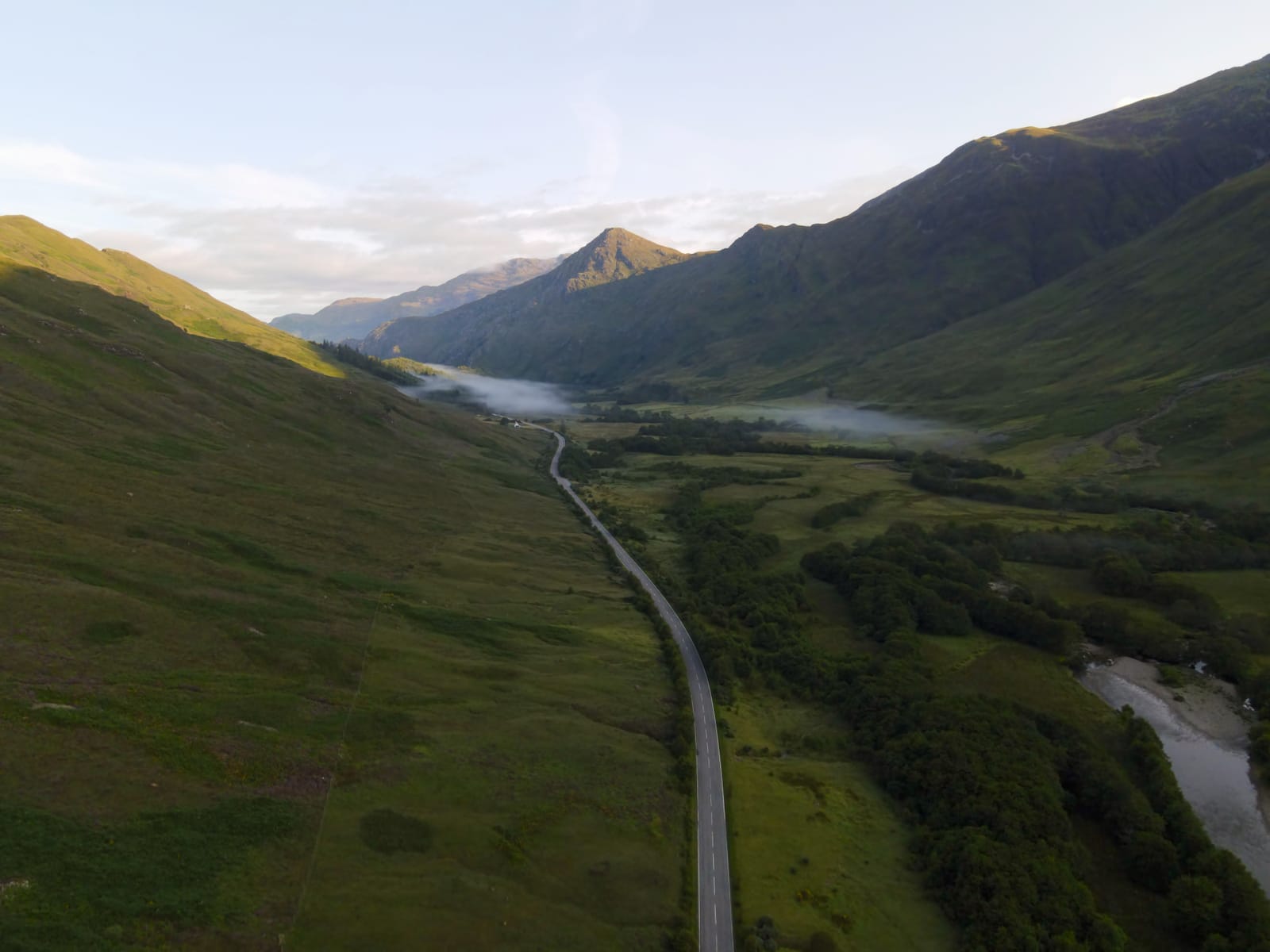
The route between Perth and Inverness runs through areas of exceptional ecological and landscape sensitivity, including the Cairngorms National Park and multiple nationally and internationally protected sites.
Transport Scotland’s Strategic Environmental Assessment, published in 2013, identified land take, woodland fragmentation and disruption to species movement as central biodiversity risks.
The assessment found that widening the existing route could produce adverse effects on ancient woodland and semi-natural ancient woodland, while new offline routes could cause still greater fragmentation.
Some offline options were rejected partly because they would cut through ancient woodland or affect protected habitats more severely than widening the existing corridor.
The environmental process therefore altered the design long before the present Biodiversity Strategy was written.
Ancient Woodland Cannot Simply Be Recreated
The newest A9 environmental material shows the limits of conventional mitigation particularly clearly.
For the Pass of Birnam to Tay Crossing section, Transport Scotland’s Environmental Impact Assessment identifies permanent loss of woodland listed on the Ancient Woodland Inventory.
Replacement planting and habitat creation are proposed.
The assessment says the replacement cannot fully mitigate the biodiversity value and intrinsic importance of the ancient woodland that would be permanently lost.
An adverse residual effect is therefore expected during the period in which replacement woodland establishes.
This is a central difficulty in applying biodiversity-gain policies to major infrastructure.
New woodland can replace tree cover and eventually create habitat. It cannot reproduce centuries of ecological development immediately.
The age, soil structure, fungi, seed banks, deadwood communities and ecological relationships associated with ancient woodland are not recreated simply by planting the same number of hectares somewhere else.
Transport Scotland Says the Birnam Scheme Can Still Produce a Net Positive Outcome
The same environmental assessment reaches a more positive conclusion when the entire mitigation and enhancement package is considered.
Transport Scotland expects the Pass of Birnam to Tay Crossing scheme to result in no net loss of biodiversity resources and ultimately to deliver a positive biodiversity effect.
The proposals include woodland and habitat creation on and off the road estate, management of invasive species, artificial nest and roost sites, mammal fencing and crossing structures.
A new Murthly Estate Bridge is expected to improve habitat connections for species including bats, badgers, pine martens and red squirrels.
Transport Scotland has used a bespoke version of England’s statutory biodiversity metric to estimate gains and losses because Scotland does not yet have its own completed national metric.
The assessment itself acknowledges that Scotland presently has no equivalent legal biodiversity-net-gain framework to England’s statutory scheme.
The result is therefore based on Scottish policy requirements and a project-specific methodology rather than a Scottish statutory percentage target.
A Road Can Damage One Habitat and Improve Another Connection
The ecological effects of transport infrastructure do not all move in the same direction.
A widened road creates a larger physical barrier across a landscape. It can increase the distance animals must cross and increase edge effects on nearby woodland.
But reconstruction also creates opportunities to replace inadequate culverts, add wildlife tunnels, improve river crossings, install mammal passages and restore habitat alongside the carriageway.
The original A9 assessment recognised both effects.
It identified the existing A9 itself as a barrier to species movement and said dualling could provide opportunities to improve permeability through underpasses, culverts, specific wildlife crossings and other structures.
The new Biodiversity Strategy adopts landscape connectivity as one of its four central aims.
The road estate is therefore being treated simultaneously as part of the biodiversity problem and as land through which habitat connections might be rebuilt.
Transport Scotland Controls a Long, Narrow Estate Across the Country
The biodiversity strategy is not limited to new roads.
Transport Scotland manages a national trunk-road estate extending through woodland, peatland, farmland, rivers, mountains and urban areas.
The strategy argues that this linear estate creates opportunities to connect habitats across large distances.
Its Delivery Plan proposes better mapping of ecological assets, restoration of degraded habitats, management of invasive species, improved soil management and more deliberate links between transport land and neighbouring nature networks.
Existing management practices are also being reconsidered.
Roadside vegetation that was historically cut primarily for engineering, safety or appearance can provide habitat if managed differently. Drainage infrastructure can be redesigned as blue-green infrastructure. Woodland can stabilise slopes while also creating ecological connections.
The Rest and Be Thankful is cited by Transport Scotland as one example where native woodland planting contributes both to slope stability and habitat creation.
The Strategy Will Be Written Into Contracts
The new approach reaches beyond policy statements.
Transport Scotland says biodiversity requirements will increasingly be built into contracts and specifications for its contractors and consultants.
Each new road project is expected to have a suitably qualified biodiversity manager or champion reporting into the agency’s biodiversity governance structure.
Existing trunk-road operating companies and design-build-finance-operate concessionaires will also be expected to strengthen biodiversity reporting.
The agency says ecological performance will increasingly be measured through indicators such as species numbers, habitat area and habitat condition, supported by georeferenced records.
That creates an administrative trail through which the strategy can eventually be compared with actual road-estate outcomes.
The First Hard Deadline Is 2030
The timing is significant.
Scotland’s Biodiversity Strategy aims for the country to be nature-positive by 2030 and to have restored and regenerated biodiversity by 2045.
Transport Scotland says its own strategy is intended to contribute to both goals.
The A9 programme, however, continues well beyond 2030.
The Government’s current delivery plan schedules completion of dualling between Perth and Inverness by the end of 2035.
The A96 programme has no comparable final construction date under the current phased approach, although work on the Nairn Bypass is intended to begin in 2029–30.
Scotland will therefore reach its first national nature-positive deadline while major road construction is still under way or preparing to begin.
The A9 Is Now Being Delivered Section by Section to 2035
The original commitment was to dual the A9 between Perth and Inverness by 2025.
That target was missed.
The revised programme now aims for completion by the end of 2035.
Transport Scotland’s 2026 Delivery Plan changed the sequence and funding approach for the remaining sections while retaining the final date.
Work is already progressing on parts of the route, with further sections scheduled to enter construction over the coming years.
This creates an unusual opportunity for the Biodiversity Strategy to influence projects already designed to very different stages.
Some A9 sections have mature environmental assessments and statutory orders. Others remain earlier in procurement or design.
The practical effect of the 2026 biodiversity policy may therefore differ considerably between sections.
The A96 Presents a Larger Strategic Conflict
The A96 is more difficult because Transport Scotland’s own comparison of options found that full dualling performs significantly worse environmentally than a more limited package of interventions.
The Refined Package assessed through the Corridor Review combined bypasses, public transport, active travel, rail freight and road-safety interventions without constructing a continuous dual carriageway from Inverness to Aberdeen.
That package was assessed as having moderate negative cumulative effects on biodiversity.
Full dualling was assessed as major negative.
The same pattern appears across several other environmental topics, including soils, natural resources, water and landscape.
The Scottish Government nevertheless chose to retain the commitment to dualling, delivered in phases.
The biodiversity strategy therefore cannot simply steer Transport Scotland towards the least environmentally damaging strategic option because the strategic transport decision has already been taken politically.
Its influence will instead fall primarily on route design, mitigation, habitat restoration and the manner in which individual sections are delivered.
Protected Sites Still Have Their Own Legal Tests
The new strategy does not replace the existing protections applying to internationally and nationally designated sites.
Special Areas of Conservation and Special Protection Areas remain subject to habitats legislation. Sites of Special Scientific Interest have their own protections. Protected species and ancient woodland require separate consideration through relevant law and policy.
The A96 assessment records that further Habitats Regulations appraisal is required to determine whether proposed interventions could adversely affect the integrity of European protected sites.
The A9 has likewise undergone programme-wide and project-specific habitats assessment.
A biodiversity strategy cannot authorise impacts that would otherwise fail those legal tests.
The New Natural Environment Act Raises the Future Stakes
The Natural Environment (Scotland) Act received Royal Assent in March 2026.
Among its central provisions is a requirement for Scottish ministers to establish statutory nature-restoration targets.
At least one target must be set for habitat condition or extent, species status and the environmental conditions required for nature regeneration.
Those targets will sit above individual public bodies such as Transport Scotland, whose actions contribute to the national result.
The precise targets and metrics will become important when regulations are brought forward.
Until then, the legal biodiversity duty remains framed around public bodies furthering conservation as far as is consistent with their proper functions, rather than meeting a numerical biodiversity target on every individual project.
The Strategy Could Make Future Road Decisions More Evidentially Demanding
The immediate consequence of the new Biodiversity Strategy is unlikely to be a wave of court cases stopping roads.
Its more significant effect may be documentary.
Transport Scotland has committed itself publicly to reducing habitat degradation, increasing connectivity, restoring ecosystems and delivering positive effects from new schemes.
It intends to report annually on progress and through its statutory three-year biodiversity reporting cycle.
It is also building ecological requirements into contracts and establishing more measurable performance indicators.
Future environmental assessments can therefore be compared directly with the commitments Transport Scotland has now made for its estate as a whole.
Where a project causes substantial habitat loss, the agency will increasingly have to demonstrate not only how damage has been reduced but where the claimed positive biodiversity effect is being created, how it is measured and whether it survives over time.
Some Losses Will Remain Even Where the Overall Calculation Is Positive
The Pass of Birnam assessment shows why that scrutiny will be necessary.
Transport Scotland expects a positive overall biodiversity result after mitigation and habitat creation.
The same assessment records permanent ancient-woodland loss that cannot be fully mitigated.
Both statements can be true.
A numerical or landscape-scale biodiversity gain does not mean every individual habitat affected by a road has been replaced with an ecological equivalent.
That is particularly relevant where old woodland, peatland or highly specialised habitats are involved.
The developing Scottish biodiversity metric will have to deal with differences in habitat condition, rarity, replaceability and the long periods required for newly created habitat to mature.
Transport Scotland Has Set Itself a Measurable Test
The agency’s October strategy does not resolve the environmental argument over major road building.
It makes the terms of that argument clearer.
Transport Scotland accepts that transport infrastructure has contributed to habitat loss and fragmentation. It accepts that new schemes can cause further loss. It says development must increasingly leave biodiversity in a better state and that its wider estate should become part of Scotland’s nature recovery.
At the same time, the Scottish Government remains committed to completing the A9 dualling programme and progressing A96 dualling despite environmental assessments recording significant adverse effects.
The test will therefore be visible in the projects themselves.
By 2030, Scotland intends to have halted biodiversity loss. Five years later, the A9 dualling programme is scheduled to be complete. The A96 may still be under construction.
Transport Scotland’s new reporting system is intended to measure the ecological condition of the network throughout that period.
It will eventually show whether habitat creation, restoration and improved connectivity are large enough to offset the continuing biodiversity costs of expanding the road estate — and where losses remain that cannot be recreated elsewhere.
Sources
Transport Scotland Biodiversity Strategy — October 2026
Transport Scotland, 2 October 2026
https://www.transport.gov.scot/publication/transport-scotland-biodiversity-strategy-october-2026/
Transport Scotland Biodiversity Strategy — Delivery Plan
Transport Scotland, 2 October 2026
https://www.transport.gov.scot/publication/transport-scotland-biodiversity-strategy-delivery-plan/
Transport Scotland Biodiversity Strategy — Strategic Aims
Transport Scotland, 2 October 2026
https://www.transport.gov.scot/publication/transport-scotland-biodiversity-strategy-october-2026/chapter-2-strategic-aims/
Transport Scotland Biodiversity Strategy — Governance
Transport Scotland, 2 October 2026
https://www.transport.gov.scot/publication/transport-scotland-biodiversity-strategy-october-2026/chapter-4-governance/
A96 Corridor Review — Strategic Environmental Assessment: Assessment Findings
Transport Scotland
https://www.transport.gov.scot/publication/strategic-environmental-assessment-sea-draft-environmental-report-a96-corridor-review/assessment-findings/
A96 Corridor Review — Mitigation and Enhancement Measures
Transport Scotland
https://www.transport.gov.scot/publication/strategic-environmental-assessment-sea-draft-environmental-report-a96-corridor-review/mitigation-and-enhancement-measures/
Dualling the A96
Transport Scotland, 3 February 2026
https://www.transport.gov.scot/news/dualling-the-a96/
A96 Inverness to Nairn Including Nairn Bypass
Transport Scotland, current 2026
https://www.transport.gov.scot/projects/a96-dualling-inverness-to-aberdeen/a96-inverness-to-nairn-including-nairn-bypass/
A9 Dualling Delivery Plan Update
Transport Scotland, 4 February 2026
https://www.transport.gov.scot/news/a9-dualling-delivery-plan-update/
A9 Dualling Programme — Strategic Environmental Assessment Non-Technical Summary
Transport Scotland, 24 July 2013
https://www.transport.gov.scot/publication/a9-dualling-programme-strategic-environmental-assessment-non-technical-summary/
A9 Pass of Birnam to Tay Crossing — Environmental Impact Assessment: Biodiversity
Transport Scotland, 2026
https://www.transport.gov.scot/publication/environmental-impact-assessment-report-pass-of-birnam-to-tay-crossing-a9-dualling/volume-1-chapter-12-biodiversity/
Nature Conservation (Scotland) Act 2004
Scottish Parliament, 2004
https://www.legislation.gov.uk/asp/2004/6/contents
Natural Environment (Scotland) Act 2026
Scottish Parliament, 2026
https://www.legislation.gov.uk/asp/2026/6/contents
Biodiversity: Planning Guidance
Scottish Government, 17 December 2025
https://www.gov.scot/publications/scottish-government-planning-guidance-biodiversity/
Scottish Biodiversity Strategy to 2045: Tackling the Nature Emergency in Scotland
Scottish Government
https://www.gov.scot/publications/scottish-biodiversity-strategy-2045-tackling-nature-emergency-scotland-2/