
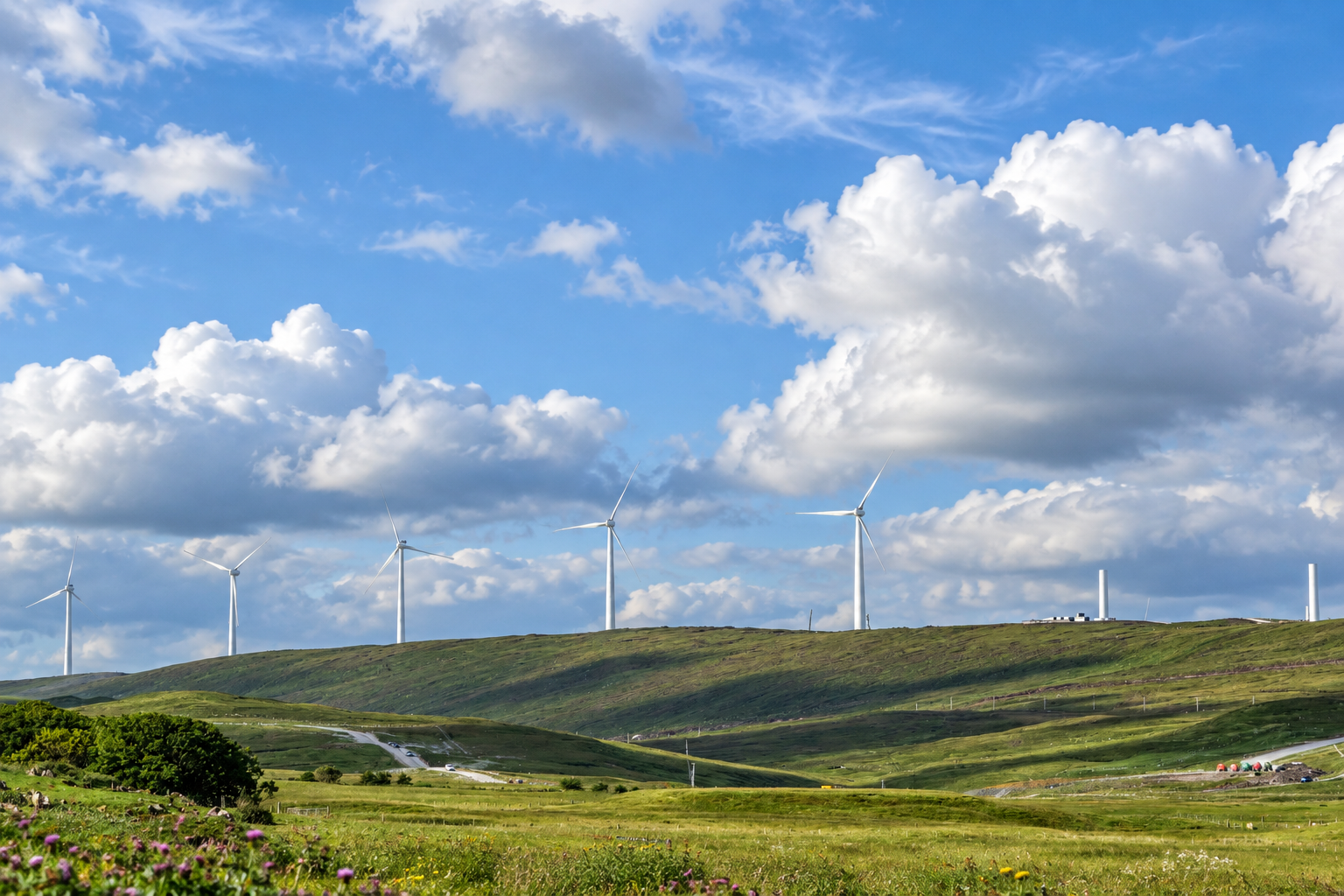
Shetland Islands Council has cut its forecast rental income from the 103-turbine Viking wind farm by £150,000. The adjustment provides an early measure of how money from the £580 million development is moving through council rent, community benefit, local taxation and the wider electricity system.
Shetland Islands Council expects to receive £550,000 from the Viking wind farm in 2026-27, £150,000 less than the £700,000 it included in this year’s budget.
The revised figure emerged during a meeting of the council’s Policy and Resources Committee on 14 September. The council owns the Busta Estate, where 18 of Viking’s 103 turbines are located, and receives commercial ground rent under a long-term land agreement.
The rent contains a fixed annual element of about £177,000 and a further payment linked to wind-farm production.
The first operating figures emerged in 2024-25, when Viking was generating commercially for only part of the financial year. Council records subsequently showed £277,000 of production-related income for that period.
For 2025-26, the first full financial year after commercial generation began, the council initially estimated that the production-linked payment would be about £400,000. Added to the fixed rent of roughly £177,000, that produced an expected total of about £577,000. The amount ultimately received was approximately £550,000.
When the council prepared its 2026-27 budget, it increased the expected Viking rental income to £700,000. Finance officers have now revised that forecast back to £550,000, telling councillors that the higher budget figure had been set when limited information was available about the production-linked element of the agreement.
The £150,000 difference is therefore between the council’s original 2026-27 budget assumption and its latest forecast. It is not money that had already been received and subsequently lost.
The rental income is separate from Viking’s community-benefit payments. Part of the land arrangement is also understood to be shared with crofting tenants using the Busta Estate.
More Than £2 Million a Year Goes Through a Separate Community Fund
Viking’s principal community-benefit agreement provides £2,214,500 a year to the Shetland Community Benefit Fund, with the amount index-linked over the operating life of the wind farm.
The agreement took effect when commercial generation began in September 2024. It followed a construction-period arrangement under which £400,000 a year was provided between 2020 and 2024.
The money is administered independently by the Shetland Community Benefit Fund and distributed to projects across the islands.
By April 2026, the fund said more than £2 million had been awarded to projects under its strategic priorities. Support has gone to community buildings, training, youth work, local development posts and household energy-efficiency measures. A further £225,000 was distributed through its community grant scheme during the 2025-26 fund year.
SSE Renewables describes the community-benefit commitment as being worth around £72 million over an assumed 25-year operating life when indexation is included.
Viking Has Also Changed Shetland’s Rates Base
The project has produced another financial effect through non-domestic rates.
Scottish Government figures published this year show Shetland Islands Council retained £1,705,381 through the Non-Domestic Rates Incentivisation Scheme for 2024-25.
The government specifically identified the addition of Viking Energy Wind Farm LLP as the reason for the unusually large increase in Shetland’s tax base. Viking was listed with a rateable value of £9.525 million.
The £9.525 million is the valuation used within the business-rates system rather than an annual payment to the council. The £1.705 million represents Shetland’s retention under the Scottish Government scheme following growth in its non-domestic-rates base.
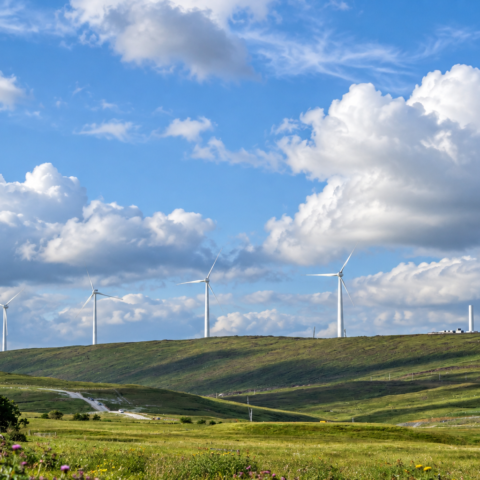
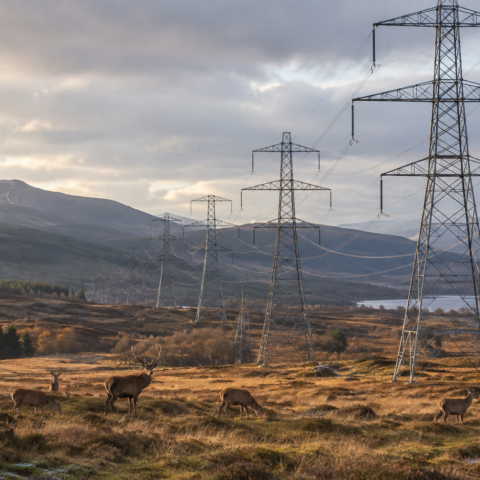
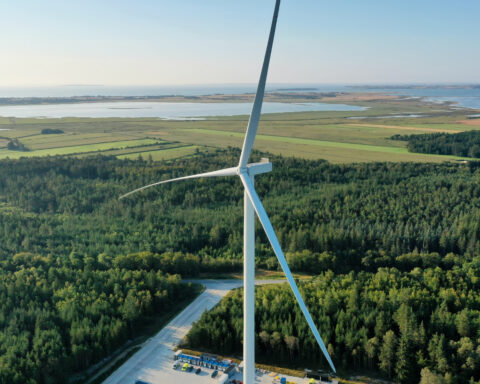
Viking itself is a 443MW development completed in September 2024 at a stated cost of £580 million. Its 103 turbines are connected to the wider British electricity system by the 600MW subsea transmission link between Shetland and Caithness.
SSE estimates that the wind farm can produce around 1.8 terawatt-hours of electricity in a typical year.
Nearly £28 Million Recorded in Constraint Payments
Renewable Energy Foundation data compiled from the electricity Balancing Mechanism records approximately £28.1 million in constraint payments associated with Viking since the wind farm entered operation.
Its figures show £9.329 million in 2024, £9.649 million during 2025 and £9.112 million during 2026 up to 10 September.
Constraint payments arise when the electricity network cannot safely move all the power being generated in one part of Britain to the places where it is required.
The National Energy System Operator can instruct generators to reduce output through the Balancing Mechanism. Generators may then receive payments associated with reducing production while generation is increased elsewhere on the system.
The presence of the 600MW Shetland transmission link does not mean that electricity leaving the islands can always continue through the wider Scottish and British network without restriction.
Large quantities of wind generation are concentrated in northern Scotland, while much of Britain’s electricity demand lies farther south. Transmission capacity between those areas can become constrained when generation is high.
There is no evidence in the material examined that Viking has breached the rules governing constraint payments. The figures record the consequences of operating substantial new generating capacity within a transmission network where reinforcement remains under construction.
Shetland Is Changing What It Expects From Future Energy Projects
Many of Viking’s agreements were negotiated years before the turbines entered commercial service.
Since then, Shetland has developed a more formal approach to the economic return it expects from large energy developments.
In December 2024, Shetland Islands Council endorsed the A Fair Share for Shetland report produced by its Energy Transition Task Force.
The work examined community benefit, local and shared ownership, compensation, commercial returns and taxation. It also considered whether calculating community benefit primarily according to installed generating capacity adequately reflects the value of projects operating in places with unusually productive renewable resources.
Shetland’s wind conditions allow turbines to generate particularly high volumes of electricity. The report examined how arrangements linked to actual production or revenue can produce a different local return from payments based primarily on installed capacity.
That work has since developed into the Shetland Development Charter, approved by councillors in July 2026.
The charter sets expectations for companies proposing major developments in the islands, including community benefit, local ownership opportunities, supply-chain participation, housing and wider economic contribution.
The first developer signed the charter on 1 September, with proposals including a local electricity discount, a minimum 5% community-ownership opportunity and measures intended to increase local participation in the project supply chain.
Viking predates that framework.
Its first full years of operation are now producing an operating record of the money associated with the development. For 2026-27, Shetland Islands Council currently expects £550,000 in commercial rent rather than the £700,000 entered in its budget. More than £2.2 million a year is flowing through the separate community-benefit agreement, while the project has also materially enlarged Shetland’s non-domestic-rates base.
As further energy developments are proposed around Shetland, those figures provide a measurable record against which the islands’ newer arrangements for community benefit, ownership and local economic return can be assessed.
Sources
SIC projecting £550k income from Viking wind farm this year
Shetland News, 14 September 2026
https://www.shetnews.co.uk/2026/09/14/sic-projecting-550k-income-viking/
SIC set to receive more than £500k this year from hosting wind turbines on land
Shetland News, 6 January 2026
https://www.shetnews.co.uk/2026/01/06/sic-set-receive-500k-year/
Land owners receive first Viking Energy rent payment
Shetland News, 12 April 2021
https://www.shetnews.co.uk/2021/04/12/land-owners-receive-first-viking-energy-rent-payment/
Viking Wind Farm and Related Projects
Shetland Islands Council
https://www.shetland.gov.uk/planning-building/viking-wind-farm-related-projects
About the Shetland Community Benefit Fund
Shetland Community Benefit Fund
https://www.scbf.org.uk/about
Over £2 million awarded to projects supporting Shetland communities through the Viking Community Fund
Shetland Community Benefit Fund, 2026
https://www.scbf.org.uk/news/over-2-million-awarded-to-projects-supporting-shetland-communities-through-the-viking-community-fund
£225,000 shared between community projects
Shetland Community Benefit Fund, 2026
https://www.scbf.org.uk/news/225-000-shared-between-community-projects
Viking Wind Farm
SSE Renewables
https://www.sserenewables.com/onshore-wind/great-britain/viking/
Local Government Finance Circular 5/2026: Non-Domestic Rates Incentivisation Scheme 2024 to 2027
Scottish Government, 2026
https://www.gov.scot/publications/local-government-finance-circular-5-2026-non-domestic-rates-incentivisation-scheme-ndris-2024-to-2027/
Balancing Mechanism Wind Farm Constraint Payments — Viking
Renewable Energy Foundation, data updated 10 September 2026
https://www.ref.org.uk/constraints/index.php?dir=asc&order=4&tab=yr&wf=VKNG
What are constraint payments?
National Energy System Operator
https://www.neso.energy/energy-101/electricity-explained/how-do-we-balance-grid/what-are-constraints-payments
A Fair Share for Shetland
Shetland Islands Council, December 2024
https://www.shetland.gov.uk/climate-change/fair-share-shetland
Shetland Islands Council approves the Shetland Development Charter
Shetland Islands Council, 1 July 2026
https://www.shetland.gov.uk/news/article/3962/shetland-islands-council-approves-the-shetland-development-charter
First company signs up to the Shetland Development Charter
Shetland Islands Council, 1 September 2026
https://www.shetland.gov.uk/news/article/3985/first-company-signs-up-to-the-shetland-development-charter