
A wind farm near Lairg will become the first project in Britain to use GE Vernova’s Cypress turbine. Its blades can be transported in separate sections and assembled closer to the wind farm, addressing a problem created by the increasing physical scale of modern onshore wind.
A new generation of wind turbine is coming to the Scottish Highlands.
On 3 September, GE Vernova announced an agreement with Irish energy company ESB to supply 16 Cypress turbines for Chleansaid Wind Farm, approximately 13 kilometres north-east of Lairg in Sutherland.
The 96MW project will be the first wind farm in the United Kingdom to use GE Vernova’s Cypress platform.
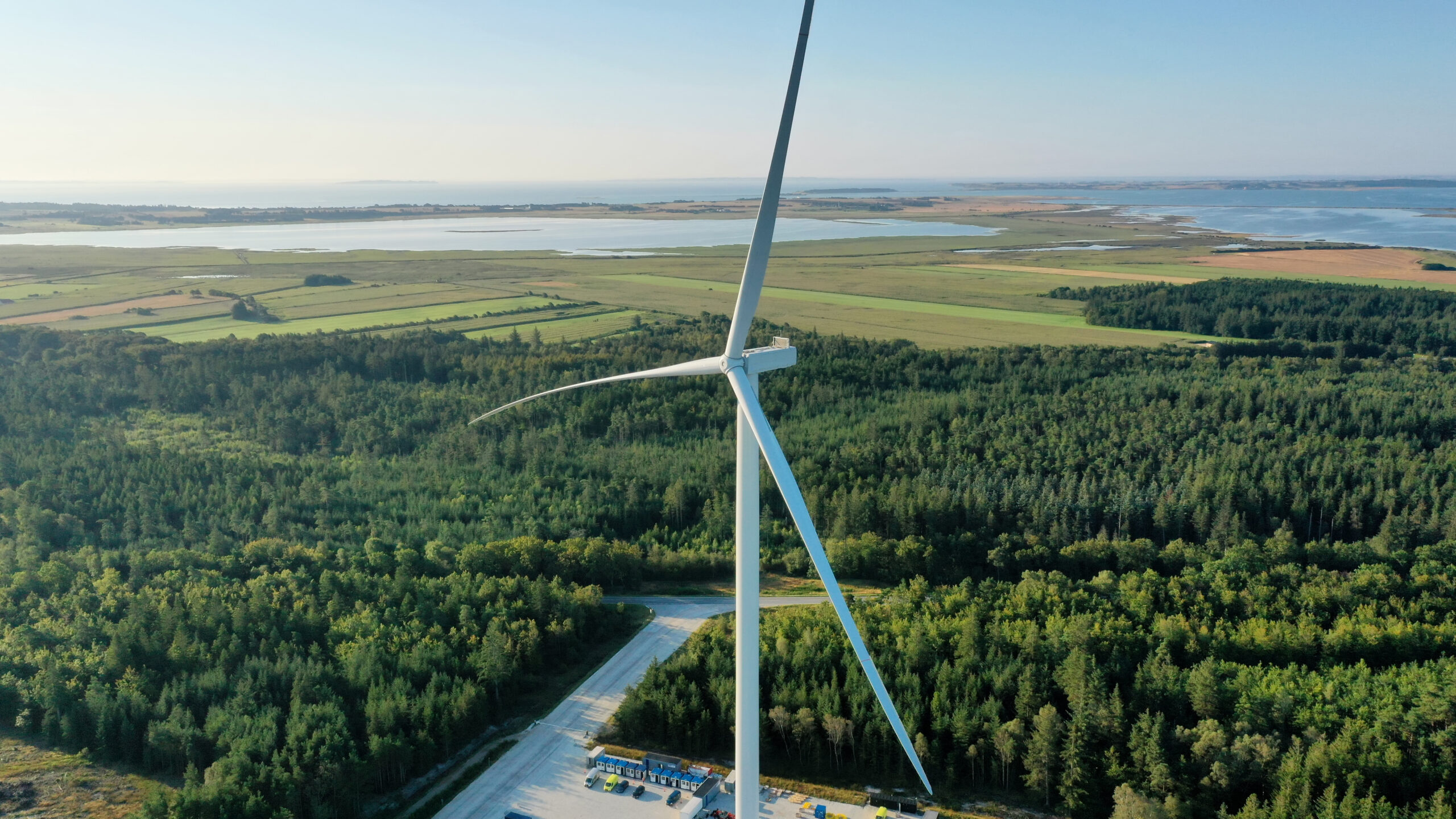
Each machine will have a generating capacity of 6.1MW and a rotor diameter of 158 metres.
The turbines will be manufactured in Germany.
The technology arriving in Sutherland contains an unusual engineering feature. Instead of manufacturing each turbine blade as one continuous structure that must be transported intact from factory to wind farm, the Cypress blade can be manufactured and transported in two sections.
The sections are subsequently joined as part of the turbine installation process.
The reason is partly electricity generation and partly geography.
Wind turbines have become larger because larger rotors can sweep a greater area of air. Longer blades can capture more energy, including at lower wind speeds, allowing each turbine to produce considerably more electricity than earlier generations of onshore machines.
But every increase in blade length creates another engineering problem before the turbine reaches the wind farm.
The blade has to get there.
A wind turbine begins its journey on ordinary infrastructure
Modern wind farms are usually built in places selected for their wind resource, environmental suitability, land availability and access to the electricity system.
Those places are not necessarily close to ports, motorways or industrial transport corridors.
In the Highlands, turbine components may have to travel considerable distances through road networks designed decades or centuries before the components existed.
A turbine blade is not particularly heavy compared with some industrial loads. Its length creates the difficulty.
Junctions, roundabouts, bridges, retaining walls, road signs, street furniture, overhead cables and sharp bends can determine whether a component can physically reach a site.
Wind farm developers therefore carry out abnormal-load route assessments before construction.
Road modifications can be required. Temporary works may be needed at corners. Signs and barriers can be removed and replaced. Vegetation may have to be managed. Traffic can require temporary control while turbine components pass.
The larger the rotor becomes, the more difficult this calculation can become.
GE began developing Cypress partly in response to that constraint.
The idea behind Cypress dates to 2017
GE announced the first turbine in what became the Cypress platform in September 2017.
The early machine was rated at 4.8MW and used a 158-metre rotor.
The platform was developed during a period when the onshore wind industry was increasing turbine output while attempting to reduce the cost of electricity generated over the life of a project.
GE and its blade manufacturer LM Wind Power developed a two-piece blade intended to allow a larger rotor to reach sites where transporting an equivalent single-piece blade could be difficult.
The first 5.3MW Cypress prototype was installed at Wieringermeer in the Netherlands in late 2018 and began producing electricity in February 2019.
GE described the split blade at the time as a means of opening locations that larger turbines might otherwise be unable to reach.
The technology subsequently moved into commercial production.
In 2020 GE announced a 6MW version of the Cypress platform using the same principle.
The machines ordered for Chleansaid are rated at 6.1MW and use a 158-metre rotor.
GE Vernova says more than 1,800 turbines from its 6MW product family have now been deployed internationally and have accumulated more than 38 million operating hours.
Britain has not previously used the Cypress turbine.
Chleansaid has been developing for six years
The project itself predates this week’s turbine announcement.
Environmental surveys began in February 2020.
Two temporary meteorological masts were approved later that year to measure the wind resource.
Environmental Impact Assessment work continued through the pandemic, with some field surveys temporarily suspended during the first Covid restrictions and desk-based work continuing.
Public consultation followed in 2021.
ESB submitted the formal Section 36 application to the Scottish Government in March 2022.
The application proposed 16 turbines: 12 with maximum blade-tip heights of 200 metres and four with maximum heights of 180 metres.
It also included approximately 20MW of battery energy storage.
Scottish ministers granted consent on 15 December 2023.
The consent allows construction and operation for 35 years.
Chleansaid is located on Dalnessie Estate near the junction of the A836 and A838.
It should not be confused with an earlier Dalnessie Wind Farm proposal on a different part of the estate, which was discontinued in 2014. ESB says the two projects are unrelated.
The project has now crossed from development into construction
On 2 September 2026, one day before GE Vernova announced the turbine order, ESB confirmed that it had reached Final Investment Decision on Chleansaid.
The company has executed the principal construction contracts.
GE Vernova will supply the turbines and provide service support under a 20-year agreement.
Kirby Group will deliver the electrical balance of plant.
Farrans Construction will deliver the civil balance of plant, including the infrastructure required around the turbines.
Construction is expected to begin later in 2026.
Commercial operation is targeted for 2028.
ESB owns the project outright.
It is the company’s first wholly developed onshore wind project in Scotland and the first project to reach construction from an ESB pipeline of approximately 2GW of onshore wind opportunities under development across Scotland and Wales.
Chleansaid has also secured a 15-year Contract for Difference.
The CfD gives the project a long-term electricity revenue framework rather than leaving all of its future income exposed directly to wholesale market prices.
Sixteen turbines will produce 96MW
The generating capacity illustrates how far onshore wind technology has moved.
Sixteen 6.1MW machines produce a nominal total slightly above 97MW, while ESB describes the consented project as a 96MW wind farm.
Earlier commercial wind farms in Scotland required substantially larger numbers of turbines to reach comparable capacities.
Scotland’s first commercial wind farm, Hagshaw Hill in South Lanarkshire, opened in 1995 with 26 turbines and a total capacity of 15.6MW.
Each original Hagshaw turbine was rated at 600kW.
A single Cypress machine ordered for Chleansaid therefore has roughly ten times the rated capacity of one of those first-generation Scottish turbines.
That comparison does not mean one modern turbine simply replaces ten old turbines in every circumstance. Wind conditions, turbine availability, rotor size, grid connection and capacity factor all affect actual electricity production.
It does show the scale of technological change over three decades.
Scotland’s earliest commercial wind farms were built with turbines measured in hundreds of kilowatts.
The next generation is measured in multiple megawatts per machine.
The turbines have become taller as well as more powerful
Generating capacity is only one part of the change.
Modern turbines reach higher into the atmosphere and sweep a much larger area with their blades.
The Cypress machines at Chleansaid will use a 158-metre rotor.
A rotor of that diameter sweeps an area of approximately 19,600 square metres.
The project’s planning consent permits maximum blade-tip heights of 200 metres for most of the turbines.
That physical scale changes both performance and infrastructure requirements.
A larger swept area allows the turbine to intercept more moving air.
Higher towers can reach wind conditions different from those nearer the ground.
But larger machines require larger foundations, cranes capable of greater lifts, suitable construction compounds and transport arrangements for longer components.
The split blade addresses one part of that chain.
The blade is not simply cut in half
A wind turbine blade is a highly engineered composite structure.
It must remain sufficiently light to rotate efficiently while withstanding repeated loading over millions of operating cycles.
It experiences changing aerodynamic forces, gravity, vibration, rain, temperature variation and extreme weather.
A joint introduced into that structure has to transmit those loads through the blade while maintaining the required structural performance over its operating life.
The Cypress design was developed by GE Renewable Energy, LM Wind Power and GE Research.
When the first prototype entered operation in 2019, GE said the technology drew on decades of blade-manufacturing experience.
The two sections are manufactured as parts of a blade system rather than an ordinary blade being divided after manufacture.
The design allows the sections to travel separately and be assembled for operation.
Transport becomes one of the design parameters of the turbine itself.
Scotland’s geography is part of the engineering problem
The technology has particular relevance to Scotland because a large share of the country’s onshore wind resource lies away from major industrial roads.
The Highlands contain long stretches of single carriageway, bridges, settlements and road alignments that were never designed around components approaching modern turbine dimensions.
Wind development has already required extensive route planning throughout rural Scotland.
Some projects require abnormal loads to travel from ports through several council areas before reaching their final site.
Transport constraints can influence turbine selection during development.
A project may have sufficient wind resource and land for a larger rotor while the practical route to the site limits the equipment that can be delivered.
Split-blade technology changes that equation by reducing the length of the individual blade sections moved along the road.
It does not eliminate abnormal-load transport.
Tower sections, nacelles, transformers, cranes and other large components still have to reach the wind farm.
Road suitability remains part of construction planning.
The technology removes one of the more difficult dimensions from the longest component.
The turbines will be made in Germany
The Chleansaid order also shows the geography of the wind industry’s supply chain.
GE Vernova says the turbines will be manufactured in Germany.
The wind farm will stand in Sutherland.
It will be owned by ESB, the Irish state-owned electricity company.
Its turbine supplier is GE Vernova, a US-headquartered global energy company.
Its civil construction contractor, Farrans, operates across Britain and Ireland.
Kirby Group will deliver the electrical infrastructure.
This is characteristic of modern renewable infrastructure: the generating asset may be Scottish in location while ownership, manufacturing, engineering and finance cross several countries.
The economic value retained locally therefore depends on more than the headline investment or installed megawatts.
Construction contracts, accommodation, haulage, civil works, maintenance, local procurement, business rates and community arrangements form separate parts of the economic footprint.
ESB says local companies will be encouraged to tender for construction opportunities where possible.
The community fund could run for 35 years
ESB has committed to a community benefit fund based on £5,000 per installed megawatt.
At the project’s planned capacity, the company has previously estimated a fund of up to approximately £500,000 a year.
Across a 35-year operating life, that could amount to approximately £17.5 million under the assumptions published during development.
The final arrangements will depend on the operating project and the community benefit structure adopted.
ESB has also offered discussion of community shared ownership.
Shared ownership differs from a community benefit payment.
A community benefit fund is a payment associated with the development.
Shared ownership involves a community acquiring an economic interest in the generating asset and receiving returns associated with that ownership.
ESB’s project material states that it is willing to discuss such an arrangement if local communities wish to pursue it.
The landscape around the turbines is part of the consent
The project sits within Highland peatland and upland habitat.
Its environmental assessment consequently covers more than the turbine positions.
ESB has committed to peat management and habitat management associated with the development.
Measures considered during project development included peatland restoration, native woodland planting and habitat work for protected species.
Those measures can extend beyond the direct footprint of turbine foundations and access tracks.
The project therefore combines two forms of engineering: construction of the generating infrastructure and management of the land altered during construction and operation.
The environmental obligations remain in place regardless of the turbine technology selected after consent.
The first British Cypress turbines are arriving after the technology has already matured elsewhere
Britain is not acting as the experimental site for the basic Cypress platform.
The first prototype was operating in the Netherlands in 2019.
GE Vernova now reports more than 1,800 turbines from its 6MW family operating internationally.
The Scottish project is instead the first deployment of that established platform in the UK.
That timing reflects the long development cycle of wind farms.
A turbine technology can move from prototype to commercial deployment internationally while individual Scottish projects continue through environmental assessment, consultation, consent, electricity-market auctions, financing and procurement.
Chleansaid began environmental work in 2020.
It applied for consent in 2022.
Consent followed in 2023.
Final Investment Decision came in September 2026.
Generation is expected in 2028.
The eight-year period from initial environmental work to planned operation is part of the infrastructure timetable behind a modern wind farm.
Scotland’s next wind farms may use fewer machines to produce more electricity
The history of Scottish wind power has been accompanied by a steady increase in turbine scale.
That changes the appearance of projects as well as their economics.
Fewer high-capacity turbines can sometimes deliver generating capacity that once required many more smaller machines.
The trade-off is that each machine becomes physically larger.
That changes visual effects, aviation considerations, construction requirements and transport.
Technology is now adapting to those constraints.
The Cypress split blade is one example.
Rather than limiting the rotor solely to what can be transported as a single object, the manufacturer redesigned the blade around the journey to the wind farm.
Chleansaid will be the first place in Britain where that approach becomes part of an operating wind project.
Thirty years after Scotland’s first commercial wind farm began generating with 600kW machines, Sutherland is preparing for turbines rated at more than 6MW each.
The increase in power has been accompanied by an increase in physical scale.
For the next generation of Scottish wind farms, the roads leading to the turbines are now part of the technology problem.
SOURCES
GE Vernova Signs Agreement to Supply Turbines for ESB’s Chleansaid Wind Farm in Scotland — GE Vernova — 3 September 2026 — https://www.gevernova.com/news/press-releases/ge-vernova-signs-agreement-supply-turbines-esbs-chleansaid-wind-farm-scotland
ESB Reaches Final Investment Decision and Executes Construction Contracts for Chleansaid 96MW Wind Farm in Scotland — ESB — 2 September 2026 — https://esb.ie/news—insights/press-releases/article/2026/09/02/esb-reaches-final-investment-decision-and-executes-construction-contracts-for-chleansaid-96mw-wind-farm-in-scotland
Chleansaid Wind Farm — Application ECU00002031 — Scottish Government Energy Consents Unit — application received 30 March 2022;