
 The sea, the weather and the extraordinary light of Scotland’s western islands have inspired generations of artists. For Ellis O’Connor, who grew up on Uist in the Outer Hebrides, those landscapes have become the foundation of a distinctive approach to painting that is attracting increasing recognition.
Her latest exhibition, Deep Time, Inner Space, opened at Glasgow’s Annan Gallery on 31 October and continues until 22 November 2026.
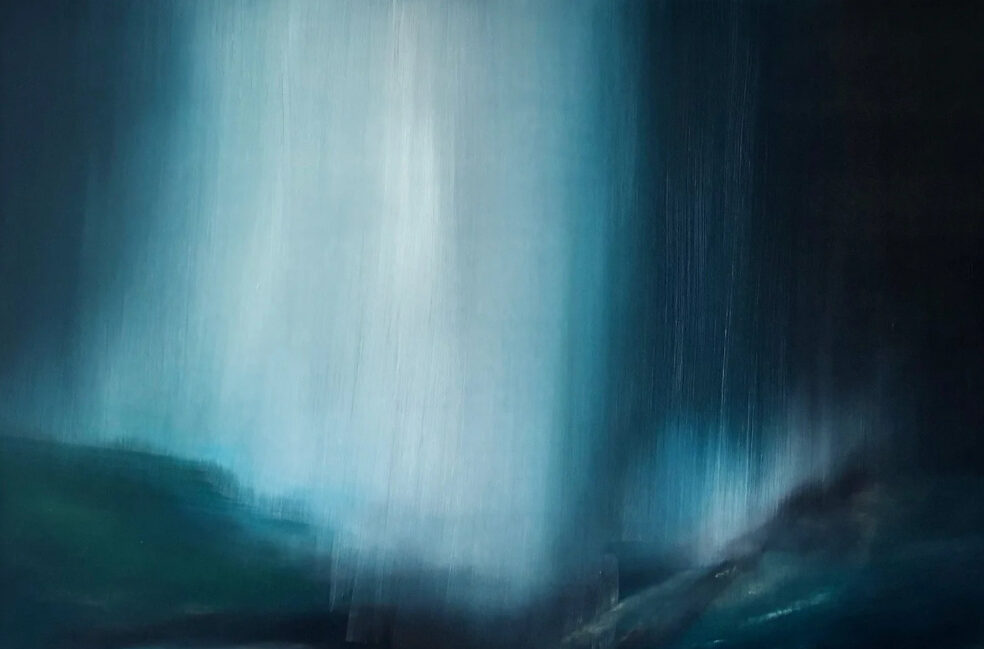
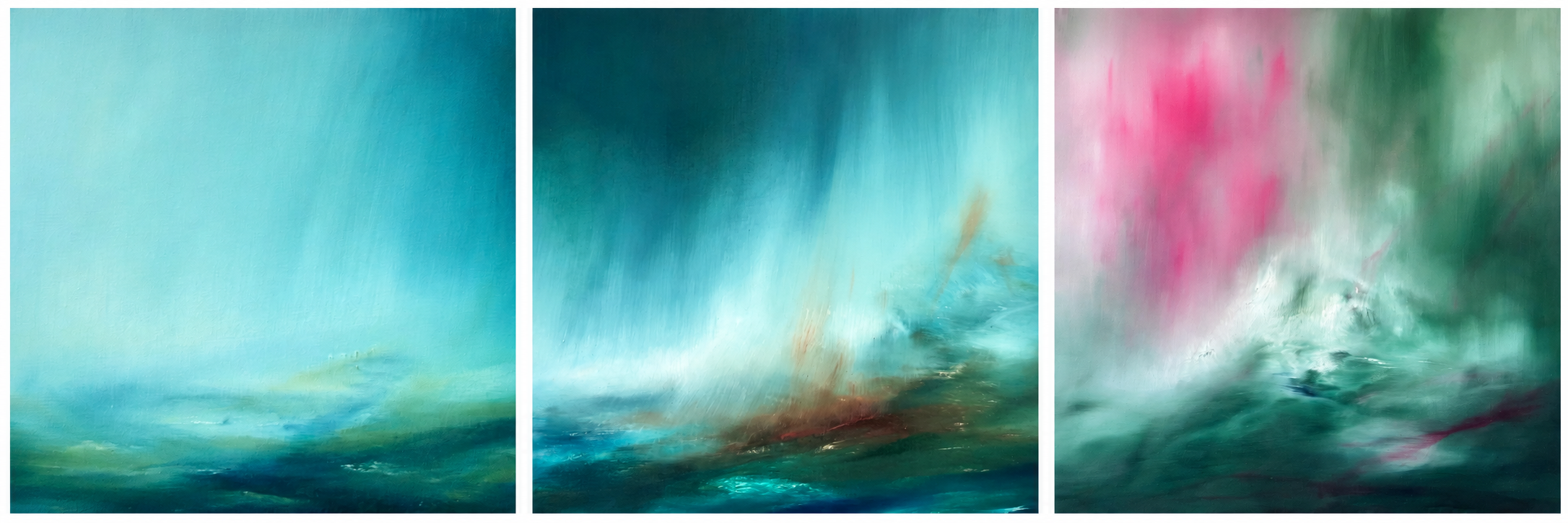
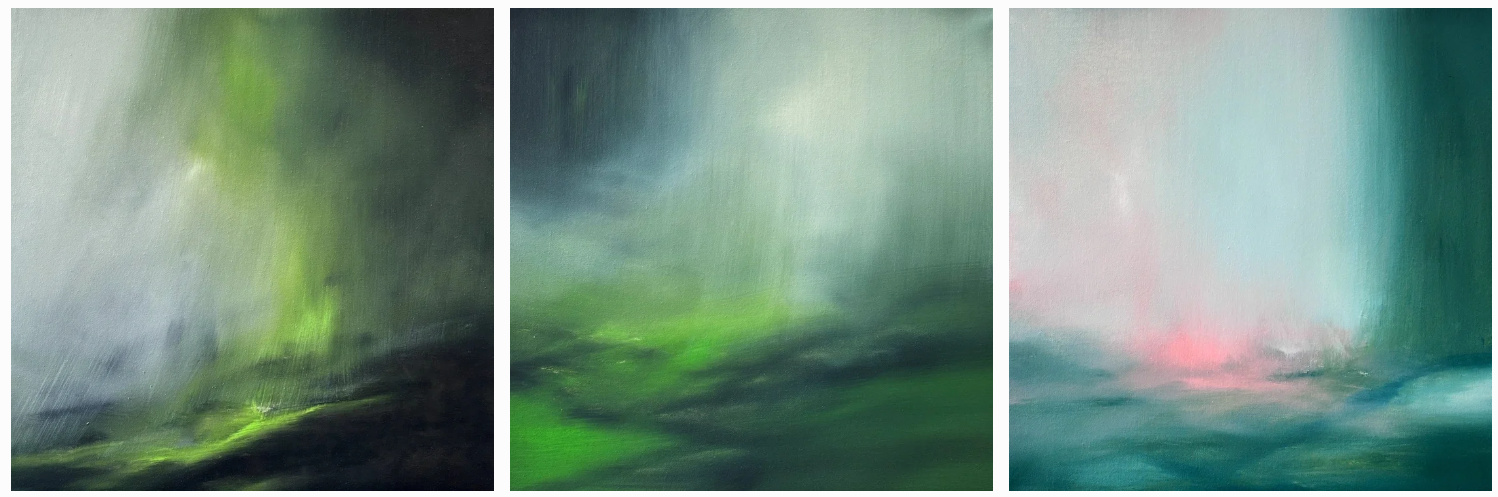
The collection brings together new paintings exploring the relationship between landscape, memory and the experience of being in wild places. Rather than producing conventional representations of coastlines and mountains, O’Connor uses colour, texture and movement to convey the atmosphere of the natural world.
Her paintings are often dominated by deep blues, greens, greys and shifting areas of light. Forms appear and disappear through layers of paint, sometimes suggesting a horizon, a bank of cloud, a breaking wave or the last light of evening.
They are landscapes that do not always reveal precisely where they were made.
A Childhood Shaped by the Outer Hebrides
O’Connor grew up on Uist, where the Atlantic, open skies and rapidly changing weather are defining features of daily life.
The Outer Hebrides offer an unusual environment for a developing artist. The islands’ long beaches, peatlands, mountains and exposed coastlines can change appearance dramatically within minutes as light moves across the landscape.
Those conditions have remained important throughout her career.
O’Connor studied Fine Art at Duncan of Jordanstone College of Art & Design in Dundee, graduating in 2014, before completing a master’s degree in Art and Humanities in 2016.
Her subsequent career has included exhibitions throughout Scotland and artistic residencies abroad, allowing her to explore environments beyond the Hebrides while retaining the influence of her early surroundings.
In 2016, she participated in an expedition around the Svalbard archipelago in the High Arctic, an experience that provided opportunities to study remote northern landscapes.
Her achievements include the Royal Scottish Academy Landscape Award, the John Byrne Award and the Royal Scottish Academy’s John Kinross Florence Scholarship.
These experiences have contributed to an artistic practice concerned not only with the appearance of landscapes but with the physical sensations and impressions they create.
Painting in the Wind and Rain
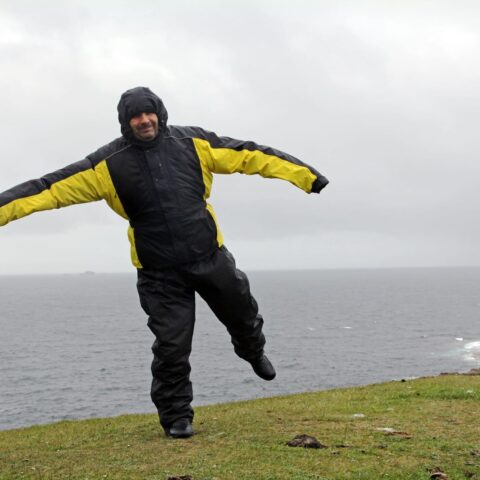
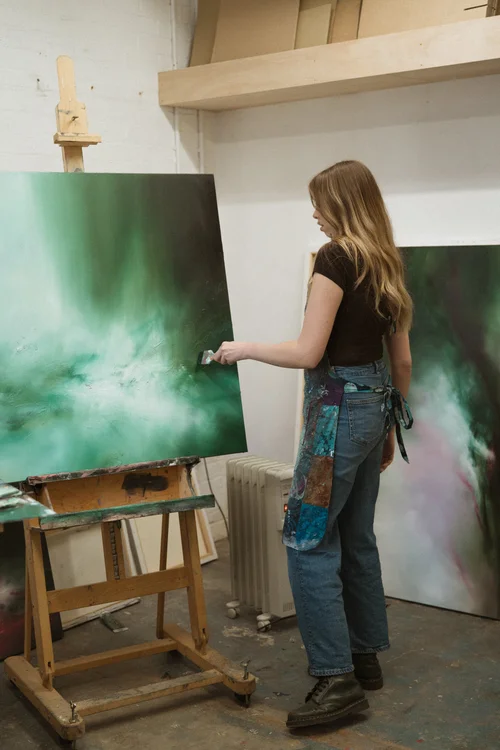
One of the most interesting aspects of O’Connor’s work is her willingness to create art outdoors in difficult conditions.
Rather than relying exclusively on photographs or sketches made during comfortable weather, she has undertaken painting and drawing directly in exposed landscapes.
Wind, rain and the movement of the elements become part of the working process.
She has described working outdoors in extreme weather as an almost performative experience, with the physical act of making the work becoming inseparable from the environment itself.
Some of these studies provide the starting point for larger paintings completed later in the studio.
Her methods can involve conventional oil paints alongside natural materials, including sand and dried seaweed, incorporated into the painting’s surface.
The resulting textures help connect the physical object with the places that inspired it.
This approach produces a different relationship between artist and landscape from that of a painter working entirely from photographs.
The finished painting is not necessarily intended to reproduce a recognisable view. Instead, it records something of the movement, atmosphere and experience of being there.
Landscapes Between Memory and Imagination
The new Glasgow exhibition develops these ideas further.
According to Annan Gallery, Deep Time, Inner Space emerged partly from a period of exploration and international travel.
The paintings examine how encounters with unfamiliar landscapes can remain in memory long after the original experience has ended.
The exhibition’s title suggests two different ways of understanding place.
Deep time refers to the immense geological and environmental history of the Earth, extending far beyond the human lifetime. Inner space concerns the personal impressions, memories and responses through which people experience the world.
O’Connor’s paintings bring these ideas together.
A landscape may appear ancient, immense and almost untouched, while the colours and gestures used to describe it are intensely personal.
Among the works presented by the gallery are A World Apart, An Unmapped Place, Beneath All Things, The Ocean Within, The Other Side of Blue and Where Worlds Meet.
The titles offer clues to the themes running through the collection without prescribing exactly what viewers should see.
The gallery describes the work as occupying a space between physical landscape and imagination.
That distinction is important. Although the paintings are informed by actual places, they are not intended to function as documentary records of specific geographical locations.
Their purpose is to communicate something that may be less easily captured through a conventional landscape photograph.
The Scottish Landscape Beyond the Picture Postcard
Scottish landscape painting has a long and varied history.
Mountains, lochs, glens and coastlines have been represented through detailed topographical studies, romantic nineteenth-century paintings, modernist experimentation and contemporary abstraction.
O’Connor belongs to a tradition of artists who use landscape as an opportunity to explore colour, movement and human perception rather than simply recording scenery.
Her work often avoids familiar picturesque conventions.
Instead of carefully defined mountains beneath an attractive sky, the viewer may encounter a dark expanse interrupted by a luminous band of colour. A coastline may be suggested by a change in texture rather than a clearly drawn boundary.
The effect can be particularly appropriate to the Western Isles, where sea and sky frequently appear to merge and where rain, mist and sudden sunlight can obscure or transform the visible landscape.
These qualities also connect her work to broader questions about environmental change.
O’Connor’s gallery biography identifies the relationship between human activity and the environment as an important concern in her practice.
Her paintings do not present environmental issues through statistics or direct political arguments. They encourage viewers to consider the natural world through a more immediate visual experience.
A Growing Career in Scottish Art
O’Connor’s professional development demonstrates the continuing importance of Scotland’s art colleges, galleries and opportunities for independent artists.
Following her studies in Dundee, she has developed a body of work represented by several Scottish galleries, including Annan Gallery in Glasgow and Gallery Heinzel in Aberdeen.
Her paintings have also appeared in exhibitions elsewhere in Britain.
The techniques vary, but a consistent interest in atmosphere and movement links much of the work.
Her recent exhibition also illustrates the extent to which contemporary Scottish art draws inspiration from both local places and international experience.
The Hebrides remain an important influence, but the landscapes she has encountered during travel and residencies have expanded the geographical range of her practice.
What connects them is not a single location but an interest in the physical and emotional experience of the natural environment.
Seeing the Work in Person
Large-scale abstract paintings can be difficult to appreciate through a computer screen.
Subtle differences in surface texture, the thickness of paint and the relationship between areas of light and darkness can be diminished when a work is reduced to a small digital image.
The Glasgow exhibition therefore offers visitors an opportunity to examine O’Connor’s paintings at their intended scale.
The collection is also an introduction to an artist whose work is rooted in the Scottish landscape without being confined to conventional landscape painting.
For people familiar with the Atlantic coast, there may be something recognisable in the movement of the colours, the uncertainty of the horizon and the suggestion of weather passing over water.
Others may encounter the paintings without identifying any particular place.
Both experiences are consistent with the artist’s approach.
The intention is not always to tell the viewer where to look, but to create the sensation of being somewhere.
And perhaps that is one of the most interesting qualities of O’Connor’s work.
A landscape does not have to be reproduced exactly to remind us of a place we know.
Sometimes its character can be found in the movement of a brush, a sudden change of light or the colours left behind when the weather has passed.
Exhibition Details
Exhibition: Ellis O’Connor — Deep Time, Inner Space
Venue: Annan Gallery, 164 Woodlands Road, Glasgow, G3 6LL
Dates: 31 October – 22 November 2026
Admission: Free
Gallery website: https://annanart.com/current-exhibition
Artist’s website: https://www.ellisoconnor.com/