
There are certain signs that summer is over in the Highlands. The swallows leave, the evenings draw in, Mr Gunn begins carrying logs into the house with the solemn expression of a man preparing for a siege, and nobody suggests sitting outside unless there is ample wine, a bonfire and a starry night.
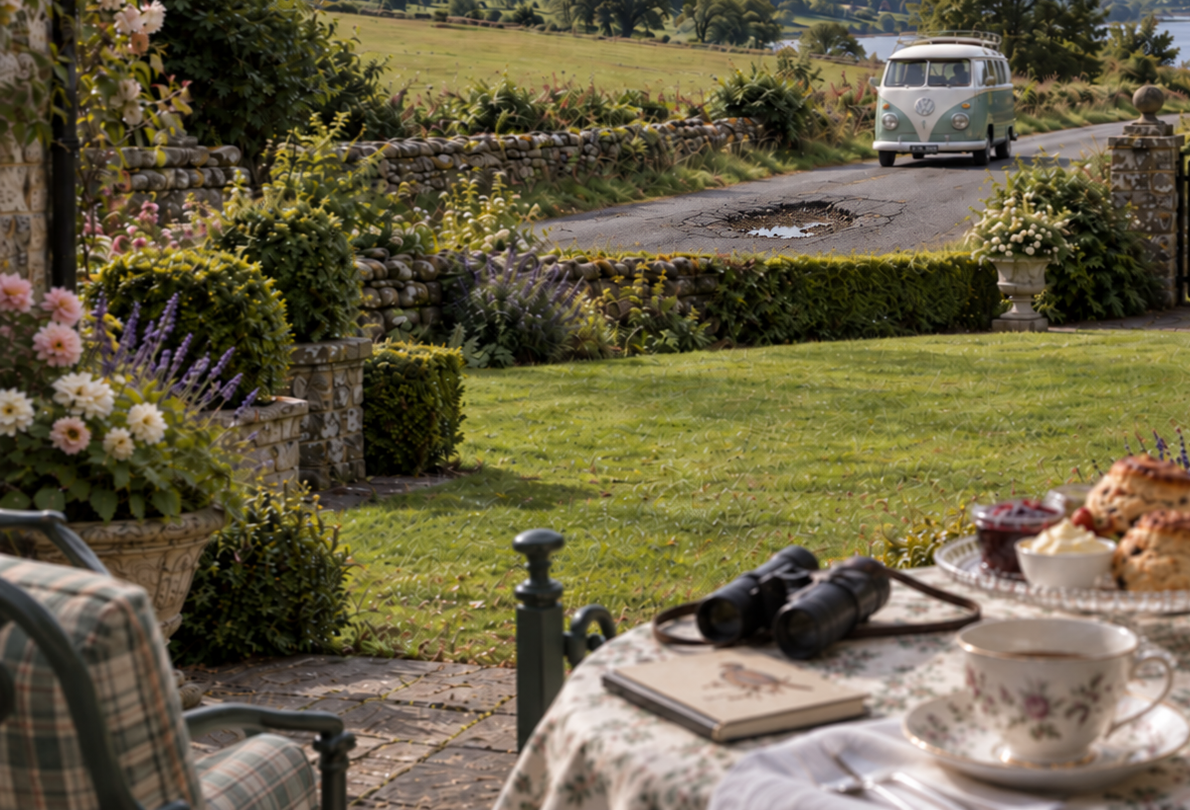
The pothole is still there, of course. Nothing as dramatic as repair has taken place. It remains immediately outside our house, a broad, dark depression in the road which began in spring as a modest imperfection and, after several months of rain, traffic and official awareness, developed into something with presence. I have reported it to the council three times. The council therefore knows about it almost as well as I do, although I have had the advantage of seeing it every day.
My first report was responsible and civic-minded. I provided the location, dimensions and photographs requested by the online form and resisted writing “outside my house” under every heading. The second report was more detailed because by then I had watched its development and could speak with some authority. By the third, I felt we were corresponding about a mutual acquaintance. I informed the council that it had become wider, deeper and considerably more successful at attracting attention, although the form did not provide a box for personality.
For several weeks I regarded it as an annoyance. Then, one afternoon, a white van came along the road at just the wrong angle and went into it with a tremendous thump. The driver slowed, looked in his mirror and continued on his way. I looked up from the garden and discovered, to my surprise, that I had enjoyed the whole thing enormously.
After that I began to notice patterns. Local people generally knew where the pothole was and approached it with the calm manoeuvre of people who had already paid for one suspension repair and did not intend to finance another. Visitors were less fortunate. Camper vans were particularly promising, delivery vehicles depended on the driver, and the people who owned enormous four-wheel drives frequently approached with such confidence that one felt the pothole took it personally. Hire cars were the most reliable performers because their drivers tended to be looking simultaneously at the scenery, the satnav and the side of the road on which they had suddenly remembered they were supposed to be driving.
I happened to mention this to Effie. I did not invite her over specifically to watch vehicles hit a hole in the road. I want that clearly understood. I merely said there had been some activity outside the house recently, and Effie, displaying the healthy concern of a neighbour, asked what sort of activity and at what time it generally occurred. She arrived the following afternoon at half past two, by coincidence bringing biscuits.
The weather was still warm then, so we took our tea outside. Our chairs happened to face the road, which was not deliberate either, although Effie did move hers slightly after discovering that a rose bush obstructed her view of traffic approaching from the bend. For twelve minutes nothing happened. Then a blue hatchback appeared, travelling at a speed suggesting its driver had not yet encountered the local road network in any meaningful way. Effie stopped speaking. I stopped pouring. The car reached the pothole with a magnificent bang, emerged successfully from the other side and continued towards the village.
“Oh, that was a good one,” Effie said.
I reminded her that we were not actually watching.
After that the gatherings grew naturally, which is how most dangerous organisations begin. Jean heard about the pothole and came for tea the following Tuesday. Then Margaret arrived, and Margaret changed everything because Margaret is interested in photography. Until then we had maintained the entirely defensible position that four women sitting beside a road, drinking tea and becoming suddenly silent whenever a vehicle approached, could be explained as ordinary social behaviour. The appearance of a camera with a telephoto lens made this argument considerably harder to sustain.
Margaret assured me that she was interested only in movement. She had recently been learning how to photograph wildlife and wanted to practise using a setting on her camera designed for fast action. I pointed out that a Ford Focus was not wildlife, although after watching one bounce out of the pothole and veer briefly towards the verge, I conceded that there were similarities.
The first photographic session was remarkable. Margaret positioned herself discreetly beside the hedge, which in her case meant crouching behind a hydrangea holding equipment capable of photographing the surface of the moon. A silver estate car approached. She lifted the camera and suddenly there came a furious clicking noise as the vehicle entered the pothole, its front wheel disappeared, the suspension compressed and the driver experienced what I imagine was a brief but complete reassessment of his afternoon.
Margaret examined the pictures.
“What setting is that?” Jean asked.
“Sports action.”
That was the moment the pothole ceased to be road maintenance and became an event.
We developed standards. A vehicle merely brushing the edge did not count. People deliberately driving into it after clearly seeing it were regarded as poor sportsmanship. Delivery vans were common enough not to excite us unless travelling unusually quickly, while camper vans remained dependable crowd-pleasers because cupboards and crockery seemed to become involved. Nobody kept a written score because I refused to allow matters to descend to that level, although Effie did once remark that Thursday had been “better than Monday,” which suggested an informal league table existed in her head.
It was during one of these afternoons that Mr Gunn discovered us. He had been mowing the front grass and apparently became suspicious after noticing that every time a vehicle approached the house, four women stopped talking and turned their heads in exactly the same direction. This would probably have remained unexplained had a delivery van not appeared just then. The van hit the pothole. Margaret’s camera erupted into sports action mode. Effie made a small noise of appreciation.
Mr Gunn stopped the mower.
He looked at the road. Then he looked at us. Then he abandoned the mower entirely and came over. The table was covered in an assortment of teapots, mismatched china, shortbread tins, cake plates, handbags, camera equipment, phones and binoculars, as though a church tea had somehow merged with a press box.
“What the hell are you doing?”
I said we were having tea.
Mr Gunn surveyed the table. Jean was holding a plate of shortbread. Effie had positioned herself with the best view of the pothole. Margaret had a camera with a lens approximately the size of a drainpipe resting on her knee.
“Having tea,” he repeated.
“Yes,” I said. “Just having tea.”
He looked at the road again. “And the camera?”
“Margaret likes photography.”
There are occasions in marriage when providing additional information can only weaken one’s position, so I poured him a cup of tea instead. Another car approached. We all remained admirably composed. It avoided the pothole completely.
Mr Gunn watched it disappear.
“Huh,” he said.
Within half an hour he was telling Margaret that she ought to increase her shutter speed.
The difficulty with an activity involving several women is that secrecy eventually becomes impossible. Jean had taken a short video on her phone during one of the better incidents, not because we were documenting anything, she explained, but because she happened to have her phone in her hand when a large motorhome arrived. This explanation would have been more convincing had the resulting film not begun twelve seconds before the motorhome reached the pothole.
Jean sent the clip to Elspeth.
Elspeth watched it three times and asked whether there were any more.
This should have been the moment when one of us recognised that matters were getting out of hand. Instead, Jean sent her another one.
By the end of the afternoon Elspeth had received a white van, two hatchbacks and something involving a roof box which produced such an extraordinary noise from the rear of the vehicle that nobody could decide whether it had come from the suspension or the luggage. Elspeth began sending messages asking what time the next session was. The following day she appeared in person with a folding chair.
Agnes found out because Elspeth told her. Agnes objected strongly to the entire business on the grounds that it was unkind to motorists, potentially intrusive and not the sort of thing grown women ought to be doing with their afternoons. She maintained this position until a courier van hit the pothole while she was standing at our gate. After that she came over and asked whether there was any tea left.
Morag was more complicated because she was spending part of the summer at the house on the island. She did not know anything about the pothole until somebody — and nobody has ever admitted responsibility — sent her Jean’s motorhome video.
My telephone rang almost immediately.
“What is this?”
I told her it was a motorhome.
“I can see it’s a motorhome. What are you all doing?”
“Nothing.”
“You are filming cars going into a pothole.”
“We’re having tea.”
There was a silence.
“Without me?”
This, apparently, was the offence.
Morag demanded everything. Not an explanation. The footage. Jean sent the white van. Elspeth sent the roof-box incident. Margaret photographed her camera screen and sent a sequence of still images from the silver estate car. Within an hour Morag, sitting on an island several miles away, had become our remote analyst.
She was extremely critical of the filming.
“Too much hedge,” she wrote beneath one clip.
On another: “You’ve moved before the back wheel goes in.”
Then: “WHO FILMED THIS VERTICALLY?”
Jean was offended.
Morag said if we were going to do this, we could at least do it properly.
I reminded everyone that there was no “this.”
Nobody responded.
Rhona, meanwhile, was in Benidorm.
This information became relevant only because Elspeth accidentally sent the white-van video to the entire group rather than to Morag. Rhona replied several minutes later with a photograph of herself sitting somewhere extremely sunny beside a swimming pool, wearing sunglasses and holding a large glass of something orange.
“Excellent,” she wrote. “Any camper vans today?”
It was still the middle of the afternoon at home. Rhona pointed out that Spain was an hour ahead and therefore she was entitled to have moved on from tea.
After that the pothole acquired an overseas audience. At approximately three o’clock each afternoon, if anything worthwhile occurred, somebody sent it to Rhona. She began requesting slow-motion replays. On one occasion a small red car went into the pothole particularly hard and Rhona replied with three cocktail-glass symbols and the number nine.
“What does nine mean?” I asked.
“Score,” said Effie.
“We are not scoring them.”
Nobody answered.
Agnes continued to disapprove while somehow never missing an afternoon.
That was in August. By early September, pothole afternoons had become sufficiently established that nobody needed formally to arrange them. If the weather was decent, somebody appeared. Tea was made. Chairs were taken outside. Conversation continued normally until the sound of an engine came round the bend, at which point an extraordinary concentration descended over otherwise respectable women.
Then it turned colder.
At first we attempted to continue. We wore cardigans. Then coats. Jean brought a blanket for her knees, which I thought indicated that matters had gone too far, although I accepted it ten minutes later. The tea became cold almost immediately. Margaret complained that her fingers were too stiff to operate the camera properly. Effie maintained that we could sit outside perfectly comfortably while visibly shivering.
Last week we finally admitted defeat. Rain was blowing sideways across the garden and the temperature had fallen to the point where even Mr Gunn, who believes central heating before October represents a moral failure, went inside, turned on the heat, and insisted that we come indoors.
We sat inside instead. All four of us looked towards the window.
“You can still see from here,” Effie said.
I told her it was not the same.
And it isn’t. Anyone can look through a window. Pothole season was about sitting outside with tea, pretending to discuss ordinary matters while waiting for an unsuspecting Vauxhall to appear around the bend. It was about grown women becoming entirely silent because a stranger was about to discover something we already knew.
The council may eventually repair it. I assume that remains the official ambition. But after three reports, an entire summer, several hundred cups of tea and what Morag now describes as an inadequate archive of usable footage, I have accepted that the pothole is probably staying.
Pothole season, however, is officially over.
Not because the council fixed the road.
Because Scotland fixed the weather.