
Scotland’s peatland restoration programme has passed a significant environmental milestone, with more than 100,000 hectares of degraded peatland now placed on the road to recovery, according to NatureScot.
The conservation agency is marking the achievement during Peat Week 2026, held from 3 to 5 November, bringing together land managers, scientists, contractors and environmental organisations to examine the progress and challenges of restoring Scotland’s damaged peatlands.
The announcement comes as Scotland attempts to increase the pace of habitat restoration under its climate-change commitments, with the Scottish Government establishing a longer-term ambition to restore 400,000 hectares of degraded peatland by 2040.
Although the latest milestone represents substantial progress, it also illustrates the scale of the remaining task.
Scotland has approximately two million hectares of peatland, making it home to some of Europe’s most extensive peatland landscapes. Government assessments estimate that roughly 70 per cent, or 1.4 million hectares, is degraded.
The area placed on the road to restoration therefore represents only a fraction of the country’s damaged peatland resource.
Why Scotland’s Peatlands Matter
Peatlands are among Scotland’s most important natural carbon stores.
They develop when partially decomposed plant material accumulates in wet conditions over thousands of years. Because waterlogged soils contain relatively little oxygen, the organic material breaks down slowly and carbon remains stored within the peat.
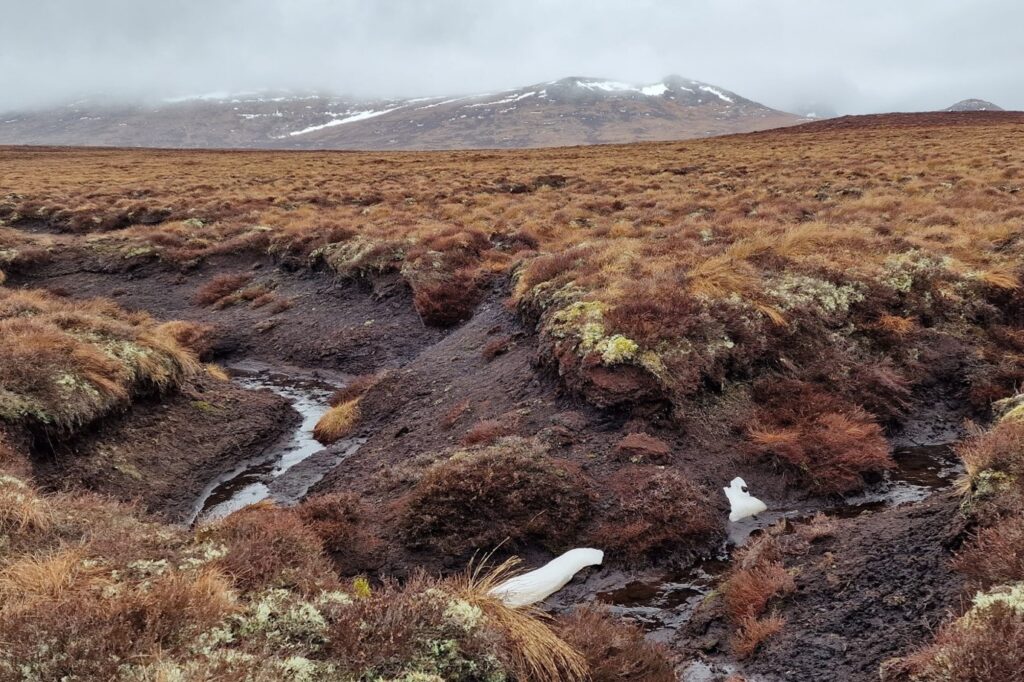
When peatlands are drained, eroded or otherwise damaged, oxygen enters the soil and the stored organic material can begin decomposing more rapidly, releasing greenhouse gases.
Restoring damaged peatland generally involves returning water levels towards more natural conditions, stabilising exposed peat and encouraging the recovery of suitable vegetation.
Work can include blocking drainage channels, reshaping eroded peat banks and re-establishing plant cover to reduce further erosion.
Healthy peatlands also help regulate water movement through upland catchments and provide habitats for specialised plants, birds and invertebrates.
Their condition therefore matters not only for climate policy but also for biodiversity, water quality and the resilience of Scottish landscapes during periods of drought and intense rainfall.
Restoration Has Accelerated
The Scottish Government’s most recent adaptation report shows that peatland restoration activity has increased substantially over the last several years.
During 2021–22, approximately 5,631 hectares were restored.
That figure rose to 14,918 hectares in 2024–25 and 15,448 hectares during 2025–26.
The latest annual result exceeded the government’s target of restoring at least 12,000 hectares during the financial year.
The Scottish Government committed £35.5 million towards peatland restoration in its 2025–26 budget, supporting work carried out through the Peatland ACTION partnership and associated delivery organisations.
The programme works with landowners, land managers and specialist contractors to identify damaged areas, develop restoration projects and carry out practical work on the ground.
Restoration also requires technical knowledge. Machinery used in peatland environments must operate on sensitive ground, sometimes in remote upland locations where access and weather conditions complicate construction.
Projects may also require ecological surveys, hydrological assessment and continuing monitoring after the initial work has been completed.
The investment therefore supports a specialised sector of environmental work involving surveyors, ecologists, engineers, contractors and land-management professionals.
Restored Does Not Mean Fully Recovered
NatureScot’s description of the latest milestone is important.
The agency says more than 100,000 hectares have been placed on the road to recovery. This does not mean that every hectare has already returned to its original ecological condition or is functioning as a fully recovered carbon store.
Peatland recovery can take years, and the benefits of restoration may develop gradually.
Blocking an artificial drainage channel can help raise water levels, but damaged vegetation may need considerable time to recover. Severely eroded surfaces can require additional intervention before peat-forming plants become established.
Monitoring is consequently essential to determine whether restoration measures are achieving the intended results.
NatureScot’s Peatland ACTION programme uses geographical information, hydrological measurements and vegetation surveys to record work and assess changes at restoration sites.
The organisation also supports long-term research into peatland condition and the environmental consequences of different restoration techniques.
The distinction between hectares receiving restoration treatment and hectares achieving sustained ecological recovery is important when interpreting national progress.
A Much Larger Target for 2040
Scotland’s peatland-restoration ambitions have expanded as scientific understanding of the climate and ecological importance of these landscapes has developed.
The previous national target was to restore 250,000 hectares by 2030. The government’s newer Climate Change Plan extends the longer-term ambition to 400,000 hectares by 2040.
Meeting that ambition will require restoration activity to continue at a substantial annual rate, supported by funding, skilled workers and access to suitable land.
The 2025–26 restoration total of 15,448 hectares demonstrates that annual delivery has increased, but sustaining and expanding that rate remains a considerable undertaking.
The challenge is also complicated by the fact that peatland restoration is not a single, uniform operation. Conditions vary between blanket bogs, lowland raised bogs, heavily eroded hillsides and peatlands affected by drainage or previous land use.
Individual sites can require different techniques, and restoration outcomes depend on local hydrology, vegetation, grazing management and the extent of existing damage.
Peat Week Focuses on the Work Still Ahead
NatureScot’s Peat Week programme is examining how Scotland can expand restoration, support employment and improve the technical methods used to repair damaged peatlands.
Events scheduled during 3–5 November include discussions of increasing restoration capacity, supporting a fair transition through environmental employment, and solving the practical challenges encountered during restoration work.
The programme brings attention to an area of environmental policy that receives less public scrutiny than renewable energy or transport emissions, despite the considerable volume of carbon stored in Scotland’s soils.
Its importance extends beyond emissions accounting.
Damaged peatland can affect watercourses, habitats and the long-term condition of upland landscapes. Restoration requires cooperation between public agencies, private landowners, conservation organisations and the people responsible for managing land over many years.
The achievement of more than 100,000 hectares placed on the road to recovery demonstrates the scale of work already undertaken.
The larger measure of success will be whether those landscapes remain healthy, whether restored sites deliver measurable ecological benefits, and whether Scotland can sustain the programme across the much greater area of peatland still in poor condition.
Sources
Peatland ACTION — Peat Week 2026, NatureScot, event held 3–5 November 2026.
https://www.nature.scot/peatland-action-peat-week-2026
Scottish National Adaptation Plan: Annual Report 2025 to 2026 — Nature Connects, Scottish Government, June 2026.
https://www.gov.scot/publications/scottish-national-adaptation-plan-annual-report-2025-2026/pages/3/
Peatland ACTION — Restoration Data, NatureScot, updated 17 August 2026.
Scotland’s Climate Change Plan 2026–2040: Sectoral Annexes, Scottish Government, 2026.
https://www.gov.scot/publications/scotlands-climate-change-plan-2026-2040-annexes/pages/14/