

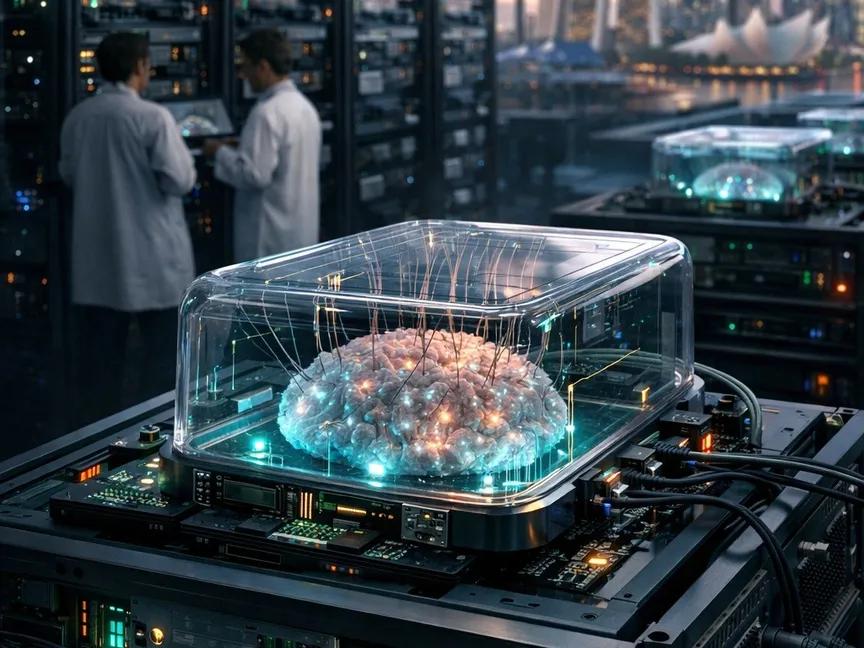
Scientists in Scotland were cultivating living nerve cells on electronic interfaces and recording their electrical signals in 2009, nearly two decades before experimental data centres in Australia and Singapore began using living human neurons as part of functioning computer systems.
The research, conducted at the University of Glasgow, involved growing networks of nerve cells, directing their development into predetermined patterns and building electronic devices capable of detecting their activity. A further Glasgow-associated study published in August 2026 demonstrated how computer-generated electrical stimulation could influence the activity of laboratory-grown cortical networks.
These Scottish experiments were not biological data centres. Their original purposes were to advance neuroscience, neural interfaces and medical research. Nevertheless, they addressed some of the same technical problems that confront the companies now attempting to turn living human neurons into a new form of computing infrastructure.
The development has moved beyond theoretical research. In March 2026, Australian company Cortical Labs unveiled a biological data centre in Melbourne containing 120 computers built around living human neural cultures. Five months later, the company and its partners demonstrated another installation containing 20 biological computing units at the National University of Singapore.
Unlike conventional computers, which process information entirely through electronic components, these experimental systems use living neurons grown from stem cells on silicon chips. The cells receive electrical signals, respond through their own biological activity and communicate with computer software through microscopic electrodes.
The neurons must also be kept alive. They require nutrients, oxygen, carefully controlled temperatures and protection from contamination. In effect, the computers operate with miniature biological life-support systems.
For Scotland, the development creates an unusual scientific connection between its established neuroscience research, its expanding data-centre industry and international efforts to develop computing systems that might eventually use less electricity for certain tasks.
Glasgow Was Growing Neural Networks on Electronic Interfaces in 2009
One of Scotland’s clearest documented connections comes from research completed at the University of Glasgow in 2009 by Rongyu Tang.
The doctoral thesis, titled Listening to Neurons — Development and Understanding of Microelectrode Arrays Systems, described the development of electronic systems capable of recording activity from living nerve cells.
The researchers cultivated rat neurons in a laboratory chamber they called a neural bathtub. They used microscopic surface features and protein patterns to encourage the cells to form predetermined networks.
Specially designed microelectrode arrays were then used to detect electrical signals generated by the living neurons.
The work investigated several problems that remain important to biological computing: how to establish reliable electrical contact with individual cells, how to distinguish neural signals from electronic noise, and how to provide sufficient oxygen to sustain the cultures.
The project also explored the small amounts of electrical energy associated with nerve impulses and the way those signals could be recorded using electronic equipment.
Glasgow was not the first institution internationally to connect living neurons to electrodes. Earlier work in the United States and elsewhere had already demonstrated electrical recording from cultured nerve cells.
However, the 2009 thesis establishes that Scottish researchers were actively developing the interface between living neural networks and computer hardware years before today’s biological computing facilities appeared.
Although the Glasgow system was not designed as a commercial computer, its underlying engineering has important similarities to modern biological processors.
Scottish Researchers Are Still Working With Living Neural Networks
The research has continued into the present decade.
On 13 August 2026, researchers associated with the University of Glasgow published a peer-reviewed study in Brain Stimulation examining the use of reservoir computing to generate electrical stimulation patterns for living cortical neural networks.
The paper, Minimal Reservoir Computing Generates Hippocampal-Inspired Stimulation for Open-Loop Modulation of Cortical Networks In Vitro, involved Professor Hadi Heidari and colleagues working with international collaborators.
The researchers used a computational model to produce patterns of electrical stimulation inspired by activity associated with the hippocampus, a region of the brain involved in memory and other neurological functions.
Those signals were delivered to cultures of living rat cortical neurons grown on multielectrode arrays.
The experiment produced changes in some measurements of neural firing and bursting activity, although the primary pooled analysis did not achieve conventional statistical significance. The researchers also acknowledged uncertainty about the precise contribution of the computationally generated timing patterns.
The work was principally concerned with neural stimulation and potential future treatments for neurological conditions, including epilepsy.
It did not demonstrate that the cultured cells could operate as commercial computers. Rather, it showed how computational methods and living neuronal networks can be connected within a controlled experimental system.
That distinction is important because biological computing depends on reliable communication in both directions: electronic equipment must deliver information to living cells and interpret the signals produced in response.
Aberdeen Is Growing Human Brain Tissue From Stem Cells
At the University of Aberdeen, scientists are investigating another aspect of the technology: producing complex human neural tissue in the laboratory.
The Kang-Berg laboratory, associated with Dr Eunchai Kang and Dr Daniel Berg, studies human brain development using neural stem cells, brain organoids and other three-dimensional cellular models.
Brain organoids are small, laboratory-grown structures containing cells that reproduce selected features of developing brain tissue. They are not complete miniature human brains.
The Aberdeen researchers investigate how human neural stem cells develop into different cell types and organise into tissue. Their work also examines the roles of supporting cells, including microglia and vascular cells.
This research is primarily intended to improve scientific understanding of brain development, disease and neurological injury.
There is no verified evidence that the laboratory is operating a biological computer or using its organoids to provide commercial computing services.
Nevertheless, the ability to grow, sustain and study functioning human neural tissue is relevant to the wider field of biological computing.
Unlike conventional silicon processors, which can be manufactured with highly consistent properties, biological processors depend on living cell cultures that grow, change and eventually deteriorate.
Producing reliable neural tissue is therefore one of the technological challenges facing any attempt to expand biological computing beyond experimental systems.
Edinburgh and Strathclyde Add Related Expertise
The University of Edinburgh has established research programmes involving stem-cell biology, neural development, biomedical engineering and microelectronic systems.
Research associated with the UK Dementia Research Institute at Edinburgh uses advanced cellular models to investigate how neurons function, communicate and deteriorate during neurological disease.
These fields contribute relevant knowledge about living neural systems and the technologies used to investigate them.
At the University of Strathclyde, researchers are participating in major UK programmes developing brain-inspired computing technologies.
In May 2025, Strathclyde announced its involvement in the £5.6 million UK Multidisciplinary Centre for Neuromorphic Computing. The university is contributing expertise in photonics and energy-efficient information processing.
Strathclyde is also involved in Neuroware, a £12.8 million programme intended to advance the development and commercialisation of neuromorphic hardware.
There is an important distinction between neuromorphic computing and biological computing.
Neuromorphic systems imitate some characteristics of nervous systems using engineered electronics, optical devices or other artificial components. Biological computing uses living neural cells directly as part of the processor.
Although the technologies share scientific interests, participation in neuromorphic research does not establish that an institution is operating computers containing living human neurons.
Melbourne Now Has a Data Centre Containing 120 Biological Computers
In Australia, Cortical Labs has taken a different approach by building computing systems around the electrical activity of living human neurons.
Its CL1 biological computer contains approximately 200,000 neurons grown from stem cells and connected to a silicon chip fitted with microscopic electrodes.
The electrodes deliver electrical stimulation and record the responses generated by the neural network. Computer software translates those signals into information that can be used in experiments and interactive computing tasks.
In March 2026, Cortical Labs unveiled a Melbourne facility containing 120 CL1 units, representing approximately 24 million neurons distributed across separate biological processors.
The facility allows researchers and developers to access the systems remotely through a platform known as Cortical Cloud.
Instead of physically maintaining their own neuronal cultures and laboratory equipment, researchers can submit experiments and observe the responses of living neural networks connected to the company’s electronic infrastructure.
This is a significant development, although its scale remains modest compared with ordinary commercial data centres.
The facility is best understood as an experimental biological computing installation, rather than a replacement for the large server farms used by cloud providers and artificial intelligence companies.
Singapore Has Followed With Its Own Biological Data Centre
In Singapore, Cortical Labs has partnered with data-centre operator DayOne and the National University of Singapore to establish a second installation.
The partnership was announced in March 2026, and the prototype was publicly demonstrated on 6 August, with a formal announcement on 17 August.
The installation contains 20 CL1 biological computing units and is located within a research environment at the university’s Life Sciences Institute.
Professor Rickie Patani, a neuroscientist at the National University of Singapore, is involved in the programme, which aims to investigate the computing potential of living human neural networks alongside possible applications in biomedical research.
The partnership has identified drug discovery, biological modelling, robotics and advanced computing as potential fields of investigation.
It also intends to explore larger installations, although substantial expansion will depend on technical performance, reliability, financing and the practical difficulties of operating living biological systems.
Neither the Australian nor the Singapore installation has demonstrated that biological computing can replace the processors used to train major artificial intelligence systems.
Their importance is that they establish the operation of remotely accessible computing systems incorporating living human neurons.
Can Living Neurons Actually Learn?
One of the reasons scientists are interested in biological computing is the ability of neural networks to adapt their electrical activity in response to stimulation.
Earlier Cortical Labs experiments connected cultured neurons to a simplified version of the video game Pong. Electrical stimulation represented information about the game’s environment, while signals from the neurons influenced the movement of a virtual paddle.
More recent demonstrations have involved biological neural systems interacting with Doom, another computer game.
These experiments show that living neural cultures can participate in feedback-driven information-processing tasks.
However, they do not establish that the neurons understand the games, possess human intelligence or are conscious.
The extent to which experimental improvements arise from biological adaptation, feedback mechanisms and conventional software must be carefully distinguished.
Biological computing is therefore an emerging form of specialised information processing, not evidence that scientists have constructed a thinking human brain inside a computer.
What Would Biological Computing Mean for Scotland’s Data Centres?
The development comes as Scotland examines the environmental and infrastructure consequences of conventional data-centre investment.
On 16 September 2026, the Scottish Government announced that new data-centre applications exceeding 50 megawatts of power capacity would require an Environmental Impact Assessment. The direction took effect the following day.
Ministers identified electricity consumption, water use, greenhouse gas emissions and impacts on surrounding communities among the issues requiring examination.
The potential attraction of biological computing is that some forms of information processing might eventually be carried out using less electrical energy than conventional processors.
Cortical Labs has promoted its technology as a low-power alternative for particular applications. However, those claims should not be confused with proof that biological processors can complete equivalent commercial computing workloads more efficiently.
Reliable comparisons would have to account for processing capability, the electricity consumed by supporting equipment, biological maintenance, cell replacement and the useful output delivered by the system.
A biological computer may consume relatively little electricity while performing a very limited task. That does not necessarily make it more efficient than a conventional processor capable of completing a much larger workload.
Nor would biological computing remove every environmental impact associated with data-centre operation. Living cultures require sterile equipment, nutrient solutions, controlled environments and ongoing maintenance.
At present, no published evidence establishes that large biological computing installations could meet Scotland’s mainstream commercial computing requirements.
Nevertheless, the experimental facilities in Melbourne and Singapore demonstrate an additional technological pathway at a time when Scotland is making significant decisions about the infrastructure needed for future computing demand.
Could Scotland Build Its Own Biological Data Centre?
Scotland possesses several areas of scientific expertise relevant to the development of biological computing.
Glasgow researchers have documented experience in cultivating neural networks, designing microelectrode interfaces and investigating computationally generated stimulation of living neural cultures.
Aberdeen has expertise in human neural stem cells and brain organoids. Edinburgh contributes established capabilities in neuroscience and biomedical engineering, while Strathclyde is participating in research into alternative computing architectures.
These capabilities do not automatically amount to an operational biological computer.
A dedicated facility would require the integration of reliable human neural cultures, electronic interfaces, software, sterile biological maintenance systems and methods for demonstrating useful computational performance.
It would also require funding, appropriate governance and evidence of scientific or commercial demand.
No publicly confirmed Scottish installation of Cortical Labs’ CL1 system, or equivalent Scottish commercial biological data centre, has been identified through the sources examined for this report.
Nor has a direct commercial or research partnership between Cortical Labs and the Scottish institutions discussed here been established.
Scotland’s contribution is therefore best understood as expertise in relevant underlying science rather than a verified role in developing the Australian company’s product.
The Questions Facing Biological Computing
The technology now presents researchers with challenges that conventional computer manufacturers rarely encounter.
Silicon chips do not need food, cannot become infected and do not die naturally after a period of operation. Living neurons do.
Biological processors must also produce useful results despite variations between different cell cultures and changes in their activity as they develop and age.
Research will need to establish whether neural systems can perform valuable computing tasks reliably enough to justify the expense and complexity of their maintenance.
For Scotland, the scientific opportunity is not yet a proven replacement for conventional data centres. It is the possibility that existing strengths in neuroscience, stem-cell research, microelectronics and computing could contribute to a new industry if the technology becomes commercially practical.
The connection between Glasgow’s experiments in 2009 and the biological computing facilities operating in 2026 is not a documented chain of invention. It is evidence that scientific work involving living neurons and electronic interfaces has been under way in Scotland for many years.
As researchers in Australia and Singapore begin operating facilities built around those general principles, the question is whether biological computing can develop from laboratory experimentation into a reliable and useful form of infrastructure.
Frequently Asked Questions: How Do Biological Data Centres Work?
Are scientists putting entire human brains into computers?
No. Current biological computers do not contain complete human brains. They use small networks of living neurons derived from stem cells and grown on electronic chips.
A CL1 unit contains approximately 200,000 neurons. The human brain contains around 86 billion neurons, organised into vastly more complex structures involving many additional types of cells.
The cultivated networks do not have the anatomy, sensory organs or biological systems of an entire brain.
Where do the human brain cells come from?
The neurons can be produced from induced pluripotent stem cells. These are cells that have been reprogrammed into a state from which they can develop into different specialised cell types.
Some such cells originate from donated human blood or skin samples. Researchers use controlled laboratory procedures to encourage them to develop into neurons.
The process does not require removing neurons from the brain of a living person.
How do scientists keep the brain cells alive?
Each neural culture must be maintained in a carefully regulated environment, sometimes called a biological life-support system.
The cells require water, dissolved nutrients, oxygen, stable acidity and suitable temperatures. They must also be protected from bacteria, fungi and other sources of contamination.
Cortical Labs’ CL1 includes an internal system intended to support living neurons for extended periods without requiring a conventional open laboratory culture setup.
The system maintains conditions compatible with neural survival while the electrodes communicate with the cells.
Do biological computers need to be fed?
Yes. Living neurons require nutrients to survive and maintain their electrical activity.
The culture medium contains glucose, amino acids, salts and other substances needed for cellular metabolism. Its precise formulation depends on the type of cells and experimental system.
At Cortical Labs’ Melbourne installation, the company has described replenishing the nutrient fluid daily. Different installations may use different maintenance schedules.
The cells are not eating food in the ordinary sense. They absorb dissolved nutrients from the surrounding liquid.
Do the cells need oxygen?
Yes. Neurons require oxygen for normal cellular energy production.
Biological computing equipment must regulate the culture’s gas environment and ensure sufficient oxygen reaches the cells through their nutrient medium.
Carbon dioxide levels and acidity must also be controlled. The appropriate conditions depend on the culture design and are not necessarily identical to ordinary atmospheric conditions.
What happens to the waste produced by the cells?
Living neurons consume nutrients and produce metabolic waste. Without maintenance, the culture medium becomes depleted and its chemical balance changes.
A biological support system must therefore replace or replenish the fluid and prevent harmful substances from accumulating.
This can involve pumps, fluid reservoirs, tubing, filters and controlled exchange of the nutrient solution.
Future facilities may automate much of this maintenance, although the reliability and costs of large-scale operation remain to be established.
How warm must the cells be kept?
Human neural cultures are commonly maintained at approximately 37°C, close to normal human body temperature.
Exact environmental requirements depend on the type of culture, its medium and the equipment being used.
A future biological data centre would therefore require precise environmental control for its living cultures, even if it could reduce some of the cooling requirements associated with conventional high-power processors.
How long can a biological computer stay alive?
Cortical Labs states that its CL1 life-support system is designed to maintain living neurons for up to six months.
This is a manufacturer-stated capability, not a guarantee that every culture will remain healthy or computationally useful for that period.
Cell survival depends on nutrient supply, sterility, environmental stability and the biological properties of the culture.
Long-term reliability is one of the principal challenges facing the technology.
What happens when the neurons die?
The biological culture must be replaced if it is no longer viable or capable of performing its intended task.
The electronic components may continue to function and can potentially be reused with replacement neural cultures, depending on the equipment’s design.
However, a new culture would not automatically preserve information represented by the activity or connections of the previous cells.
If biological systems are eventually used for sustained computing services, reliable methods of restoring their operating state may become necessary.
What would a large biological data centre actually look like?
A future facility would probably resemble a combination of a conventional data centre and a specialist biotechnology laboratory.
Instead of entire brains suspended in large glass tanks, a practical design would more likely use compact, enclosed cartridges containing cultivated neural networks.
Rows of equipment could house biological processors connected to nutrient supplies, environmental monitoring systems, electronic interfaces and conventional servers.
Technicians would need to manage biological maintenance alongside computer networking, software and equipment repairs.
This is a plausible design extrapolated from today’s experimental systems, not a verified blueprint for future commercial installations.
Would biological data centres need electricity?
Yes. The living neurons obtain chemical energy from nutrients, but the surrounding equipment requires electricity.
Electronic stimulation, signal recording, data communications, pumps, environmental control and conventional computing hardware all consume power.
The potential benefit is that some neural processing might eventually be performed with lower total electrical demand for particular applications.
That advantage has not yet been established for mainstream commercial data-centre workloads through independently reproducible, like-for-like comparisons.
Could the neurons become conscious?
There is currently no established evidence that the small neural cultures used in biological computers experience awareness, emotions, suffering or other forms of subjective experience.
Producing electrical signals, forming connections and changing activity in response to stimulation do not by themselves demonstrate consciousness.
However, consciousness remains a difficult scientific problem, and researchers are continuing to discuss the ethical implications of increasingly complex laboratory-grown neural systems.
Future developments may require additional standards for consent, biological oversight and the treatment of advanced neural cultures.
Could a biological data centre eventually be built in Scotland?
Scientifically, Scotland has research capabilities relevant to such a development, particularly in cultivated neural networks, electronic interfaces, stem-cell biology and neuroscience.
Whether a facility is built would depend on technological progress, commercial demand, funding and a decision by a research institution or company to establish one.
No confirmed Scottish biological data-centre project equivalent to the operating Australian or Singapore prototypes has been identified in the available public record.
For now, Scotland’s documented position is that of a country with relevant scientific expertise rather than an established operator of biological computing infrastructure.
Sources
- Listening to Neurons — Development and Understanding of Microelectrode Arrays Systems, Rongyu Tang, University of Glasgow, doctoral thesis, 2009.
- Minimal Reservoir Computing Generates Hippocampal-Inspired Stimulation for Open-Loop Modulation of Cortical Networks In Vitro, Angel Canal Alonso and colleagues, Brain Stimulation, 13 August 2026.
- Professor Hadi Heidari — Research Profile and Grants, University of Glasgow, institutional research information, accessed October 2026.
- Human Brain Organoids, Neural Stem Cells and Neurogenesis, Kang-Berg Laboratory, University of Aberdeen, research programme information, accessed October 2026.
- Edinburgh Centre Research, UK Dementia Research Institute, research programme information, accessed October 2026.
- National Neuromorphic Centre to Advance Brain-Inspired Computing, University of Strathclyde, 7 May 2025.
- Strathclyde to Contribute Neuromorphic Photonics Expertise to UK Brain-Inspired Computing Centre, University of Strathclyde, 18 September 2025.
- CL1 — The Biological Computer: Technical Information and Life Support, Cortical Labs, product information, accessed October 2026.
- This Melbourne Data Centre Runs on Human Brain Cells, Australian Computer Society, Information Age, 11 March 2026.
- Biological Data Centre Prototype Established at NUS Medicine, National University of Singapore, 11 March 2026.
- NUS Medicine, DayOne and Cortical Labs Unveil Biological Data Center Prototype in Singapore, National University of Singapore, 17 August 2026.
- DayOne and Cortical Labs to Develop Singapore’s First Biological Data Center, DayOne, 10 March 2026.
- Inside the Data Centre Where the Day Starts With Cerebrospinal Fluid, The Register, 14 March 2026. Interview reporting on the maintenance and feeding of Cortical Labs’ neural cultures.
- Direction for New Data Centres, Scottish Government, 16 September 2026.
- Data Centres: Chief Planner Letter and Environmental Impact Assessment Direction, Scottish Government, 16 September 2026.