
The Scottish Government has invited residents to help shape a proposed replacement for Scotland’s 32 councils. The consultation comes as council leaders, trade unions and ministers disagree over how reform should proceed, and fundamental questions about local powers, funding and democratic accountability remain unresolved.
The Scottish Government opened a public questionnaire on Friday, 13 November, inviting people across Scotland to contribute to proposals that could fundamentally change how their councils operate and who makes decisions about their communities.
The questionnaire closes on 11 December and forms part of a three-month programme of engagement involving Scotland’s 32 councils, the Convention of Scottish Local Authorities (COSLA), trade unions and other organisations.
The announcement follows proposals published in September to replace the present council structure with between six and ten larger regional authorities and approximately 120 to 160 smaller community authorities. Special arrangements could be introduced for island communities.
Ministers say their objective is to improve public services by moving appropriate decisions closer to communities while allowing larger organisations to manage services that require regional coordination.
However, the proposed arrangement would also move significant responsibilities away from existing councils. Some powers could be exercised by much larger authorities, while others could be transferred to new community bodies. Further functions currently managed by national public agencies could come under regional or local democratic control.
The central question is therefore not simply how many councils Scotland should have, but which decisions residents would be able to influence locally, which would move further away, and who would control the money required to carry them out.
Which Decisions Could Move Closer to Communities?
Under the Government’s opening proposal, community authorities would deal with functions whose consequences are particularly local.
These could include decisions on householder planning applications, licensing, community planning, the maintenance of public green spaces, historic environments, town-centre regeneration and local leisure, sporting and cultural facilities.
A community authority might therefore exercise direct responsibility over facilities and development decisions that presently sit within a larger council.
The Government also envisages a role for community authorities in planning and commissioning more closely coordinated local support, including services for families.
These proposals would potentially allow residents to deal with elected representatives responsible for a smaller and more recognisable geographical area.
However, there is a difference between creating a community authority and giving it meaningful independence.
If a community body can decide how a public facility should operate but depends entirely on a regional authority to approve its budget, the larger organisation would continue to exercise substantial control.
The Government’s September paper acknowledges this issue. It proposes a statutory obligation requiring regional authorities to devolve appropriate functions to community authorities, but has not yet established the complete division of responsibilities or corresponding financial powers.
The scope of that obligation, and the discretion retained by regional authorities, would determine whether community authorities become substantial decision-making institutions or remain heavily dependent on regional administration.
What Could Move Away From Existing Councils?
The Government’s proposed regional authorities would take responsibility for major strategic functions across territories considerably larger than many existing council areas.
These could include economic development, business support, housing, strategic planning, employability services and elements of transport.
Regional authorities could also assume certain responsibilities presently exercised by national agencies, including functions associated with Regional Transport Partnerships and potentially Transport Scotland.
For services already administered by councils, ministers envisage regional responsibility for waste and cleansing, environmental services, regulatory functions, resilience and emergency response, and substantial elements of education.
Some education decisions could be directed more locally, although the Government has not established how responsibility would be divided between regional authorities, community authorities, individual schools and national education bodies.
The proposed redistribution would create different consequences for different communities.
A town might acquire greater influence over smaller planning decisions or its local leisure facilities while losing its existing council’s direct control over strategic housing policy, major infrastructure or education budgets.
In rural Scotland, the geographical scale of regional authorities would be especially important. Communities already separated from administrative centres by long distances could find certain strategic decisions being taken across a much larger territory.
Separate arrangements for island communities are under consideration, but no final model has been agreed.
The Government argues that larger regional organisations could coordinate major services more effectively and reduce administrative duplication. Whether those improvements outweigh the possible loss of local control will depend on the eventual distribution of powers, financial resources and democratic accountability.
Who Would Control Council Tax and Local Spending?
The financing of the proposed authorities remains one of the most consequential unanswered questions.
The Scottish Government has indicated that decisions about the allocation of responsibilities between national, regional and community government must come before the final funding arrangements can be established.
It has also acknowledged that the division of revenue-raising powers will require consideration.
This raises questions about who would set and collect council tax, how funds would be distributed among community authorities, and whether smaller authorities would have any independent ability to raise or retain revenue.
A regional authority could control the principal budget while allocating funds to community authorities according to an agreed formula. Alternatively, greater financial discretion could be assigned directly to the local level.
Neither approach has been settled.
The distinction matters because an authority without adequate resources or financial discretion may have limited capacity to respond to local priorities, even when it holds formal responsibility for a service.
It is also unclear how the proposed reorganisation would affect existing council assets, liabilities, borrowing arrangements, contracts and pension obligations.
The Government has said that workforce, assets, service delivery and implementation issues would require careful examination before changes are introduced.
Scotland’s existing councils own and manage substantial public assets, from schools and housing to roads, leisure centres and administrative buildings. Replacing the present authorities would require decisions about how those responsibilities and assets transfer to successor organisations.
Council Leaders Want Reform to Begin With Services, Not Boundaries
COSLA has challenged the Government’s approach while accepting that public services require reform.
Following discussions among council leaders on 30 October, the organisation called for an approach based on improving services rather than assuming that changing administrative structures would produce better results.
COSLA’s alternative principle is that services should be local by default, regional where that adds value, and national where necessary.
Its president, Councillor Shona Morrison, has argued that decisions about reform must be supported by evidence, proper engagement and an understanding of existing financial pressures.
Council leaders have also called for a review of funding and taxation arrangements and for reforms to cover the wider public sector rather than focusing principally on councils.
This creates an important difference between the two approaches.
Ministers have presented an initial model of regional and community authorities to guide the discussion. COSLA wants the future structure to emerge from evidence about which services need changing and at what level they should operate.
The Government maintains that its proposals are a starting point rather than a final decision.
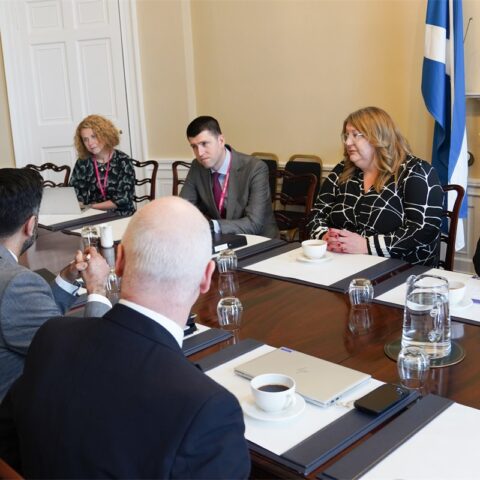
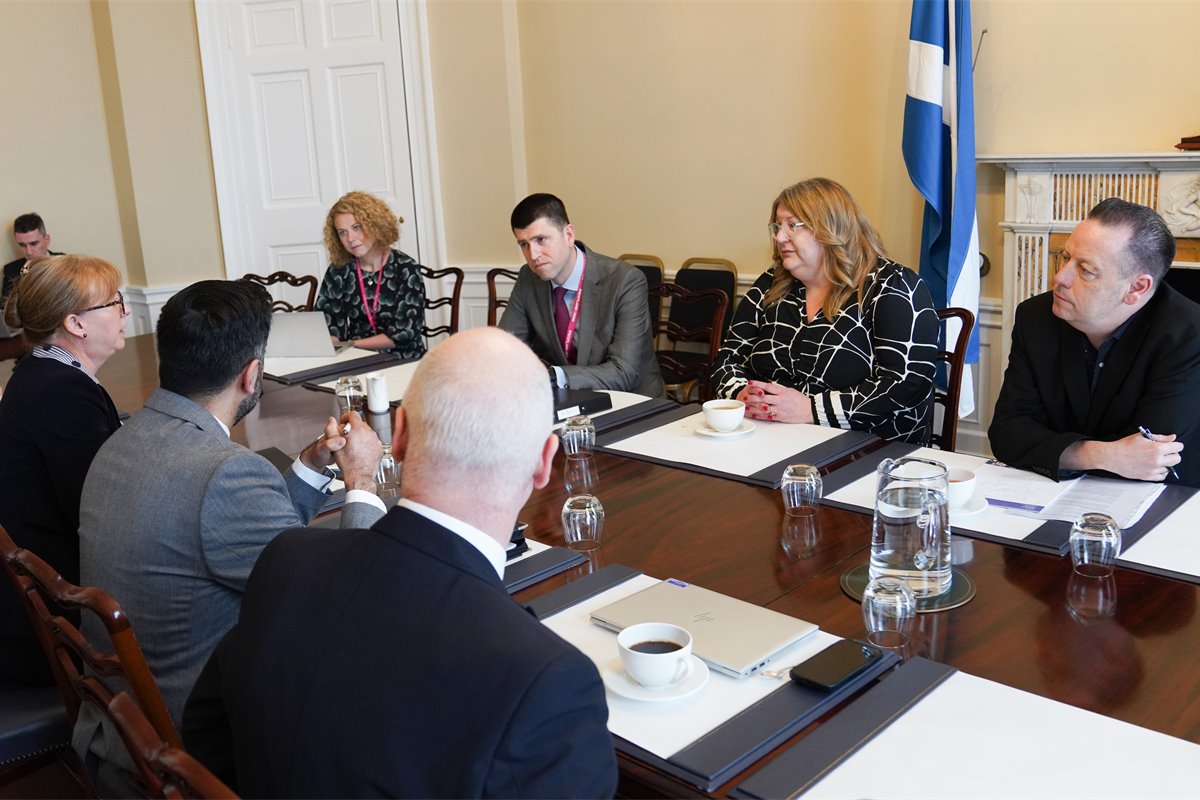
Discussions continued into November. During Scottish Parliament questions on 10 November, Deputy First Minister Jenny Gilruth confirmed that ministers had met COSLA’s presidential team on 4 November and had agreed that reform should be developed with local government, communities, employees and trade unions.
Nevertheless, concerns about the timetable and level of detail remained apparent during the parliamentary exchange.
What Happens to Council Employees?
COSLA and the local government trade unions UNISON, GMB and Unite have jointly warned that the proposed restructuring is creating uncertainty for employees.
Their concerns include the possible transfer of staff, future employment arrangements and the protection of terms and conditions.
This is not a minor consideration. The Government’s plan envisages common regional administrative structures serving both regional and community authorities.
That could alter how finance, human resources, information technology, procurement and other administrative functions are organised.
It could also affect professional services currently employed or managed within individual councils.
The unions and COSLA have called for realistic timescales, meaningful workforce participation and a clear evidence base before major changes proceed.
No final staffing transfer arrangements have been announced.
Scotland’s New Local Democracy Law Adds Another Test
The consultation also takes place against a legal development previously examined by Modern Scot.
The European Charter of Local Self-Government (Incorporation) (Scotland) Act 2026 came into force on 15 October, establishing enforceable protections relevant to local democratic authority, the distribution of responsibilities, consultation and financial autonomy.
Modern Scot reported on 26 October that the Act had taken effect just as ministers were considering the replacement of Scotland’s existing councils.
The Charter establishes the principle that public responsibilities should generally be exercised by authorities closest to citizens, taking account of efficiency, the nature of the responsibilities and other relevant considerations.
It also requires prior consultation of communities affected by local-authority boundary changes and recognises principles of financial resources appropriate to local responsibilities.
These provisions do not prevent Scotland from reorganising local government. Nor do they automatically give existing councils a veto over restructuring.
They do, however, create legal standards against which the resulting arrangements and relevant government actions may be assessed.
A future reform Bill introduced at Holyrood would also require a published Charter compatibility statement under the 2026 legislation.
The precise legal consequences would depend on the final proposals and the legislative powers used to implement them.
The law therefore adds an important dimension to the consultation: ministers will need to consider not only whether the new structure is administratively practical, but whether it provides an appropriate degree of democratic local self-government.
Social Care Could Be Restructured Alongside Councils
A further unresolved issue concerns social care and social work.
The Government has explicitly included these responsibilities in its discussions about local government reform, alongside its separate proposals for NHS restructuring.
Ministers have said all options for social care and social work should be considered, including how services might operate within future regional and community arrangements.
This could have substantial consequences for services involving older people, disabled residents, children and families.
Social care frequently depends on coordination between councils, health services, housing providers and community organisations. Any redistribution of responsibilities would therefore need to account for both statutory duties and existing arrangements for delivering support.
The eventual structure of social care has not been decided.
Modern Scot has previously examined the wider consolidation of Scottish public bodies and the history of health and local-government integration. The current consultation introduces another opportunity to determine whether responsibilities will be coordinated through larger institutions, retained at community level, or shared across different public bodies.
The Public Questionnaire Is Open, but the Major Decisions Remain Ahead
Public Finance Minister Hannah Mary Goodlad said the purpose of reform was to improve services and move decision-making as close to communities as possible.
The questionnaire invites residents to comment on how local government is currently organised, which aspects of reform they consider most important, and what opportunities or concerns they identify.
Although the wider engagement programme lasts three months, the public questionnaire itself closes on Friday, 11 December.
The Government says responses will help inform the next phase of work. It has not presented the questionnaire as a referendum or as a vote on a completed replacement structure.
There is still no approved map of the proposed regional or community authorities, no final schedule distributing statutory functions between them, and no agreed system determining their respective financial powers.
Nor has the Government published a complete implementation plan showing how existing councils would transfer their staff, buildings, services, contracts and obligations.
Those decisions will determine the practical significance of the reform.
For residents, the eventual test will be whether they gain genuine influence over the decisions affecting their own communities, while retaining effective democratic oversight of the larger organisations responsible for essential public services.
The questionnaire is the beginning of public participation in that discussion, not the conclusion of it.
Sources
Scottish Government. Public Urged to Share Views on Local Government Reform. 13 November 2026. https://www.gov.scot/news/public-urged-to-share-views-on-local-government-reform/
Scottish Government. Public Sector Reform: Proposal. 21 September 2026. https://www.gov.scot/publications/public-sector-reform-proposal/
Scottish Government / Comhairle. Share Your Views on Local Governance Reform. November 2026. https://comhairle.scot/conversations/local-governance-reform
COSLA. Public Service Reform Must Start With Outcomes, Not Structures. 30 October 2026. https://www.cosla.gov.uk/news/2026/october/public-service-reform-must-start-with-outcomes%2C-not-structures
COSLA. COSLA and Local Government Trade Unions Joint Statement on Public Service Reform. October 2026. https://www.cosla.gov.uk/news/2026/october/cosla-and-local-government-trade-unions-joint-statement-on-psr
Scottish Parliament. Official Report: Meeting of the Parliament. 10 November 2026. https://www.parliament.scot/chamber-and-committees/official-report/search-what-was-said-in-parliament/meeting-of-parliament-10-11-2026
Accounts Commission. Local Government Policy Update. 5 November 2026. https://audit.scot/uploads/ac202611_local_gov_policy_update.pdf
Modern Scot. The Great Consolidation of Scotland’s Public Bodies. 21 September 2026. https://modern.scot/the-great-consolidation-of-scotlands-public-bodies/
Modern Scot. COSLA Tells Ministers Council Reform Must Be Agreed, Not Imposed. 30 September 2026. https://modern.scot/cosla-tells-ministers-council-reform-must-be-agreed-not-imposed/
Modern Scot. Scotland’s Councils Gain New Legal Protections Just as Government Proposes to Replace Them. 26 October 2026. https://modern.scot/scotlands-councils-gain-new-legal-protections-just-as-government-proposes-to-replace-them/