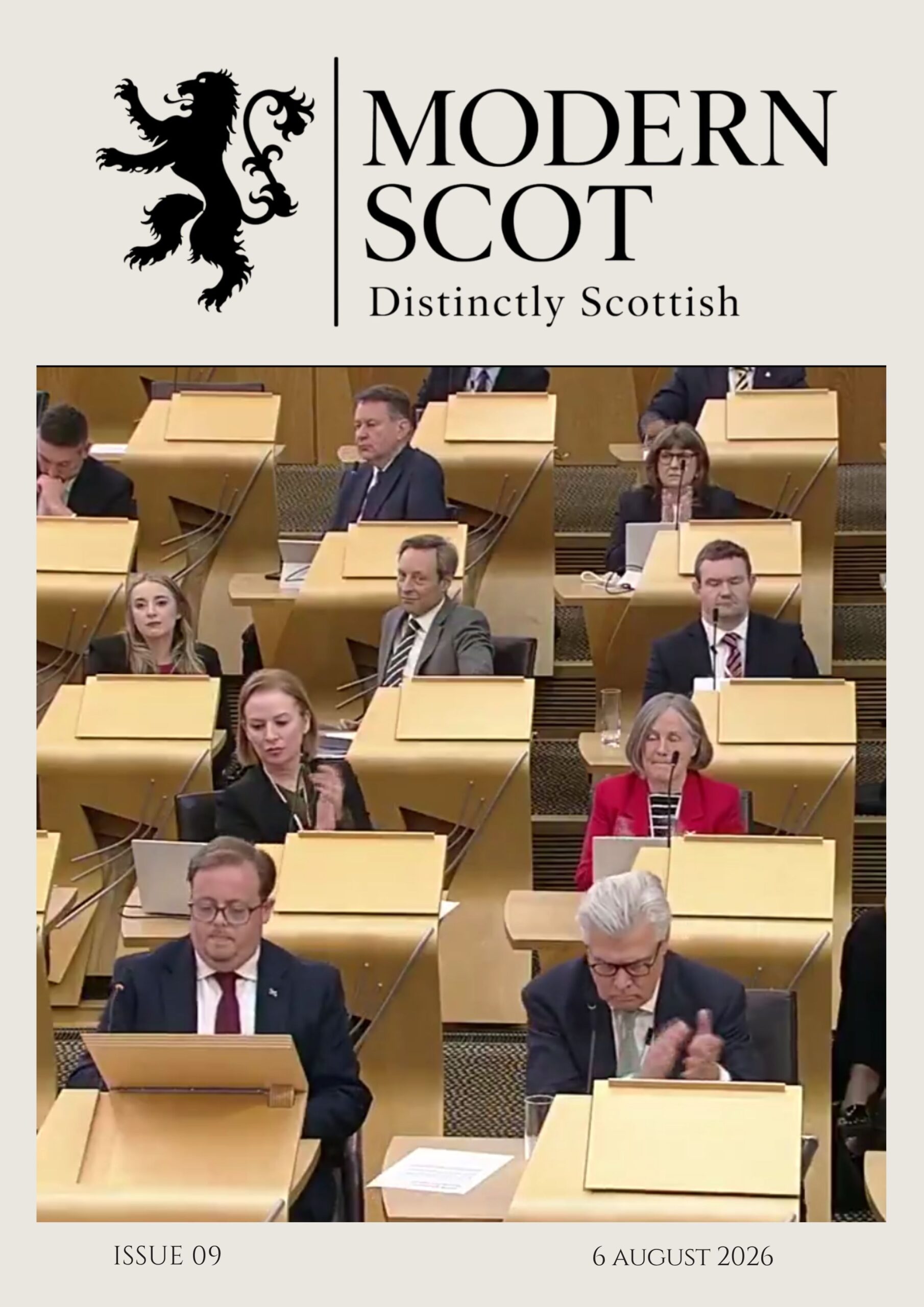

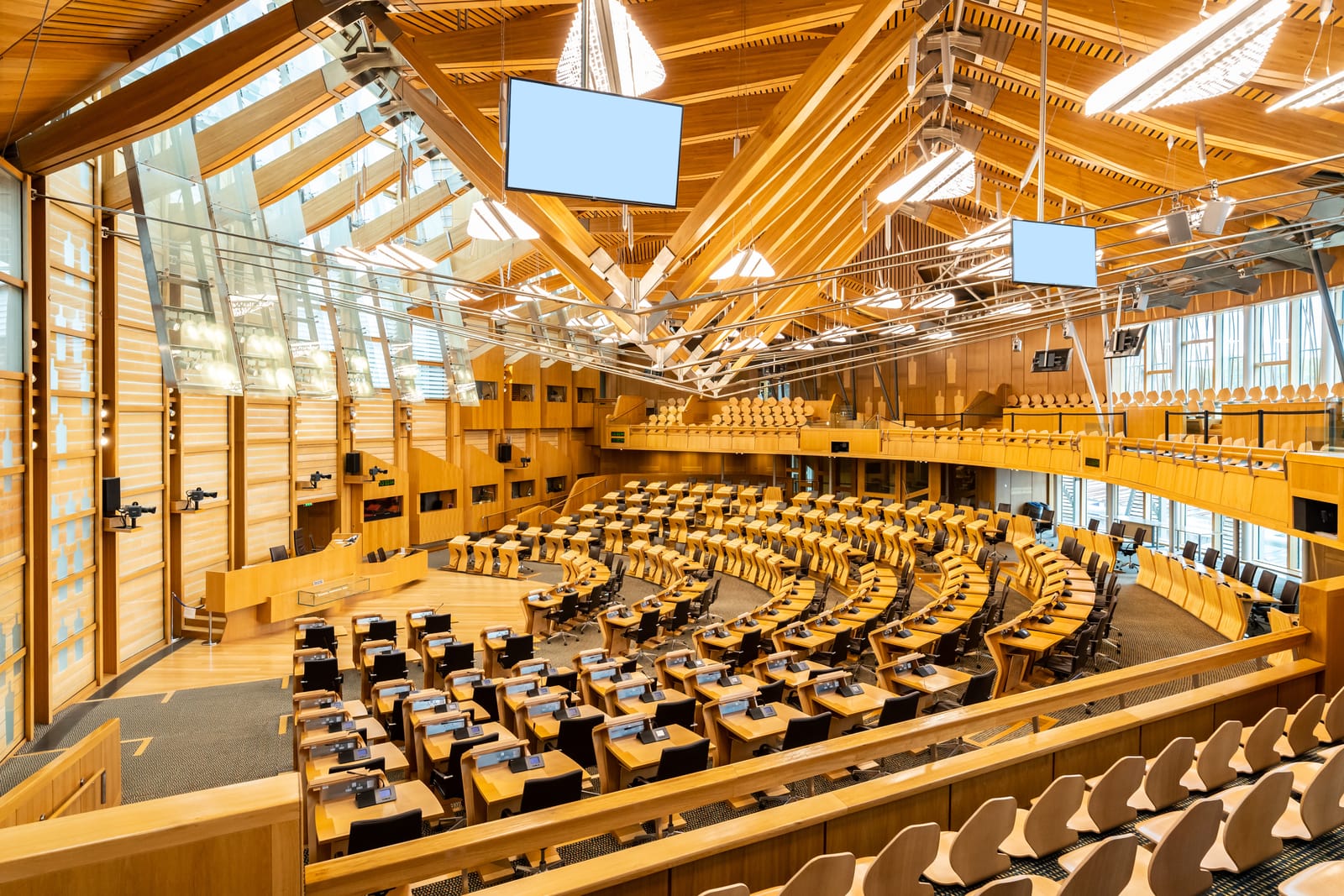
The 2026 Holyrood election has returned the SNP as Scotland’s largest party, but not with the comfort of command. Beneath the headline result lies a more fragmented Parliament, a weakened older opposition order, and an electorate that appears less settled than the seat count first suggests.
Scotland has returned the SNP as the largest party at Holyrood, but not to the political landscape it once knew.
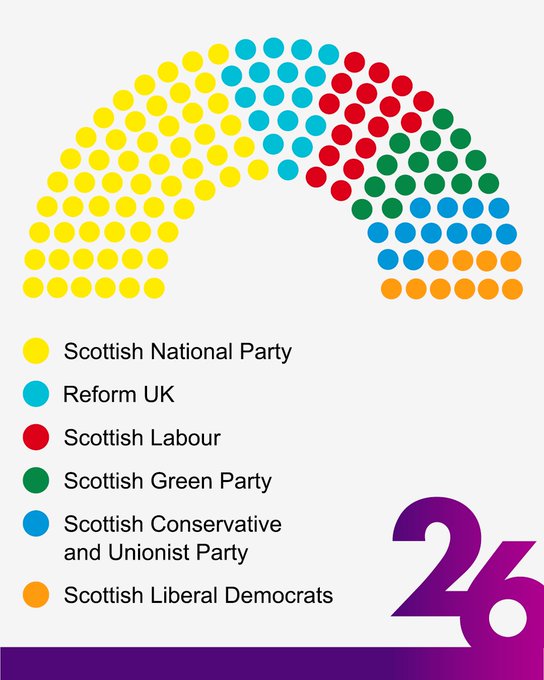
After Thursday’s Scottish Parliament election, counted on Friday, the country woke to a familiar first line and a less familiar second one. The SNP remained the largest party and secured a fifth consecutive term in government, but fell short of an outright majority. Current national reporting places the party on 58 of the Parliament’s 129 seats, below the 65 required for sole control. The result keeps John Swinney in the central position in Scottish politics, but it also leaves him facing a Parliament in which negotiation, not dominance, is likely to shape the next phase of government.
The temptation, in the hours after any election, is to make the result sound simple. Scotland has rarely obliged. Since devolution began in 1999, Holyrood has been designed to resist Westminster style landslides. Its Additional Member System gives voters two ballot papers, one for a constituency MSP and one for a regional list. The Parliament has 129 MSPs, made up of 73 constituency members and 56 regional members. Every voter in Scotland is represented by one constituency MSP and seven regional MSPs. The system was built to temper the force of first past the post with proportional correction. It does not always produce tidy government. It was never meant to.
That matters now because the 2026 result looks less like a single national verdict than a series of unsettled local and regional signals. The SNP won again, and that remains the central fact. But it did not return to the near majority strength of 2021, when Nicola Sturgeon’s party won 64 seats, one short of an overall majority. That earlier election confirmed the SNP’s long post 2007 command of Scottish politics. This one confirms something colder and more complicated: the party is still first, but it is no longer moving through a landscape arranged around its own certainty.
The historical weight of the result should not be missed. The SNP first entered government in 2007, initially as a minority administration. It won an outright majority in 2011, a result that transformed the politics of the United Kingdom and led, three years later, to the 2014 independence referendum. After that referendum, Scotland did not return to the older Labour dominated order. Instead, the SNP became the country’s governing habit. The 2026 election extends that era, but in altered condition. A fifth term is a political achievement of real scale. A fifth term without a majority is also a warning. Governing parties can endure even as the electorate becomes more restless.
The opposition picture is no less revealing. Labour’s result appears to have fallen far short of the recovery some had expected. The Guardian reported Labour and Reform UK each on 17 seats, with Labour recording its weakest Holyrood performance since devolution in 1999. That is a remarkable position for a party that once treated Scotland as a foundation stone of its British electoral strength. In the first Scottish Parliament election in 1999, Labour was the dominant force in devolved Scotland. In 2026, it remains important, but no longer inevitable.
The Conservatives also appear diminished. Current reporting places them on 12 seats, behind both Labour and Reform UK. For a party that held second place at Holyrood in recent years, the result suggests a serious squeeze. In 2021, the Conservatives won 31 seats and remained the principal unionist opposition. In 2026, that role is no longer secure. The arrival of Reform UK as a substantial parliamentary presence has changed the right of centre map, and with it the language of opposition politics at Holyrood.
Reform’s performance is one of the most important facts of the election, not because it won government, but because it entered the Scottish Parliament as a force large enough to alter debate. Current national reporting puts Reform UK on 17 seats, level with Labour. That is not a footnote. It is a sign that some Scottish voters who were not persuaded by the older party structure have found a new vehicle, however controversial that vehicle may be. A serious review of the election does not need to praise or condemn that development. It does need to notice it.
The Greens, meanwhile, appear to have strengthened their position. According to current reporting, the Scottish Greens recorded a historically strong performance, including constituency breakthroughs. The Guardian reported the party on 15 seats and said it had captured two constituency seats. The Times also reported Green constituency gains, including Edinburgh Central and a Glasgow seat formerly associated with Nicola Sturgeon. If confirmed in the final official record, those gains mark an important shift for a party that has often relied heavily on regional list representation. Constituency victories are different. They suggest that support has rooted itself in particular places, not merely in the proportional balance of the electoral system.
The Liberal Democrats also had a meaningful election, particularly in the north and west. Highland Council’s official results show the party winning Caithness, Sutherland and Ross, where David Green took 14,666 votes against the SNP’s Maree Todd on 9,574. In Skye, Lochaber and Badenoch, Andrew Baxter won for the Liberal Democrats with 15,223 votes, ahead of the SNP’s Eilidh Munro on 14,273. In Inverness and Nairn, the SNP held the seat, but narrowly: Emma Roddick won with 11,162 votes against Liberal Democrat Neil Alexander on 10,735. These are not merely Highland curiosities. They show that in parts of Scotland where distance, ferries, rural services, depopulation and public infrastructure are not abstractions, the governing party faced a sharper local test.
That pattern should be handled carefully. It would be easy to declare a revolt of the north, and easy journalism is seldom worth the ink. The safer conclusion is narrower and stronger. In several Highland constituencies, Liberal Democrat candidates were able to turn local discontent into parliamentary victories or near victories. That may reflect dissatisfaction with national government, but it may also reflect candidate reputation, local organisation, and long standing Liberal Democrat strength in parts of the Highlands and islands.
Edinburgh and Glasgow also mattered. The Times reported that Edinburgh now has a more varied political representation, with four parties holding seats in the capital after significant swings. It also reported Green breakthroughs in Edinburgh Central and Glasgow. These urban results suggest that the politics of Scotland’s cities is not only a contest between nationalism and unionism. It is increasingly shaped by housing, climate, younger voters, public services, identity, rent, transport and the daily costs of remaining in a city that can price out the people who make it live.
There is also the matter of turnout. The Guardian reported turnout at 53.1 percent, notably lower than the 2021 election. That figure, if it stands in the final official record, should trouble every party. Low turnout is not a mandate for cynicism, but neither is it a detail to be swept aside. In a Parliament created to bring democratic power closer to Scotland, more than a third of a century after the failed 1979 devolution referendum and nearly three decades after the successful 1997 vote, public disengagement is itself a political fact.
The deeper history is useful here. Scotland voted in 1997 to establish its Parliament, and Holyrood first met after the 1999 election. That institution was supposed to change not only where decisions were made, but how politics felt. It promised scrutiny closer to home, committees with teeth, and a less theatrical culture than Westminster. At times, Holyrood has delivered that. At other times, it has reproduced familiar evasions in a different chamber, only with better stonework.
This election belongs to that longer story. It does not overturn devolution. It does not end the SNP era. It does not restore the Labour Scotland of the late twentieth century. It does not make Reform the new government, nor the Greens the new centre of power. What it does is more subtle. It confirms that Scottish politics has entered a more crowded phase. The binary habits of the last decade are still present, especially around independence, but they no longer explain enough on their own.
For John Swinney, the result is both a victory and a discipline. He can say that the SNP has won again, and he would be right. He can say that the party remains the largest voice in the Scottish Parliament, and he would be right again. But a minority position requires consent beyond one party’s benches. Budgets, reforms, public service decisions and legislative programmes will now depend on arithmetic and persuasion. That is not an accident of the system. It is the system doing what it was built to do.
For Labour, the result raises a harder question. The party had hoped that holding power at Westminster would help it look like a government in waiting in Scotland. The election suggests something more awkward. Scottish voters may be dissatisfied with the SNP, but dissatisfaction is not the same as transfer of trust. Labour still has roots in Scotland, but the result suggests that historical strength does not automatically become renewed confidence.
For the Conservatives, the immediate challenge is practical and serious. If Reform can take enough of the opposition space to leave the Conservatives weakened, the party must decide whether it is defending an older unionist identity, rebuilding as a centre right Scottish force, or trying to survive a changed political argument. The election has not removed conservatism from Scotland. It has made the party organisation that traditionally carried it look less secure.
For the Liberal Democrats and Greens, the election offers opportunity of different kinds. The Liberal Democrats can point to places where they defeated or seriously challenged the SNP, especially in rural and northern Scotland. The Greens can point to signs that their vote is no longer only proportional and urban in a general sense, but able to win named constituencies. Both parties may now matter more in the daily work of Parliament than their raw seat totals alone suggest.
For Reform, the question is whether breakthrough can become responsibility. Protest is easier than legislative craft. Holyrood’s committee system, budgets, amendments and devolved responsibilities will test whether a party built partly on disruption can turn electoral support into parliamentary influence. If Reform’s new MSPs want to shape Scottish politics rather than merely disturb it, they will have to do the less glamorous work of scrutiny, negotiation and legislation.
The public, meanwhile, may be sending a message less dramatic than the headlines prefer. Scotland has not chosen upheaval. It has chosen continuation under strain. It has kept the SNP first, weakened several familiar opponents, allowed smaller parties more space, and brought a new populist force into Parliament. That is not a clean verdict. It is a complicated instruction.
There will be many instant interpretations of this election. Some will say it is about independence. Some will say it is about the cost of living. Some will say it is about public services, ferries, NHS waiting times, climate, Westminster, leadership fatigue, rural neglect, city housing, or voter apathy. The honest answer is that it is probably about many of these things at once. Elections are rarely referendums on one grievance. They are inventories of accumulated trust and accumulated irritation.
The 2026 Scottish Parliament election has therefore produced something more important than a night of winners and losers. It has produced a Parliament that looks more like the country’s unease. The SNP still leads. The old opposition order has shifted. Smaller parties have gained room. Reform has arrived. The Greens have deepened their claim. The Liberal Democrats have reminded Scotland that local political memory can still defeat national momentum.
The next test will not be what the parties say about the result. That will come easily enough, and with the usual quantity of solemn adjectives. The test will be whether the new Parliament can turn a fragmented mandate into competent government. Scotland has voted for continuity, but not complacency. It has returned the familiar party of government, while altering the terms under which that party must govern.
In that sense, the election is not a flash in the pan. It is a marker in the longer history of devolution. Scotland’s Parliament was created to contain difference, not erase it. In 2026, that founding design has become visible again. The country has not spoken with one voice. It has spoken in several, and Holyrood will now have to listen to all of them.
SOURCES
The Guardian, John Swinney urges Starmer to show Scotland greater respect after SNP victory, 8 May 2026.
The Times, Scotland election results in maps and charts, 8 May 2026.
Highland Council, Scottish Parliamentary Elections 2026 results.
Scottish Parliament, Election 2026.
Electoral Commission, The electoral system for the Scottish Parliament election.
Scottish Parliament Information Centre, Scottish Parliament electoral system, 4 November 2025.