
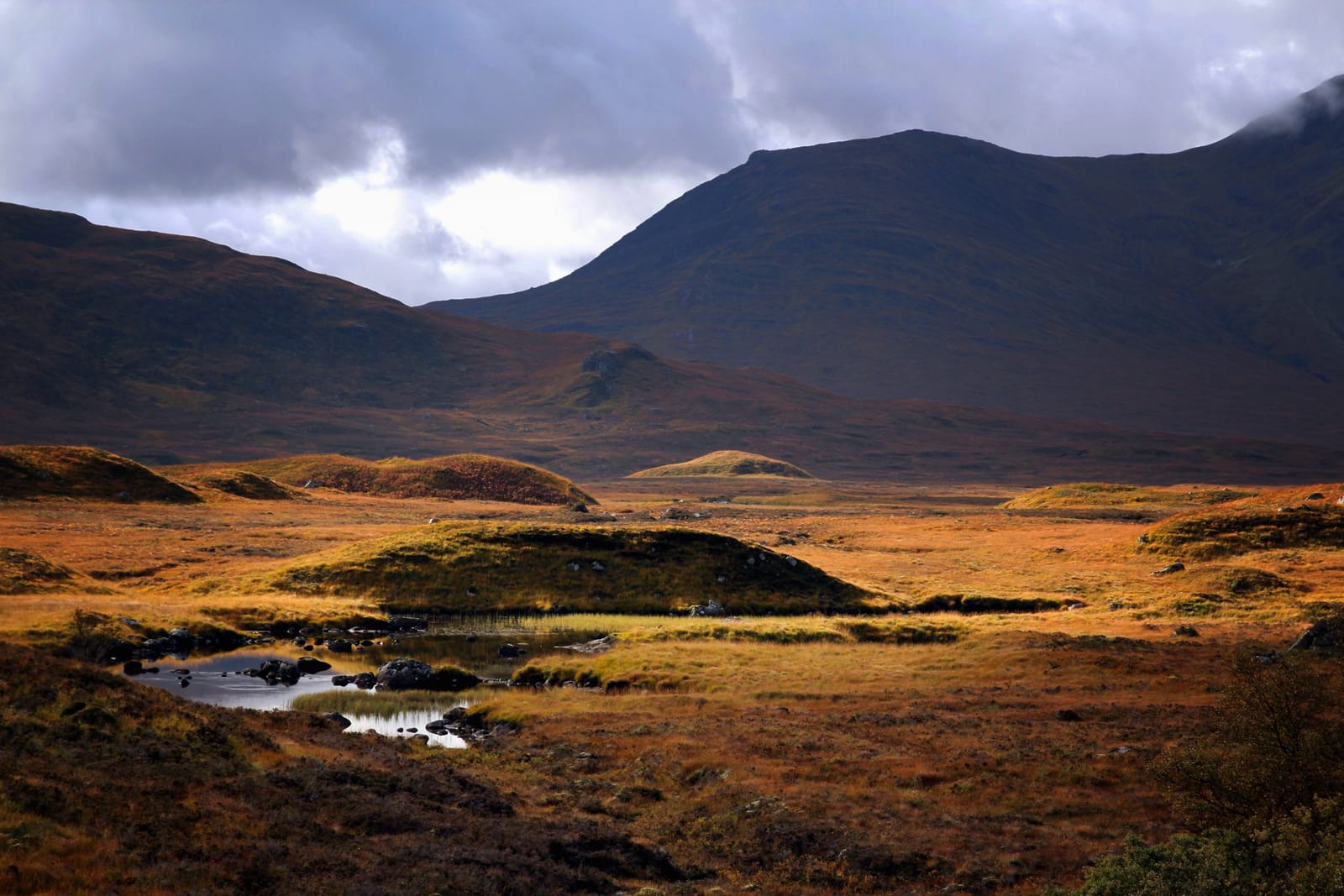
New restoration contracts appeared this week for peatland on North Uist and in the Highlands. Behind the engineering work is an emerging market in which repairing damaged Scottish land can create carbon units with owners, buyers, contracts and a place on a national registry.
On 2 September, a contract notice appeared on Public Contracts Scotland for a multi-phase peatland restoration project on North Uist Estate.
The notice was published by Caledonian Climate Partners on behalf of the estate. Contractors have until 23 September to tender for the work.
Two days earlier, on 31 August, the same company advertised another contract covering phases four to seven of peatland restoration at Invercassley in the Highlands.
Public Contracts Scotland was simultaneously carrying another peatland restoration procurement at Rosal in Sutherland.
These notices describe physical work on damaged land: peatland restoration.
There is another economy developing around such work.
Restoring peat can prevent greenhouse gases that would otherwise have been released from damaged peatland. Under an established UK system called the Peatland Code, those avoided emissions can be measured, independently checked, recorded as carbon units and transferred to buyers.
A damaged bog can therefore acquire a second description.
It remains land.
It remains habitat.
It remains a store of water and carbon accumulated over thousands of years.
Under particular conditions, its restoration can also generate a financial product.
Peat does not need to be removed for carbon to be sold
The carbon market operating around peatland is not based on extracting carbon from the ground.
It works by calculating emissions that restoration is expected to prevent.
Healthy peatlands accumulate partially decomposed plant material in waterlogged conditions. Carbon contained in that vegetation can remain stored in peat for very long periods.
Drainage changes the system.
When peat dries, oxygen enters material that was previously waterlogged. Decomposition increases and greenhouse gases can be released. Erosion can expose further peat. Burning, extraction, drainage and other changes can also alter emissions.
Restoration commonly attempts to raise water levels and stabilise the peat.
That can involve blocking drainage ditches, reprofiling eroded peat, restoring vegetation and carrying out other engineering and ecological work appropriate to the site.
The climate value under the Peatland Code is calculated from the difference between the emissions expected from the damaged peatland and those expected after restoration.
The resulting unit is measured in tonnes of carbon dioxide equivalent.
One verified Peatland Carbon Unit represents one tonne of CO2 equivalent emissions prevented by restoration.
Scotland already has the machinery for turning restoration into units
The Peatland Code is a voluntary UK standard administered by the IUCN UK Peatland Programme.
Projects seeking to generate recognised units have to enter a formal process.
The land must qualify. The project has to be registered. Restoration plans and carbon calculations are independently assessed. Restoration itself is subsequently checked. The site is then verified over time.
Every Peatland Code project is recorded on the UK Land Carbon Registry.
The registry also records carbon units, transactions, ownership and use.
At the beginning of a project, the expected future carbon benefit can be represented by Pending Issuance Units.
A Pending Issuance Unit is not a verified emissions reduction.
It represents an expected future tonne of emissions saving.
Those units can nevertheless be allocated or sold before the environmental benefit has been fully delivered.
After restoration has been completed and the required period has passed, independent verification determines whether the expected change has occurred.
The first verification normally takes place five years after restoration ends.
Eligible Pending Issuance Units can then become Peatland Carbon Units.
Only the verified unit represents an emissions saving that has actually occurred under the Code.
The future carbon can be sold before it exists as a verified saving
This creates an unusual financial structure.
A restoration project may need money at the beginning for surveys, contractors, machinery, project development and monitoring.
The environmental benefit accumulates later.
Pending Issuance Units allow part of that future benefit to be marketed before final verification.
A company can therefore pay for an interest in carbon reductions expected to occur years into the future.
The Peatland Code describes a Pending Issuance Unit as effectively a promise to deliver a Peatland Carbon Unit later.
It is not guaranteed.
If the expected benefit is not delivered, the relevant pending unit can be marked as not delivered on the registry.
Verified units operate differently.
Once a Peatland Carbon Unit has been used by its owner for an eligible carbon claim, it is retired on the registry and cannot be used again.
The system is designed to prevent the same verified tonne being repeatedly sold and claimed.
So who owns the carbon?
The Peatland Code addresses this directly.
Until carbon benefits are sold, its current guidance states that the landowner is the sole owner of the emissions-reduction benefits generated by the project unless a contract establishes another arrangement.
Those benefits can be sold during the life of the project.
Project developers can also manage carbon units through registry accounts on behalf of project owners.
The registry therefore separates several roles that can easily be collapsed into the word “owner”.
There is the owner of the land.
There can be a project developer managing the restoration and carbon process.
There can be an investor providing finance.
There can be a buyer acquiring carbon units.
There may also be tenants, crofters or other people holding rights over the same land.
The Scottish Government’s principles for responsible natural-capital investment specifically address situations in which rights to carbon are transferred to third parties.
They say information about those transfers should be publicly available, including through the UK Land Carbon Registry.
Scotland has deliberately been trying to create this market
This development has not happened accidentally.
The Scottish Government has spent several years examining how private money can be brought into peatland restoration.
In 2023 it published research specifically examining ways of mobilising private investment into Scotland’s natural capital, including financial mechanisms for peatland restoration and voluntary carbon markets.
In November 2024 it published Scotland’s Natural Capital Market Framework.
The framework describes forests, peatlands, soils, water, biodiversity and other environmental systems as forms of natural capital.
It sets out a policy for attracting more private investment alongside public environmental spending.
The Government’s position is that public finance alone cannot meet the scale of restoration required.
The framework consequently supports expansion of voluntary carbon markets through the Peatland Code and Woodland Carbon Code.
It also establishes principles covering environmental integrity, land ownership, community participation and the distribution of benefits.
Carbon changed the Scottish land market before the market was mature
The first phase of natural-capital investment had consequences beyond restoration projects.
Demand for land capable of producing forestry or carbon value became part of the Scottish rural property market.
Land suitable for tree planting and degraded peat attracted buyers interested in the future financial value of carbon and natural capital.
The Scottish Land Commission began monitoring the effect.
Its 2026 Rural Land Market Insights research records what happened next.
The earlier surge has largely subsided.
Land agents interviewed for the Commission’s research said demand for land specifically for natural-capital investment fell sharply during 2024 and had almost disappeared during 2025.
The report says some early investors encountered the practical realities of owning and managing land and some struggled to exit investments profitably.
Prices for some marginal land suitable for forestry or containing degraded peat have consequently moved back towards levels seen before the earlier investment rush.
The carbon market has therefore already passed through a speculative phase before peatland carbon became an established mainstream financial asset.
The market does not require investors to buy Scotland
The Scottish Government’s natural-capital principles explicitly state that an investor seeking carbon units should consider whether ownership of the underlying land is necessary.
Other structures can be used.
An investor can finance a project.
A company can contract to buy future units.
A project developer can manage restoration and registration on behalf of an existing owner.
Carbon rights can be transferred contractually without transferring the estate itself.
The Scottish Government has encouraged management agreements, partnerships and collaboration where those structures can provide wider economic and community benefits.
This separates the market for land from the market for environmental units generated through land management.
A hectare of peatland can remain in the same ownership while the economic rights associated with its future carbon savings move elsewhere.
The contract can last longer than the transaction
Peatland restoration is not a short-term commodity trade.
The environmental change has to persist.
Projects under the Peatland Code are monitored and verified over extended periods. After the first verification, further verification normally occurs at least every ten years.
The carbon units are therefore attached to environmental performance continuing through time.
That creates obligations extending beyond the moment when a buyer pays for a unit.
Land management has to remain compatible with the restored condition.
The project has to continue meeting the Code.
Changes affecting delivery can alter the number or status of carbon units.
A buyer purchasing future carbon is consequently purchasing an environmental outcome that depends on land being managed in a particular way for years afterwards.
Fire, drought and failed restoration enter the financial calculation
Peatland is a physical ecosystem.
Carbon units do not remove ecological risk.
A restored site can experience drought.
Vegetation can change.
Restoration work can perform differently from projections.
Wildfire can damage peat and release stored carbon.
Climate change itself can alter the environmental conditions under which a restoration project was designed.
The Peatland Code therefore requires independent validation and repeated verification rather than treating the initial carbon estimate as a final result.
Pending units that cannot be delivered can be removed from circulation as not delivered.
The carbon market consequently turns environmental performance into part of financial performance.
The same land can have several economic purposes
Scottish peatland rarely exists in an economic vacuum.
It can form part of a croft.
It can lie within a sporting estate.
It can support grazing.
It can affect water management.
It can sit beside forestry.
It can contain protected habitat.
It can influence downstream flood behaviour.
It can also contain archaeological evidence preserved by waterlogged conditions.
Carbon finance adds another economic interest to the same ground.
The Scottish Government’s framework consequently requires natural-capital projects to consider wider land uses rather than maximise carbon value alone.
Its principles refer specifically to food production, biodiversity, flood management, tenants, crofters, communities and existing economic activity.
Scotland has already seen how a new land value can alter ownership
Rural land prices respond to the income and future value buyers believe land can produce.
Agriculture has long shaped that calculation.
Forestry changed it.
Renewable-energy leases changed it again in particular locations.
Carbon introduced another possible source of value.
The Scottish Land Commission’s research records sharp increases in the value of some grazing and marginal land during the earlier period of forestry and natural-capital demand.
Its 2026 report also raises the relationship between changing land use and agricultural production.
Good arable land has continued to attract agricultural buyers, while grazing land experienced larger price movements as forestry and natural-capital demand entered the market.
The Commission’s research now describes the speculative natural-capital surge as having dissipated.
What remains is a more developed policy and regulatory system for projects capable of producing verified environmental outcomes.
The Scottish Government wants communities inside the market
The Natural Capital Market Framework contains an explicit expectation that local communities should receive benefits from natural-capital projects.
It defines community benefits as intentional social and economic benefits negotiated for the long-term wellbeing of communities affected by landholdings or activities.
The framework expects projects to create benefits shared between public, private and community interests and to support community wealth building.
It does not establish a universal statutory percentage of carbon revenue that must be paid to communities.
The practical arrangements can therefore differ between projects.
The framework relies on responsible-investment principles, Scottish Land Commission guidance and engagement between owners, investors and communities.
The financial value created by a project can consequently be divided in several ways: restoration costs, project-development fees, verification and registry costs, landowner income, investor returns, carbon-buyer expenditure and any negotiated community benefit.
Public money and private carbon finance can meet on the same bog
Scotland already spends substantial public money restoring peat through Peatland ACTION.
NatureScot leads the programme with partners including national parks and other public bodies.
Private finance creates another possible funding source.
The relationship between the two is governed by rules intended to ensure that carbon credits represent environmental benefits additional to what would have happened without carbon finance.
The Peatland Code therefore applies tests around project eligibility and additionality.
Public grants and private carbon income cannot simply be treated as two unrelated payments for the same environmental result without accounting for how the project became financially viable.
Scotland’s policy has increasingly been directed towards blended structures in which public intervention can help create conditions for private capital while carbon standards protect the integrity of the units produced.
North Uist brings the market onto land with a very different history
The contract published on 2 September concerns North Uist Estate.
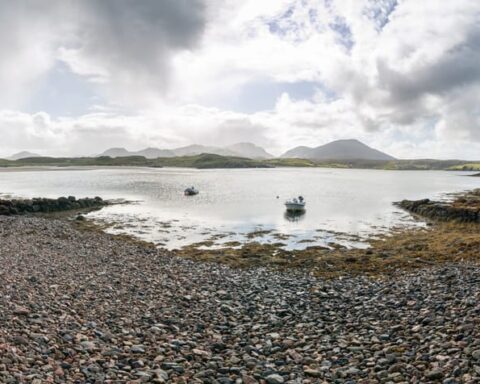
North Uist is part of one of Scotland’s most extensive peatland landscapes.
Peat there is not simply an environmental commodity.
It sits within a Hebridean landscape shaped by crofting, common grazing, domestic peat cutting, estate ownership, conservation and community life.
The new contract notice does not itself state that the North Uist restoration project will generate Peatland Code carbon units.
It should not be assumed that every peatland restoration contract is a carbon-credit project.
Its appearance alongside other privately managed restoration procurements nevertheless shows the growing professional infrastructure around peatland work: specialist project developers, contractors, environmental assessment, engineering and long-term restoration programmes.
Carbon finance operates within that wider restoration industry.
The carbon is not the peat
The language of natural capital can make a landscape sound as though it has been converted into a balance-sheet entry.
The legal and technical structure is narrower.
A buyer of a Peatland Carbon Unit does not buy the bog.
The unit represents one verified tonne of greenhouse-gas emissions avoided through an eligible restoration project.
The land remains subject to its ownership, tenure, environmental regulation and other rights.
The unit can be transferred separately.
That separation is precisely what creates the market.
Environmental improvement that previously had no readily tradable financial unit can be measured and converted into something capable of being bought, held, transferred and retired.
Scotland is now dealing with two different natural-capital stories
The first was the rush for land.
Investors saw forestry, carbon and environmental value in Scottish rural property. Prices rose in parts of the market. Concerns followed about ownership concentration, communities, farming and the arrival of buyers whose principal interest was natural capital.
That phase has cooled considerably according to the Scottish Land Commission.
The second story is more technical.
The infrastructure of the market is being built.
There are standards.
There are independent validators.
There is a national registry.
There are project developers.
There are contracts for future units.
There are verified units capable of being retired against eligible corporate emissions claims.
There are government principles governing community benefit and responsible investment.
And there is a growing restoration industry carrying out the physical work from the Western Isles to the Highlands.
The North Uist and Invercassley contracts published this week are small entries in that larger development.
Scotland’s damaged peatlands have long been measured in hectares, depth, habitat condition and tonnes of stored carbon.
They can now also produce registered units with serial numbers, ownership records and buyers.
The next phase of Scotland’s natural-capital market will be determined not simply by how much peat is restored, but by the contracts around that restoration: who finances it, who owns the resulting carbon rights, who buys them, what obligations remain attached to the land and how much of the financial value stays in the places where the peat itself lies.
SOURCES
Proposed Peatland Restoration – North Uist Estate Multi-Phase — Caledonian Climate Partners / Public Contracts Scotland — 2 September 2026 — https://www.publiccontractsscotland.gov.uk/search/show/search_view.aspx?ID=SEP563598&catID=
Invercassley Phases 4-7 Peatland Restoration – Highland — Caledonian Climate Partners / Public Contracts Scotland — 31 August 2026 — https://www.publiccontractsscotland.gov.uk/search/show/search_view.aspx?ID=AUG563460&catID=
Peatland ACTION – Fund – How to apply — NatureScot — updated September 2026 — https://www.nature.scot/climate-change/nature-based-solutions/peatland-action/peatland-action-fund-how-apply
Peatland ACTION – Processing and assessing applications — NatureScot — 2026 — https://www.nature.scot/peatland-action-processing-and-assessing-applications
Peatland ACTION and Peatland Code – Frequently Asked Questions (FAQs) — NatureScot — 2026 — https://www.nature.scot/climate-change/nature-based-solutions/nature-based-solutions-practice/peatland-action/peatland-action-resources/peatland-action-and-peatland-code
Natural Capital Market Framework — Scottish Government — 5 November 2024 — https://www.gov.scot/publications/natural-capital-market-framework/
Section 1: Attracting more high-integrity private investment in Scotland’s natural capital — Scottish Government — 5 November 2024 — https://www.gov.scot/publications/natural-capital-market-framework/pages/3/
Mobilising private investment in natural capital: report — Scottish Government — 27 April 2023 — https://www.gov.scot/publications/mobilising-private-investment-natural-capital/
Executive summary – Mobilising private investment in natural capital: report — Scottish Government — 27 April 2023 — https://www.gov.scot/publications/mobilising-private-investment-natural-capital/pages/3/
Section 1: Introduction – Mobilising private investment in natural capital: report — Scottish Government — 27 April 2023 — https://www.gov.scot/publications/mobilising-private-investment-natural-capital/pages/4/
Section 7: Scotland Carbon Fund – Mobilising private investment in natural capital: report — Scottish Government — 27 April 2023 — https://www.gov.scot/publications/mobilising-private-investment-natural-capital/pages/10/
Scotland’s Climate Change Plan: 2026–2040 – Annex 3: Monitoring and Analytical Annex — Scottish Government — 2026 — https://www.gov.scot/publications/scotlands-climate-change-plan-2026-2040-annexes/pages/15/
Peatland ACTION – Update and conversation on change to support expansion of peatland restoration in Scotland — NatureScot — 2024 — https://www.nature.scot/doc/peatland-action-update-and-conversation-change-support-expansion-peatland-restoration-scotland