

Researchers at the University of Strathclyde have used chemistry associated with whisky production to propel tiny particles through liquid. The work is early laboratory science, but it shows how a traditional Scottish industry can still offer serious ideas to modern materials research.
Scientists at the University of Strathclyde have used chemistry associated with whisky production to make microscopic particles move through liquid.
The research, published in ACS Applied Materials & Interfaces, was carried out by Khalifa Mohamed, Kelly Henze and Juliane Simmchen in Strathclyde’s Department of Pure and Applied Chemistry. The paper is titled “Whisky Inspired Active Matter” and examines whether the chemical reactivity between copper and sulfur compounds, familiar in whisky making, can be used to power microscale movement.
The work does not mean whisky is being poured into machines. It means researchers have taken a real piece of whisky chemistry and tested whether that reaction can be adapted for active matter research, where tiny particles are designed to move under their own chemical power.
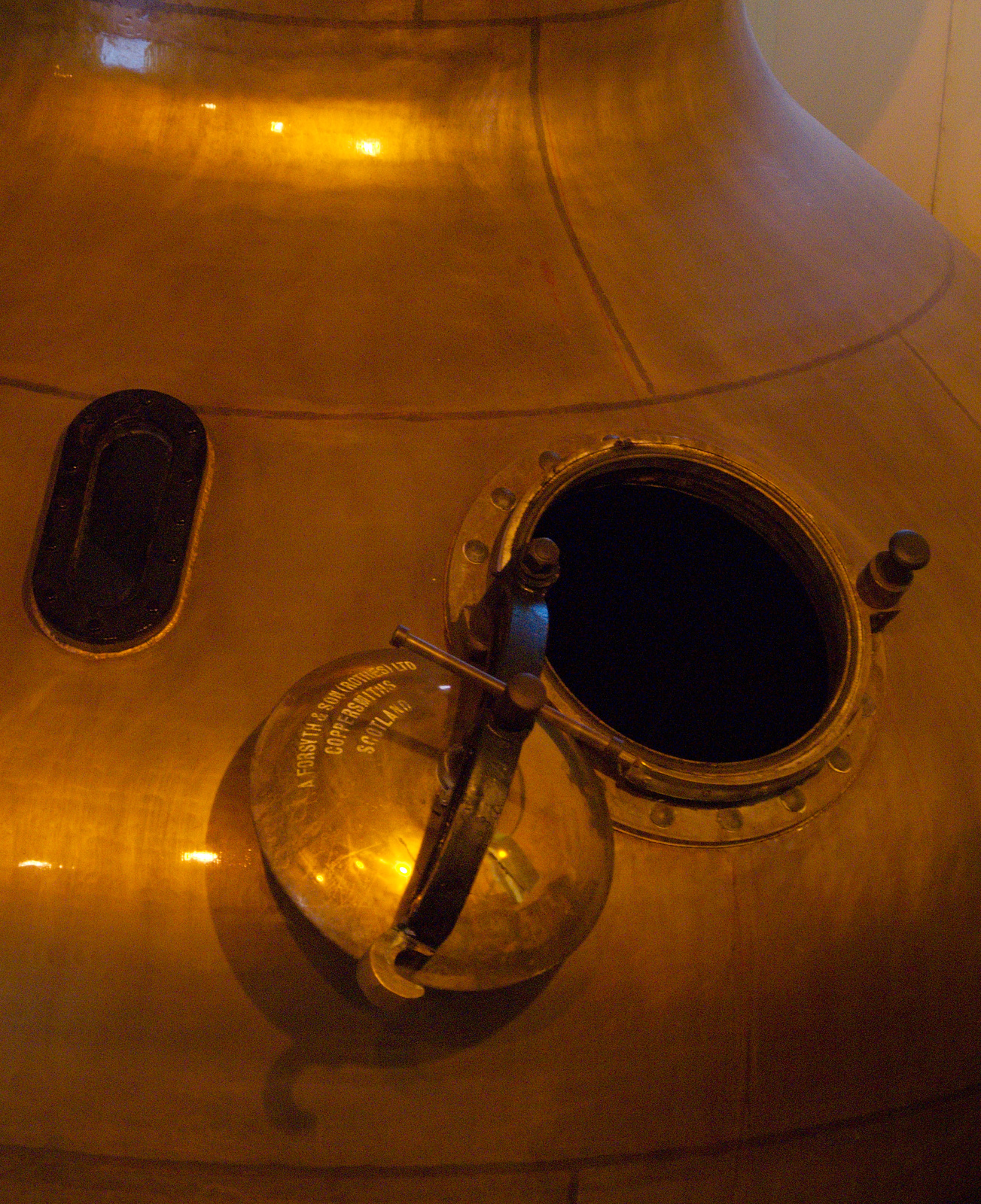
In whisky production, copper plays a long established role. Copper stills interact with sulfur compounds during distillation, helping shape the final aroma and flavour of the spirit. The same chemistry also slowly consumes copper over time, which is one reason stills must eventually be repaired or replaced.
The Strathclyde researchers used that copper and sulfur relationship as inspiration for microscopic swimmers. Their system used spherical silica particles partly capped with copper. These are known as Janus particles, named after the Roman god with two faces, because the particle has two different sides. In this case, one side is copper and the other is silica.
The particles were placed in liquids containing dimethyl sulfide and other sulfur containing compounds. Dimethyl sulfide is one of the sulfur compounds associated with whisky chemistry. The researchers examined whether these chemicals could serve as fuel for the motion of the copper capped particles.
The study found that water soluble aliphatic monosulfides could actuate the microswimmers, with speeds reaching up to 30 micrometres per second. At that scale, such movement is not trivial. The particles are only micrometres across, so motion has to be distinguished from ordinary random movement in liquid, known as Brownian motion.
The American Chemical Society’s public explanation of the work says the team used custom Python code to distinguish active swimming from Brownian motion. It describes a proposed mechanism in which copper oxidises in solution, creating a local gradient of copper ions. Those ions react with dimethyl sulfide to form dimethyl sulfoxide, with the resulting chemical gradient helping propel the particles.
The possible uses are still future questions. Microswimmers and active matter are being studied internationally because they may one day contribute to systems that move, mix, sense or respond at very small scales. Potential areas of interest include materials science, environmental sensing, microfluidics and biomedical research. The Strathclyde work does not deliver those applications by itself. It adds another chemical route that researchers can study and refine.
For Scotland, the value of the work lies partly in how it connects old and new industrial knowledge. Whisky is too often treated only as heritage, tourism or export value. Those are real parts of the industry, but they do not exhaust its significance. Distilling is chemistry, engineering, materials wear, fluid dynamics, cask science, fermentation, microbiology, temperature control and sensory analysis. The industry contains scientific questions that are not trapped in the past. The Strathclyde paper makes that visible.
SOURCES
ACS Applied Materials & Interfaces, “Whisky-Inspired Active Matter”, 20 April 2026
University of Strathclyde Strathprints, “Whisky-inspired active matter”
University of Strathclyde research portal, “Whisky-inspired active matter”
American Chemical Society, Headline Science, “Tried-and-true whisky chemistry powers microswimmers”
Phys.org, “Whiskey chemistry propels microscopic machines through liquid”, 3 June 2026
ACS Figshare, “Whisky-Inspired Active Matter” supporting collection