
More than 10,000 people and organisations were notified that they had a right to participate in the examination of SSEN Transmission’s proposed power line between Aberdeenshire and Angus. The project is intended to remove constraints on Scotland’s electricity network, but its route across farmland, private water catchments and rural landscapes remains contested.
Scottish ministers are considering more than 10,000 representations associated with one of Scotland’s most contested current electricity transmission projects.
A Scottish Government environmental-information release concerning objections to the Kintore–Tealing line was published on 20 July. Separate figures provided to the Scottish Parliament show that the Planning and Environmental Appeals Division notified 10,524 individuals and organisations that they had a right to take part in the examination. The total comprised 10,493 interested parties and 31 statutory consultees. Of the interested parties, 10,005 were contacted by email and 488 by letter.
Those figures require careful description. The government did not say that 10,524 separate objections had been submitted. The total includes statutory consultees and interested parties entitled to participate, rather than a verified count of individually written objections opposing every aspect of the development.
Campaigners have described the response as approximately 11,000 objections. That conveys the scale of organised opposition, but the official participation figure is the more precise measure.
The number of representations will give the decision political weight. It will not decide the application by itself. Electricity consent is not determined by counting submissions as votes. Reporters and ministers must consider the planning, environmental and technical substance of the evidence alongside national energy policy and the developer’s case.
SSEN Transmission applied on 19 September 2025 for consent under Section 37 of the Electricity Act 1989 and for deemed planning permission under Scottish planning legislation.
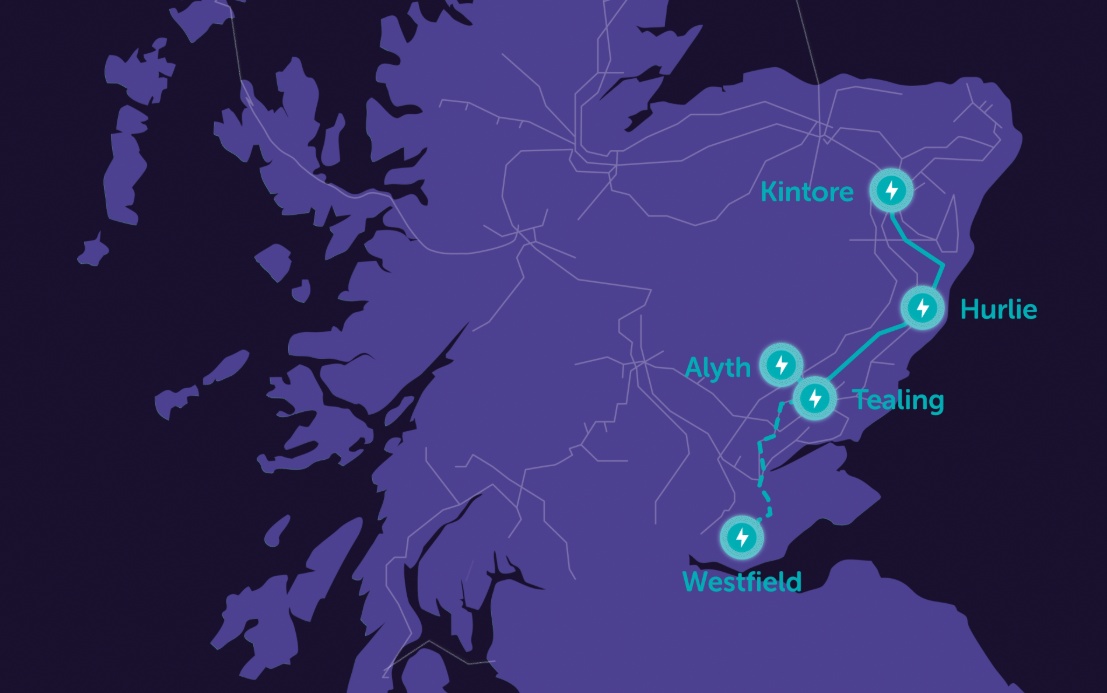
The company describes the main development as an approximately 106-kilometre, double-circuit 400kV overhead line between Kintore and Tealing. It would run from the existing Kintore substation to a proposed substation at Hurlie in Fetteresso Forest and then to the proposed Emmock substation near Tealing. The steel lattice towers would average around 57 metres in height.
The formal Energy Consents Unit description is more extensive. It records 105.2 kilometres of principal new 400kV line, together with approximately 13.84 kilometres of crossings, diversions, realignments and reconductoring involving existing 132kV and 275kV lines.
Including those associated works, the application comprises approximately 119.04 kilometres of new overhead line. The maximum support height recorded in the application is 71.67 metres. The familiar 106-kilometre description is therefore accurate for the main connection, but does not include every overhead-line intervention forming part of the application.
Consultation feedback was not a formal representation
SSEN held several rounds of public consultation before submitting the application. The company says feedback influenced the development of the project and the examination of route alternatives.
Comments submitted to SSEN during that period did not automatically become formal representations before Scottish ministers.
SSEN’s own project information made the distinction clear. Comments sent to the applicant during the development process were consultation feedback. People wishing their views to form part of the statutory decision-making process had to submit them separately to the Energy Consents Unit after the application was lodged.
A resident could therefore attend an exhibition, write to SSEN and object to the proposed alignment, yet still have no formal representation before ministers unless the objection was submitted again through the government process.
Some of the later objections were prepared with assistance from ObjectNow, an artificial-intelligence tool trained using the application documents and material assembled by campaigners.
The Financial Times reported that the software facilitated approximately 11,000 objections within three weeks. It allowed users to generate lengthy submissions, review the text and add personal information. Campaigners said the tool helped people engage with hundreds of complex planning and environmental documents. Industry representatives raised concerns about duplication, administrative pressure and the possibility of automated systems overwhelming consenting bodies.
The use of a drafting tool does not make a representation invalid. Equally, the repetition of the same argument across thousands of submissions does not necessarily increase its evidential weight. The examination must distinguish between the scale of public concern and the strength of the planning and environmental points raised.
Angus and Aberdeenshire reached different positions
Angus and Aberdeenshire councils did not reach the same conclusion about the line.
Angus Council held a special meeting on 17 November 2025. Planning officers had recommended that the council raise no objection, subject to conditions, but councillors voted unanimously to object.
The council’s case included unacceptable landscape and visual effects, cumulative effects arising from other energy infrastructure, risks to biodiversity and the loss of ancient woodland.
An objection from a relevant planning authority requires ministers to arrange an examination before determining a Section 37 application. The case was referred to the Planning and Environmental Appeals Division on 19 January 2026.
Reporters David Liddell and Christopher Warren have been appointed. The case is being considered through hearings and further written submissions, including community sessions and hearings on landscape, visual effects and planning conditions.
Aberdeenshire Council submitted no objection.
The Aberdeenshire response was issued through the council’s planning service rather than following a vote of the full council. The published material includes a covering letter, report of handling, proposed conditions and comments from elected members.
A no-objection response does not mean the council found the development harmless. It can still request mitigation and detailed conditions. Angus Council’s objection is not a veto either. It triggered examination of the disputed issues, but Scottish ministers retain the final decision.
The procedures nevertheless gave residents different forms of visible political participation. Angus councillors debated the matter publicly and rejected the recommendation made by their officers. In Aberdeenshire, the council’s response was completed through established delegated arrangements.
Private water supplies required further information
Private water supplies have become a distinct part of the examination.
The Energy Consents Unit requested additional information on 19 January. SSEN submitted further material on 27 February covering private supplies, groundwater abstractions and updates to the hydrology, hydrogeology and soils sections of its environmental assessment.
Many rural homes and businesses are not connected to the public water network. They depend on springs, wells, boreholes or surface catchments that may be affected by changes to drainage, soil conditions and groundwater movement.
Construction of the line would involve tower foundations, access tracks, vegetation clearance, compounds, heavy vehicles and work near watercourses. The potential risk to an individual supply depends on the location and design of the work and the characteristics of the catchment.
The request for further information is not evidence that water supplies will be contaminated. It shows that the original environmental material was not accepted as the final evidence on the subject. The reporters must decide whether supplies have been properly identified and whether avoidance measures, monitoring and contingency arrangements are adequate.
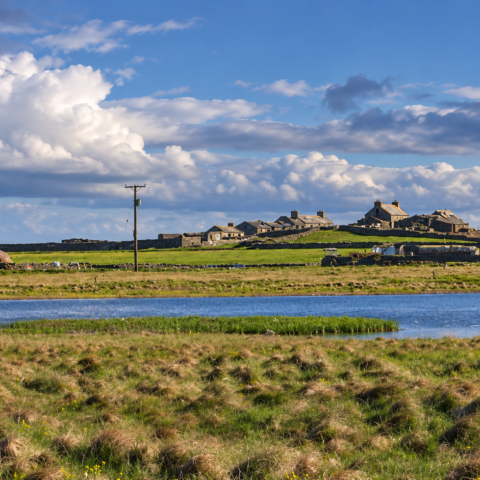
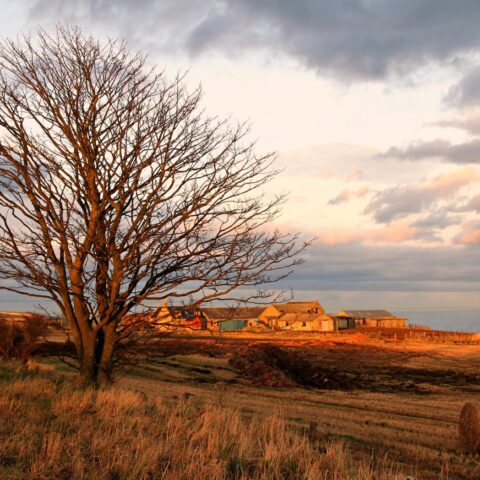
The route would also cross productive agricultural land in Angus and Aberdeenshire. Farmers and landowners have raised concerns about foundations, drainage, soil compaction, access tracks, construction traffic and the effect of overhead conductors on the operation of machinery.
Some effects would be temporary. Others, including tower bases, access rights and safety restrictions, would remain for the operating life of the line.
SSEN says it has refined the proposed alignment in response to environmental, technical, economic and community considerations. It describes its task as identifying a technically feasible and economically viable route expected to cause the least practicable disturbance.
Campaigners argue that the cumulative presence of towers, substations, access routes and related energy developments would alter the character of rural Angus and Aberdeenshire.
An average tower height of approximately 57 metres makes the visual effect unavoidable. Its severity will vary according to terrain, distance, screening and the number of structures visible together. The statutory examination must test both the developer’s visualisations and the evidence provided by residents, councils and specialist consultees.
The network has a genuine capacity problem
The case for reinforcement begins with a documented limitation in Scotland’s transmission network.
The National Energy System Operator expects electricity transfers from north to south to increase as more onshore and offshore renewable generation connects in northern Scotland.
Its assessment says the B1a transmission boundary is limited to 2GW because of a thermal constraint on the existing Kintore–Tealing 275kV circuit. Farther south, the B4 boundary between the SSEN Transmission and SP Transmission networks is limited to 4GW by a thermal constraint on the Tealing–Westfield 275kV circuit.
When more electricity is generated than the network can carry, the system operator may pay generators to reduce production and arrange replacement electricity elsewhere. Those constraint costs are ultimately recovered through the electricity system.
The proposed line forms part of the Accelerated Strategic Transmission Investment programme approved by Ofgem. The wider East Coast reinforcement is intended to carry more electricity along Scotland’s eastern transmission corridor, accommodate additional generation and reduce reliance on older 275kV infrastructure.
That establishes a need for greater transmission capacity. It does not settle whether SSEN’s chosen alignment, tower design and mitigation are acceptable.
Underground cables, subsea links and alternative overhead routes have different construction costs, technical limits and environmental effects. Undergrounding can reduce long-term visual effects but requires extensive excavation and may create greater disruption to soils, drainage and agriculture during construction. Subsea alternatives require landing points, converter or substation infrastructure and connections back into the onshore system.
The question before ministers is therefore not simply whether the grid requires investment. It is whether the submitted project is a justified and proportionate way to provide it.
Consumers ultimately fund approved costs
SSEN Transmission is a privately owned, regulated network company. It raises initial capital for transmission projects through debt and equity rather than receiving the full construction cost as a direct government grant.
Ofgem determines which efficient costs the company may recover through regulated revenues. Those revenues are ultimately paid through network charges forming part of household and business electricity bills across Great Britain.
Ofgem has awarded early construction funding equal to 20 per cent of the budget for SSEN’s wider East Coast Onshore 400kV project, which includes the Kintore–Tealing line, substations and associated reinforcement.
The cash value has not been published for commercial reasons. The allowance can support surveys, design work, procurement, enabling activity and the early ordering of scarce equipment. Ofgem has stressed that the funding is not planning consent.
A full efficiency assessment is still required. Costs judged inefficient should not be recovered from consumers, while approved expenditure would be repaid over time through network charges.
The regulator argues that greater network capacity should reduce constraint costs and exposure to volatile gas prices. Whether the eventual savings outweigh the cost of construction will depend on delivery, future generation, electricity demand and the performance of the wider system.
Current UK Government guidance recommends a community fund of £200,000 for each kilometre of qualifying new overhead line, alongside separate amounts for substations and other installations.
Applied to a 106-kilometre line, that would imply approximately £21.2 million for the overhead-line element. The guidance makes clear that these funds are ultimately financed by Great Britain’s electricity billpayers. They are separate from payments or compensation due to individual landowners.
Community funding may support useful local projects. It does not determine whether the environmental and social effects of the proposed route are acceptable.
No decision date has been confirmed
The Scottish Government has stated an ambition to determine priority transmission applications within 52 weeks of submission. For Kintore–Tealing, that period began when the application was lodged on 19 September 2025.
Ministers have confirmed that no specific determination date has been agreed. They said a decision would be taken only after consideration of the evidence and the reporters’ assessment and recommendations.
The Planning and Environmental Appeals Division currently lists 4 January 2027 as its target date. That is a target for the examination and reporting process, not a guaranteed date for a ministerial decision. It also falls beyond the government’s 52-week ambition.
The disagreement cannot be reduced to a choice between renewable energy and rural protection. Scotland’s electricity network requires greater capacity, while communities along the proposed route would carry much of the project’s physical effect.
The decision is whether this line, on this alignment, using these towers and these safeguards, is a proportionate response to the capacity the electricity system requires.
Sources
https://www.gov.scot/publications/foi-202600506154/
https://www.parliament.scot/chamber-and-committees/questions-and-answers?msp=5665&page=1
https://www.energyconsents.scot/ApplicationDetails.aspx?cr=ECU00005225
https://www.dpea.scotland.gov.uk/CaseDetails.aspx?id=126952
https://www.ssen-transmission.co.uk/projects/project-map/kintore-tealing-400kv-ohl-connection/
https://www.angus.gov.uk/committees/angus_council_special/angus_council_special_17_november_2025
https://www.gov.scot/publications/foi-202500496928/
https://www.gov.scot/publications/foi-202600501727/
https://www.parliament.scot/home/chamber-and-committees/questions-and-answers?msp=16206&page=1
https://www.ft.com/content/810a1604-d2a4-4f6d-a266-35c07f970321