
In April 1723, a German artist named Matthias Buchinger was working in Edinburgh. He made drawings on vellum so intricate that some of their writing could barely be read without magnification. He produced religious texts, coats of arms and family trees for Scottish patrons, advertised himself publicly in the city and demonstrated writing forwards, backwards, upside down and in mirror form. Some of his Scottish works survive. Others have passed through private collections and auction rooms. For much of modern Scottish art history, he has remained almost invisible.
Matthias Buchinger arrived in Scotland already carrying a reputation. Born near Nuremberg in 1674, he travelled widely through Europe before reaching Britain, where he built a career that combined calligraphy, drawing, performance and public exhibition. His work could be astonishingly small. Letters became ornament. Prayers became hair, borders and architectural detail. Heraldry could be built from lines so fine that the image appeared conventional until examined closely.
By the early 1720s, London advertisements were calling him “the Famous Mr. Buchinger”. In Edinburgh, however, the surviving evidence allows something more precise than reputation. It places him physically in the city, working for named Scots, producing dated objects and advertising where he could be seen.
One surviving handbill from 1723 announced that “Matthew Buchinger” had arrived in Edinburgh and could be seen at Mrs Mackay’s at the foot of Blackfriars Wynd. The bill presented him as “The Wonder of the World” and advertised the exceptional nature of his bodily condition and artistic abilities. The collector Ricky Jay later believed the surviving copy might be unique.
The notice belonged to a world in which artists, performers, musicians, automata, curiosities and demonstrations circulated through cities before modern museums or commercial galleries had assumed their later forms. Buchinger did not depend upon one patron or one institution. He could work for aristocrats, merchants and members of the public, sell individual examples of calligraphy and use performance itself as part of his livelihood.
Edinburgh left a dated trail of his work
On 23 April 1723, Buchinger completed an elaborate manuscript on vellum in Edinburgh containing the Ten Commandments, the Apostles’ Creed and the Lord’s Prayer. The composition placed the texts within an architectural frame and included Hebrew and Greek lettering. The sheet measured only around 15 by 12 centimetres.
The work was personalised for John Thomson, a merchant in Edinburgh, and his wife Elizabeth Ronaldson. Buchinger adapted the composition by adding a small family record naming the couple and their children.
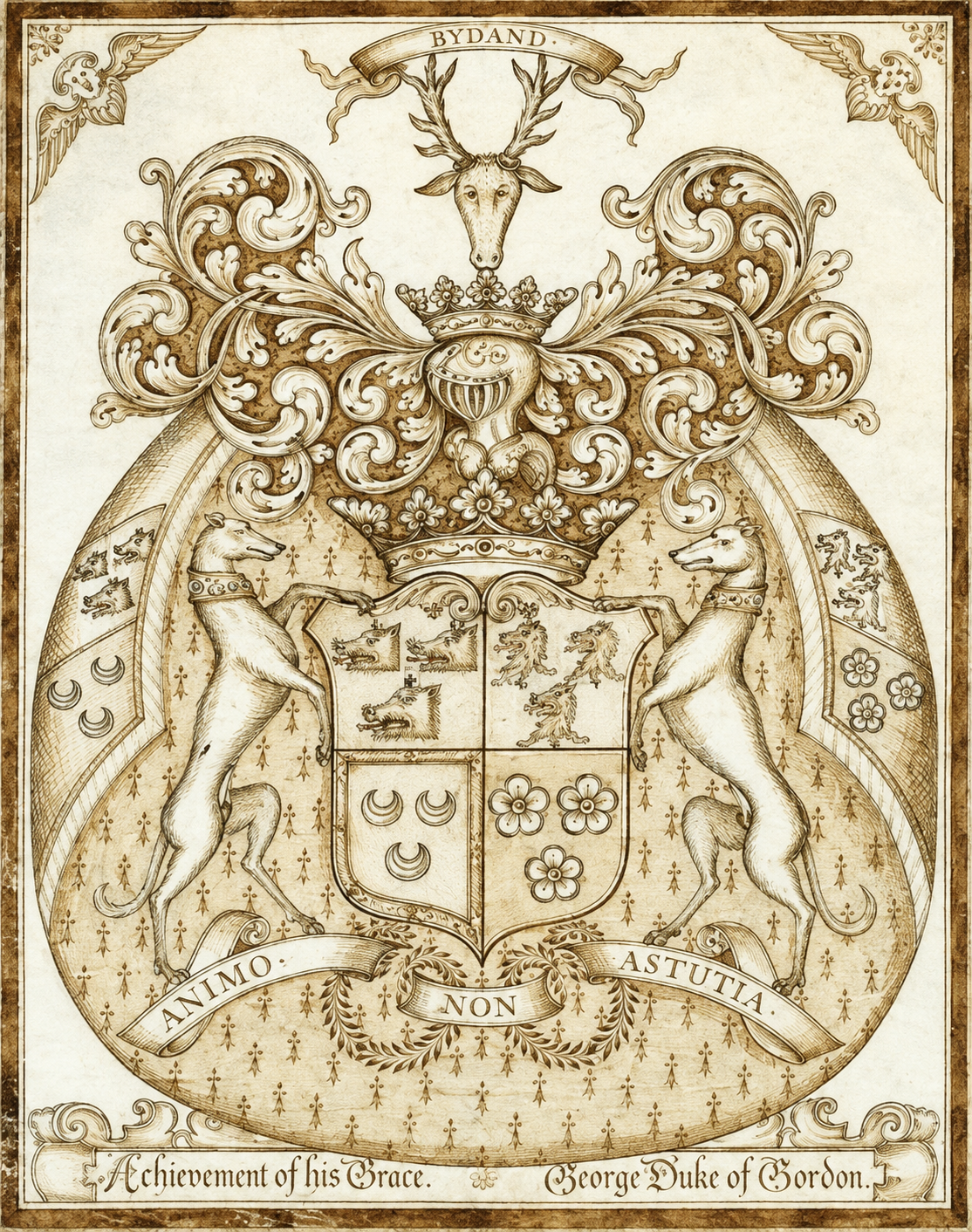
Two days later, on 25 April, he completed another Scottish commission: the coat of arms of George Gordon, 3rd Duke of Gordon.
The surviving drawing is approximately 18 by 15 centimetres and was executed in pen and brown ink over a graphite underdrawing. It carries the Gordon arms with two deerhounds as supporters, a stag’s head as crest and the mottos “Bydand” and “Animo non Astutia”. The sheet is now associated with the Ricky Jay collection and has been exhibited through the Metropolitan Museum of Art.
The Duke himself was still a child. Cosmo George Gordon had been born in 1720 and inherited the dukedom in infancy. The commission therefore belonged less to personal portraiture than to the visual culture of lineage, rank and family identity that surrounded aristocratic households.
For Buchinger, heraldry was ideal material. Coats of arms already depended upon systems of symbols, animals, text, mottoes and geometry. His skill lay in compressing complex information into spaces that rewarded close inspection.
His writing could run in every direction
Buchinger also sold demonstrations of penmanship.
A surviving calligraphic specimen made in Edinburgh on 30 April 1723 shows him writing forwards, backwards, upside down and in mirror form. The sheet is only around 15 by 18 centimetres. Beneath an ornamental alphabet, he signed himself and recorded that he had been born in Germany in 1674.
The work reveals the commercial side of his practice. Not every piece was a large commission. Buchinger could produce smaller demonstrations of virtuosity that functioned almost like portable performances. A purchaser did not simply acquire handwriting. The object preserved proof of an event: the artist had demonstrated something difficult and unusual in front of an audience.
This mattered because much of Buchinger’s reputation depended upon direct encounter. Printed descriptions circulated widely, but his appeal came from people seeing him work and then carrying away an object that authenticated what they had witnessed.
He returned to Scotland and produced his largest family tree
Buchinger’s Scottish connection continued after 1723. By the winter of 1727–28 he was again based largely in Edinburgh, where surviving works show a different scale of ambition.
One of the most remarkable is a family tree of the Stewarts of Allanton and the Denhams of Edinburgh, dated 10 May 1729. Drawn in pen and ink on vellum, it measures roughly 30 by 40 centimetres and is the largest and most elaborate family tree currently associated with Buchinger’s surviving work.
The composition commemorates the marriage of Sir Thomas Stewart and Susanna Denham in 1677. Two genealogical trees are organised around heraldic material and surrounded by ornamental borders and Latin mottoes. The amount of text is unusually large for Buchinger, turning the family’s ancestry into both document and image.
The Metropolitan Museum of Art describes the work as evidence of Buchinger’s close relationships with Scottish patrons during this period. The sheet also preserves something less visible: the appetite among Scottish elite families for genealogy as art.
Genealogy was not merely information. It was status made visible. A family tree demonstrated descent, connection, legitimacy and continuity. Buchinger transformed those claims into intricate objects that could be displayed, preserved and inherited.
Scotland suited his art unusually well
The Scottish commissions reveal how closely Buchinger’s practice matched the interests of early eighteenth-century patrons.
Heraldry remained central to aristocratic identity. Family genealogy was politically and socially useful. Religious texts still occupied an important place in domestic visual culture. Calligraphy itself possessed prestige in a period when handwriting was a practical skill but elaborate penmanship remained an art.
Buchinger could combine all of these things.
His work also arrived in Scotland at a moment of considerable institutional and social change. The Union of 1707 was still recent. Edinburgh remained the legal, intellectual and administrative centre of Scotland, while aristocratic families were renegotiating their relationship with London, Westminster and the wider British state.
In that setting, heraldic and genealogical art retained particular force. A coat of arms or family tree could assert continuity at precisely the moment political structures around the family were changing.
Buchinger did not need to be Scottish to participate in that culture. His foreignness was part of his appeal. He brought an established continental tradition of micrography, calligraphy and virtuoso penmanship into a society already accustomed to international artistic exchange.
One of his Scottish works is still in a national collection
Scotland itself retains at least one substantial Buchinger work.
The National Galleries of Scotland holds an Altarpiece dated 1728, executed in pen and brown ink on vellum. The sheet measures approximately 35 by 25 centimetres and is currently in storage rather than on permanent display.
The work belongs to the same period in which Buchinger was active in Edinburgh and demonstrates that his Scottish years were not confined to heraldic commissions or performance pieces.
Its survival in a national collection is important because much of Buchinger’s work has passed through private hands. His drawings are portable, relatively small and highly collectible. Their provenance often moves through individuals, dealers and auctions rather than remaining attached to the places in which they were made.
Much of the surviving Scottish evidence ended up far from Scotland
The dispersal of Buchinger’s Scottish work is one reason his place in Scottish art history is easy to miss.
The Duke of Gordon drawing is associated with the Ricky Jay collection and has been shown through the Metropolitan Museum of Art in New York. The Stewart–Denham family tree followed a private collecting history that included sale at Sotheby’s in London in 1983 and again in 2021. Buchinger’s Edinburgh calligraphic specimens have likewise appeared in specialist auction catalogues.
These are not objects most Scottish readers encounter in national museum displays.
The evidence survives across several different systems: major museum collections, private holdings, auction records, old printed handbills, manuscript catalogues and specialist studies of calligraphy and performance.
That dispersal creates an unusual historical problem. An artist can have spent years working in Scotland, produced substantial Scottish commissions and left material connected to Edinburgh families, yet remain marginal in conventional accounts of Scottish art because the surviving objects no longer sit together.
Buchinger was also performing himself
His reputation cannot be separated from the way his body was presented to audiences.
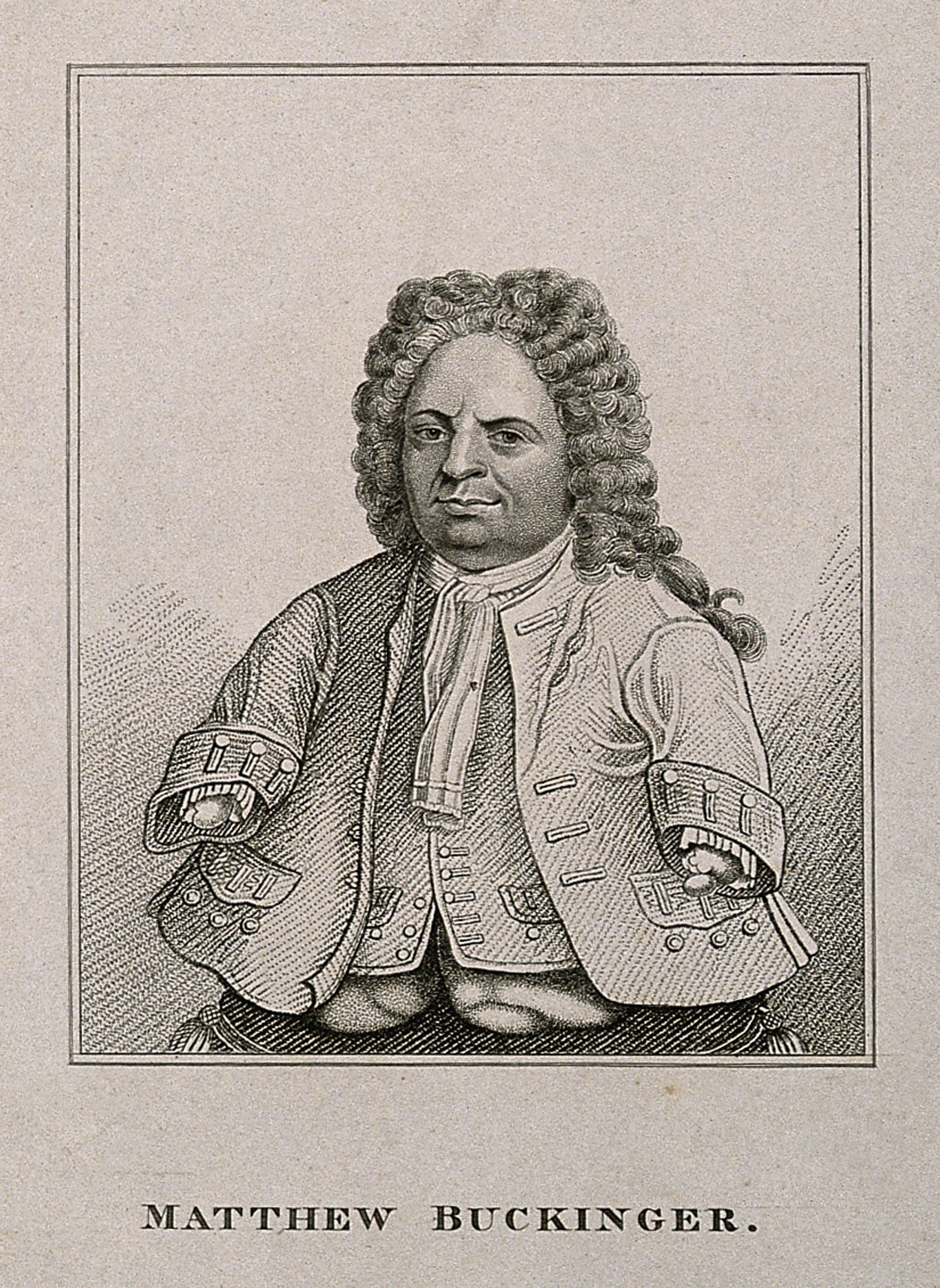
Buchinger was born without fully formed hands or feet. Contemporary advertisements repeatedly foregrounded this fact, sometimes using language that would now be recognised as spectacle marketing. He was promoted under names including the “Little Man of Nuremberg” and “The Wonder of the World”.
Yet the surviving work resists reducing him to that spectacle.
He was a technically sophisticated artist who built a long international career from precision drawing, calligraphy, music, performance and personal branding. His clientele ranged from ordinary paying spectators to aristocratic patrons. He travelled extensively and repeatedly produced signed, dated objects identifying the city in which he made them.
The Scottish works therefore preserve two histories at once. They belong to the history of disability and public performance, but they also belong to the history of drawing, typography, heraldry and manuscript art.
The two cannot be separated cleanly because Buchinger himself did not separate them. His artistic ability was part of the public demonstration through which he earned his living.
His micrography turned language into image
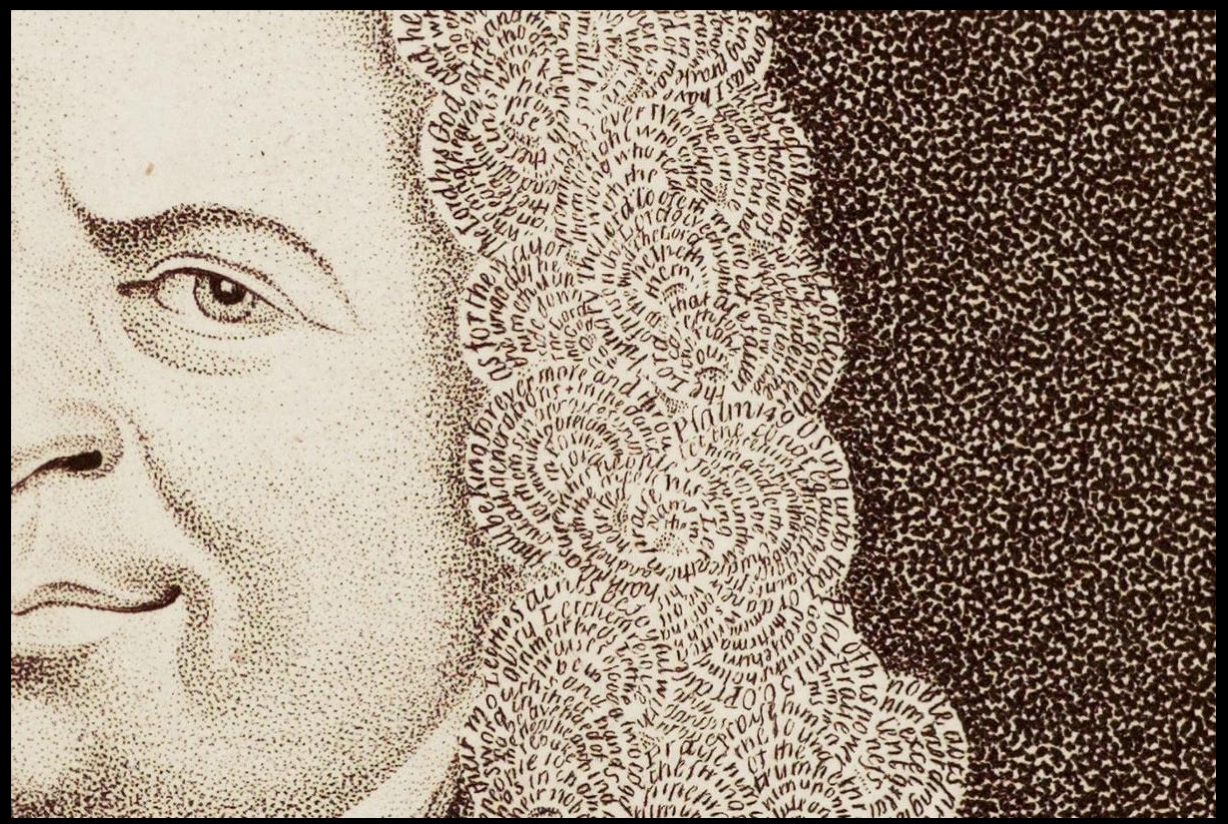
Buchinger is most famous for micrography: the construction of visual forms from extremely small writing.
His best-known self-portrait uses minute script within the curls of his wig. Under magnification, what first appears to be decorative line becomes text.
The technique belongs to an older artistic tradition in which written language could function simultaneously as image and meaning. Buchinger pushed that relationship toward virtuosity. Viewers could appreciate the overall composition from a distance and then discover another level of information when approaching closely.
That made his art unusually suited to private possession. A patron did not exhaust the object at first glance. The work rewarded handling, close viewing and repeated inspection.
His Scottish family trees use the same principle at a larger scale. Names, dates, descent and family history become the structure from which the image itself is built.
The Edinburgh handbill may be almost unique
One of the rarest surviving pieces of evidence for Buchinger’s Scottish career is not a drawing but an advertisement.
The 1723 Edinburgh handbill announcing his appearance at Mrs Mackay’s at the foot of Blackfriars Wynd survives as a single printed sheet approximately 20 by 16 centimetres. It includes a woodcut image of Buchinger and describes the abilities audiences could expect to see.
An account of the handbill appeared in The Scots Magazine in 1807, where the writer believed the surviving example to be unique. Ricky Jay, who later owned the sheet, reached a similar conclusion.
The address provides a rare geographical anchor for the story.
Blackfriars Wynd ran through Edinburgh’s Old Town from the High Street towards the Cowgate. Buchinger was therefore not operating from an abstract aristocratic court or secluded workshop. He was advertising himself in one of the busiest urban environments in Scotland.
People could read the notice, find the address and go to see him.
His Scottish work sits between fine art and popular entertainment
Modern categories make Buchinger harder to place than he would have been in his own lifetime.
He was a draftsman, calligrapher and micrographer, but also a performer. He produced objects of extraordinary technical refinement while advertising himself through handbills and public demonstrations. He accepted elite commissions but also sold smaller examples of his work.
His career therefore crossed boundaries that later museum culture would separate more sharply.
A coat of arms might now be catalogued as a drawing. A calligraphic specimen could be treated as manuscript material. A handbill belongs to print history. A public appearance belongs to performance history. A family tree belongs partly to genealogy. A religious composition might be treated as devotional art.
Buchinger moved across all of those forms without difficulty.
The survival of his work has been accidental and uneven
His Scottish commissions survive because particular owners kept them.
Vellum is durable, but small works on vellum are also easily dispersed, sold, inherited or lost. A coat of arms can remain in a family collection for generations and then enter the art market. A handbill can survive because somebody pasted it into an album. A family tree can pass through collectors without remaining publicly visible.
The resulting record is fragmented rather than absent.
That makes Buchinger different from an artist represented by a coherent archive or a body of paintings hanging in Scottish public collections. His Scottish career has to be reconstructed from objects now scattered across institutions and sales records.
The dates nevertheless form a clear pattern.
Edinburgh, April 1723: religious manuscript, heraldic commission, calligraphic demonstrations and a public advertisement.
Edinburgh, 1728 and 1729: larger and increasingly complex works, including the surviving altarpiece and genealogical commissions.
The pattern establishes something more substantial than a travelling performer passing briefly through Scotland. Buchinger returned, worked for Scottish patrons and produced some of the most elaborate surviving objects of his career there.
One Scottish commission preserves an entire social world in miniature
The Stewart–Denham family tree may be the clearest example.
Its subject is not simply ancestry. The names within it represent marriages, estates, inheritance and relationships through which elite Scottish society organised itself. Buchinger turned that network into a single decorative object small enough to be held in two hands.
In another century, comparable information might have been painted on a large genealogical panel or carved into a monument. Buchinger compressed it into vellum and ink.
That compression is characteristic of his entire career. Large claims were made small: religious belief, aristocratic lineage, national identity, personal virtuosity.
The Scottish works remain technically remarkable, but their historical value lies equally in what they preserve around the art itself. They record who commissioned art, what those patrons wanted represented and how an itinerant European artist could make a living in early eighteenth-century Edinburgh.
Scotland has part of the story. The rest is scattered
The National Galleries of Scotland still holds Buchinger’s 1728 Altarpiece. Edinburgh’s streets retain the geography through which he moved, even where buildings and wynds have changed. Scottish family names remain embedded in the surviving commissions.
Much of the material evidence, however, now lies elsewhere.
Some works are in American collections. Others have moved through London auction houses. The handbill associated with his Edinburgh appearances belonged to a private collector. The archival trail extends across manuscript catalogues and specialist collections far beyond Scotland.
For an artist whose work depended upon extreme concentration and minute detail, Buchinger left an unusually dispersed historical footprint.
Three centuries later, that footprint can still be reconstructed closely enough to place him in Edinburgh on individual days.
On 23 April 1723 he completed a religious manuscript for an Edinburgh merchant. On 25 April he completed the Duke of Gordon’s arms. On 30 April he produced another calligraphic specimen. Six years later, in May 1729, he signed one of his largest genealogical works in the same city.
Those surviving dates preserve a small artistic world that has largely disappeared from view: an eighteenth-century Edinburgh in which a German micrographer could arrive with a handbill, set up in Blackfriars Wynd, attract paying audiences and Scottish patrons, and leave behind works so fine that three hundred years later they still require magnification to reveal everything he put into them.
Sources
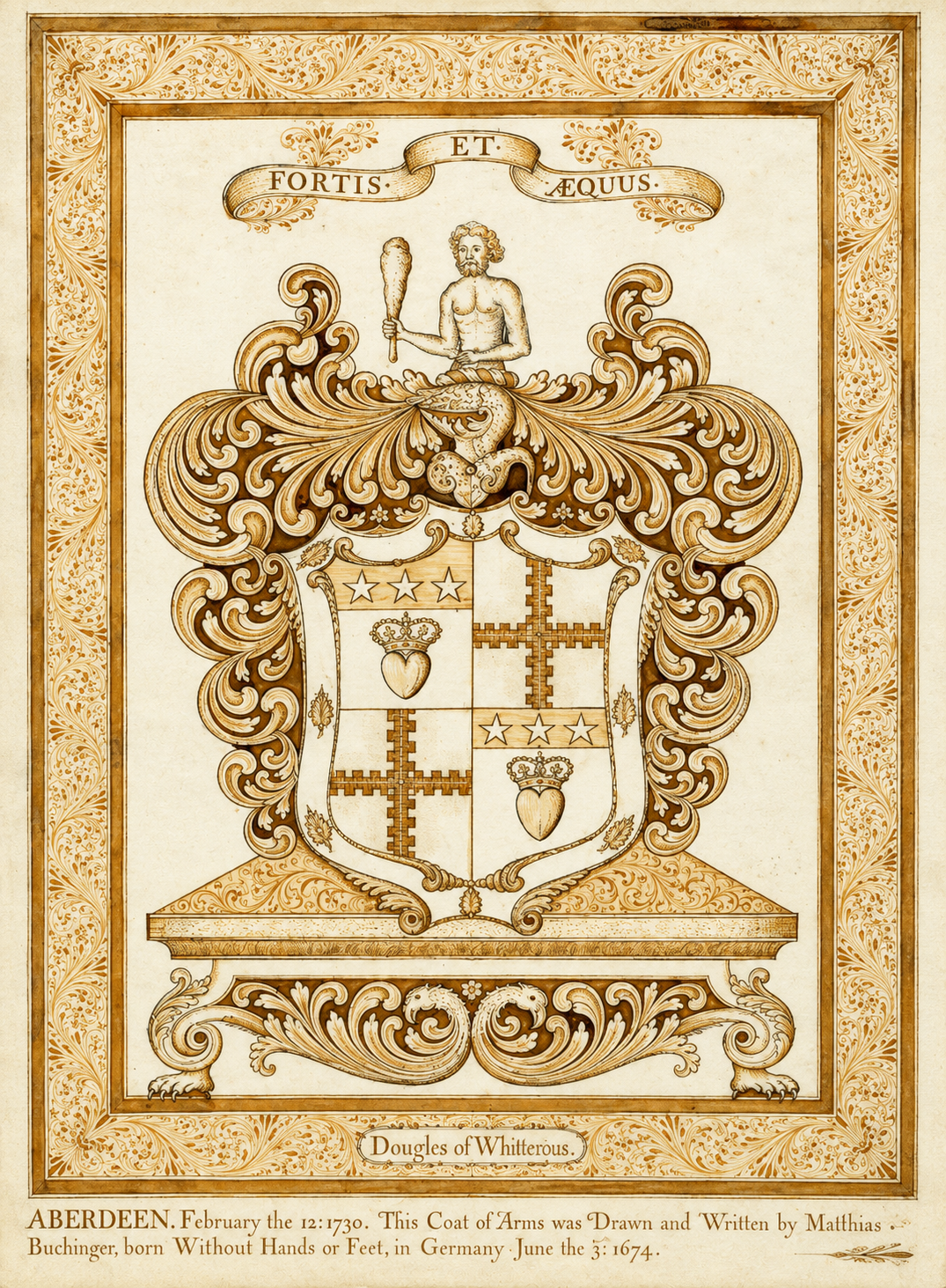
Coat of Arms of the Duke of Gordon, Edinburgh
The Metropolitan Museum of Art — 1723 work; collection record accessed September 2026
https://www.metmuseum.org/art/collection/search/697929
Ten Commandments, Personalized to John Thomson and Family, Merchant of Edinburgh
The Metropolitan Museum of Art — 1723 work; collection record accessed September 2026
https://www.metmuseum.org/art/collection/search/701356
Family Tree of the Stuarts of Allentown and the Denhams of Edinburgh
The Metropolitan Museum of Art — 1729 work; collection record accessed September 2026
https://www.metmuseum.org/art/collection/search/697927
Buchinger Family Tree
The Metropolitan Museum of Art — 28 May 1729; collection record accessed September 2026
https://www.metmuseum.org/art/collection/search/697928
Wordplay at the Met: The Drawings of Matthias Buchinger
The Metropolitan Museum of Art — 2016
https://www.metmuseum.org/de/perspectives/wordplay-matthias-buchinger-drawings
An Altarpiece
National Galleries of Scotland — Matthias Buchinger, 1728; collection record accessed September 2026
https://www.nationalgalleries.org/art-and-artists/15103
The Wonder of the World — Edinburgh Handbill
Sotheby’s, The Ricky Jay Collection — handbill printed Edinburgh, 1723; sale catalogue 2021
https://www.sothebys.com/en/buy/auction/2021/the-ricky-jay-collection
Written by Matthew Buchinger — Calligraphic Specimen
Sotheby’s, The Ricky Jay Collection — Edinburgh, 30 April 1723; sale catalogue 2021
https://www.sothebys.com/en/buy/auction/2021/the-ricky-jay-collection/buchinger-matthias-written-by-matthew-buchinger
The Largest and Most Elaborate of Buchinger’s Family Trees
Sotheby’s, The Ricky Jay Collection — Edinburgh, 10 May 1729; sale catalogue 2021
https://www.sothebys.com/en/buy/auction/2021/the-ricky-jay-collection/buchinger-matthias-the-largest-and-most-elaborate
Featured Item: Matthias Buchinger
Blackie House Library and Museum — 2025
https://blackiehouse.org/featured-item/featured-item-2025-buchinger/