
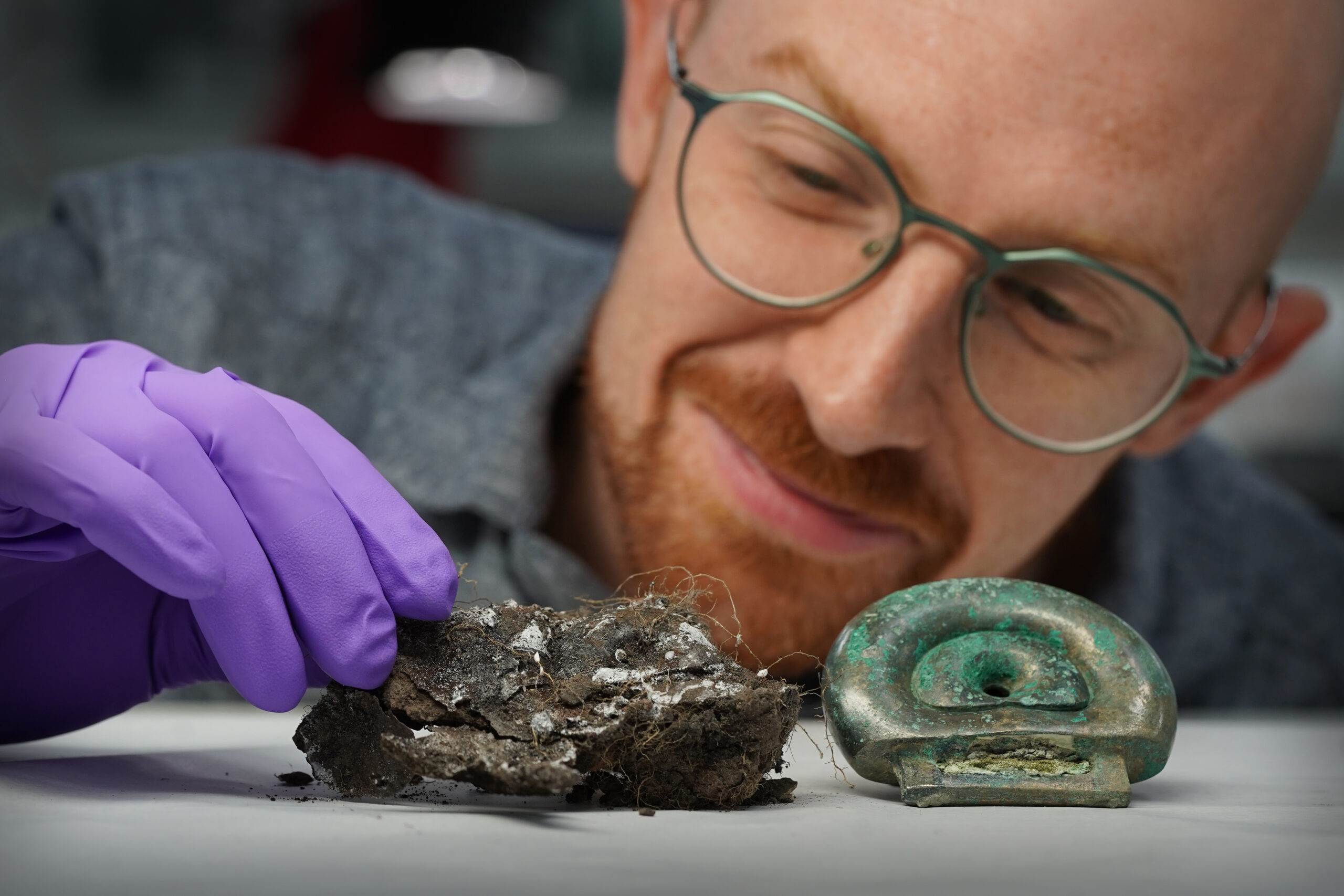
The Blyth find combines clay mould remains with a copper ingot and axeheads. Conservation of the neighbouring Peebles Hoard has revealed tin-rich, silver-coloured surfaces on its bronze objects.
Clay fragments excavated in the Scottish Borders may have been used to manufacture bronze fittings found seven miles away in the Peebles Hoard, National Museums Scotland announced on 7 October 2026. The surviving shapes offer a possible connection between finished prehistoric objects and their makers’ materials.
The Blyth Hoard was discovered near Blyth Bridge in 2022. It contains two bronze axeheads, a complete copper ingot and fragile remains of mould material, dating to approximately 1150–800 BC. The same metal detectorist, Mariusz Stępień, had found the Peebles Hoard in June 2020.
At Blyth, Stępień first detected an axehead, noticed other metal in the ground and reported the discovery to the Treasure Trove Unit. Museum archaeologists excavated the group and took it to Edinburgh for conservation.
The evidence in the clay
Matthew Knight, the museum’s senior curator of early prehistory, identifies the remains of two, possibly three, clay moulds or cores. Their forms resemble those needed to produce particular Peebles fittings. He considers it highly probable that whoever buried the Blyth material was involved in making some or all of those fittings, although the link remains under investigation.
The clay is incomplete and exceptionally fragile. Archaeologists recorded a three-dimensional model of the deposit using photographs before applying conservation materials to help preserve it. Further mould material may once have existed and decayed.
National Museums Scotland describes the copper ingot as the first complete example of its kind found in Scotland. Knight interprets it as evidence of fresh raw material entering the area. Its geographical source has not been established; future analysis is intended to investigate that origin.
Keeping the objects together
The Peebles discovery had already shown why the arrangement of a find could be as revealing as its individual pieces. In their first specialist account, published in the winter of 2020–21, archaeologists Emily Freeman and Matthew Knight described organic straps linking bronze fittings that might otherwise have appeared unrelated.
The field excavation took approximately three weeks. Large stones had made the ground unsuitable for ploughing, helping keep the deposit intact. Taking out each object separately would have destroyed information about those connections, the authors explained. The team recorded the hoard in three dimensions and lifted it with the surrounding earth for further excavation under controlled conditions.
The resulting block travelled to the University of Southampton’s µ-VIS X-ray Imaging Centre. Its size and weight presented an engineering problem, but computed tomography allowed researchers to examine its interior before dismantling the deposit. The scans recorded relationships between the materials and showed that some objects had been made using lost-wax casting, an unusual technique in Bronze Age Britain.
In lost-wax casting, a maker forms a model in wax and encloses it in material capable of withstanding heat. Heating removes the wax, leaving a space into which molten metal can be poured. The process allows the metal to take the model’s shape. Its identification at Peebles supplies evidence about manufacture independently of the later comparison with the Blyth fragments.
Metal designed for sound and colour
Dating to about 1000–800 BC, Peebles contains more than 500 pieces and components, some belonging to larger objects. Among the finds are two rattle pendants, constructed from interlinked bronze rings and hanging plates. The museum identifies them as the first found in Scotland, with comparable objects more commonly recorded in Denmark, northern Germany and northern Poland. They would have made a sound when suspended from a moving horse or wooden vehicle.
Other survivals preserve much smaller acts of making. Bronze buttons remain threaded onto cords; pins, studs and raised metal bosses remain embedded in wood or leather. A sword survived inside its wooden scabbard. The decorated straps retain connections between their components, although their full purpose remains unresolved.
Conservation then changed the appearance of the metal itself. On 16 October 2025, National Museums Scotland announced that cleaning had revealed silver-coloured surfaces beneath earth and green corrosion. The objects are bronze, an alloy of copper and tin. Their unexpected colour was associated with a concentration of tin at the surface.
The museum’s current account specifies that qualitative X-ray fluorescence analysis identified the high tin content. Its researchers regard deliberate surface enrichment as the probable explanation: tin drawn towards the surface of the bronze, rather than simply a separate coating added through plating or dipping. Further work is needed to understand the process.
Conservator Bethan Bryan has described the work as involving the preservation of fragile organic remains alongside the removal of dirt and corrosion. Cleaning the metal and keeping the attached material available for research are concurrent tasks. In its 2025 announcement, the museum estimated that full conservation would require three years and reported support from the Pilgrim Trust, the Leche Trust and private donors.
Two burials, unfinished explanations
The Blyth excavation also found burnt material. Knight considers whether this helped preserve the clay, while leaving open whether moulds were fired there. The cairn may have been a significant place for deposition or simply a marker for material someone intended to recover. The deposit does not yet establish the location of a workshop.
At Peebles, the original excavation report placed the hoard pit within part of an apparent round structure. Freeman and Knight proposed that burial might have marked the structure’s closure, while explicitly warning that further study could change that interpretation. Neither group has a securely established explanation for why its contents were left underground.
The evidence survived through a reporting system that applies to archaeological objects of significance, including materials other than precious metal. Treasure Trove’s guidance asks finders to leave hoards in place and contact the unit or a local authority archaeologist immediately, so that the objects and their surroundings can be examined together.
Both hoards have now been allocated to National Museums Scotland. Peebles conservation began in 2025 and is scheduled to continue until 2028. Research into the Blyth moulds and copper, and their possible relationship with the Peebles fittings, remains in progress.
Sources
‘Extraordinary’ Bronze Age find in the Scottish Borders
National Museums Scotland, 7 October 2026.
https://media.nms.ac.uk/news/extraordinary-bronze-age-find-in-the-scottish-borders
What is the Blyth Hoard?
Matthew Knight, National Museums Scotland, undated; accessed 22 October 2026.
https://www.nms.ac.uk/discover-catalogue/the-blyth-hoard
The Peebles Hoard: A new Late Bronze Age discovery from Scotland
Emily A. Freeman and Matthew G. Knight, Later Prehistoric Finds Group Newsletter, issue 16, winter 2020–2021, pages 3–6.
https://laterprehistoricfinds.com/wp-content/uploads/2023/03/lpfg_newsletter_16_winter_2020.pdf
Southampton x-ray scanning helps preserve important archaeological hoard
University of Southampton, 24 October 2024.
https://www.southampton.ac.uk/news/2024/10/southampton-xray-scanning-helps-preserve-important-archaeological-hoard.page
Guidelines for the Technical Examination of Bronze Sculpture: Table 1
Getty Conservation Institute, undated table; accessed 22 October 2026.
https://www.getty.edu/publications/bronze-guidelines/tables/01/
Unique Bronze Age Hoard acquired for the nation
National Museums Scotland, 24 October 2024.
https://media.nms.ac.uk/news/unique-bronze-age-hoard-acquired-for-the-nation
3000-year-old secret of the Peebles Hoard revealed
National Museums Scotland, 16 October 2025.
https://media.nms.ac.uk/news/3000-year-old-secret-of-the-peebles-hoard-revealed
What is the Peebles Hoard?
National Museums Scotland, undated; accessed 22 October 2026.
https://www.nms.ac.uk/discover-catalogue/what-is-the-peebles-hoard
Information for Finders
Treasure Trove Unit, undated; accessed 22 October 2026.
https://treasuretrovescotland.co.uk/information/information-for-finders/