
The Galeón Andalucía will spend 11 days in Ayr this August, offering visitors a close view of the ships that helped create the first enduring trade routes between Europe, the Americas and Asia. The vessel also carries a history less comfortable than the familiar language of discovery and adventure.
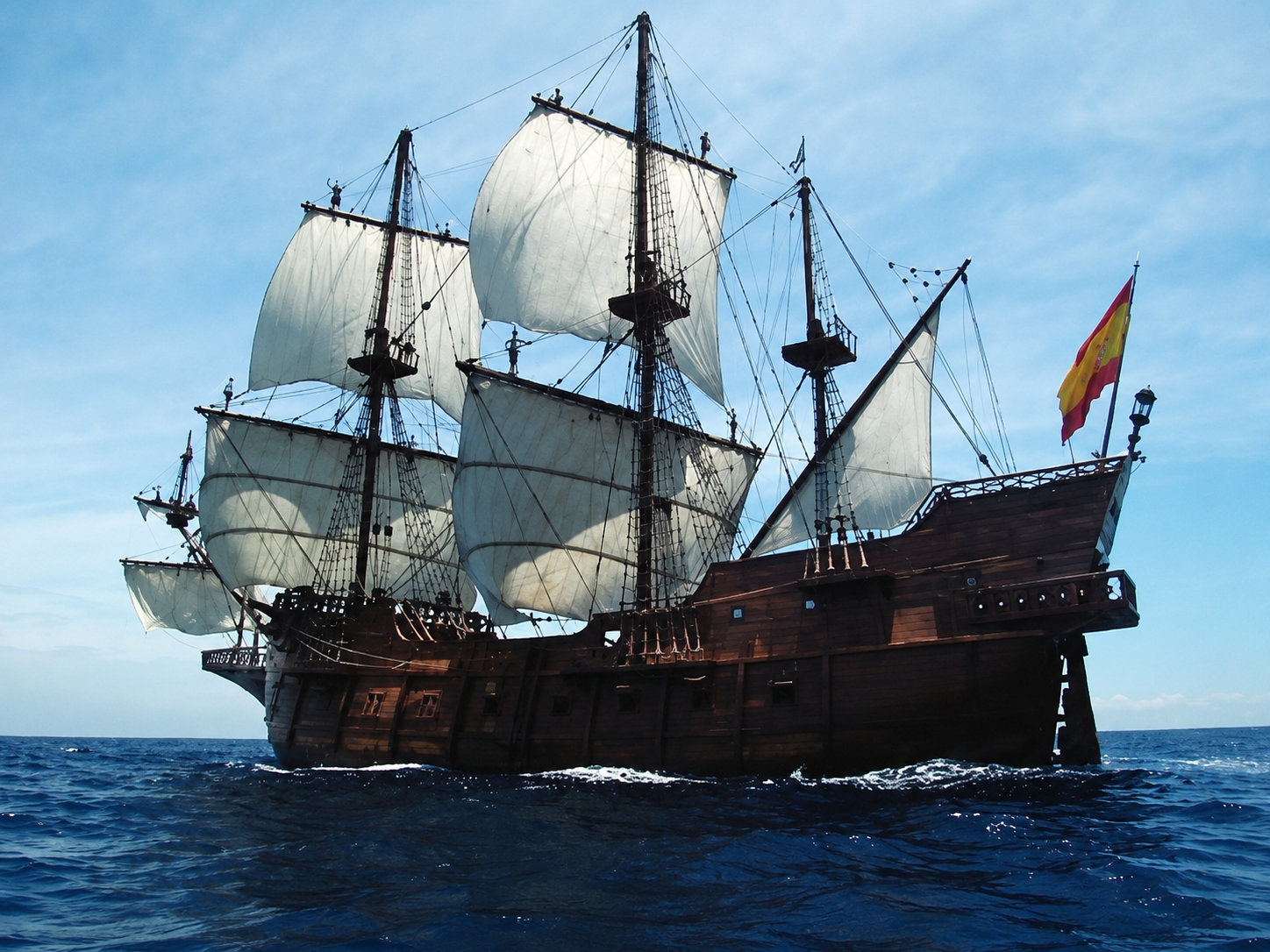
Four masts and almost 1,000 square metres of sail will rise above Ayr Harbour next month when the Galeón Andalucía makes its first visit to South Ayrshire.
The seaworthy replica of a Spanish galleon is expected to arrive on Wednesday 12 August. It will open to the public from Thursday 13 August until Sunday 23 August, before departing on 24 August. Visitors will be admitted between 10am and 8pm each day at South Harbour Street.
The ship is operated by the Fundación Nao Victoria, a Spanish non-profit organisation that maintains historical replicas as working vessels and floating museums. Its Ayr visit is being supported by South Ayrshire Council and Associated British Ports, which operates the ports of Ayr and Troon.
Although commonly described as a replica of a 17th-century galleon, the Galeón Andalucía is not a reconstruction of one particular named ship. It is a full-sized interpretation of the armed merchant vessels built by Spain and Portugal between the 16th and 18th centuries, drawing upon historical records and the shared characteristics of ships that crossed the Atlantic and Pacific.
That distinction makes the vessel more useful as an exhibition. Rather than reproducing the surviving evidence from a single wreck or set of plans, it demonstrates how the galleon developed as a practical piece of ocean-going infrastructure: broad enough to carry large cargoes, high-sided for defence and fitted with artillery to protect valuable goods.
The foundation’s technical specifications give the vessel an overall length of 49.4 metres, a beam of 10.1 metres and a weight of 589 tonnes. Her seven sails cover 965 square metres, while more than ten kilometres of rope are used in the rigging. Ten cast-iron cannons are positioned on each side and the two principal anchors weigh 800 kilograms apiece.
Visitors will be able to explore the ship’s decks and displays relating to food, sleeping arrangements, navigation and the handling of cannon equipment. The scale may be impressive from the quayside, but the interior is intended to show how little private space existed aboard the original ships.
A large historic galleon might carry around 150 officers, sailors, merchants, servants, passengers and family members, together with livestock and supplies. The Fundación Nao Victoria estimates that the available living space could amount to approximately 1.5 square metres per person. Privacy was largely a privilege of rank, while ordinary crew members slept and worked among cargo, animals, ropes, weapons and the accumulated smells of a long voyage.
The replica itself was built at Punta Umbría in Andalusia following three years of historical research, six months of design work and 16 months of construction involving 126 workers. It was launched in November 2009.
Its outward appearance is largely wooden, using iroko, pine and beech, but the underlying hull and deck structure was made from fibreglass before being clad in timber. Steel cables reinforce parts of the standing rigging, and modern engines allow the vessel to travel safely with a far smaller crew than its historical predecessors. It can sail under canvas when conditions permit, although engines are used when the wind is unsuitable.
The ship has since travelled to ports on four continents, including Shanghai, Manila, Singapore, Hong Kong, New York, Quebec and London. Its international voyages mean that the exhibit arriving in Ayr is itself an ocean-going ship rather than a static museum piece.
Councillor Alec Clark, South Ayrshire Council’s depute leader, described the visit as “a rare opportunity to experience what life would’ve been like for people at sea”.
Aurelia Peddie, commercial manager for Associated British Ports at Ayr and Troon, said the organisation was looking forward to working with the council to make the ship’s first visit to the Port of Ayr “a fantastic and memorable experience”.
The trade behind the sails
The exhibition’s language of exploration and maritime discovery describes only part of the galleon’s history. These vessels were also the machinery of Spanish imperial government, colonial settlement and commercial extraction.
Galleons carried European food, cloth, weapons and tools westwards. On their return journeys, their holds contained silver, gold and other commodities from the Americas. Across the Pacific, the Manila galleon system linked the Philippines with Acapulco in present-day Mexico between 1565 and 1815. Asian silk, porcelain, ivory and spices travelled eastwards in exchange for silver mined in Spanish America. From Mexico, goods could be carried overland and shipped onwards to Europe.
The route was one of the earliest durable systems of global trade. Its influence can still be traced in art, ceramics, clothing, food and language across Asia and the Americas. The Metropolitan Museum of Art estimates that as much as one-third of the silver mined in New Spain and Peru may have travelled towards the Far East.
It was not, however, a neutral exchange among equal partners. The ships operated within colonial economies and depended heavily upon labour that traditional European accounts have frequently placed at the edge of the story.
Research into the Manila trade shows that Indigenous Filipino workers served as woodcutters, shipwrights, navigators, deckhands and soldiers. Many of the Pacific galleons were constructed or repaired with Philippine timber and expertise. Labour could be compulsory, poorly paid and dangerous, while Filipino and other Asian sailors formed a substantial part of the crews required to keep Spain’s Pacific routes operating.
Conditions at sea were equally severe. Voyages could last for months, with overcrowding, poor nutrition, contaminated water and little effective treatment for disease. Historical accounts record high mortality from starvation, scurvy and illness, particularly during the earlier years of the Manila route. Some vessels reached port with only a fraction of their original crews alive.
A visit to the Galeón Andalucía therefore offers more than a handsome ship and a collection of cannon. Its decks provide a physical measure of the engineering achievement, the commercial ambition and the human confinement involved in maintaining routes that crossed entire oceans.
Advance tickets bought by 12 August cost £12 for visitors aged ten and above, £6 for children aged five to ten and £30 for a family ticket covering two adults and three children. Prices then rise to £15, £7 and £37 respectively. Tickets may be available aboard the ship, although the organisers warn that daily capacity is limited and that no further admissions will be sold once a date has reached capacity. Group tours are available on selected weekdays during the visit.