
An 1891 seaweed album added to Scotland’s national collection leads back to a workshop behind an island hotel, where quarrymen, women colourists and a future Gaelic novelist helped make books for the tourist trade.
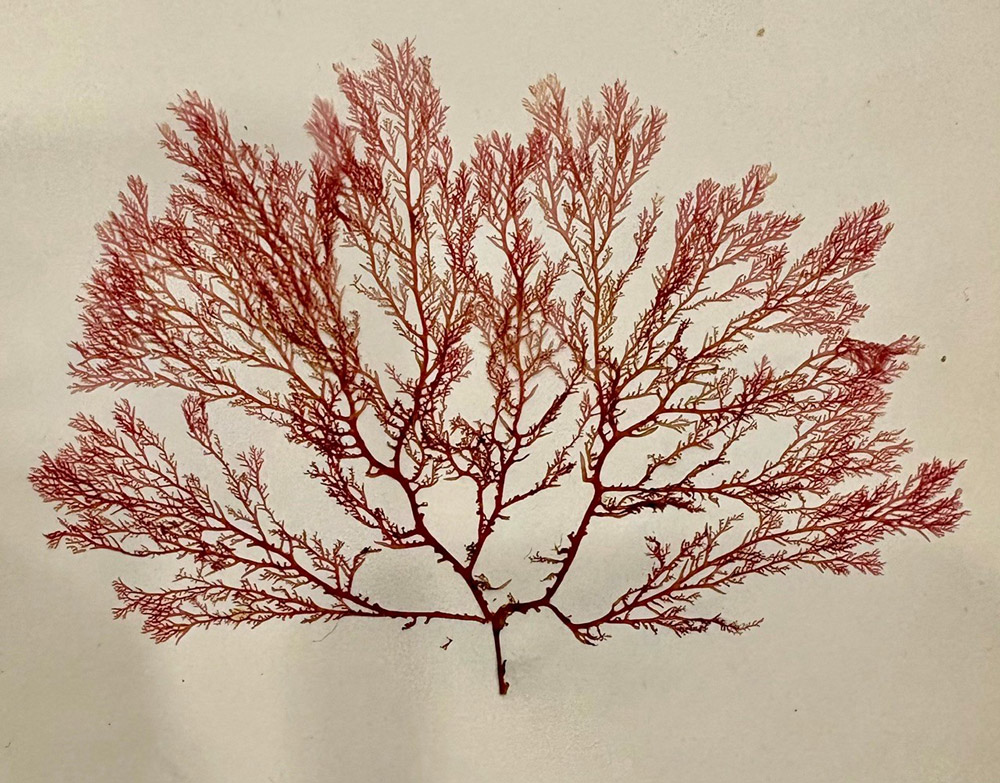
An 1891 album containing six pressed seaweed specimens from Iona has entered the National Library of Scotland’s collections. Listed in its 2025–26 annual review, Flowers of the Sea survives from the Iona Press, a small publishing enterprise that sold souvenirs to visitors during the island’s short summer season.
The album belongs to a history of work extending beyond its printed cover: granite quarrying on neighbouring Mull, the production of illustrated books in London, women colouring pictures by hand, and the development of modern Gaelic literature. The people involved moved between these occupations, sometimes combining several to make a living.
A copy of Flowers of the Sea described in Dean Cooke Rare Books’ 2025 York catalogue measures 13 by 15 centimetres. It contains six mounted specimens inside white paper wrappers with a blue label. The catalogue attributes that label’s design to J. Jerment Anderson; an inscription inside the cover reads “21.IX.91”, or 21 September 1891. The object brought a piece of the shoreline into a book small enough to carry away from the island.
From the quarry to illustrated books
The National Library dates the press’s foundation to 1887 and identifies its founders as William Muir, formerly manager of the Torr Mor granite quarry, and John MacCormick, the quarry foreman’s eldest son. The Metropolitan Museum of Art’s account of the press records that Muir had moved from the Ross of Mull to London in 1876. The island business therefore grew out of connections maintained after his departure.
In London, Muir established the Blake Press at Edmonton, reproducing William Blake’s illustrated poetry. Leeds Libraries holds his 1885 editions of Songs of Innocence and Songs of Experience, protected by green slipcases and blue wrappers. Inside are 28 hand-coloured plates in the first volume and 22 in the second, separated by tissue guards. Their wrappers advertise editions of 50 copies.
The work demanded more than operating a printing press. Muir described his method explicitly: “All outlines are drawn and all the colouring is by hand.” Leeds’ collections account explains that completing an edition could take years, sometimes decades, because only a few copies were coloured at a time. This London enterprise supplied a parallel to the production of illustrated souvenirs on Iona, where individual copies also acquired their colours through handwork.
The workshop behind the hotel
E. Mairi MacArthur’s research into Iona’s social and economic history places the press in a former bothy behind the Columba Hotel. Her 1989 doctoral thesis cites the visitor Malcolm Ferguson’s account of William’s sister, Miss Muir, supervising the establishment while a young island woman worked the press. The prospectus advertised local employment: “Native labour is as far as possible employed”.
Blake scholar Keri Davies identifies William’s sister as Hannah T. Muir. His research chronology also records the involvement of Flora Ritchie and her father, Captain Ritchie, who provided a room and financial assistance. Davies reproduces testimony that island girls coloured pictures for both the Iona Press and Muir’s London Blake operation, under instruction from Muir and Flora. Their work therefore also reached books issued by a publisher based beyond the island.
MacCormick’s work was equally practical. Davies records him setting type, operating the press and binding. This was a partnership in which the preparation of literature and the manufacture of books could fall to the same person. The founders’ names on a catalogue entry represent only part of the labour involved in producing the finished objects.
The Metropolitan Museum preserves The Iona Press Scrap Book, dated 1887–91, bringing several products together. Its contents include an island map, a plan of Iona Cathedral and pages from The Iona Autograph Album, The Great Hymn Altus, The Blessing of the Ship and The Burial March of King Duncan. The museum identifies illustrations by J. C. Nicol, Charles McEwen and the Reverend David Duncan Ormond. Some of its lithographs are hand-coloured. Across these pages, visitors could buy views and plans alongside literary and religious texts.
Gaelic in the summer trade
Among the press’s successes was The Blessing of the Ship, a traditional prayer associated with island sailors beginning a voyage. MacArthur records sales of 400 copies from its first printing. An English translation made the Gaelic text accessible to visitors unfamiliar with the language. The press produced about a dozen small pamphlets, at least three of which reached a second edition.
MacCormick brought an education that extended well beyond the workshop. Sheila M. Kidd’s study of his writing records teacher training in Glasgow, university study in Latin, Greek, logic and mathematics, and a brief teaching career in North Uist before his return to Mull. Born in 1860, he was the eldest of 11 children. Literary work did not become his only occupation: family records described him variously as a journalist, quarry manager and quarry foreman.
Kidd places most of the press’s output between 1887 and 1893; the National Library dates its closure to 1902. MacArthur found that its proposed list of publications was never completed, including a planned history of Iona. Hannah Muir’s souvenir business lasted longer: postcards and other items remained on sale in her small gift shop into the 1920s.
MacCormick later settled in Glasgow, supporting his writing with other employment, including work as a cemetery clerk at the Necropolis. His novel Dùn-Àluinn, identified by Kidd as the first Gaelic novel, was serialised in the People’s Journal in 1910 and published as a book in 1912.
Sources
Annual review 2025 to 2026
National Library of Scotland, updated 1 October 2026.
https://www.nls.uk/about-us/plans-and-policies/annual-review-2025-to-2026/
York Book Fair 2025 catalogue
Dean Cooke Rare Books, 2025.
https://aba.org.uk/assets/catalogues/YorkAntiq25.pdf
The Iona Press Scrap Book
The Metropolitan Museum of Art, collection record for an object dated 1887–91; accessed 22 October 2026.
https://www.metmuseum.org/art/collection/search/352054
Muir Than Just a Copy: The Beautiful Reproductions of William Blake’s ‘Songs of Innocence and Experience’
Leeds Libraries, 7 August 2020.
https://secretlibraryleeds.net/2020/08/07/muir-than-just-a-copy-the-beautiful-reproductions-of-william-blakes-songs-of-innocence-and-experience/
The Island of Iona: Aspects of Its Social and Economic History from 1750 to 1914
E. Mairi MacArthur, University of Edinburgh, 1989.
https://era.ed.ac.uk/handle/1842/19067
A William Muir chronology II: 1884–1940
Keri Davies, Index Rerum, 15 June 2014.
https://keridavies.blogspot.com/2014/06/a-william-muir-chronology-ii-1884-1940.html
The Forgotten First: John MacCormick’s ‘Dùn-Àluinn’
Sheila M. Kidd, Scottish Gaelic Studies, volume 22, 2006.
https://eprints.gla.ac.uk/4586/