
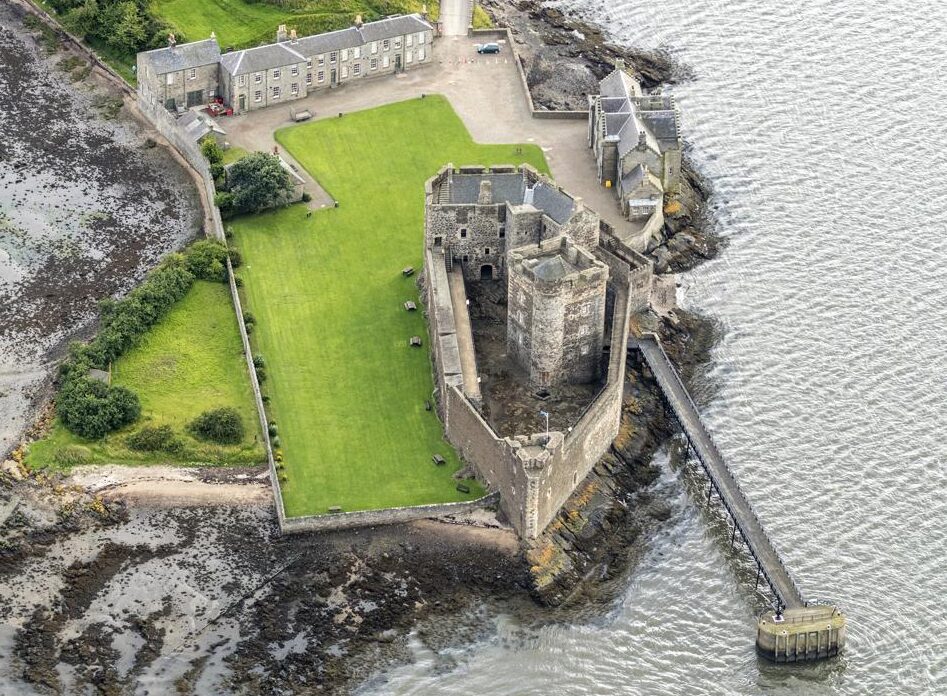
A message left by a travelling Scottish musician in 1941 is among the historic markings being examined in a new exhibition at Blackness Castle on the Firth of Forth.
The inscription, in the castle’s North Tower, was made by a member of the Inver Scotia Nomads, a group of young musicians who performed traditional Scottish music at venues around the country.
Their visit took place during the Second World War, and the mark they left survives on the castle wall.
The story forms part of Marking Time, an exhibition organised by Historic Environment Scotland (HES), which opened at Blackness Castle in November 2026.
The exhibition examines graffiti and other markings made across Scotland over approximately 5,000 years, from prehistoric carved stones to contemporary street art.
Prisoners, Soldiers and Visiting Musicians
Blackness Castle was built in the fifteenth century on a rocky promontory overlooking the Firth of Forth.
In 1537, James V converted it into a state prison and artillery fortification.
During its use as a prison, inmates left inscriptions and markings on the walls of their cells.
Military personnel stationed at the castle also recorded their presence by carving dates and initials into the stone.
The resulting marks provide evidence of people who occupied the building for different reasons, often centuries apart.
The surviving inscription left by the Inver Scotia Nomads records a visit connected with music rather than imprisonment or military service.
Dr Alex Hale, Learning Manager at HES and one of the exhibition’s curators, identified the 1941 marking as one of the surviving examples within the castle.
According to Hale, the musicians had performed at Blackness and left their mark after the event.
Graffiti From Prehistoric Scotland
The exhibition brings together photographs of markings from historic sites across Scotland.
Some date back approximately 5,000 years.
Prehistoric carved stones form one part of the material examined, alongside later inscriptions concerning personal relationships, wars, occupations and everyday events.
The exhibition considers the purposes of these marks and the circumstances in which they were made.
Stone carvings, prison inscriptions, military graffiti and modern painted work have different histories and were produced using different materials and techniques.
Their survival also varies according to the surfaces on which they were made and the conditions to which they have been exposed.
Many historic marks were recorded incidentally during archaeological investigation, building surveys or conservation work.
Others remain visible to visitors at the sites where they were originally made.
Why Historic Graffiti Is Recorded
Historic Environment Scotland maintains records of buildings, archaeological sites and other features forming part of Scotland’s historic environment.
Graffiti can form part of that record.
An inscription may identify the presence of a person in a particular place. A date may establish when part of a building was being used. A drawing or symbol may provide information about an occupation, belief or event.
However, not every mark can be dated or attributed to an individual.
Interpretation may depend on surrounding archaeological evidence, handwriting, materials, associated objects or historical records.
At Blackness, the castle’s long military and custodial history provides context for many of its surviving inscriptions.
HES has incorporated examples into Marking Time alongside photographs from other locations across Scotland.
An Exhibition Moving Between Historic Sites
The exhibition was previously presented at Fort George and Stanley Mills in Perthshire before moving to Blackness Castle.
It was co-curated by Alex Hale and Sace Lockhart.
Visitors can examine the exhibition material and then see examples of historic graffiti preserved within Blackness Castle itself.
HES is also preparing a publication by Hale entitled Marking Time: Graffiti in Scotland from Street Art to Rock Art, scheduled for spring 2027.
The book will examine historic and contemporary marking practices through examples from across Scotland.
Visiting Blackness Castle
Marking Time is scheduled to run at Blackness Castle on selected dates until Sunday 7 March 2027, according to the current Historic Environment Scotland events listing.
The exhibition is included with admission to the castle.
The castle’s published winter opening hours are 10am to 4pm, with last admission at 3.15pm. Historic Scotland members receive free admission.
Blackness Castle remains in the care of HES, which maintains its historic structures and visitor facilities.
The exhibition brings together marks left by people over thousands of years, including the initials of soldiers, inscriptions associated with prisoners and the surviving record of a Scottish musical performance in 1941.
The original markings remain part of the physical history of the places where they were made.