
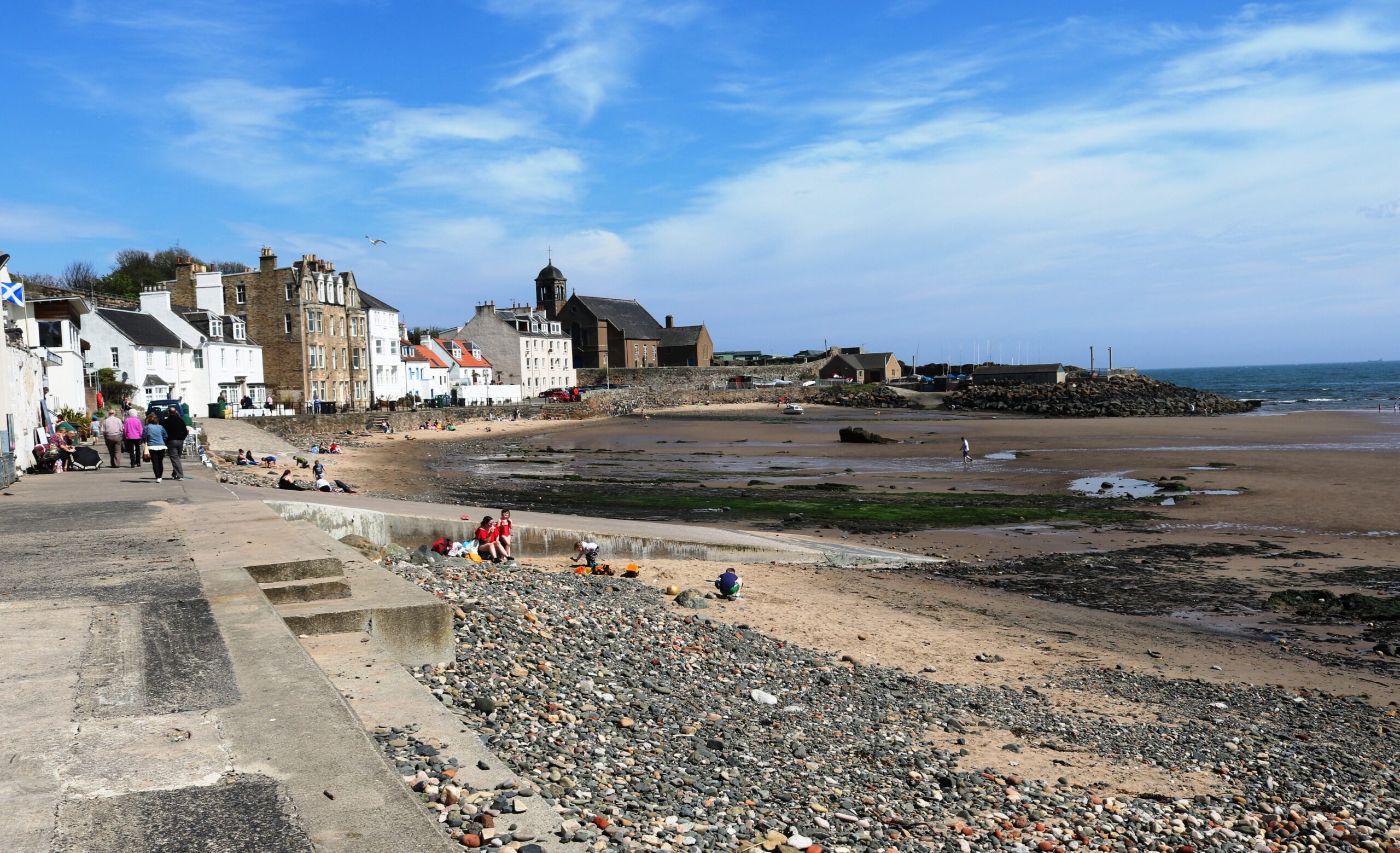
Kinghorn Harbour Beach is carrying a fourth consecutive Poor classification, while bacterial pollution in the burn crossing the sand has prompted a warning expected to remain throughout the 2026 bathing season. Scottish Water told MSPs last year that it did not know when the underlying problem would be fixed.
Kinghorn Harbour Beach is one season away from permanent advice against bathing after years of investigation, engineering work and repeated bacterial contamination failed to secure a lasting improvement in water quality.
The Fife beach is classified as Poor for the 2026 bathing season, following the same result in 2022, 2023 and 2024. If monitoring this summer produces another Poor annual classification, Kinghorn will have recorded five consecutive failures and permanent advice against bathing would have to be displayed from 2027.
A separate warning is already in place over pollution in Kinghorn Burn, which travels underground through the town before crossing the beach and entering the Firth of Forth.
The Scottish Environment Protection Agency and Scottish Water have advised people and animals to avoid contact with the burn after testing found intermittently poor water quality that may present a risk to health. Temporary signs installed at the harbour and beach access points are likely to remain for the rest of the bathing season.
There is no general restriction on bathing or paddling in the designated harbour water. SEPA is monitoring the sea separately and says it will change its advice if problems are identified there.
The result is an unusual distinction for beach users: the sea remains available for bathing, but the polluted watercourse flowing across the sand should be avoided.
Pollution Levels Remain High In The Burn
SEPA tests bathing waters for Escherichia coli and intestinal enterococci, bacteria used as indicators of faecal contamination and potential health risks.
Their presence does not by itself prove that untreated sewage is responsible. Contamination may enter water through sewer overflows, incorrect drainage connections, surface-water systems, private infrastructure or other sources.
SEPA’s published profile identifies sewer overflows and surface-water discharges among the risks affecting Kinghorn Harbour. It advises against bathing during heavy rain and for one or two days afterwards because rainfall can increase pollution entering the water.
Several samples taken during the 2026 season exceeded the thresholds used to indicate low-quality coastal bathing water at the time of testing.
A sample collected on 18 May recorded 620 colony-forming units of E. coli and 500 units of intestinal enterococci per 100 millilitres. On 1 June, the figures rose to 4,000 and 1,100 respectively.
For coastal waters, SEPA describes individual results above 500 for E. coli or 200 for intestinal enterococci as indicative of low water quality when the sample was taken. Annual classifications are calculated separately using statistical analysis of four years of results, rather than any single reading.
Later samples showed lower bacterial levels, but separate testing of Kinghorn Burn continued to produce high results.
A SEPA spokesperson said the regulator had increased sampling frequency “in order to closely monitor bacterial levels in the watercourse and understand the full extent of the ongoing pollution pressure”.
The agency said precautionary advice was likely to remain in place throughout the bathing season.
Anyone who develops sickness, diarrhoea, stomach cramps or fever after contact with the burn has been advised to consult NHS Inform or call NHS 24 on 111.
Scottish Water Told MSPs It Did Not Know When The Problem Would Be Fixed
The uncertainty surrounding Kinghorn was acknowledged by Scottish Water during evidence to the Scottish Parliament’s Net Zero, Energy and Transport Committee in April 2025.
Professor Simon Parsons, the company’s director of environment, planning and assurance, said Scottish Water had worked with SEPA for years to understand the pollution affecting the harbour.
He said a former combined sewer overflow had been removed and that investigators believed pollutants might be entering through groundwater ingress into the sewerage system.
Asked directly by Green MSP Mark Ruskell when the problem would be fixed, Parsons replied:
“We are not sure at the moment.”
He said the source had not been fully established and that Scottish Water would provide a remedy if evidence showed its assets were responsible, or support action where the cause lay elsewhere.
Scottish Water’s latest public statement says investigations are continuing across both the local sewer network and the wider underground drainage system.
The company described the situation as “a uniquely complex issue” and said it recognised the concern caused by continued high sample results.
No published timetable states when the investigation will conclude, when further construction may begin or what action will follow if no single pollution source can be identified.
Enforcement Notice Was Successfully Appealed
Parsons also confirmed to MSPs that Scottish Water had successfully appealed an enforcement notice issued by SEPA.
He said the company had been unclear about what it was being required to do.
The appeal did not settle the source of the contamination or resolve the water-quality failure. It removed the original enforcement requirement after Scottish Water challenged the clarity of the notice.
The available official record does not explain whether SEPA subsequently considered a replacement notice, what alternative enforcement action followed or which organisation will be required to carry out remedial work if responsibility remains divided.
SEPA says improvement work continues with Scottish Water, local authorities and other partners. Its public information records investigations, removal of cross-connections, sewer repairs, further monitoring and updated modelling, but does not set out a final recovery programme.
£700,000 Work Brought Only Temporary Improvement
Kinghorn Harbour was also classified as Poor in 2017 and 2018.
Investigations identified the Bleaching Hill combined sewer overflow, which discharged into the Lady Burn, as a key source of pollution. The overflow was closed in September 2018, and Scottish Water spent approximately £700,000 on work intended to prevent further discharges.
The beach improved to Sufficient status in 2019 and again in 2021. No standard classification was calculated in 2020 because pandemic restrictions shortened the sampling season.
Poor status returned in 2022 and has remained since.
The improvement following the 2018 project indicates that removing the overflow had an effect. The later deterioration shows that it did not address every source of contamination affecting the burn and harbour.
Scottish Water has since removed incorrect connections and repaired defects identified in the sewer system. The company has not published the total cost of investigations and repairs carried out after the original £700,000 scheme.
The official profile describes a two-square-kilometre catchment containing Kinghorn Burn and Lady Burn, with urban drainage, underground watercourses, sewers and surface-water infrastructure meeting beneath the town. Agriculture is not identified as affecting the designated bathing water.
Warning Follows A Wider Incident In 2025
The current warning is not the first recent disruption at Kinghorn.
In July 2025, high microbiological readings at Kinghorn Harbour and Burntisland prompted temporary advice not to swim, paddle or play in the sea or in streams entering the beaches.
Visitors were told to keep pets away, wash their hands and footwear, avoid removing objects from the beach and not collect shellfish from the affected area.
The 2026 warning is narrower because it applies specifically to Kinghorn Burn rather than the entire designated bathing water.
For residents and visitors, however, the harbour has now faced repeated notices, four successive Poor classifications and continuing uncertainty over the source.
Sources
Scottish Environment Protection Agency — Kinghorn Harbour Beach Results
https://bathingwaters.sepa.org.uk/locations-and-results/results/?location=4565
Scottish Environment Protection Agency — Kinghorn Harbour Bathing Water Profile
https://bathingwaters.sepa.org.uk/profiles/profile?location=4565
SEPA — Update: Pollution Affecting Kinghorn Burn, 14 July 2026
https://beta.sepa.scot/news/2026/update-14th-july-2026-sepa-and-scottish-water-warn-beach-users-of-pollution-affecting-the-kinghorn-burn/
Scottish Water — Scottish Water And SEPA Warn Beach Users Of Pollution Affecting Kinghorn Burn, 1 July 2026
https://www.scottishwater.co.uk/about-us/news-and-views/2026/07/010726-scottish-water-warns-beach-users-of-pollution-affecting-kinghorn-burn
Scottish Water — Investigations Continue As Kinghorn Burn Warning Remains In Place, 13 July 2026
https://www.scottishwater.co.uk/about-us/news-and-views/2026/07/130726-investigations-continue-as-kinghorn-burn-pollution-warning-remains-in-place
Scottish Parliament — Net Zero, Energy And Transport Committee Official Report, 1 April 2025
https://www.parliament.scot/chamber-and-committees/official-report/search-what-was-said-in-parliament/NZET-01-04-2025?iob=139733&meeting=16358
SEPA — Scotland’s Bathing-Water Season Begins With 90 Sites Monitored, 1 June 2026
https://beta.sepa.scot/news/2026/scotland-s-bathing-water-season-begins-with-90-sites-monitored-across-the-country/
SEPA — 2026 Bathing-Water Classifications
https://bathingwaters.sepa.org.uk/classifications/
Fife Coast And Countryside Trust — Pollution Incident At Burntisland And Kinghorn Harbour Beaches, 16 July 2025
https://fifecoastandcountrysidetrust.co.uk/pollution-incident-at-burntisland-and-kinghorn-harbour-beaches/
Water Magazine — Kinghorn Burn Warning To Remain Throughout Bathing Season, 15 July 2026
https://www.watermagazine.co.uk/2026/07/15/kinghorn-burn-warning-to-remain-throughout-bathing-season-as-pollution-investigations-continue/