
Moray Substation Released Greenhouse Gas Equivalent to 1,131 Tonnes of CO₂
Ofgem is considering excluding a major gas release at Blackhillock from a transmission operator’s emissions-incentive calculations, less than two years after rejecting an exemption for an earlier leak at the same site.
An electricity substation near Keith in Moray released a greenhouse gas with the equivalent warming impact of approximately 1,131 tonnes of carbon dioxide following an electrical equipment failure in August, according to newly published regulatory documents.
The release occurred at the Blackhillock 400-kilovolt substation on 12 August, when an internal electrical fault triggered the rupture of a safety device and the escape of 46.56 kilograms of sulphur hexafluoride, known as SF₆.
The gas, widely used to insulate high-voltage electrical equipment, is one of the most powerful greenhouse gases in industrial use. Under the calculation adopted by energy regulator Ofgem, one kilogram has the same estimated warming effect over 100 years as 24,300 kilograms of carbon dioxide.
Ofgem is now considering an application from the site’s operator, SSEN Transmission, to classify the incident as an exceptional event.
If approved, the emissions would be excluded from the company’s performance calculation under a regulatory scheme that can reward electricity transmission operators for limiting greenhouse gas leakage or impose financial penalties when they exceed their targets.
The proposal has particular significance because Ofgem rejected a similar application involving another SF₆ leak at Blackhillock in July 2025. In that case, the regulator concluded that an installation error and inadequate gas monitoring had contributed to a failure that could reasonably have been prevented.
The incidents involved different circumstances, and there is no evidence in the published records that they shared a cause. Nevertheless, they raise questions about equipment reliability, emissions monitoring and the standards used to determine when an electricity network operator should bear the financial consequences of a greenhouse gas release.
Ofgem’s latest consultation was published on 29 October and remains open until 20 November. Its proposed decision is not final.
How the August Failure Occurred
The latest incident took place while equipment at Blackhillock was being returned to service following planned maintenance.
According to Ofgem’s technical assessment, a reserve busbar and a supergrid transformer had been taken out of service to allow maintenance on an electrical disconnector.
Disconnectors are switching devices used to isolate sections of high-voltage electrical equipment. Busbars distribute electrical power between circuits within a substation.
After the maintenance was completed, operators began the switching sequence required to return the equipment to service.
During the process, an internal electrical fault occurred as part of the equipment was being energised. The fault damaged a disconnector and triggered protection systems designed to isolate the affected electrical circuit.
Approximately 11 minutes after the fault, the equipment recorded indications relating to gas pressure.
An inspection subsequently established that a rupture disc had operated, allowing the gas contained within the affected circuit-breaker compartment to escape.
Rupture discs are protective components designed to release pressure when it becomes excessive, helping prevent potentially more dangerous equipment failures.
In this case, their operation resulted in the loss of the compartment’s entire recorded SF₆ inventory of 46.56 kilograms.
The operator’s submission states that the incident occurred inside the 400kV gas-insulated switchgear building and was not associated with severe weather or external third-party damage.
The precise initiating failure mechanism has not yet been established.
SSEN Transmission is investigating the equipment failure with technical assistance, and Ofgem has said that its eventual decision will take account of any further findings.
The published consultation does not establish whether the incident interrupted electricity supplies to consumers or identify any resulting injuries. Those matters should not be inferred from the information available.
Why Such a Small Quantity of Gas Matters
The physical quantity released at Blackhillock may appear modest when compared with industrial emissions commonly measured in thousands or millions of tonnes.
Its climate significance comes from the properties of the gas itself.
Sulphur hexafluoride has been used in electricity transmission and distribution equipment for decades because it provides highly effective electrical insulation and helps extinguish electrical arcs when high-voltage circuits are interrupted.
These characteristics allow powerful electrical equipment to be housed in comparatively compact installations.
The disadvantage is that SF₆ is exceptionally effective at trapping heat in the atmosphere.
Ofgem’s calculation for the Blackhillock incident uses a global warming potential of 24,300 over 100 years.
On that basis, the release of 46.56 kilograms represents 1,131.408 tonnes of carbon dioxide equivalent.
This does not mean that 1,131 tonnes of carbon dioxide physically escaped from the substation. It means that the estimated climate-warming effect of the SF₆ release is equivalent to that quantity of carbon dioxide over the specified assessment period.
Different official publications sometimes use different global warming potential values because they draw on different scientific assessment and reporting conventions.
The UK’s National Atmospheric Emissions Inventory, for example, has used an earlier value of 22,800. A government-commissioned study published in October 2026 uses the more recent value of approximately 24,300, consistent with Ofgem’s calculation in this case.
SF₆ is also exceptionally persistent.
The October study estimates its atmospheric lifetime at approximately 3,200 years. Once released, the gas can therefore contribute to warming over a period far longer than the normal operating life of the equipment in which it was used.
According to the National Atmospheric Emissions Inventory, electrical insulation accounted for approximately 88% of the UK’s SF₆ emissions in 2024.
These emissions arise from leakage during normal operation, maintenance and equipment failures, as well as losses associated with manufacture, filling and decommissioning.
The Blackhillock incident demonstrates how a single equipment failure can produce emissions substantially greater than might be expected from the mass of gas involved.
Why Ofgem Is Considering an Exemption
Electricity transmission operators are subject to financial incentives intended to encourage reductions in emissions from gases used in high-voltage equipment.
Under the regulatory framework introduced for the 2026–2031 electricity transmission price-control period, companies can receive financial rewards when their emissions performance meets or exceeds agreed targets.
They can also face financial penalties when their performance falls short.
However, the framework recognises that some releases may occur because of events outside an operator’s reasonable control.
In those circumstances, a company can apply for an exceptional-event classification.
To qualify, it must demonstrate that the circumstances were beyond its reasonable control and could not reasonably have been prevented, or their impact mitigated, through economically efficient measures.
The new rules also require the amount of gas released to exceed 15 kilograms before an exceptional-event claim can be considered.
SSEN Transmission notified Ofgem of the Blackhillock incident on 25 August, within the required 14-day period.
It subsequently provided supporting technical information on 23 September.
The evidence included records of a three-monthly inspection carried out in June 2026, five-year maintenance completed in April and a partial-discharge survey undertaken in August 2025.
Partial-discharge testing is used to identify indications of deterioration or electrical insulation problems before they develop into more serious failures.
The affected gas-insulated switchgear bay was manufactured in 2015 and commissioned in February 2017.
Ofgem found that the available maintenance records did not identify warning signs that would have indicated an impending failure.
It also considered the timing of the gas-pressure indications relevant, suggesting that the release followed a sudden electrical fault rather than a prolonged deterioration that had allowed gas to escape gradually.
The regulator concluded, provisionally, that the operator had taken reasonable preventive and mitigating measures.
It is therefore proposing to accept the application and exclude the 46.56 kilograms from the company’s emissions-incentive performance calculation.
That exclusion would not undo the emissions or remove the greenhouse gas from the atmosphere.
Nor would an exceptional-event decision establish that every aspect of the equipment’s condition or future reliability had been resolved.
It would determine how the particular release is treated under one part of the operator’s financial regulatory arrangements.
The monetary effect has not been quantified in the published consultation, and it would be misleading to describe the proposal as cancellation of a specific fine.
Ofgem Rejected an Earlier Blackhillock Claim
The significance of the current consultation becomes clearer when examined alongside an earlier case at the same substation.
On 19 October 2024, Blackhillock experienced a separate release involving 6.115 kilograms of SF₆.
SSEN Transmission notified Ofgem on 1 November 2024 and subsequently sought to have the incident treated as an exceptional event under the regulatory arrangements then in force.
Ofgem rejected the application in a final decision published on 18 July 2025.
The regulator concluded that an installation error during construction had been the primary cause of the leak.
It also found that the absence of a functioning online gas-density monitoring system had probably increased the impact of the incident.
Such monitoring systems are intended to identify changes in gas density or pressure that can indicate a leak.
Ofgem considered the absence of an operational monitoring system to be within the operator’s reasonable control.
It also rejected the suggestion that the company’s responsibility could be reduced because the original installation error had been made by a contractor.
The contractor had been working on the operator’s behalf, Ofgem found, and its actions therefore remained within the company’s responsibility.
SSEN Transmission disputed the regulator’s assessment.
In its consultation response, the company argued that the alarm failure could not have been detected through its immediate monitoring arrangements and that the incident had therefore been unforeseeable.
Ofgem maintained its position.
It concluded that the evidence did not demonstrate that the event was beyond the operator’s reasonable control or that it could not have been prevented.
The latest incident is materially different.
The August 2026 release was much larger, and the available evidence points towards a sudden internal electrical fault rather than the installation and monitoring problems identified in the earlier case.
The incidents were also assessed under different regulatory periods, including changes to the exceptional-event rules.
The earlier decision therefore does not automatically determine the outcome of the current application.
Nevertheless, the contrasting cases illustrate the importance of the evidence used to distinguish unavoidable equipment failures from incidents involving preventable shortcomings.
They also leave a broader question about what measures the operator has taken to ensure that lessons from previous incidents are applied across the site.
The published documents do not establish whether the two failures involved related equipment or whether any common technical factors exist.
Blackhillock’s Role in Scotland’s Electricity Network
Blackhillock is an important part of the electricity transmission system serving northern Scotland.
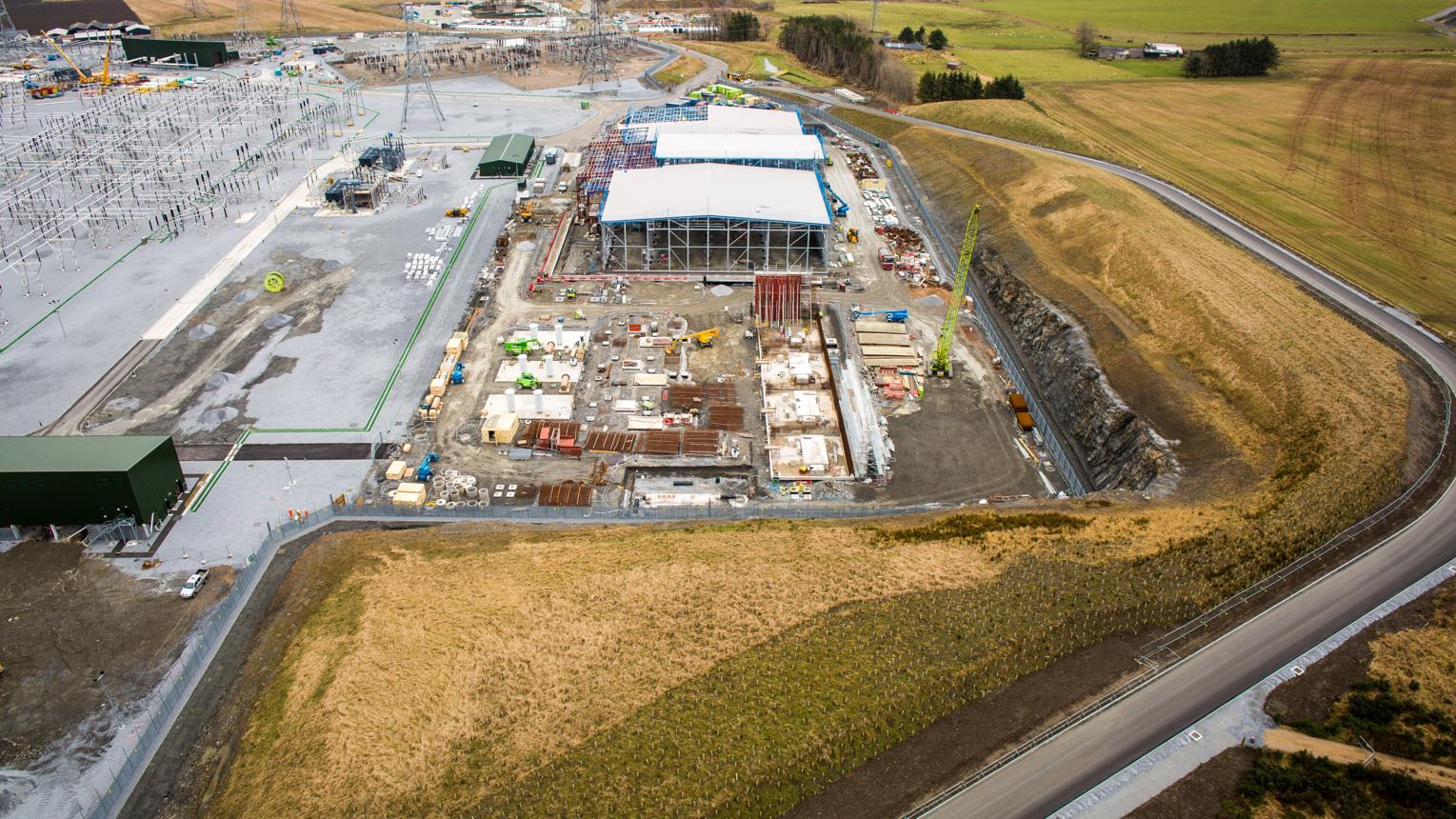
Situated near Keith in Moray, it connects high-voltage power lines and equipment used to move electricity across the region and into the wider British transmission network.
The site formed a major component of the £1.1 billion Caithness–Moray transmission development, one of the largest electricity infrastructure investments undertaken in northern Scotland since the hydroelectric expansion of the twentieth century.
That project included a 113-kilometre subsea high-voltage direct-current cable across the Moray Firth, connecting infrastructure in Caithness with the converter station at Blackhillock.
Designed to transfer up to 1,200 megawatts, the connection was intended to strengthen the electricity network and accommodate additional renewable generation.
The expanded substation incorporates equipment operating at several voltage levels, including 132kV and 400kV gas-insulated switchgear, 275kV air-insulated equipment and high-voltage direct-current conversion facilities.
The 400kV switchgear was commissioned in 2017, following an extensive construction programme.
Blackhillock’s importance has grown as Scotland has developed more onshore and offshore renewable generation.
Electricity from wind farms must be transmitted through an increasingly extensive network of substations, cables, overhead lines and switching equipment.
Although renewable generators do not burn fossil fuels when producing electricity, their connection to the grid still depends on industrial equipment with environmental impacts of its own.
SF₆ is one such example.
The expansion of the transmission network can increase the total quantity of gas held in electrical equipment unless new technologies replace conventional SF₆-based systems.
The August release involved the existing Blackhillock 400kV installation. It should not be confused with the separately proposed Blackhillock 2 substation associated with future electricity transmission developments.
The Industry Is Developing Alternatives
The Blackhillock incident comes as the electricity industry faces increasing pressure to reduce its use of SF₆.
A study commissioned by the UK Department for Energy Security and Net Zero and published on 20 October examined the prospects for phasing out the gas from new electrical switchgear.
The research, undertaken by Ramboll, drew on consultation with network operators, equipment manufacturers, regulators and other industry specialists.
It found that alternatives are already commercially available for some voltage classes.
However, their technical maturity, cost and availability vary significantly.
For equipment operating at 11kV and parts of the 66kV-to-132kV range, SF₆-free technology is relatively well developed.
The situation is more complicated at the highest transmission voltages, where alternatives exist but remain subject to supply constraints and, in some cases, reliance on transitional gas mixtures.
The study also identified uncertainty in Britain’s regulatory and financing arrangements.
While the European Union has introduced a timetable restricting the use of fluorinated gases in new electrical switchgear, Great Britain has not adopted an equivalent comprehensive phase-out schedule.
Instead, operators work within existing fluorinated-gas legislation and the environmental incentives administered by Ofgem.
The researchers argued that clearer regulation and more predictable financial arrangements would help manufacturers and electricity companies invest in alternative technologies.
They also found that the higher initial cost of SF₆-free equipment could be managed with relatively limited effects on average consumer electricity bills.
The main constraints, according to the study, lie in investment certainty, technical approval and the ability of manufacturers to supply equipment at the required scale.
This is particularly relevant to Scotland, where major transmission projects are being developed to connect new renewable generation and reinforce the electricity network.
Decisions made now about substation design and equipment procurement could determine how much SF₆ remains in service for decades.
The Operator’s Wider Environmental Performance
The Blackhillock release also needs to be understood in the context of SSEN Transmission’s broader environmental performance.
In its 2025–26 annual reporting, published in September, the company reported an SF₆ leakage rate of 0.10% across its transmission network.
It described this as a sector-leading result and highlighted a 31% reduction in operational greenhouse gas emissions over the preceding five-year regulatory period.
The reported leakage rate relates to the company’s network-wide performance during an earlier reporting period, rather than the August 2026 incident.
It therefore cannot be used to determine the individual significance of the Blackhillock release.
Equally, a major isolated incident does not by itself establish that the operator’s wider maintenance arrangements are ineffective.
SSEN Transmission is also involved in developing and installing equipment intended to reduce the industry’s dependence on SF₆, including alternative insulation technologies used in transmission infrastructure elsewhere in northern Scotland.
The evidence consequently presents a more complicated picture than one of either consistent failure or complete environmental success.
The operator has demonstrated reductions in its wider reported emissions while continuing to manage substantial quantities of an exceptionally powerful greenhouse gas within existing equipment.
The challenge is to maintain reliable electricity supplies while reducing both routine leakage and the risk of major releases associated with equipment failures.
The Questions Still Awaiting Answers
Ofgem’s consultation establishes the quantity of gas released, the immediate circumstances of the incident and the regulator’s preliminary assessment.
It does not establish the underlying engineering cause of the electrical failure.
That investigation remains important because the regulator’s proposed exemption is based partly on the conclusion that there was no reasonable warning of the incident and no practicable opportunity to prevent it.
A final technical report could strengthen that conclusion or identify additional circumstances requiring consideration.
Questions also remain about the condition of similar switchgear at Blackhillock and other substations, whether any inspections or engineering changes have been introduced since August, and the extent to which the 2024 incident informed subsequent maintenance arrangements.
The operator’s published submission does not provide enough information to establish whether the two events had any underlying technical connection.
More detailed reporting of the company’s overall emissions, equipment inventory and exceptional-event claims would also help determine the scale of the issue across the expanding transmission network.
For the regulator, the immediate decision concerns whether an incident involving 46.56 kilograms of SF₆ should affect the operator’s financial performance under its emissions incentive.
For Scotland’s electricity industry, the longer-term issue is how to expand and modernize a network essential to renewable energy while reducing its dependence on equipment containing gases with exceptionally high global warming potential.
The Blackhillock case illustrates both challenges.
The release occurred during the operation of infrastructure supporting Scotland’s transition to lower-carbon electricity. The greenhouse gas escaped from equipment used to make that transition possible.
Ofgem is accepting responses until 20 November. Its final decision will determine how the August incident is treated under the financial incentive scheme, but the wider question of preventing future releases will depend on the conclusions of the technical investigation and the industry’s progress towards safer, lower-emission alternatives.
Sources
SHET’s Insulation and Interruption Gas Exceptional Event Claim at Blackhillock (RIIO-ET3). Ofgem. 29 October 2026.
https://www.ofgem.gov.uk/consultation/shets-insulation-and-interruption-gas-exceptional-event-claim-blackhillock-riio-et3
SHET’s Insulation and Interruption Gas Exceptional Event Claim at Blackhillock — Consultation and Technical Assessment. Ofgem. 29 October 2026.
https://www.ofgem.gov.uk/sites/default/files/2026-10/SHET-IIG-exceptional-event-consultation.pdf
Decision on Insulation and Interruption Gas Exceptional Event Claim for SSEN at Blackhillock. Ofgem. 18 July 2025.
https://www.ofgem.gov.uk/decision/decision-insulation-and-interruption-gas-exceptional-event-claim-scottish-and-southern-electricity-networks-ssen-blackhillock-0
Blackhillock Exceptional Event Claim — Final Decision Letter. Ofgem. 18 July 2025.
https://www.ofgem.gov.uk/sites/default/files/2025-07/Blackhillock%20IIG%20Decision%20Letter_July%202025.pdf
Pathways to SF₆-Free Distribution Networks. Department for Energy Security and Net Zero / Ramboll. 20 October 2026.
https://www.gov.uk/government/publications/pathways-to-sf6-free-distribution-networks
Sulphur Hexafluoride — National Atmospheric Emissions Inventory. Department for Energy Security and Net Zero. Updated 29 July 2026.
https://naei.energysecurity.gov.uk/node/84
How to Operate or Service Electrical Switchgear Containing SF₆. Department for Environment, Food & Rural Affairs / Environment Agency. Updated 21 March 2025.
https://www.gov.uk/guidance/how-to-operate-or-service-high-voltage-switchgear-containing-sf6
SSEN Transmission Publishes 2025/26 Reports Highlighting Strong RIIO-T2 Delivery and Progress Towards Clean Power 2030. SSEN Transmission. September 2026.
https://www.ssen-transmission.co.uk/news/news–views/2026/9/ssen-transmission-publishes-202526-reports-highlighting-strong-riio-t2-delivery-and-progress-towards-clean-power-2030/
Latest Energisation for Largest Substation in UK. SSEN Transmission. May 2017.
https://www.ssen-transmission.co.uk/news/news–views/2017/5/latest-energisation-for-largest-substation-in-uk/
Caithness–Moray Transmission Link. SSEN Transmission.
https://www.ssen-transmission.co.uk/projects/project-map/caithness—moray/
Blackhillock Substation. SSEN Transmission.
https://www.ssen-transmission.co.uk/projects/project-map/blackhillock-substation/