
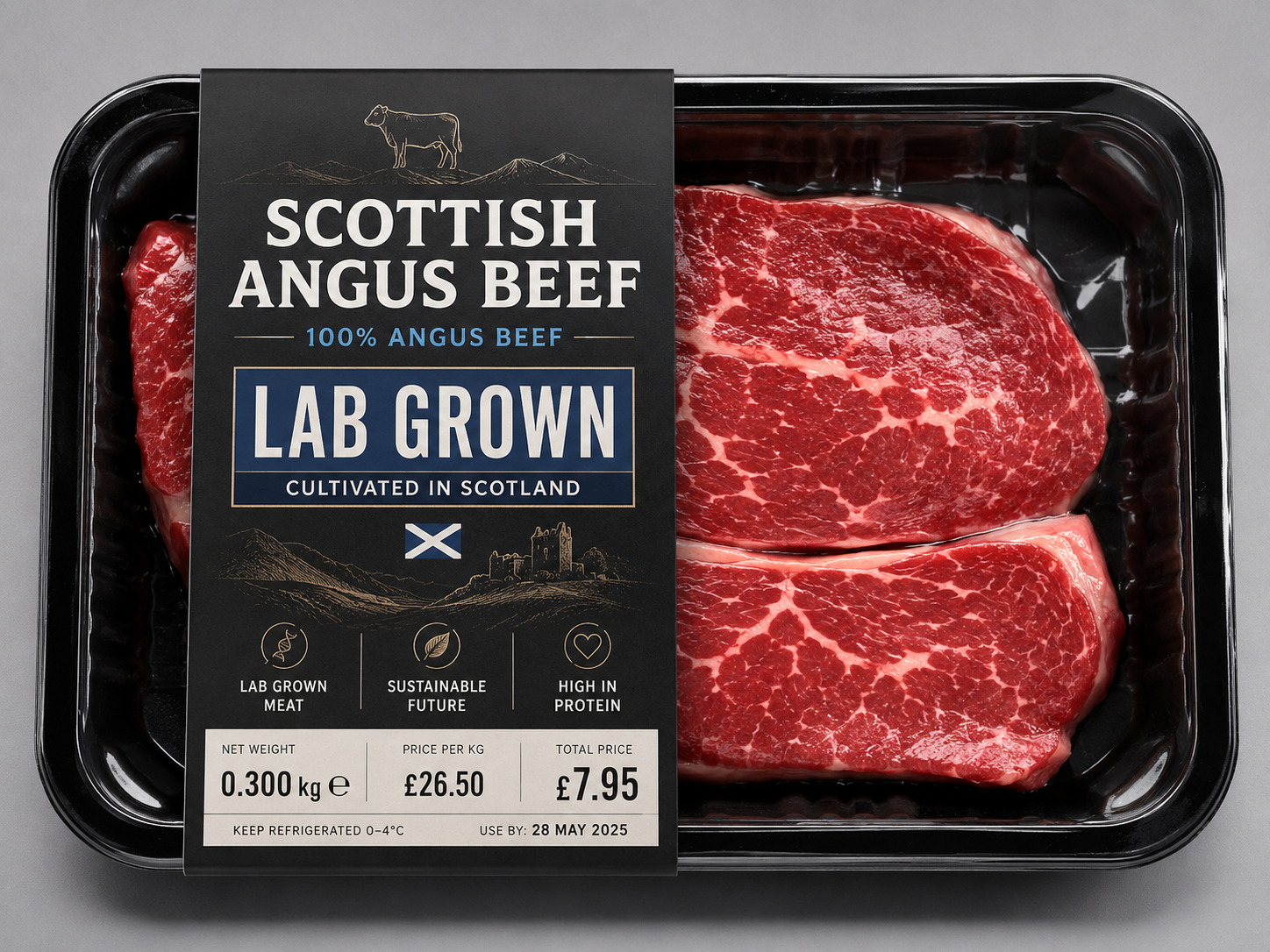
Food Standards Scotland has helped publish four new guidance documents for businesses developing cell-cultivated and other novel foods, bringing products grown from animal cells another step closer to the British regulatory system.
The guidance, published jointly with the Food Standards Agency on 10 July 2026, covers production methods, microbiological hazards, market-authorisation applications and controlled taste trials. It does not approve any cultivated-meat product for sale, and none is currently authorised for human consumption in Great Britain. Each product would still require its own safety assessment and ministerial approval before entering the market.
The publication raises a wider Scottish question. Public agencies are devoting money, scientific expertise and regulatory capacity to preparing an industry that does not yet exist at commercial scale here, while farmers and crofters in the Highlands and islands continue to report basic transport problems affecting livestock, freight and access to markets.
The two matters do not come from the same departmental budget, and it would be inaccurate to suggest that money spent assessing cultivated food could simply have purchased a ferry. Food Standards Scotland is a non-ministerial public body, independent of both industry and the Scottish Government, and is responsible for preparing for food-safety risks whether or not ministers favour the product concerned. It is accountable through the Scottish Parliament and funded through a separate budget line.
The comparison nevertheless exposes a question of public priority. Scotland has found the institutional capacity to help companies navigate a future market for food grown in vessels, while island communities remain dependent upon lifeline transport that users repeatedly describe as lacking capacity, reliability and affordable freight space.
A Transport Scotland consultation on the next Northern Isles ferry contract recorded demands for additional freight capacity, more sailings and improved reliability. Crofters and farmers argued that freight charges placed them at a disadvantage compared with mainland producers. Reliability was described by one public body as underpinning every other aspect of a lifeline service.
Cultivated-food regulation and ferry procurement are different functions, but government is ultimately judged across the whole of public life. A country able to look ten years ahead for an experimental food industry should also be capable of securing dependable transport for the agricultural communities already producing food today.
Did Scotland ask whether people wanted it?
There has been no Scottish referendum, national consultation or public vote asking whether people want cultivated meat sold in Scotland.
Nor would such a vote normally be required before regulators began preparing safety standards. Food Standards Scotland’s legal responsibility is to anticipate emerging food technologies, identify possible hazards and assess individual applications. Regulation is not the same as promotion, and publishing safety guidance does not compel shops to stock a product or consumers to buy it.
There has, however, been public-opinion research, and its findings are hardly a ringing endorsement.
In the Food and You 2 survey for Scotland, respondents were asked whether they would like to include lab-grown meat in their diets if it became available. Only 28% said they definitely or probably would. Sixty per cent said they probably or definitely would not, while 12% were unsure. Among the 942 online respondents answering the question, only 8% said they would definitely like to try it.
That survey is evidence of public attitudes, not public consent. It does not establish that every Scottish consumer opposes the technology, but it does show that regulators are preparing for a market most respondents said they did not intend to join.
Food Standards Scotland and the FSA also commissioned a wider evidence review of consumer attitudes. It found that most available research concerned cultivated meat rather than dairy, plants or seafood, and that important gaps remained in understanding the views of religious groups, vegetarians, vegans and other sections of the population.
The democratic issue is that the policy discussion has so far been conducted mainly among regulators, scientists and applicant companies. A safety-assessment system answers whether a product may legally be sold. It does not answer whether Scotland wants to subsidise the industry, attract its factories, place it in public procurement or treat it as part of the country’s agricultural future.
Those decisions require a broader public discussion.
Where is the proof that it is safe?
There is no body of long-term human evidence proving that cell-cultivated meat as a category is safe to eat for decades. The products are too new, few have been authorised internationally, and consumption has been too limited to provide the sort of population data available for established foods.
That does not mean the products are necessarily unsafe. It means safety cannot be declared for the category in advance.
The British approach is intended to assess each product separately. A company would have to explain the origin and stability of its cells, the ingredients used to grow them, its production process, possible contaminants, allergen risks, nutritional composition and the consistency of manufactured batches. Approval of one cultivated chicken product would not prove the safety of a different beef, pork or seafood product.
An FSA-commissioned hazard review published in 2022 identified a range of potential biological, chemical and manufacturing hazards. These included microbial contamination, residues from growth media, the stability of cell lines, allergens, materials used in processing and contamination introduced during large-scale production. The report described the technology as novel and said cultivated animal cells could present new risks requiring examination. It was a hazard-identification exercise, not a declaration that the food had already been proved safe.
The current regulatory sandbox exists partly because officials do not yet have all the answers. Its workshops have examined which tests companies should be expected to conduct, how taste trials involving unauthorised foods should be managed and what evidence is necessary to demonstrate safety.
The responsible position is therefore neither to claim that cultivated meat is inherently dangerous nor to describe it as established and safe. It remains an emerging manufacturing process whose products must be judged from evidence supplied for each application.
The burden of proof should rest with the producer.
Would the health risks associated with meat disappear?
Not automatically.
Cultivated meat is often presented as though removing the farm and slaughterhouse also removes every health concern associated with eating meat. That conclusion is not supported by the evidence.
In 2015, the World Health Organisation’s International Agency for Research on Cancer concluded that processed meat causes colorectal cancer and classified red meat as probably carcinogenic to humans. Its analysis estimated that eating 50g of processed meat daily was associated with an 18% increase in colorectal-cancer risk. The agency stressed that the absolute risk to an individual remained comparatively small but rose with the amount consumed.
Some of the mechanisms under investigation concern processing, preservatives and high-temperature cooking. Others may relate to components naturally present in red meat, including haem iron. A cultivated product designed to reproduce the composition, fat, colour and cooking behaviour of conventional red meat may also reproduce some of those characteristics.
If cultivated cells are turned into sausages, burgers, cured products or other heavily processed foods, the fact that the cells began in a bioreactor would not transform the finished product into a health food. Salt, saturated fat, nitrites, smoke flavourings, binders and cooking methods would still matter.
There may also be opportunities to alter the nutritional profile. Producers might reduce saturated fat, omit particular preservatives or change the ratio of nutrients. Such changes could produce a different health outcome, but that would depend upon the actual product. It cannot be assumed merely from the production method.
The proper comparison is not “farm meat bad, cultivated meat safe”. It is between two particular foods, their ingredients, nutritional composition, processing and patterns of consumption.
Scotland’s role is already substantial
Scotland is not merely observing the field.
Researchers at the Roslin Institute developed a pig stem-cell line capable of repeated growth while retaining its ability to form fat. The work could help companies create cultivated fat, which contributes flavour, texture and cooking behaviour to meat products. The cells are being made available to academic and commercial researchers. The research is valuable, although it is not an approved food product and does not establish long-term dietary safety.
Scotland also produced ENOUGH, formerly 3F BIO, a Glasgow-headquartered company using fungal biomass fermentation to make protein for meat and dairy alternatives. Its large manufacturing plant is in the Netherlands rather than Scotland.
The pattern deserves attention. Scotland may supply regulation, research, livestock knowledge and intellectual property while production plants, brands and profits are established elsewhere.
At the same time, conventional agriculture remains embedded in Scotland’s rural economy. Farms and crofts sustain food production, haulage, veterinary services, auction marts, abattoirs and island communities. Their immediate concern is less likely to be whether cultured pork fat can be grown successfully than whether animals, feed and finished products can reach the mainland reliably and at a viable cost.
The new guidance is legitimate regulatory preparation. It should not be mistaken for public approval, proof of long-term safety or a settled agricultural policy.
Food Standards Scotland has begun answering the question of what evidence a company must provide before cultivated food may be sold. Scotland has yet to answer the larger questions: whether people want it, how it will be labelled, whether its claimed health benefits withstand scrutiny, what public money will support it, and whether the country will protect the farmers and crofters who are already producing food while institutions prepare for those who may one day grow it in tanks.
Sources
https://www.gov.uk/government/news/new-guidance-for-cell-cultivated-and-novel-food-businesses
https://www.food.gov.uk/board-papers/regulatory-sandbox-for-cell-cultivated-products-ccps-0
https://www.food.gov.uk/board-papers/ccp-sandbox-progress-report
https://www.food.gov.uk/print/pdf/node/26586
https://www.foodstandards.gov.scot/about-us/how-we-work
https://www.foodstandards.gov.scot/about-us/who-we-are/our-remit
https://www.iarc.who.int/wp-content/uploads/2018/07/pr240_E.pdf
https://www.iarc.who.int/wp-content/uploads/2018/11/Monographs-QA_Vol114.pdf