

Scotland did not simply stop celebrating Christmas after the Reformation. Kirk courts punished people for keeping Yule, Parliament removed the Christmas court holiday, and Christmas Day remained an ordinary working day for generations. Yet the old season persisted in bread, candles, fires, games, omens and household customs — while much of the public celebration moved towards Hogmanay.
In Aberdeen in December 1574, fourteen women were called before the kirk session for what the record described as “playing, dancing & singing of filthy carols on Yule day”. They were admonished.
The surviving minutes make the scene unusually clear. The Reformation had already transformed Scotland’s official religious life, but people were still keeping Yule. Elsewhere the authorities complained about cards and dice, masked dancing, bells, Yule loaves, disguising, heavy drinking and other activities that belonged to the old festive season. In Glasgow, on 26 December 1583, five people were ordered to make public repentance for keeping Yule.
Those cases are a better starting point for the history of Scottish Christmas than the familiar claim that Christmas was simply “banned” and disappeared. It did not disappear. It became contested.
Before the Reformation, Yule had been woven into the calendar of royal, religious and household life. Afterwards, the reformed kirk attacked the observance of feast days that had no scriptural authority. Parliament eventually removed the Yule vacation from the courts. Christmas could be treated as an ordinary working day. Yet the language of Yule, and a remarkable collection of practices attached to it, continued to appear in Scottish records for centuries.
Some of the customs are well documented. Others survive only in later folklore. And some of the explanations repeated today, that Hogmanay comes from the French words for “man is born”, that first-footers had to be dark because fair-haired Vikings once brought terror to Scottish doors, or that a Highland cloud-bull was a survival of the cult of Mithras, are much less secure than the customs themselves.
Before the Reformation, Scotland Kept Yule in Public
At the court of James IV, Yule was not a private or apologetic affair. Royal accounts place the king and his household celebrating the season at Edinburgh Castle, Holyrood, Aberdeen, St Andrews, Linlithgow and Arbroath. The court moved, and Yule moved with it.
Food, greenery, entertainers and games formed part of the season. Historic Environment Scotland’s examination of the royal accounts records evergreen decoration including holm, ivy and bays. A substantial Yule stock or log provided heat during the festive period. Royal fools travelled to wherever the king was keeping Yule, while the treasurer paid for costumes and “play coats” for performances and masking.
Twelfth Night and Epiphany were part of the same long season rather than an afterthought to a single day on 25 December. Court entertainments included the choosing of a King or Queen of the Bean, in which a bean hidden in festive food could determine the ceremonial ruler of the occasion. Christian Rae is recorded as Queen of the Bean in 1531. On Epiphany in 1540, an early form of David Lyndsay’s great satirical drama later known as Ane Satyre of the Thrie Estaitis was performed before the court.
Seasonal misrule was already attracting official hostility before the Protestant Reformation. In 1555, during the regency of Mary of Guise, Parliament prohibited the choosing of figures including Robin Hood, Little John, the Abbot of Unreason and the May Queen. Anyone accepting such an office could face severe penalties, including banishment. The legislation belongs to a broader attempt to regulate popular disorder rather than a specific Protestant suppression of Christmas, but it shows that festive customs were already a matter of public authority.
The Kirk Attacks the Calendar
The decisive change came after the Scottish Reformation of 1560.
The reformed Church of Scotland rejected the old cycle of saints’ days and religious festivals that it regarded as unscriptural. In 1575 the General Assembly abolished the keeping of holy days other than the Sabbath, specifically including Yule and saints’ days.
The order did not make centuries of custom disappear. That is why the kirk-session records are so valuable. Authorities only had reason to discipline people for keeping Yule because people were still keeping it.
Aberdeen’s fourteen women were not an isolated example. The records preserved by National Records of Scotland show local kirk authorities pursuing Christmas observance, while the vocabulary of the complaints gives glimpses of the celebration itself: singing, dancing, gaming, disguising, festive baking and drinking.
The pressure continued into the seventeenth century. In 1640 the Scottish Parliament abolished the “Yule vacance”, the Christmas recess observed by the Court of Session. The act declared that the kirk had been purged of the “superstitious observation” of days and therefore removed the Yule holiday. Parliament acted again in 1690 to discharge the Yule vacation.
At local level the principle could be still plainer. Records from St Andrews in the seventeenth century include orders that Yule should not be kept and that people should work as on an ordinary working day. Keeping Christmas was therefore not merely discouraged as excessive merrymaking. Work itself could become a demonstration that the day possessed no special religious status.
This is one reason Scotland’s later relationship with Christmas differed so markedly from England’s. The public festival lost institutional support while New Year retained a much larger place in Scottish winter life. But neither church discipline nor parliamentary legislation created a clean break between an “old Christmas” and a Scotland without seasonal custom.
The Word Yule Refused to Disappear
The Scots language preserves the evidence.
The Dictionary of the Scots Language records Yule in Scotland as both Christmas Day and the wider festive season, sometimes extending beyond New Year. Its older forms descend through Scots and northern English from the same Germanic family as Old English geol and Old Norse jól.
That linguistic history is real. The elaborate modern story that Yule was the twelfth name of Odin, who travelled the earth in a hooded cloak leaving bread or coins beside deserving hearths, is another matter. It is not needed to explain the Scottish word, and it should not be presented as established history without evidence.
The dictionary’s compounds are more revealing than any invented origin story. Scots spoke of Yule ale, Yule bannocks, Yule bread, Yule brose, Yule candles, Yule fires, Yule geese, Yule cheese, Yule fish, Yule sheep, Yule sowans, Yule stacks of peat and Yule wages.
This is the vocabulary of lived practice.
In Angus, an early nineteenth-century account described the first person opening the door on Yule morning as “letting in Yule”. Bread and cheese could be set at the open doorway. In northern Scotland, merchants gave Yule candles to regular customers. Some households let the candle burn itself out; others carefully extinguished and preserved it. A later Hebridean description records a large Yule candle expected to burn through the twelve nights.
Food was equally regional. An Orkney account from 1795 says every house practised killing a sheep on Yule Eve, the animal being known as the Yule sheep. In the north-east, Yule bread was baked for members of the household and could carry omens for the coming year. Yule sowans — a fermented oat preparation — might contain a ring, button, coin or other objects used in divination.
A striking Banffshire description from the nineteenth century records a large log called the “Yeel Carlin” being placed on the fire on Christmas Eve while Yule bread was baked. It is tempting to turn every such object into the remnant of an ancient pre-Christian rite, but the surviving record does not require that conclusion. What it establishes is that distinctive Christmas fire and baking customs continued in north-eastern Scotland long after the Reformation.
Nollaig Mhòr and Nollaig Bheag
Gaelic tradition adds another layer and also corrects a common misunderstanding.
The modern Gaelic word for Christmas is Nollaig. LearnGaelic records the older distinction between Nollaig Mhòr, the Big Christmas, meaning Christmas itself, and Nollaig Bheag, the Little Christmas, meaning New Year’s Day.
Nollaig Bheag is sometimes repeated in English-language accounts as an old Gaelic name for Christmas. The source does not support that usage. It distinguishes the two festivals.
The same Gaelic material preserves a traditional rhyme saying that there was never a summer without sun, never a winter without snow, and never a great Christmas without meat. The point is not romantic atmosphere but food. Meat, scarce or expensive at other times, belonged to the remembered abundance of the Christmas season.
The word Nollaig itself is also more securely explained through the history of Gaelic than through Scandinavian mythology. Older Gaelic forms are related to cognate Celtic Christmas words and have been connected by Gaelic scholars with Latin language associated with birth and nativity.
Hogmanay Did Not Come From “Homme est né”
Perhaps the most persistent story about Scottish New Year is that the word Hogmanay comes from the French homme est né, “man is born”, supposedly carried to Scotland through the Auld Alliance.
It is an attractive explanation. It is not the explanation preferred by the Dictionary of the Scots Language.
The dictionary notes that the word’s origin has long been disputed but identifies the strongest derivation as a borrowing from northern French dialect forms such as hoginane, related to sixteenth-century French aguillanneuf. Those words referred to a New Year gift, a cry made when asking for such a gift, or New Year’s Eve itself. The Scottish borrowing probably occurred before about 1560 and may indeed reflect the long French connection, but not through the phrase “man is born”.
Early Scots records fit the gift-gathering meaning. A form of Hagmané is recorded at Elgin in 1604, and later accounts describe people going from door to door on New Year’s Eve crying for Hogmanay gifts.
The shift of public winter celebration towards New Year is therefore not merely a Victorian invention. Hogmanay had its own established vocabulary and customs while Christmas remained under stronger ecclesiastical suspicion.
First-Footing: The Custom Is Older Than Its Familiar Explanation
First-footing became one of the most recognisable Scottish New Year customs, but the documentary trail is more useful than the legends attached to it.
The Dictionary of the Scots Language gives a 1792 Edinburgh example of the New Year meaning of “first-fit”: the first person to enter a house on New Year’s morning, whose arrival was believed to affect the household’s luck. By 1810 a source stressed the importance of the visitor being a fortunate or “sonsie” person. An 1818 description says a first-footer might arrive with a hot drink and currant bun, or bread and cheese.
Later records document preferences about appearance. An 1877 Galloway source says a fair-complexioned first-footer was considered unlucky. Twentieth-century oral histories remember a dark-haired man carrying coal, bun or shortbread as the desired visitor.
What the records do not establish is the familiar explanation that blond visitors were feared because they recalled Norse raiders. That may be a later attempt to explain the taboo, but it should not be stated as the historical origin without stronger evidence.
The custom itself varied. Food, drink, fuel and money all appear as first-foot gifts in different places and periods. Coal became especially familiar because it represented fuel for the household fire. The first-footer was not simply delivering an object: the visitor crossed the threshold carrying good wishes and participated in the household’s first social exchange of the year.
Handsel Was Older Still
The New Year gift had an old Scottish vocabulary of its own.
A handsel was a gift marking a beginning — a new year, new undertaking, new house or other first occasion — and carried the idea of good fortune. The word occurs in older Scots centuries before the modern ritual package of coal, whisky and black bun became standardised in popular memory.
Handsel Monday, the first Monday of the year, developed as another gift-giving day in parts of Scotland. Servants, children, workers and dependants might receive money or other gifts. It belonged to the same broad culture in which the opening of the year was treated as a moment when the first action, visitor, gift or payment could set the pattern for what followed.
Black Bun Has a History, But Not the One Usually Told
Black bun is genuinely Scottish festive food, but it does not need a prehistoric origin to be interesting.
The Dictionary of the Scots Language records bun in eighteenth-century Scotland as a plum cake or Twelfth cake. In 1808 it was described as a sweet cake or loaf containing fruit and spices and particularly associated with New Year. The name “black bun” appears later as the familiar Hogmanay cake enclosed in pastry.
That evidence supports a historical relationship between rich festive fruit cakes, Twelfth Night food and the later Scottish New Year bun. It does not establish that black bun directly replaced an ancient Scandinavian “sun cake”, nor that the radial markings on modern shortbread are the surviving rays of a solar emblem. Those explanations are often repeated but are much harder to document.
The recorded Yule breads are interesting enough without them. North-eastern sources describe individual Yule cakes baked for members of a household, with the appearance of each cake interpreted as an omen. Other records describe Yule bannocks and richly seasoned bread. Food was both celebration and divination.
The Bees, the Bull and the Border Between Custom and Folklore
Some Scottish seasonal beliefs belong explicitly to folklore rather than observable custom, and that distinction makes them more, not less, valuable.
Collections of Scottish folklore record a belief that bees behaved unusually at Christmas. In some accounts they were said to sing in their hives on Christmas Eve. Later Gaelic material records versions in which bees left their hives briefly at a significant hour.
The belief should be presented as belief. There is no need to invent a naturalistic explanation in which bees supposedly emerged because worshippers returning from church disturbed them. The important fact is that people told and preserved the story.
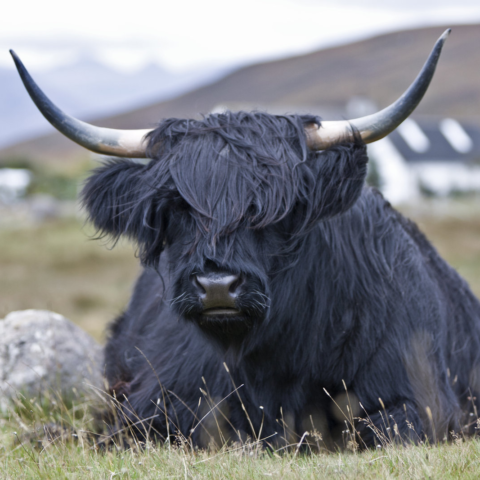
The Candlemas Bull is better documented than its modern explanations. William Grant Stewart included it in his 1823 study of Highland superstitions and festive amusements. The “bull” was a passing cloud imagined in bovine form, and its direction or appearance was read as an omen for the year ahead. Stewart himself admitted that he could not explain the origin of the belief.
That admission is significant. Later claims that the custom descended from the ancient Mithraic bull cult go much further than the early source. There is no need to manufacture a classical pedigree for an already remarkable Highland weather omen.
Divination appears repeatedly around the turning of the year: objects hidden in food, the condition of bread, the identity of the first visitor, the direction of a cloud, and other signs read for marriage, prosperity, death or misfortune. These customs were not uniform throughout Scotland and were not necessarily practised at the same date. Regional evidence matters.
Candles Survived, But the Evidence Is Regional
The old tradition of describing a universal Scottish “Night of Candles”, with lights in every window to guide the Holy Family and later the first-footers, needs qualification.
There is good evidence for Scottish Yule candles. An 1808 dictionary account says northern merchants gave them to regular customers. A Hebridean account later in the nineteenth century describes a large candle intended to last through the festive nights.
What is harder to establish is a single nationwide Scottish rule that every household placed candles in every window for the Holy Family. Similar customs are found elsewhere in Britain and Ireland, and practices could travel or overlap. The surviving Scottish evidence is strongest when it stays local: a merchant’s gift, a household candle, a particular district’s method of burning or preserving it.
That local character is a recurring feature of Scottish Yule. There was no one fixed national ceremony. Orkney, Shetland, the north-east, the Highlands, the Hebrides, Lowland burghs and later industrial towns preserved different combinations of food, fire, visiting, sport and belief.
Christmas Really Did Become a Working Day
The long consequence of Reformation policy can still be heard in twentieth-century voices.
An oral-history recording held by Tobar an Dualchais preserves the memories of Gladys and Charles Simpson, born in 1911 and 1913. In their youth, they recalled, Christmas was not celebrated and was a working day. The children hung their stockings for Santa at Hogmanay instead. Whisky, port, cake and shortbread were set out for New Year visitors, and the desired first-footer was a dark-haired man carrying coal.
That testimony should not be turned into the claim that nobody in Scotland celebrated Christmas. Families, denominations and regions differed. Catholic and Episcopalian communities maintained Christmas observance; urban practice changed; employers differed; and domestic celebrations could exist even where the day was not a general holiday.
But the memory of Christmas as an ordinary working day was real, and it survived into living memory.
The legal position also requires precision. Christmas Day was placed among Scotland’s bank holidays by the Banking and Financial Dealings Act 1971. A bank holiday did not and does not give every worker an automatic statutory right to the day off; employment contracts and industrial practice matter. The change from working Christmas to the modern holiday therefore happened gradually rather than on one morning when Scotland suddenly “got Christmas back”.
What Scotland Actually Preserved
The history of Scottish Yule becomes clearer once the most attractive origin stories are separated from the records.
There was a substantial pre-Reformation Christmas season, visible at court and in the wider ritual calendar. The reformed kirk deliberately attacked the keeping of Yule and other holy days. Parliament removed the Yule vacation. Kirk sessions punished people who continued to celebrate. Work on Christmas Day acquired religious meaning because treating it like any other day demonstrated rejection of the old feast.
Yet Yule survived in speech and practice. Scots continued to bake Yule bread, make Yule brose and sowans, kill Yule sheep, light Yule fires and candles, store Yule peat, play Yule games and tell stories about what animals, weather and visitors might reveal about the year to come.
Meanwhile New Year accumulated much of the public energy that Christmas had lost. Hogmanay gift-seeking, handsel, first-footing, food, drink and visiting formed a durable winter celebration of their own. In some twentieth-century childhoods, even Santa arrived at Hogmanay.
There is no need to imagine that every custom is an unchanged fragment of pagan Scandinavia or ancient Celtic religion. Nor is it accurate to say that Scotland simply ceased to have Christmas after 1560.
The more unusual truth is that Scotland spent centuries arguing over the calendar while people kept finding ways to mark the darkest part of the year.
Sources
- Christmas: Banned in Scotland! — National Records of Scotland, 10 December 2018. National Records of Scotland.
- Yuletide Tidings from the Court of James IV — Historic Environment Scotland, 17 December 2025. Historic Environment Scotland.
- Concerning Robin Hood and the Abbot of Unreason, chapter 40 — Records of the Parliaments of Scotland to 1707, act of 20 June 1555; K. M. Brown et al., eds., University of St Andrews. Records of the Parliaments of Scotland.
- Act discharging the Yule vacation — Records of the Parliaments of Scotland to 1707, 5 June 1640; K. M. Brown et al., eds., University of St Andrews. Records of the Parliaments of Scotland.
- Parliamentary proceedings recording royal assent to the Act discharging the Yule vacation — Records of the Parliaments of Scotland to 1707, 19 July 1690; K. M. Brown et al., eds., University of St Andrews. Records of the Parliaments of Scotland.
- Yule — Scottish National Dictionary, Dictionaries of the Scots Language; entry first published 1976, with later supplementary material. Dictionaries of the Scots Language.
- Hogmanay — Scottish National Dictionary, Dictionaries of the Scots Language; entry first published 1960, with later supplementary material. Dictionaries of the Scots Language.
- Hagmané — A Dictionary of the Older Scottish Tongue, Dictionaries of the Scots Language; historical citations from 1604 and 1692. Dictionaries of the Scots Language.
- First-fit — Scottish National Dictionary, Dictionaries of the Scots Language; entry first published 1956, with historical citations from 1792 onwards for the New Year custom. Dictionaries of the Scots Language.
- Handsel — Scottish National Dictionary, Dictionaries of the Scots Language. Dictionaries of the Scots Language.
- Bun and Black Bun — Scottish National Dictionary, Dictionaries of the Scots Language; historical descriptions from 1782 and 1808 and later Hogmanay usage. Bun; Black Bun.
- Where did the word Nollaig come from? — LearnGaelic; accessed 1 October 2026. LearnGaelic.
- The Folk-Lore of the North-East of Scotland — Walter Gregor, Elliot Stock, 1881. Historical descriptions of Yule food, baking, divination and seasonal belief; also preserved in later Scottish dictionary evidence.
- The Popular Superstitions and Festive Amusements of the Highlanders of Scotland — William Grant Stewart, first published 1823; later edition digitised by Project Gutenberg. Project Gutenberg.
- Christmas not celebrated; stockings hung up at Hogmanay; other New Year traditions — Tobar an Dualchais / Kist o Riches, School of Scottish Studies recording SA1985.141, testimony of Gladys and Charles Simpson. Tobar an Dualchais.
- Hogmanay concert and dance in Kirkcowan — Tobar an Dualchais / Kist o Riches, School of Scottish Studies recording SA1982.115. Tobar an Dualchais.
- Banking and Financial Dealings Act 1971 — UK Parliament, 16 December 1971, Schedule 1. UK Legislation.
- Bank and public holidays — House of Commons Library, 14 March 2025. House of Commons Library.