
In 1876, a message was sent from the remote Scottish archipelago of St Kilda in a most unusual fashion.
It was placed inside a wooden container, sealed against the weather, attached to a floating sheep’s bladder and released into the North Atlantic.
There was no address painted on the ocean. No postman waiting beyond the horizon. The sender could not know where the message would land, when it would be found or whether anybody would read it.
Yet this extraordinary arrangement became part of the islanders’ means of communicating with the outside world.
The St Kilda mailboat was one of the most ingenious and uncertain postal systems in Scottish history.
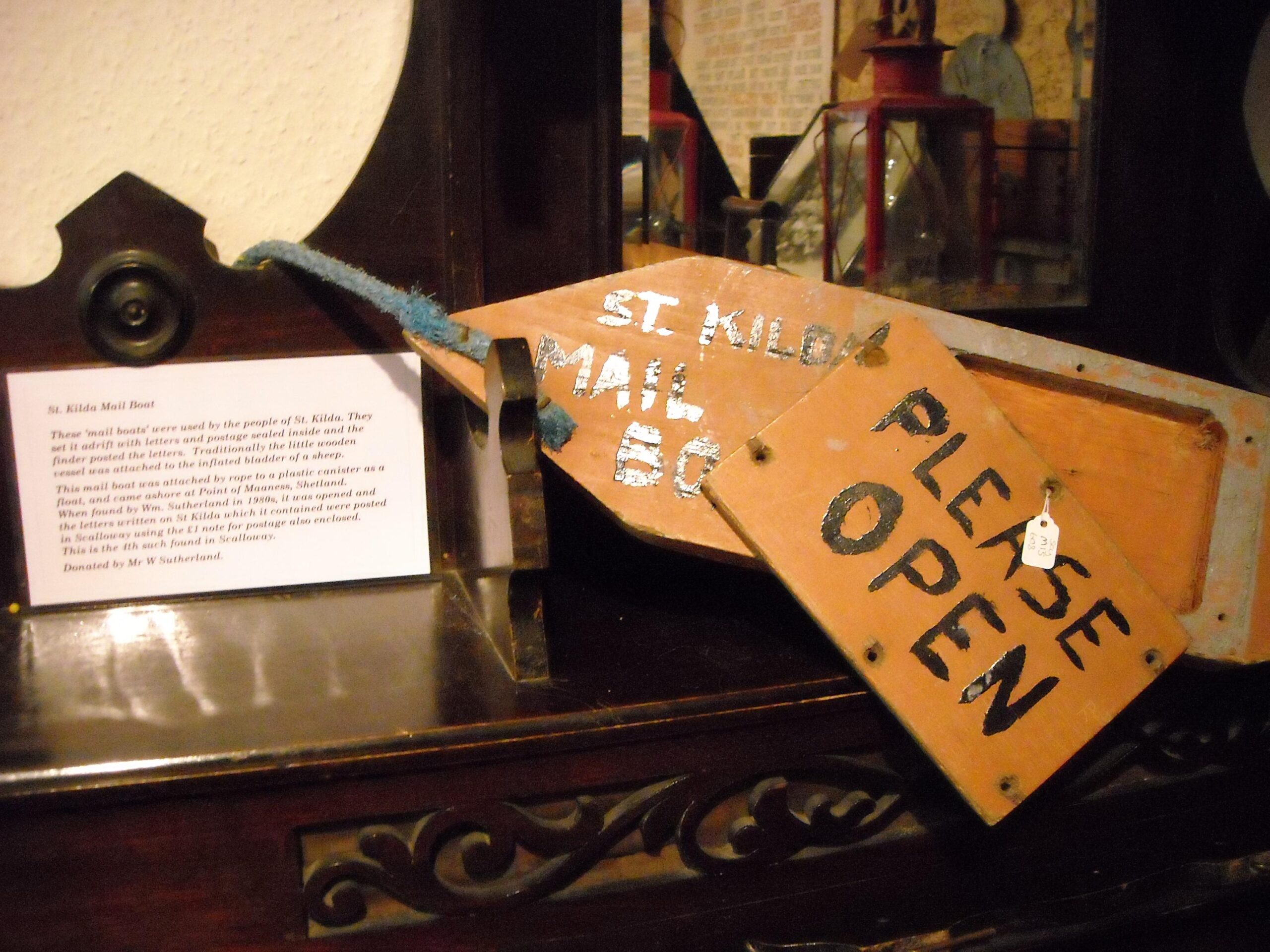
Examples survive in museum collections, including an original preserved by the West Highland Museum in Fort William.
They reveal how one of Britain’s most isolated communities adapted the materials available to them to overcome an almost impossible geographical obstacle.
An Island Beyond the Regular Post
St Kilda lies far out in the North Atlantic, approximately 110 miles west of mainland Scotland.
The archipelago’s principal inhabited island, Hirta, supported a small community whose livelihood depended on crofting, livestock and the harvesting of seabirds.
For generations, the islanders developed ways of living with an environment that made ordinary communication extraordinarily difficult.
The surrounding seas could be dangerous even during summer. Winter storms made voyages particularly uncertain, and passing boats could not be relied upon to arrive when they were needed.
People on the islands could spend extended periods without contact with the mainland.
In the nineteenth century, regular postal services elsewhere in Scotland were increasingly supported by roads, railways and steamships.
St Kilda possessed none of those advantages.
Even when steamers began making more frequent summer visits, the islanders still faced the problem of communicating during the months when ships could not safely or regularly reach them.
A letter written in November might have no conventional means of leaving the island for a considerable time.
The problem became especially serious when supplies ran short or somebody needed medical assistance.
The First Floating Message
The National Trust for Scotland records that the first St Kilda mailboat was launched in 1876, during a period of food shortage.
The early system is also associated with John Sands, a journalist and visitor who spent time on the islands.
A distress message was enclosed in a wooden receptacle, with an inflated sheep’s bladder providing buoyancy.
The idea was to use the prevailing sea currents to carry the message towards inhabited shores, where somebody might find it and forward the letter.
Over time, islanders developed a recognisable form of homemade mailboat.
The vessels were generally small wooden objects resembling miniature boats or boxes, with a compartment to contain a message.
Some were sealed in ways intended to keep seawater from destroying the contents. A length of rope connected the container to a buoy, often made from an animal bladder.
The arrangement was simple, inexpensive and extraordinarily vulnerable to the weather.
A vessel might be destroyed, become waterlogged, remain at sea for months or arrive somewhere completely unexpected.
But it offered one remarkable advantage: it could be launched without a ship, crew or scheduled voyage.
The Atlantic Became the Postman
The mailboats depended entirely on the ocean.
They were generally intended to reach the Outer Hebrides or another inhabited part of Scotland, where a finder might recognise the message and forward it through the ordinary postal service.
The Atlantic did not always cooperate.
Some messages reportedly travelled far beyond the expected destination. The West Highland Museum records St Kilda mailboats reaching places as distant as Thurso and Norway.
These remarkable journeys demonstrate both the possibilities and the weakness of the system.
An object could survive a long voyage and eventually reach somebody capable of helping. Yet a message that arrived hundreds of miles from its intended destination could hardly be described as reliable communication.
There was also no guarantee that the person who found the vessel would understand its purpose.
Some mailboats took weeks or months to reach land.
The successful recovery of an example proves that the object survived the journey. It does not prove that an urgent request was received in time to be useful.
That distinction matters when considering the system as an emergency measure rather than merely an ingenious curiosity.
A Surviving Mailboat in Fort William
The West Highland Museum holds an original example of a St Kilda mailboat.
Its construction is remarkably modest.
The object consists of a carved wooden container with a compartment for the letter, accompanied by a rope and the remains of the flotation arrangement.
There is nothing elaborate about it.
It was made to float, protect a message and attract enough attention to be opened by whoever found it.
The museum records that its example was donated in 1930, the same year the remaining permanent inhabitants left St Kilda.
The object is a powerful reminder that what appears to modern visitors as an ingenious piece of folk engineering existed because the community lacked a dependable alternative.
The islanders did not need an amusing way to send letters. They needed a connection to a world beyond the horizon.
When the Navy Brought a More Reliable Service
The First World War temporarily changed the islands’ circumstances.
The presence of a naval detachment on Hirta brought more regular deliveries of food and mail through naval supply vessels.
For a time, the community experienced a more dependable connection with the mainland.
After the war, those arrangements ended.
The National Trust for Scotland identifies the withdrawal of regular wartime communications as one factor contributing to the islanders’ increasing sense of isolation.
Other changes had already affected the community.
Tourism and outside trade altered the local economy. Emigration reduced the population, and the remaining inhabitants found it increasingly difficult to maintain the physical labour required for traditional island life.
Food shortages, illness and difficulties obtaining essential supplies added to the pressures.
The mailboat could not solve these problems.
It could carry a message, but not a doctor, a reliable supply of food or the infrastructure needed to support a small community through winter.
The Last Departure
On 29 August 1930, the remaining 36 inhabitants of St Kilda were evacuated to the Scottish mainland at their own request.
The departure ended permanent civilian settlement on Hirta.
The evacuation has sometimes been portrayed as the inevitable disappearance of an isolated way of life. The National Trust’s records provide a more complicated picture, involving demographic change, economic dependence, illness, communications and the wishes of the people themselves.
The islanders were not simply defeated by the sea. They had endured its conditions for generations.
But the circumstances required to sustain their community had changed.
The surviving mailboats offer a particularly human way of understanding what had been lost.
A small wooden box could be placed in the ocean with the hope that somebody, somewhere, would find it.
A Message Found on Lismore
The tradition has had an afterlife.
The Lismore Gaelic Heritage Centre records a modern St Kilda mailboat found at Kilcheran on Lismore in 1995 by Neil and John Carmichael.
The vessel had been released as part of a student survey and contained a message requesting that the finder open it.
Unlike the original nineteenth-century distress messages, this was a modern experiment.
Its journey was nevertheless unusual. Instead of making landfall where similar objects were expected to travel, it reached Lismore after passing through or around the Outer Hebrides and into the waters of Loch Linnhe.
The enclosed letter was forwarded.
The discovery provided another demonstration of the unpredictable routes taken by floating objects in Scotland’s western seas.
It also showed that the idea had survived long after the original community disappeared.
Scotland’s Most Uncertain Postal Service
Today, St Kilda is internationally recognised for its natural and cultural importance. Its surviving buildings, archaeological remains and extraordinary seabird colonies are protected as part of a World Heritage Site.
The islands attract considerable interest, but the mailboat deserves a place in the story that goes beyond its novelty.
It was a communication system developed under severe constraints.
It required simple materials, an understanding that ocean currents could carry objects long distances, and faith that an unknown person might be willing to help.
The latter was as important as the former.
Without somebody finding the vessel, opening it and forwarding the message, the entire enterprise came to nothing.
It was perhaps the most uncertain postal service imaginable.
And yet, among the extraordinary objects preserved from Scotland’s island history, few speak quite so clearly of the determination to remain connected.