
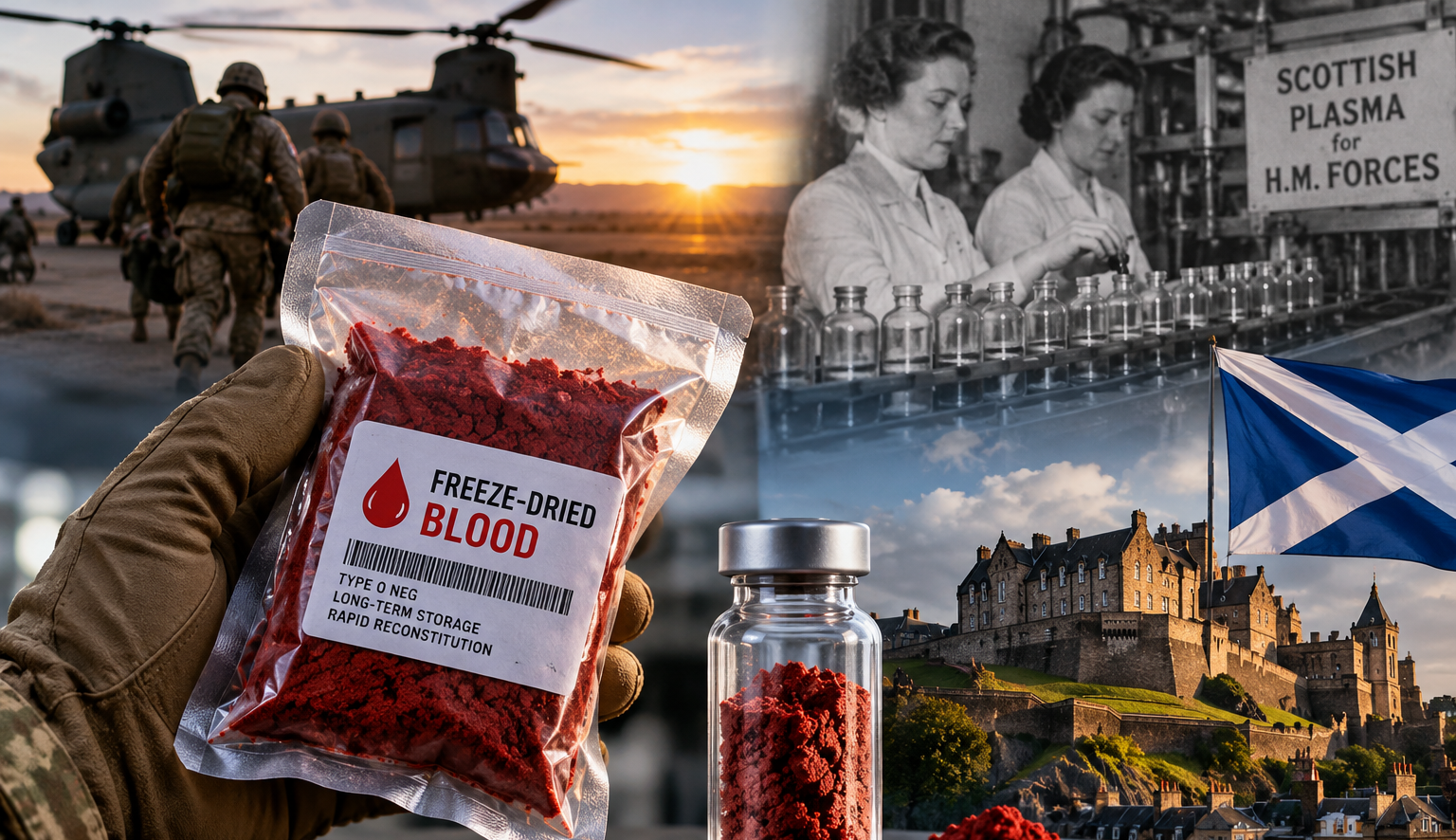
Scientists are moving closer to one of the most ambitious developments in transfusion medicine: human blood components that can be dried, stored without refrigeration and restored for emergency treatment when conventional blood supplies are unavailable.
On 18 October 2026, researchers at the Chinese Academy of Sciences published a study reporting that red blood cells protected by an experimental artificial coating could survive freeze-drying and be successfully rehydrated, with approximately 95% recovery under laboratory conditions. The treated cells retained important characteristics, including their ability to transport oxygen, and the researchers reported storage at room temperature for at least three months.
The finding follows an intensive year of American military and university research into blood products that could be carried into battlefields, remote communities and disaster areas without the refrigerated storage ordinarily required for transfusions.
In April, the US military brought together medical researchers, defence scientists and commercial developers to consider accelerating production of freeze-dried red blood cells. In May, the Defense Advanced Research Projects Agency launched a programme intended to advance synthetic and shelf-stable blood components towards clinical trials and eventual deployment.
Then, on 29 July, the US Food and Drug Administration licensed America’s first freeze-dried plasma product, allowing a component of donated blood to be stored at ordinary room temperature and rapidly prepared for transfusion.
These developments concern related but medically distinct technologies. Freeze-dried plasma is now licensed for certain emergency applications in the United States. Freeze-dried platelet-derived products have entered clinical trials. Freeze-dried red blood cells capable of restoring oxygen delivery remain experimental.
For Scotland, the research has an unusually direct historical connection. More than eight decades ago, Scottish scientists and technicians were already producing freeze-dried blood plasma in Edinburgh and Glasgow for the treatment of wartime casualties.
The technology was not originally invented in Scotland. But the country’s role in developing and manufacturing it was substantial, and surviving records reveal an early production programme that extended from a laboratory beneath Edinburgh Royal Infirmary to the Allied war effort in Europe.
The October 2026 Breakthrough: Protecting Red Blood Cells with Artificial Armour
The research published on 18 October in the scientific journal Advanced Materials addresses the central difficulty that has prevented freeze-dried red blood cells from becoming a routine medical product.
Red blood cells are delicate biological structures. Their outer membranes allow them to bend and squeeze through extremely narrow blood vessels while transporting oxygen from the lungs to tissues throughout the body.
When water is removed through conventional freeze-drying, ice formation and dehydration can damage those membranes. Rehydrating the cells does not necessarily reverse the injury. Damaged cells can rupture, releasing haemoglobin into the surrounding fluid.
That is a serious problem because free haemoglobin outside red blood cells can have harmful effects, including damage to blood vessels and kidneys.
The Chinese research team developed a protective system inspired by the walls of plant cells, which are able to withstand environmental stresses that would damage many mammalian cells.
Researchers led by Xia Zheng, Lingqi Wang, Zhang Liu and Jianjun Wang developed what they described as artificial membrane armour.
The protective coating combines a porous material known as zeolitic imidazolate framework-8, or ZIF-8, with a water-retaining polymer structure and zinc-ion interactions intended to maintain the stability of the red-cell membrane.
The materials perform different functions. The porous framework provides mechanical protection, the polymer helps retain hydration, and the zinc interactions help prevent damaging changes to the membrane during freezing and drying.
Under the reported experimental conditions, the researchers achieved approximately 95% recovery of red blood cells after rehydration using less than 5% protective material by weight.
The study also reported preservation of cell shape, membrane behaviour, metabolic activity, oxygen transport and circulation characteristics in its experimental assessments.
Importantly, the material could be stored at ambient temperature for at least three months.
This does not establish that a bag of dried blood can now be safely reconstituted and administered to patients. The findings remain preclinical, and the published results do not constitute evidence from human transfusion trials.
Further work would be required to establish the safety of the protective materials, the fate of those materials after transfusion, the long-term survival of the treated cells, compatibility with blood-bank manufacturing processes and the feasibility of producing clinically useful quantities.
Nevertheless, the result represents a substantial scientific advance towards preserving living red blood cells without continuous refrigeration.
America Wants Freeze-Dried Red Blood Cells for Battlefield Medicine
The United States military has been pursuing a related objective: allowing a medic to carry an oxygen-carrying blood product that can be prepared for transfusion without having to maintain a refrigerated blood supply.
On 8 April 2026, specialists from the US Air Force’s 59th Medical Wing, the Army Institute of Surgical Research and Naval Medical Research Unit San Antonio met with researchers, industry representatives and military medical organisations in Texas.
The gathering examined the state of freeze-dried red-cell research and the possibility of using a prize competition to accelerate development.
The military described a future situation in which a severely injured service member needs blood immediately, but neither a blood bank nor an adequately refrigerated supply is available.
Instead of relying exclusively on fluids that restore circulating volume, the proposed technology would allow a medic to rehydrate preserved red blood cells and administer cells capable of carrying oxygen to vital organs.
The difference is fundamental. Fluids can help restore circulation, but they cannot replace the oxygen-carrying capacity of lost red blood cells. Plasma can supply essential clotting proteins, but it does not replace red blood cells either.
The proposed military product would therefore address a problem that freeze-dried plasma alone cannot solve.
Participants in the April meeting included representatives of US Special Operations Command, the Armed Services Blood Program, the Joint Trauma System, universities and commercial research organisations.
The published announcement concerned research coordination and the possibility of a development competition. It did not establish that the US military had already approved or deployed freeze-dried red blood cells.
Johns Hopkins Is Attempting to Make Blood Without Donors
Another American programme goes beyond preserving cells collected from donated blood.
Researchers at Johns Hopkins University’s Applied Physics Laboratory are investigating whether red blood cells can be manufactured in a laboratory and then freeze-dried for storage.
The project is called HEART, standing for Human Erythrocytes Available for Reconstitution and Transfusion.
In research described publicly on 7 May 2026, scientists Claire Bell and Corrine Fuller explained that the programme uses stem cells and biological structures known as organoids to investigate the production of red blood cells.
An organoid is a laboratory-grown structure containing cells arranged to reproduce selected functions of an organ. In this programme, the researchers are developing bone-marrow-like structures capable of producing red blood cells.
The aim is to create a reproducible source of oxygen-carrying cells without depending on a new blood donation for every unit manufactured.
The team is investigating cells with O-negative characteristics because of their potential usefulness in emergency transfusions, where a patient’s blood group may not immediately be known.
Once produced, the cells undergo experimental preparation with protective substances before being dehydrated into a powder-like material. The intended process would allow them to be reconstituted with sterile saline when required.
If the research eventually succeeds, it could address two major difficulties simultaneously: the limited storage life of conventional red blood cells and dependence on a continuously replenished donor supply.
However, laboratory production also presents substantial challenges. Researchers must establish whether cells can be manufactured in sufficient numbers, whether they function like donated red blood cells, whether they survive preservation and rehydration, and whether they remain safe after transfusion.
The HEART programme remains experimental. Its long-term objective should not be confused with an available replacement for donated blood.
DARPA Wants a Deployable Blood Substitute by 2029
On 28 May 2026, the Defense Advanced Research Projects Agency announced another major initiative, known as RAPIID: Resuscitation and Prevention of Ischemia-Induced Dysfunction.
The programme builds on earlier work investigating synthetic components capable of performing functions ordinarily provided by human blood.
Rather than attempting to preserve a conventional unit of whole blood unchanged, the programme seeks to develop separate products capable of carrying oxygen, supporting clot formation and replacing essential plasma functions.
These components could eventually be combined or administered according to a patient’s clinical needs.
DARPA has organised the programme around a 36-month research effort, with an initial phase concentrating on preclinical safety, effectiveness and manufacturing requirements, followed by work towards early human trials and commercial production.
Its stated objective is to advance a deployable system towards FDA authorisation as early as the 2029 financial year.
That is a development target, not an approved timetable for military deployment. The final product would still need to meet regulatory standards for safety, manufacturing and clinical effectiveness.
The programme illustrates the direction of military research: not simply keeping conventional blood cold for longer, but developing components that could remain usable when refrigeration, transport and conventional medical infrastructure are unavailable.
The United States Has Already Approved Freeze-Dried Plasma
While red blood cells remain the more difficult research objective, the United States has now taken a substantial regulatory step with plasma.
On 29 July 2026, the Food and Drug Administration approved EZPLAZ Freeze Dried Plasma, manufactured by Vascular Solutions, a subsidiary of American medical technology company Teleflex.
It was the first freeze-dried plasma product to receive a full US FDA licence. Other countries, including France and Germany, have used dried plasma products under their own regulatory arrangements for years.
EZPLAZ is manufactured from plasma donated by a single donor. The plasma is freeze-dried and sealed in a flexible package, accompanied by sterile water and equipment needed to prepare the product for transfusion.
According to the manufacturer’s approved product information, it can be stored between 2°C and 25°C for up to 12 months and reconstituted in approximately one to two-and-a-half minutes.
The product is approved for adults who need plasma when other plasma products are not available. Its potential applications include severe bleeding, major transfusion requirements and particular disorders involving deficiencies of clotting factors.
Plasma is the liquid portion of blood. It contains proteins involved in coagulation, immune defence and other essential functions. During severe haemorrhage, replacing those proteins can help address the failure of blood to clot properly.
But plasma does not contain the red blood cells that deliver oxygen. Freeze-dried plasma cannot independently replace all the functions of whole blood.
The FDA’s approval also requires careful interpretation. Its regulatory review identified a direct clinical safety study involving 24 healthy volunteers, rather than a large trial demonstrating the new product’s clinical effectiveness in severely injured patients.
Regulators relied partly on the existing clinical experience of other freeze-dried plasma products and restricted the indication to situations where other plasma products are unavailable.
A further post-marketing safety study is required, including assessment of thrombotic and thromboembolic events.
Thus, while the American approval is an important practical milestone, it does not establish that every form of dried blood has become safe or ready for routine use.
Freeze-Dried Platelets Are Also Entering Human Trials
A separate development emerged on 29 September 2026, when researchers published results from a Phase 2 clinical trial of a freeze-dried platelet-derived haemostatic product.
Platelets are blood components that help form clots and prevent continuing haemorrhage. Their limited storage life presents difficulties for hospitals and blood services, particularly where demand is unpredictable.
The trial involved 19 patients with haematological cancers and bleeding associated with low platelet counts. Patients received different doses of the experimental product or conventional platelets used as a comparator.
The researchers reported reduced or stopped bleeding within 24 hours in a majority of patients receiving the experimental product across the three dose groups.
Two additional patients with severe intracranial bleeding received the product through compassionate-use arrangements, and the researchers reported resolution of their bleeding.
These findings require considerable caution. The trial was small, the comparison group contained only three patients, and the results cannot establish the product’s effectiveness or safety across a wider population.
Nevertheless, the study shows that research on dried blood components is progressing beyond laboratory testing. Plasma has reached licensed clinical use in particular circumstances, platelet-derived products are being investigated in patients, and preserving oxygen-carrying red blood cells remains a major experimental challenge.
Was Freeze-Dried Blood Invented in Scotland?
The historical answer is no, although Scotland became an important early centre of dried-plasma production.
The scientific origins of preserving biological material through freeze-drying predate the Second World War and involve researchers in several countries.
In 1935, American scientists Earl Flosdorf and Stuart Mudd published research describing methods of preserving biological materials, including serum, in a dried state.
In Britain, Dr Ronald Ian Norman Greaves and colleagues at Cambridge developed their own methods of drying biological preparations. A pilot plant was installed in 1936, initially to preserve therapeutic antisera.
By 1939, experimental batches of dried human serum and plasma produced through the Cambridge work had been shown to be safe for transfusion in the clinical assessments of that period.
These developments preceded the establishment of Scotland’s wartime plasma-drying factory.
However, the approach adopted in Edinburgh became part of Britain’s substantial effort to manufacture blood products for military casualties during the Second World War.
Inside Edinburgh’s Wartime Blood-Drying Laboratory
In 1941, Britain’s Treasury War Emergency Committee agreed to finance two major facilities for the preparation of freeze-dried human plasma. One was to be established in the south of Britain and the other in Scotland.
The Scottish unit was constructed at the Royal Infirmary of Edinburgh, where Professor C. P. Stewart and senior technician Andrew Crosbie played central roles in developing the machinery and establishing production.
The original equipment was installed in the hospital’s Clinical Chemistry Laboratories, with assistance from the Royal Infirmary’s electrical department.
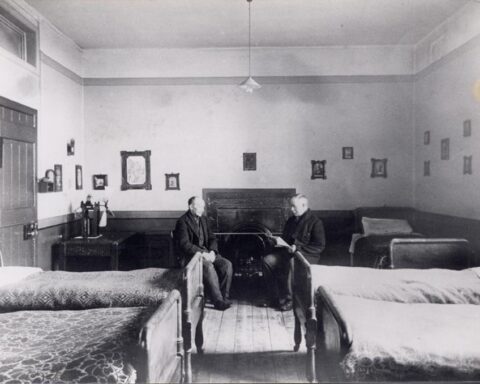
By early 1943, the Edinburgh unit was operating in underground accommodation selected partly because it offered protection from possible air raids.
A later account by the Scottish Society of the History of Medicine described the accommodation as a small, poorly ventilated cellar.
The machinery itself was a considerable technical undertaking for the period.
Its drying chamber consisted of a substantial steel pipe with an internal refrigerated coil, capable of processing approximately 100 bottles of plasma at a time.
The refrigeration system operated at temperatures reaching approximately minus 35°C and used methyl chloride, a refrigerant that was both toxic and flammable.
The equipment ran continuously, maintained over years of wartime service by Andrew Crosbie and his colleagues.
The project also depended on money raised outside government.
Historical records show that pupils and staff at Edinburgh Ladies’ College, now Mary Erskine School, contributed £560 towards the refrigeration arrangements. The refrigerator itself cost approximately £530.
These details survive in documents preserved by Scotland’s blood transfusion service and later deposited among historical records examined by the Infected Blood Inquiry.
An Edinburgh blood transfusion service publication from 1977 recalled that the freeze-drying equipment had been displayed at the Royal Scottish Museum during an exhibition celebrating the history of Edinburgh medicine.
Among the exhibits was a bottle of plasma from one of the earliest production batches, lent by a member of the Polish medical team that had worked with the Edinburgh blood transfusion service during the war.
Scottish Plasma Reached Allied Forces in Europe
The Edinburgh laboratory did not simply undertake experimental research. It supplied dried plasma for wartime medical use.
A historical paper presented to the Scottish Society of the History of Medicine records that the Edinburgh unit supplied plasma for the Royal Navy and Allied armies operating in Europe during 1944.
The same account states that some plasma was dropped over Warsaw during the desperate fighting of the 1944 uprising.
The Warsaw account is supported by the published medical history, although individual wartime dispatch records confirming the specific consignments have not been examined for this article.
The unit therefore formed part of an international medical supply system developed to treat casualties whose immediate survival depended on access to blood products far from established hospitals.
Freeze-drying offered important practical advantages. Plasma could be transported without being kept continuously frozen and later prepared for transfusion using sterile water.
In this respect, the essential wartime problem was remarkably similar to the one confronting military medical researchers in 2026: how to get useful blood components to seriously injured patients when conventional storage and transport arrangements cannot be guaranteed.
Glasgow Also Became a Centre of Dried-Plasma Production
Edinburgh was not Scotland’s only centre of wartime blood-product manufacture.
The University of Glasgow’s historical account of Scottish transfusion medicine records the establishment of a plasma manufacturing facility in the pharmacy department of the Royal Technical College, a predecessor of the University of Strathclyde.
Production was supervised by Professor James Prior Todd, Professor of Pharmacy.
Blood was collected through hospital-based donation centres, and the plasma was separated for processing and distribution through the college facility.
The Scottish National Blood Transfusion Association had been established on 1 March 1940 to coordinate blood donation and transfusion arrangements across the country.
The expanding wartime network created a more systematic approach to recruiting volunteer donors, processing blood and supplying hospitals and military medical services.
Scottish laboratories were consequently participants in one of the most significant periods of development in transfusion medicine.
Although Scotland cannot claim to have invented plasma freeze-drying, it can document an early industrial and medical contribution to making the technology practical on a substantial scale.
Why Did Dried Plasma Disappear From Routine Medical Use?
The wartime success of dried plasma also revealed serious dangers.
Early products were manufactured before modern screening methods could reliably identify blood-borne viruses. Some production methods combined donations from several people, increasing the possibility that one infected donation could contaminate a larger batch.
Transfusion-associated hepatitis became a major concern during and after the war.
In the United States, the military progressively restricted the use of pooled dried plasma, and other blood components or alternatives replaced it in many situations.
In a striking modern demonstration of both the durability and dangers of early preserved blood products, Canadian researchers published a study in January 2024 examining dried serum manufactured in 1943.
They were able to reconstitute the approximately 80-year-old material and detect proteins that had survived preservation, including albumin and several proteins involved in regulating clotting.
The material also produced positive serological findings for hepatitis B, illustrating the historical problem of transfusion-transmitted infection.
Modern dried-plasma manufacturing operates under very different standards for donor selection, infectious-disease testing, production control and regulatory assessment.
The current return to dried plasma is therefore not simply the revival of an unchanged wartime preparation. It combines the earlier preservation principle with decades of advances in transfusion science and product safety.
Scotland’s Later Plasma Industry and Its Closure
Scotland continued developing blood-product manufacture after the war.
The Edinburgh facilities expanded into the production of plasma-derived medicines, including preparations used to treat immune disorders, bleeding conditions and patients requiring replacement of specific blood proteins.
The Scottish National Blood Transfusion Service established its Protein Fractionation Centre in Edinburgh, building on earlier work and the growing need for purified plasma products.
By 1975, Scotland had achieved self-sufficiency in the manufacture of the plasma-derived medicines required for Scottish patients, according to National Services Scotland.
The position changed following concerns about the potential transmission of variant Creutzfeldt-Jakob disease through blood products.
In 1998, the Committee on the Safety of Medicines advised against the use of UK plasma for manufacturing plasma-derived medicines.
Scotland subsequently manufactured products using imported plasma, but the arrangements became increasingly difficult to maintain economically.
Production ceased, and the Edinburgh Protein Fractionation Centre closed in 2008.
This closure concerned the manufacture of plasma-derived medicines, not exclusively the wartime process of preparing dried transfusion plasma. The distinction is important because plasma fractionation produces particular medicinal proteins, whereas dried transfusion plasma is intended to retain a broader mixture of plasma components.
Scotland’s manufacturing history nevertheless demonstrates that the country once possessed substantial expertise and industrial capacity in processing human plasma.
Britain Is Now Investing in Dried Plasma Again
The United Kingdom has begun developing a new domestic dried-plasma manufacturing capability as military planners reconsider the treatment of casualties during major conflicts.
In a parliamentary answer on 7 September 2026, Defence Minister Luke Pollard confirmed that £10 million had been allocated to develop or procure dried blood products.
He said Defence Medical Command was working with the Department of Health and Social Care, NHS Blood and Transplant and commercial partners to develop a British spray-dried plasma capability.
The proposed product uses spray-drying rather than the traditional freeze-drying process. Both remove water to improve storage and transport, but they use different manufacturing techniques.
NHS Blood and Transplant is leading the development programme from Cambridge, in collaboration with defence and commercial partners.
The Cambridge facility has received a manufacturing licence, and laboratory work has demonstrated preservation of plasma clotting activity after drying and reconstitution.
However, clinical evaluation and further regulatory approvals are required before the product can be supplied routinely for treatment.
The programme is intended to improve access to plasma during military operations and potentially in civilian emergencies where obtaining conventional frozen plasma presents practical difficulties.
The British project also involves American medical technology company Velico Medical, which has been collaborating with NHS Blood and Transplant on the spray-drying process.
The £10 million allocation does not establish that a complete production programme has already been contracted or that licensed supplies are available. The Ministry of Defence confirmed in September that the detailed scope of the expenditure was still being defined.
Where Scotland Fits Into the New Blood Supply System
Scotland now collects plasma for the manufacture of plasma-derived medicines through the Scottish National Blood Transfusion Service.
Collections under its Plasma for Medicines programme began in April 2024, following renewed regulatory acceptance of UK plasma for specified medicinal products.
The collected plasma is frozen and transported to Octapharma in mainland Europe. There it is combined with plasma from other parts of the UK and processed into medicines, including immunoglobulin and albumin, for subsequent use by NHS patients.
These products began becoming available to Scottish patients through the new UK supply arrangements in April 2025.
They are not interchangeable with the emergency dried-plasma products being developed for transfusion.
Nor has a current Scottish manufacturing programme for clinically approved freeze-dried red blood cells been identified in the published material examined.
Nevertheless, Scotland has obvious reasons to follow the research closely.
The Scottish Ambulance Service’s Emergency Medical Retrieval Service provides critical care and transports seriously ill and injured patients across remote and rural Scotland, including island communities.
A 2023 study of the service found that aeromedical retrieval reduced modelled mean travel time to a critical care unit by approximately one hour and 46 minutes compared with road and ferry transport.
A safely licensed, temperature-stable blood product could eventually offer additional options for patients requiring emergency transfusion where conventional blood components are difficult to transport, store or replenish.
That possibility does not establish that such products are currently carried by Scottish retrieval teams or that their introduction would improve outcomes in every clinical situation.
Any future use would require assessment of safety, transfusion protocols, storage arrangements, costs and the clinical circumstances in which the product offered an advantage.
An Eighty-Year Medical Question Remains Unfinished
The research published in October 2026 shows how far the underlying science has moved beyond wartime dried plasma.
In the 1940s, Scottish scientists helped produce a blood component that could be stored and transported without the refrigeration required for conventional plasma.
Modern researchers are attempting something considerably more complex: preserving functional red blood cells, developing platelet-derived treatments and eventually manufacturing substitutes that can reproduce several of whole blood’s essential functions.
The most advanced licensed products remain plasma preparations. Dried red cells capable of safely replacing conventional transfused red blood cells have not yet completed the clinical and regulatory process necessary for routine use.
For Scotland, the medical history begins not with a claim of sole invention but with documented scientific and manufacturing work in Edinburgh and Glasgow during the Second World War.
More than 80 years later, laboratories in America, China and Britain are again pursuing the same practical objective that drove those wartime efforts: placing an effective blood treatment within reach of a patient before the absence of a conventional blood supply becomes fatal.
Sources
Stress-Resistant Plant Cell-Wall Inspired Cell Armor Enables Red Blood Cell Lyophilization. Xia Zheng, Lingqi Wang and colleagues, Advanced Materials, 18 October 2026.
Read the research
Military Holds Summit to Consider Launching a Prize Competition to Rapidly Develop Freeze-Dried Blood for Battlefield and Civilian Use. US Air Force Medical Service, 13 April 2026.
Read the military announcement
A Pint of Hope: Developing a Shelf-Stable Blood Substitute. Johns Hopkins Applied Physics Laboratory, 7 May 2026.
Read the research announcement
RAPIIDly Transitioning Shelf-Stable Blood Substitutes to the Battlefield. Defense Advanced Research Projects Agency, 28 May 2026.
Read the DARPA programme
FDA Licenses First-Ever Freeze-Dried Plasma Product in the U.S. US Food and Drug Administration, 29 July 2026.
Read the FDA announcement
Summary Basis for Regulatory Action: EZPLAZ Freeze Dried Plasma. US Food and Drug Administration, 29 June 2026.
Read the regulatory assessment
Reducing Cell-Free Hemoglobin Levels in Freeze-Dried Red Blood Cells for Transfusions in Austere Environments. John T. Moore and colleagues, Military Medicine, 6 August 2026.
Read the research
Randomized Phase 2 Trial of Freeze-Dried Platelets for Bleeding in Thrombocytopenic Patients With Hematologic Malignancies. Blood Vessels, Thrombosis & Hemostasis, 29 September 2026.
Read the clinical trial
Dried Plasma: State of the Science and Recent Developments. Anthony E. Pusateri and colleagues, Transfusion, 2016.
Read the historical and scientific review
Fifty Years of Blood Transfusion: The Drying and Fractionation of Plasma, 1935–1955. Transfusion Medicine, 1996. Historical journal reproduction held by the Infected Blood Inquiry.
Read the historical research
Blood Transfusion in Edinburgh. Alastair Masson, Scottish Society of the History of Medicine, Proceedings of Sessions 1988–1989 and 1989–1990.
Read the historical proceedings
History of Blood Transfusion: Edinburgh and Medicine, 1726–1976. Edinburgh and South-East Scotland Blood Transfusion Association, 1977. Record held by the Infected Blood Inquiry.
Read the historical document
A Significant Medical History: Blood Transfusion. University of Glasgow, Medical School historical archive.
Read the University of Glasgow history
The Infected Blood Inquiry: Final Report, Volume Three. UK Infected Blood Inquiry, May 2024.
Read the official inquiry
Past Meets Present: Reviving 80-Year-Old Canadian Dried Serum From World War II. British Journal of Haematology, 25 January 2024.
Read the research
Forward Blood Products: Ministry of Defence Funding. UK Parliament, written answer, 7 September 2026.
Read the parliamentary answer
Dried Plasma: Building a UK Capability for Rapid, Life-Saving Transfusion. NHS Blood and Transplant, Component Development Laboratory.
Read the NHS research programme
Plasma for Medicines Programme. NHS National Services Scotland, 1 April 2025.
Read the Scottish plasma programme
Pre-Hospital and Retrieval Medicine in Scotland: A Retrospective Cohort Study. Scandinavian Journal of Trauma, Resuscitation and Emergency Medicine, 22 August 2023.
Read the Scottish retrieval research