

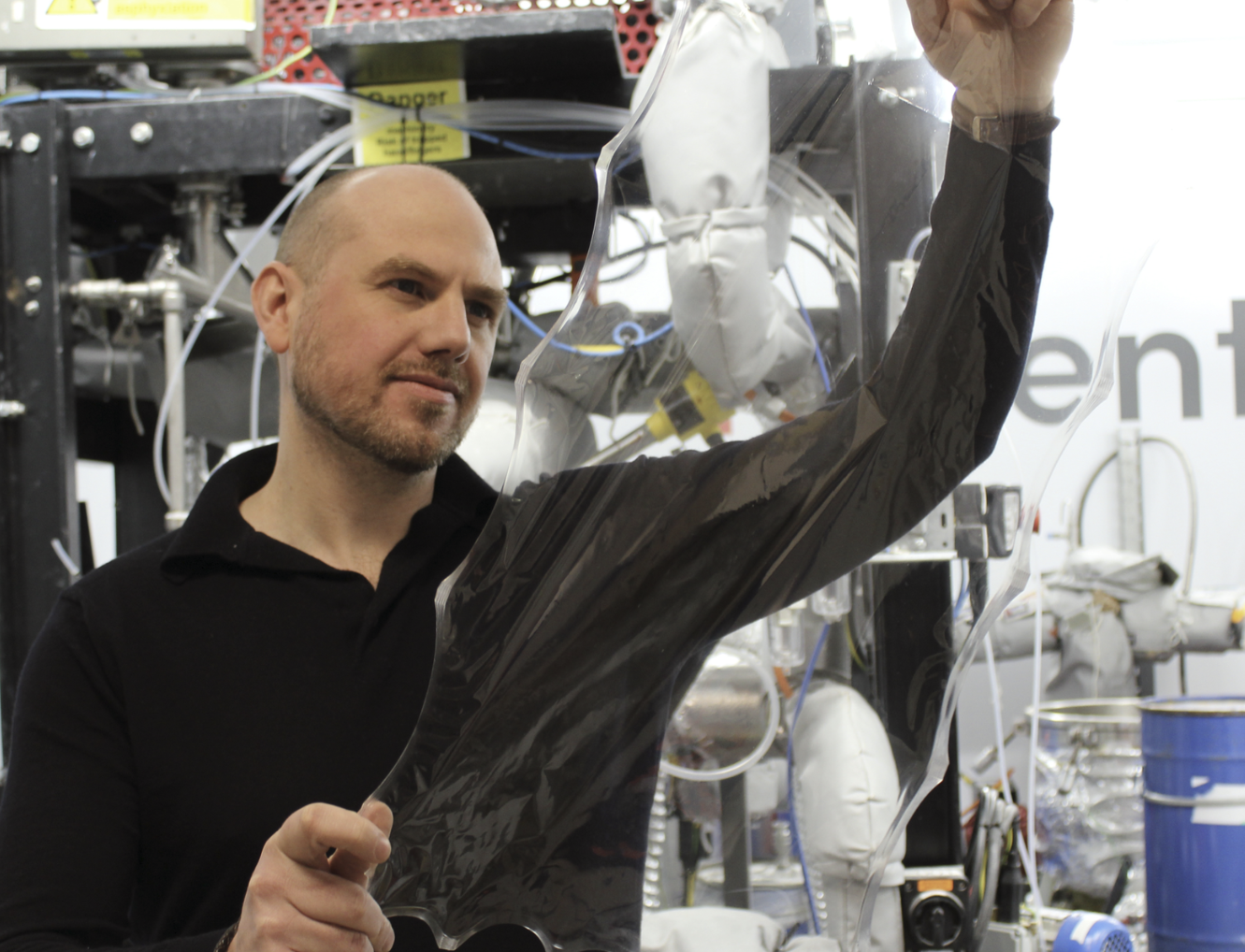
ReVentas will expand its Livingston pilot plant as it works towards commercial deployment of a solvent-based process for difficult plastic waste, although the location of future plants and the number of Scottish jobs have not been disclosed.
A Livingston recycling technology company has received a £3.5 million Scottish Enterprise grant to develop a process intended to recover reusable plastic from food packaging and other waste that conventional recycling systems struggle to handle.
ReVentas Limited will use the research and development funding over the next three years to expand its pilot plant at the Impact Technology Centre on Kirkton Campus.
The grant forms part of a £9 million development project focused on plastic films contaminated with inks, colours, odours, additives and food residues. These materials include bags, wrappers, pouches and other flexible packaging that is frequently burned, exported or rejected from existing recycling systems.
ReVentas says its technology can separate contaminants from polyethylene and polypropylene while preserving the polymers themselves. The recovered material can then be converted into pellets intended for use in new packaging, automotive components and other manufactured products.
The company was incorporated in 2020 and has operated from Livingston since 2021. Its technology developed from earlier work carried out by Impact Solutions, an independent testing and innovation laboratory based at the same site.
Scottish Enterprise said the project could help address one of the most difficult parts of the plastic waste stream while supporting the development of a circular economy in Scotland.
The award comes ahead of changes requiring plastic film and flexible packaging to be collected separately from homes and businesses across the UK by 31 March 2027.
Separate collection is expected to increase the amount of plastic film entering the waste system, but collection alone will not make the material recyclable. Facilities will still be required to sort, clean and process it into material that manufacturers are prepared to use.
Conventional mechanical recycling normally involves washing, shredding and remelting plastic. Contamination and repeated heating can reduce the quality of the recycled polymer, limiting the products that can be made from it.
ReVentas instead uses a solvent-based dissolution process. Prepared plastic is placed inside processing equipment where the target polymer is dissolved. Filters remove solid particles and other contaminants before the polymer is separated, dried and formed into pellets.
The solvent is intended to be recovered and returned to the process rather than consumed during each production cycle.
Unlike some forms of chemical recycling, the ReVentas method does not aim to break plastic down into oil, gas or its original molecular building blocks. The company says preserving the polymer allows it to produce recycled material with qualities comparable to newly manufactured plastic.
ReVentas has previously claimed that its technology could reduce carbon emissions by as much as 80 per cent compared with producing virgin plastic. The company has not published the full life-cycle assessment or detailed assumptions supporting that figure.
Independent research has found that dissolution technologies may provide environmental advantages where they replace incineration or the manufacture of new polymer. The eventual benefit depends upon the energy used by the plant, the source and recovery rate of the solvent, transport distances, the quality of the incoming waste and the amount of unusable residue produced.
The solvent formulation used by ReVentas at Livingston has not been publicly identified. While its composition may be commercially sensitive, further information would be required to assess toxicity, emissions, fire risk, losses during operation and the treatment of contaminated residues.
The company’s patent documents describe systems for recovering and recirculating solvent, including removing residual solvent from the recycled plastic during extrusion and returning it to the process following distillation.
The £3.5 million grant will meet part of the cost of a project valued at £9 million. Scottish Enterprise has not disclosed how the remaining £5.5 million will be financed.
The economic development agency has also referred to a separate £2 million investment in ReVentas and assistance provided to secure international finance. It has not stated whether the £2 million investment is included within the £9 million project or sits outside it.
ReVentas completed a Series A investment round in 2025 involving Scottish Enterprise, Poland’s Orlen VC and Beiersdorf Venture Capital, which is associated with the German consumer-products company. The value of that funding round was not disclosed.
Combining public grants, government-backed investment and private finance is common during the development of industrial technology. The absence of a complete funding breakdown nevertheless makes it difficult to establish how much of the present project is being financed by public bodies and how much is being provided by private investors.
Scottish Enterprise said the company was creating highly skilled green employment, but neither the agency nor ReVentas has stated how many jobs will result from the new project.
No figures have been provided for the number of permanent posts, the proportion based in Livingston or the temporary construction and engineering work associated with expanding the pilot plant.
ReVentas is also preparing to move beyond pilot-scale development through an engineering and licensing agreement with KBR, a multinational company headquartered in the United States.
The alliance is intended to support the design, licensing and international deployment of commercial plants using the Livingston-developed technology.
ReVentas says engineering work is under way for a demonstration plant capable of producing 10,000 tonnes of recycled high-density polyethylene each year. The company expects the facility to be commissioned during the final quarter of 2028.
Its longer-term objective is to support more than 750,000 tonnes of annual processing capacity by 2036.
The location of the first commercial demonstration plant has not been announced. ReVentas and Scottish Enterprise have also made no public commitment that future commercial plants will be constructed in Livingston or elsewhere in Scotland.
An earlier ReVentas announcement suggested that its first 10,000-tonne plant could begin operating in 2027, followed by 140,000 tonnes of additional capacity by 2031. The current timetable moves commissioning into late 2028 while setting a considerably larger target for the following decade.
Moving a process from laboratory and pilot operation into continuous industrial production can involve substantial engineering, regulatory and financial difficulties. The revised timetable means the Scottish Enterprise award remains investment in technology development rather than confirmation that commercial operation has been achieved.
The arrangement with KBR could allow ReVentas to earn revenue by licensing its process to plants around the world without financing or operating every facility itself.
That model could generate intellectual-property income and engineering work in Scotland. It could equally result in the main industrial plants, employment and physical recycling capacity being established elsewhere.
Patent records show that different parts of the technology are held by different companies.
An earlier patent family covering pigment removal and solvent recycling lists Impact Laboratories Limited, trading as Impact Solutions, as the owner. Named inventors include ReVentas founders Thomas Rose and Steven Burns.
A later patent family covering solvent-based separation and grading of reclaimed polymers lists ReVentas Limited as the owner.
Scottish Enterprise said it had helped the company develop an intellectual-property strategy. The conditions attached to the £3.5 million grant have not been made public, including whether patents developed using the funding must remain under Scottish ownership or whether the public agency will receive any return from future licensing.
There is also no published explanation of what protections would apply if ReVentas or its intellectual property were acquired by another company.
The project addresses a genuine weakness in Scotland’s recycling system. Flexible plastic packaging is produced in large quantities but remains difficult to process into material of sufficient quality for new products.
A commercially successful method could reduce incineration, limit the use of newly manufactured polymers and help Scotland handle the additional plastic film that will enter separate collections from 2027.
The return on the £3.5 million grant will depend upon more than the performance of the Livingston pilot plant. The number of Scottish jobs, the independently verified environmental savings, continued ownership of the intellectual property and the location of future commercial facilities will determine how much of the resulting industry remains in Scotland.
Sources
Scottish Enterprise — Recycling Pioneer ReVentas Secures £3.5 Million Grant
https://www.scottish-enterprise-mediacentre.com/news/recycling-pioneer-reventas-secures-gbp-3-5m-scottish-enterprise-grant-support-to-tackle-one-of-scotlands-toughest-plastic-recycling-challenges
ReVentas — ReVentas And KBR Announce Engineering And Licensing Alliance
https://reventas.co.uk/reventas-and-kbr-licensing-alliance/
ReVentas — Technology And Process Information
https://reventas.co.uk/
ReVentas — Series A Funding Announcement
https://reventas.co.uk/reventas-secures-series-a-funding/
Companies House — ReVentas Limited
https://find-and-update.company-information.service.gov.uk/company/SC661044
Scottish Government — Managing Controlled Waste And Plastic Film Collections
https://www.gov.scot/publications/duty-care-code-practice-managing-controlled-waste/pages/2/
ETH Zurich Research Collection — Environmental Assessment Of Solvent-Based Plastic Recycling
https://www.research-collection.ethz.ch/entities/publication/5c1a5adc-ea45-4353-be71-fef8bc6bfc83
Google Patents — Impact Laboratories Plastic Recycling Process
https://patents.google.com/patent/WO2020058679A1/en
Google Patents — ReVentas Polymer Dissolution Process
https://patents.google.com/patent/WO2022043392A1/en