
The future of Wave Energy Scotland remains unresolved after the Scottish Government withdrew its long-term funding commitment to an organisation it has supported with more than £70 million since 2014, prompting renewed concerns in Parliament about the loss of specialist skills, publicly funded research and opportunities for Scottish engineering businesses.
Members of the Scottish Parliament debated the future of marine energy on 12 November, questioning whether Scotland risks losing a substantial part of the research capability it has spent more than a decade developing.
The debate followed the Government’s decision to end Wave Energy Scotland’s established core funding model and provide transitional support instead.
Ministers have allocated up to £2.3 million for the 2026–27 financial year to support existing work and manage the transition. Highlands and Islands Enterprise is expected to continue financing relevant project commitments through to completion in 2027–28.
However, the Government has not announced a permanent replacement funding structure or confirmed that Wave Energy Scotland will continue operating in its existing form.
The uncertainty comes as a University of Edinburgh study identifies a possible multibillion-pound economic opportunity from developing wave and tidal electricity technologies and their associated manufacturing industries.
Why Wave Energy Scotland Was Created
Wave Energy Scotland was established in 2014 following a difficult period for the country’s early wave-power industry.
Scottish companies had developed experimental machines capable of converting the movement of ocean waves into electricity, but transforming promising engineering prototypes into reliable commercial equipment proved expensive and technically demanding.
Among the early developers were Pelamis Wave Power and Aquamarine Power.
Both companies had attracted attention for their marine engineering designs, but the wider industry struggled with the costs of development, repeated offshore testing and the difficulty of obtaining investment before technologies could demonstrate commercial reliability.
The Scottish Government responded by creating Wave Energy Scotland as a subsidiary of Highlands and Islands Enterprise.
Its purpose was to support research and development that private investors were not prepared to finance alone.
Rather than placing all public funding behind a single complete wave-energy machine, the organisation adopted competitive procurement programmes to develop components and technologies that could be used across different designs.
These included power conversion systems, control equipment, structural materials and new approaches to improving the performance and survivability of wave-energy converters.
The programme also sought to preserve engineering knowledge and publicly funded intellectual property for future use.
This was an important response to the experience of the earlier industry, where the collapse of individual businesses threatened to take valuable technical knowledge and practical experience with them.
More Than £70 Million Invested
The Scottish Government states that it has invested more than £70 million in Wave Energy Scotland since the organisation was established.
According to Wave Energy Scotland’s published information, its programmes have awarded 132 contracts and involved approximately 300 organisations across 18 countries.
These figures describe research and development activity rather than the number of commercial wave farms constructed.
The organisation’s work has supported equipment testing, prototype development, engineering research and international collaboration.
It has also helped Scottish companies participate in European-funded research programmes.
During the November parliamentary debate, Donald MacKinnon, Labour MSP for Na h-Eileanan an Iar, argued that the existing investment had created capabilities that would be difficult to replace if the organisation were dismantled.
He told Parliament that the 132 projects supported by Wave Energy Scotland had been delivered within budget, citing the organisation’s record of managing technical programmes.
However, a history of delivering publicly financed research does not automatically establish that a programme should receive permanent funding in its existing form.
Governments must also decide whether continued investment is likely to produce commercial results, whether alternative delivery arrangements are available and how research should be funded alongside competing public priorities.
Those questions are now central to Wave Energy Scotland’s future.
What Changed in the 2026 Budget?
Wave Energy Scotland’s established operating funding was omitted from the Scottish Government’s draft budget for 2026–27.
The decision prompted objections from employees, parliamentary representatives and the Public and Commercial Services Union.
In February, Dr Ruairi MacIver, a project manager at Wave Energy Scotland, submitted written evidence to the Scottish Parliament’s Net Zero, Energy and Transport Committee.
Writing in a personal capacity, he stated that the organisation had been discussing a two-year funding arrangement totalling approximately £3.08 million to fulfil existing commitments and develop an alternative funding model.
Instead, he said, management had been informed in January that no provision had been made for the organisation in the new budget.
MacIver warned that the decision could jeopardise existing contractual arrangements, European collaborations and the employment of specialist staff.
The PCS union subsequently campaigned against the withdrawal of support and raised concerns about the treatment of employees.
In March, the union announced that the Government had agreed to extend funding, preventing the immediate loss of the organisation’s existing financial support.
The Scottish Government has since confirmed the transitional allocation of up to £2.3 million for 2026–27.
That intervention has allowed work to continue, but the longer-term position remains unsettled.
European Contracts and Scottish Engineering Businesses
One of the principal concerns raised by Wave Energy Scotland staff involves EuropeWave, an international technology development programme involving Scottish, Basque and European partners.
The initiative was designed to support competing wave-energy technologies through successive stages of development and offshore demonstration.
It involves Wave Energy Scotland, the Basque Energy Agency and European funding arrangements.
In his February submission, MacIver warned that the withdrawal of funding could undermine commitments connected with the programme’s final phase.
He identified a Scottish Government contribution of approximately €2.6 million associated with work expected to generate at least €5.5 million of activity in Scotland through participating contractors.
He also raised the possibility that interrupted funding could expose the programme to contractual claims or the loss of European grant support.
Those were warnings about potential consequences at the time of his submission, not proof that such liabilities have subsequently arisen.
The Government’s later transitional funding and commitment to completing existing projects changed the immediate financial position.
Nevertheless, the case illustrates why interruptions to research funding can have consequences beyond an organisation’s own operating budget.
European research contracts frequently depend on agreed contributions from several partners. Changes to one funding commitment can affect the timetable, financing and commercial plans of other participants.
For Scottish engineering businesses, continuity may be important when preparing prototypes and securing private investment.
Mocean Energy and the Development of Scottish Wave Machines
One company associated with Wave Energy Scotland’s programmes is Edinburgh-based Mocean Energy.
The business develops floating devices designed to generate electricity through movement created by ocean waves.
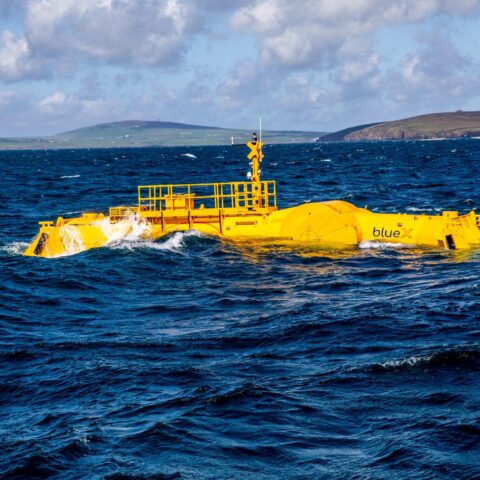
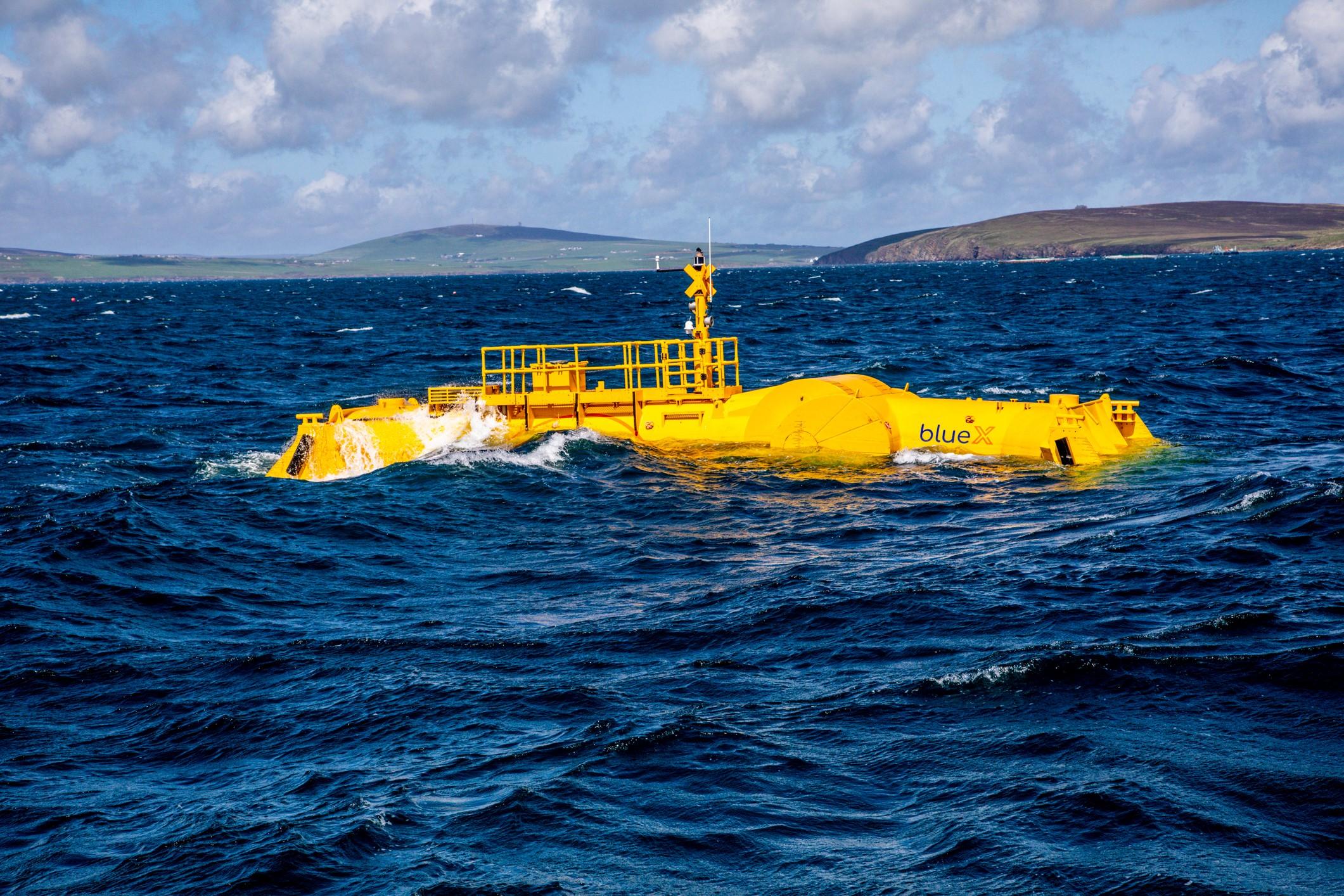
Its experimental Blue X converter was tested at the European Marine Energy Centre in Orkney during 2021.
The 20-metre-long device was manufactured by Scottish engineering company AJS Production in Fife.
During its initial offshore deployment, Blue X spent 154 days at sea and demonstrated its ability to operate in challenging marine conditions.
The device delivered relatively modest electrical outputs compared with commercial power stations, but the purpose of the trials was to test engineering performance and establish the technical basis for larger future machines.
Mocean subsequently participated in further offshore work involving subsea equipment and energy storage.
Its later Blue Horizon programme, supported through EuropeWave, was designed to advance towards a larger wave-energy converter capable of producing electricity at a higher rating.
The example illustrates how technology development normally progresses through several generations of equipment before commercial production can be considered.
It also demonstrates why the loss of research funding can create uncertainty for smaller engineering companies whose development programmes depend partly on public support.
MacIver’s February submission specifically warned that a funding interruption could threaten Mocean Energy’s continued operations.
That warning should not be treated as confirmation that the company has ceased trading or that its current projects have been cancelled.
Wave and Tidal Power Face Different Commercial Challenges
Scotland’s marine energy industry includes several technologies with different levels of commercial maturity.
Tidal-stream generators use the movement of water flowing through tidal channels. Their output is relatively predictable because tidal movements can be calculated in advance.
Wave-energy converters use the movement of waves at the sea surface or within the water column. Their designs must accommodate changing sea conditions, including severe storms, while converting irregular movement into useful electrical output.
The engineering challenges are substantial.
Devices must survive saltwater corrosion, repeated mechanical stresses and extreme weather while remaining sufficiently reliable to justify the cost of manufacture, deployment, maintenance and connection to the electricity system.
Access to offshore equipment can also be restricted by sea conditions, increasing the cost of repairs and inspections.
Scotland already has considerable experience of testing both wave and tidal technologies through the European Marine Energy Centre in Orkney.
However, research success does not automatically guarantee that a technology will reach commercial deployment.
Developers must demonstrate reliability, reduce production costs, attract investment and obtain access to viable electricity markets.
These requirements explain why the future of Wave Energy Scotland cannot be considered solely as a question of research grants.
The University of Edinburgh’s Multibillion-Pound Projection
A study published by the University of Edinburgh’s Policy and Innovation Group in 2025 examined the potential economic contribution of wave and tidal energy to Scotland through 2050.
The research was commissioned through work involving Scottish Enterprise and Wave Energy Scotland.
It found that wave and tidal installations in Scotland and the wider United Kingdom could generate almost £8.7 billion in cumulative gross value added for Scotland by 2050 under the study’s deployment assumptions.
It also examined the potential economic benefits of supplying equipment and services to international markets.
Across its wider scenarios, the research estimated possible Scottish gross value added of approximately £6 billion to £37 billion by 2050, depending on industry development and the competitiveness of Scottish suppliers.
The employment projections were similarly conditional.
The study estimated that marine energy activity across domestic and international markets could support between 12,000 and 62,000 jobs in 2050, depending on the scale of deployment and Scotland’s success in capturing supply-chain work.
Within the scenarios, UK marine energy installations could support more than 15,000 jobs in Scotland.
These figures are not forecasts of jobs already secured or guaranteed economic returns.
They depend on future investment, successful technology development, electricity market support, manufacturing competitiveness and the construction of commercial generating capacity.
They also cover both wave and tidal energy, not Wave Energy Scotland’s activities alone.
The research therefore identifies a potential opportunity while also demonstrating the scale of the industrial development needed to realise it.
What the Scottish Government Says
Responding to the parliamentary debate on 12 November, Energy Minister Stephen Gethins acknowledged concerns about the future of Wave Energy Scotland’s expertise.
He confirmed that officials remained in discussions with the organisation and the PCS union.
The minister defended the need to make difficult funding decisions under constrained public budgets.
He also argued that although wave energy has considerable longer-term potential, commercial deployment is not an immediate prospect.
Gethins told Parliament that the Scottish Government had invested more than £87 million in marine energy innovation more broadly.
He also pointed towards the need for cooperation with the UK Government, whose responsibilities include important electricity market and commercial support mechanisms.
One such mechanism is the Contracts for Difference system, which can provide revenue support for eligible low-carbon electricity generation projects.
Access to an appropriate route to market is particularly important for newer technologies whose costs are initially higher than those of established electricity sources.
However, the existence of UK Government responsibilities does not determine how Scotland should manage its own research organisations, employees or previously financed intellectual property.
Those matters were raised repeatedly by MSPs during the debate.
What Happens to the Researchers?
The PCS union argues that the Government should preserve the technical skills accumulated within Wave Energy Scotland and prevent compulsory job losses.
The organisation employs a comparatively small specialist workforce, but its functions extend beyond individual research projects.
Its staff have experience in assessing technology proposals, managing engineering contracts, coordinating research programmes and working with international partners.
Those skills could potentially remain useful to wave energy, tidal energy, offshore wind and other emerging technologies.
However, transferring staff into unrelated positions would not necessarily preserve their accumulated expertise within Scotland’s marine energy industry.
During the debate, Orkney MSP Liam McArthur said that some people previously employed by Wave Energy Scotland had already moved to other roles, potentially taking their specialist experience outside the sector.
He called for attention to the retention of skills as discussions about the organisation’s future continue.
The Scottish Government has not yet announced a completed workforce transfer plan or a permanent successor organisation.
Who Owns the Research Scotland Has Already Paid For?
Another important issue concerns the technical knowledge, research findings and intellectual property accumulated through the programme.
Wave Energy Scotland’s creation was partly intended to prevent useful engineering knowledge from disappearing when individual developers encountered financial difficulties.
Its programmes have also produced research that can inform future equipment design, testing and manufacturing.
Some intellectual property may be held or managed under specific contractual arrangements, while other research findings may be made available to industry.
Any restructuring would therefore require careful consideration of existing contracts, intellectual property rights, research archives and access arrangements.
These are assets whose value cannot necessarily be measured by their immediate sale price.
Their usefulness may emerge only when later technology programmes build upon previous work.
The public record does not yet explain in full how these responsibilities would be managed if Wave Energy Scotland ceased operating in its present form.
What Comes Next?
The future of Wave Energy Scotland remains under discussion between government officials, the organisation and staff representatives.
The transitional funding has reduced the immediate risk to existing project commitments, but it does not establish a permanent operating model.
Several questions remain unresolved: whether the organisation will continue in another form, where its employees will work, how existing research programmes will be administered and what arrangements will preserve publicly financed knowledge.
The Scottish Government must also decide how its future support for marine technology will fit alongside UK electricity market policies and international research partnerships.
The financial pressure on public budgets is real, as is the difficulty of making experimental electricity technologies commercially competitive.
Equally, the previous £70 million investment has created technical capabilities whose future usefulness may extend beyond the immediate prospects for wave power.
The November debate has brought those issues back before Parliament.
The next government decision will determine whether Scotland retains the organisation it created to preserve and advance wave-energy expertise, or establishes a different means of managing the research, people and commitments developed over the past twelve years.
Sources
Scottish Parliament. Official Report: Marine Energy (Economic Potential), Meeting of the Parliament. 12 November 2026. https://www.parliament.scot/chamber-and-committees/official-report/search-what-was-said-in-parliament/meeting-of-parliament-12-11-2026?iob=226870&meeting=20336
Scottish Parliament. Written Question S7W-04086: Future of Wave Energy Scotland. Answer by Stephen Gethins. 29 October 2026. https://www.parliament.scot/chamber-and-committees/questions-and-answers?msp=21012
Scottish Parliament, Net Zero, Energy and Transport Committee. Letter From Dr Ruairi MacIver: Wave Energy Scotland Funding Withdrawal. 5 February 2026. https://www.parliament.scot/-/media/files/committees/net-zero-energy-and-transport-committee/correspondence/2026/february-2026/letter-from-dr-ruairi-maciver-wave-energy-scotland-funding-withdrawal–202627-scottish-budget-5-febr.pdf
University of Edinburgh / Scottish Enterprise. Future Economic Potential of Tidal Stream and Wave Energy in Scotland. 2025. https://www.scottish-enterprise.com/insights-and-events/research-evaluation-and-insight/2025/future-economic-potential-of-tidal-stream-wave-energy-in-scotland
Wave Energy Scotland. About Wave Energy Scotland: History and Research Programmes. https://www.waveenergyscotland.co.uk/about/
Wave Energy Scotland. EuropeWave Programme. https://www.waveenergyscotland.co.uk/wave-technology/europewave/
Public and Commercial Services Union. PCS Wins Stay of Execution for Wave Energy Scotland. 10 March 2026. https://www.pcs.org.uk/news-events/news/pcs-wins-stay-execution-wave-energy-scotland
Public and Commercial Services Union. Ask Your MSPs to Support Marine Energy Jobs in Scotland. 16 October 2026. https://www.pcs.org.uk/news-events/news/ask-your-msps-support-marine-energy-jobs-scotland
European Marine Energy Centre. Mocean Energy: Offshore Demonstration and Technology Development. https://www.emec.org.uk/about-us/wave-clients/mocean-energy/
Highlands and Islands Enterprise. Marine Energy and Wave Energy Scotland. https://www.hie.co.uk/our-region/our-growth-sectors/energy/marine-energy/