
For most of my married life, I have operated a highly efficient weather forecasting service from the kitchen window. It requires no electricity, has never needed updating and is particularly accurate when the rain is coming sideways.
Mr Gunn considers this system inadequate.
Last week, he bought a weather station.
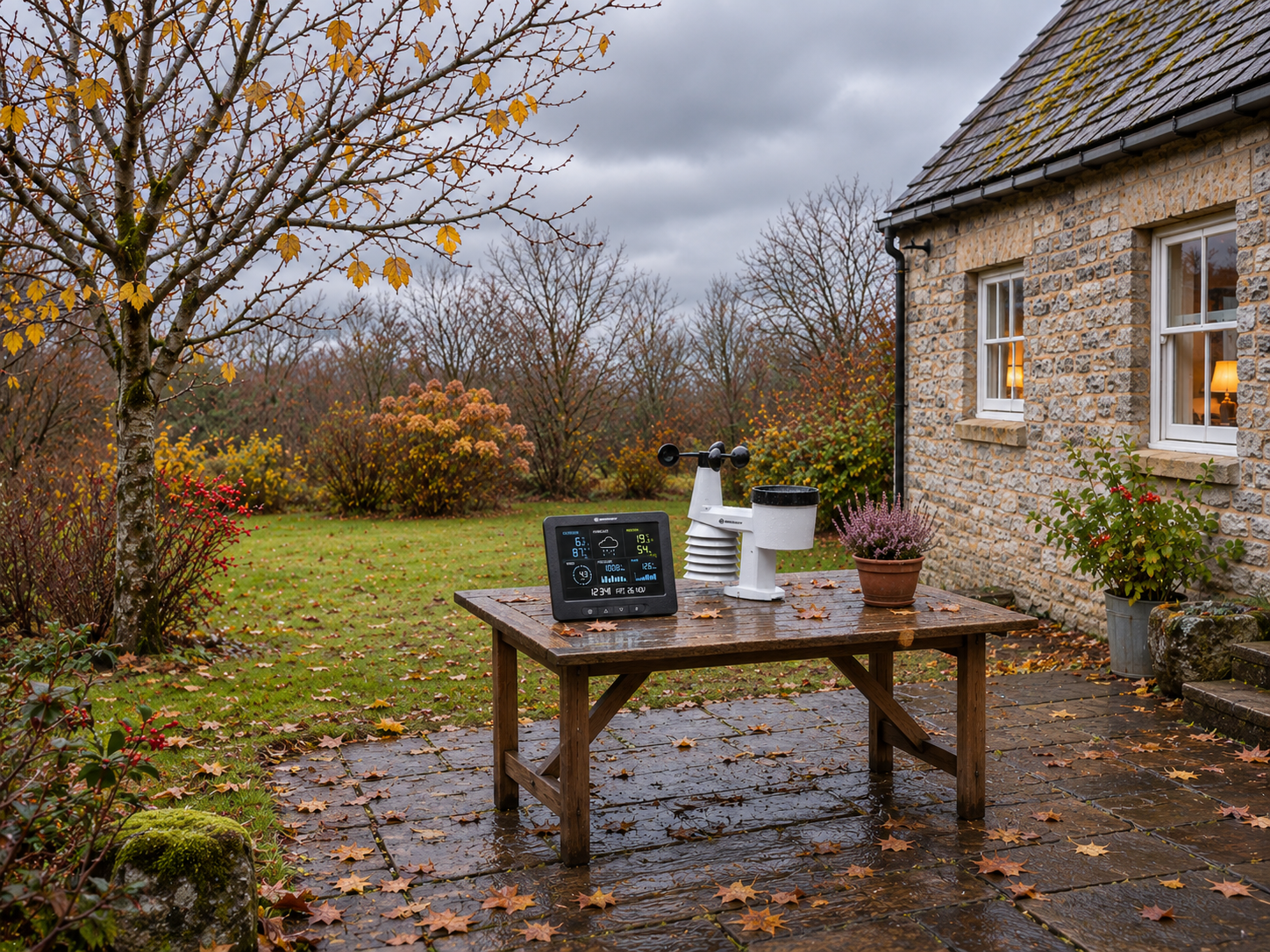
I had imagined a little thermometer and perhaps a rain gauge. What arrived was a collection of seventeen mysterious components, three instruction booklets, enough brackets to construct a small bridge and something called an anemometer, which resembles three miniature teacups attempting to escape from a stick.
Apparently, it measures wind speed. I have always measured wind speed by watching the washing line. If the sheets are moving, there is a breeze. If the sheets have disappeared, there is a gale. If they are discovered in the next parish, it is probably best to stay indoors.
Mr Gunn’s method would be more scientific.
The equipment promised to measure temperature, humidity, rainfall, atmospheric pressure and several other conditions that Scotland has been producing quite successfully without our assistance.
It would also communicate directly with his telephone.
I have noticed that men who cannot remember to tell their wives when the coal scuttle is empty are perfectly capable of arranging for a plastic instrument in the garden to communicate with the entire world.
The installation began on Tuesday.
Within fifteen minutes, the kitchen table resembled the aftermath of a collision between an electrical shop and a small aircraft. Mr Gunn studied the instructions, which showed a cheerful suburban house surrounded by a perfectly flat garden containing no trees, no buildings and, apparently, no Scottish weather.
The station required an unobstructed position.
This presented difficulties. Our garden contains trees, a shed, a greenhouse, a stone wall and several areas that have never satisfactorily recovered from previous projects undertaken by Mr Gunn.
He briefly considered the roof.
I explained that I had no intention of telling an ambulance crew that my husband had fallen off the house while attempting to establish the speed of the wind.
He settled for a position beside the shed.
The installation occupied most of the afternoon. There was drilling, hammering and the occasional long silence that generally indicates a screw has disappeared into the grass. I offered assistance twice and was informed that everything was under control, which in our household is usually the last reassuring statement made before something catches fire.
By teatime, the weather station was operational.
Our humidity was seventy-eight per cent.
I was delighted to learn this. For years I had relied on the primitive method of examining the towels hanging over the radiator. If they remained damp after two days, the humidity was high. If they developed an interesting smell, the humidity was very high.
Now we had proof.
The station also informed us that rain was approaching. This would have been more impressive had it not been raining for twenty minutes.
Mr Gunn assured me that the equipment would become more useful as it accumulated information.
This worried me. Once my husband begins collecting information, there is very little prospect of it ever being discarded. We have receipts for appliances that ceased functioning in 2014, instructions for a washing machine that went to the council tip years ago, and a spreadsheet documenting the performance of our household batteries.
I could already imagine Christmas 2034, when Mr Gunn would interrupt dinner to announce that the atmospheric pressure was almost identical to that recorded on the second Tuesday of November 2026.
He would produce a graph.
The family would be expected to admire it.
The first crisis occurred on Thursday, when the station announced that the temperature outside had reached twenty-three degrees Celsius.
Now, Scotland occasionally surprises us with a pleasant November afternoon, but twenty-three degrees seemed ambitious, particularly as I had scraped ice from the windscreen that morning.
Mr Gunn was inclined to believe the instrument.
This is one of the peculiarities of modern domestic life. A man can stand in his own garden, shivering in a woollen jumper, yet remain convinced that the temperature is positively Mediterranean because a machine says so.
I went outside to investigate.
The sensor was attached to the shed immediately above the outlet from Mr Gunn’s workshop heater.
We had successfully established the temperature of the shed.
Once the sensor was moved, the reading dropped to six degrees, which was considerably closer to the conditions being experienced by the rest of Scotland.
Mr Gunn described this as a minor installation error. I suggested that if the instrument could be persuaded to measure the greenhouse next, we might finally qualify as a tropical destination.
By Friday, he had connected the station to an international weather network.
Apparently, people anywhere in the world could now consult the temperature, wind speed and rainfall recorded in our back garden.
I found this extraordinary.
Somewhere in southern France, a complete stranger could be sitting beside a swimming pool examining the humidity behind our shed, while I was still waiting for Mr Gunn to remember that we needed coal.
He showed me the network map. A tiny dot represented our house, surrounded by thousands of other dots belonging to equally enthusiastic weather observers.
I began to wonder whether there were women all over Europe wondering why their husbands had spent so much money proving it was raining.
Effie arrived that afternoon and was introduced to the equipment.
Effie is a practical woman who has lived in the Highlands long enough to know that winter usually arrives several weeks before the council is prepared to acknowledge it.
She listened politely to Mr Gunn’s explanation and asked whether the station could warn us when the roads were icy.
He explained that it monitored temperature and atmospheric conditions.
Effie then wanted to know whether it could inform the council.
It was a reasonable suggestion. If the instrument could communicate with a weather enthusiast in Belgium, surely it could send a message to the local gritting department.
Unfortunately, the equipment was designed to collect information rather than persuade public authorities to act upon it.
Effie was disappointed. She had hoped we might finally possess something capable of alerting the council to the arrival of winter before the roads became impassable.
I told her that if the station ever managed this, I would personally nominate it for a public service award.
By Saturday, Mr Gunn had accumulated forty-eight hours of meteorological observations and was beginning to speak with the authority of a man who had personally discovered the climate.
He informed me that the wind had reached thirty-two miles an hour the previous afternoon.
I remembered the occasion. It had knocked over the bird feeder, scattered seed across the path and carried a flowerpot halfway to the vegetable garden.
Until that moment, I had been unable to establish whether the wind was travelling at thirty-one or thirty-three miles an hour. I was grateful to have the uncertainty resolved.
The following morning, after several hours of heavy rain, the station announced that we had received no rainfall whatsoever.
This was surprising.
The paths were flooded, the lawn was saturated and a puddle beside the shed was beginning to acquire the appearance of a small ornamental lake. Even the birds had taken refuge beneath the hedge, where they sat looking as though they were considering legal action.
Mr Gunn inspected the rain gauge.
A leaf had lodged in the opening.
Once removed, the accumulated water began registering on the display.
The instrument had not been wrong, exactly. It had simply been unable to observe the weather because part of the weather was obstructing it.
I considered this a serious weakness in a meteorological device.
I also considered mentioning that our gutters operate on much the same principle, although they require less electronic equipment and have been waiting for Mr Gunn’s attention since September.
By Monday, he had decided to move the entire installation to the opposite side of the garden, where it would be less susceptible to environmental interference.
I refrained from pointing out that the environment was likely to remain in the garden regardless of where he put it.
The operation required another afternoon of drilling, measuring and consulting instructions. At one stage, Mr Gunn asked me to hold the pole while he tightened a bracket.
It was raining, naturally.
There I stood in the vegetable patch, holding a metal pole above my head while my husband explained the importance of accurately measuring atmospheric conditions.
I pointed out that if lightning struck, he would obtain some exceptionally interesting data.
He finished tightening the bracket.
By evening, everything was working perfectly. The temperature was six degrees, the humidity was eighty-one per cent and the wind was travelling at four miles an hour.
Outside, it was cold, damp and slightly breezy.
It was a remarkable agreement between modern technology and the view from the kitchen window.
Then the internet went down.
Mr Gunn regarded this as a national emergency.
He examined the router, restarted the receiver and checked his telephone. The station was still measuring the weather, but it could no longer transmit its findings to the international network.
Meanwhile, the clouds gathered, the wind strengthened and rain began striking the kitchen window.
I put another log on the fire.
The weather station had lost its connection to the world, but the world had evidently not lost its connection to the Highlands.
By lunchtime, the internet was restored.
Mr Gunn announced that during the interruption we had received twelve millimetres of rain.
This explained the puddles on the path, the wet boots beside the door and the fact that I had been obliged to change my socks.
I was beginning to wonder how we had managed all these years without it.
I have since made my peace with the weather station. Mr Gunn enjoys it, and I suppose there are worse occupations for a husband during a Highland winter. It keeps him interested, encourages him to spend time outdoors and provides an almost inexhaustible supply of graphs.
He has even started checking the atmospheric pressure before deciding whether to hang out his workshop towels.
I consider this progress. For years, I have been trying to persuade him that towels should be hung somewhere other than the back of a chair.
Yesterday, he informed me that the temperature had fallen five degrees overnight, which explained the frost on the car.
I had always assumed that the frost on the car explained the drop in temperature, but we agreed not to pursue the matter.
This morning, as I was preparing to go into town, Mr Gunn advised me to take a coat because the station indicated a chance of rain.
Outside, the sky was black, the trees were bending and water was running down the road.
I thanked him for the warning.
It is comforting to know that after several hundred pounds’ worth of equipment, three changes of location, a blocked rain gauge, an overheated shed and an interruption to international communications, we have finally acquired a machine capable of telling us that it is raining in Scotland.
There is, however, something I have not told Mr Gunn.
Yesterday, I caught myself consulting the weather station before deciding whether to put the washing out.
I am keeping this information to myself.
If he finds out, he’ll make a graph.