
Last Christmas, Mr Gunn and I received a present from a woman I haven’t seen properly since university.
Her name is Susan. We were friendly enough in those days, although never particularly close, and for reasons neither of us could probably explain, we have continued exchanging small Christmas presents for more years than I care to count.
Usually, it’s something harmless.
A mug from wherever she’s been on holiday. A packet of fancy biscuits. Once, a little ceramic donkey that arrived without an explanation and has lived on our windowsill ever since.
I generally send her something similar.
We exchange Christmas cards, write a few lines about the year and occasionally promise to meet up. We never do. I know she lives in a city, has been married and divorced, and seems to travel quite a bit. Beyond that, our knowledge of each other’s lives is largely based on Christmas cards.
We sent Susan a voucher for a five-course meal for two at a rather nice restaurant. We thought she’d enjoy an evening out.
In return, she sent us a beautifully printed voucher for three hours with a professional home organiser.
Fully paid.
At our house.
I read it twice.
Mr Gunn examined it.
“What’s wrong with our house?”
“Nothing.”
“Then why is Susan sending someone to organise it?”
“I haven’t the faintest idea.”
There was a little note enclosed.
I used Paige, she was absolutely wonderful. She got me completely sorted. I thought you might enjoy having her round. Happy Christmas! Susan.
I looked at Mr Gunn.
He looked at me.
“Wasn’t Susan the one who sent us that donkey?” he asked.
“Yes.”
“Perhaps she should have sent another.”
I wondered what sort of state Susan’s house had been in that she called a professional for help.
I’d always imagined she lived rather well. The occasional photographs on her Christmas cards showed nice furniture, tasteful curtains and the sort of spotless kitchen that makes a person wonder where the owners keep their actual belongings.
But perhaps her house contained an almighty pile of shite.
We didn’t know each other well enough for me to ask.
I put the voucher in the kitchen drawer and forgot about it.
In January, Susan sent a message asking whether we’d enjoyed our present.
I couldn’t very well tell her we’d put it beside the takeaway menus.
So I booked Paige.
She arrived on a Tuesday morning at nine o’clock.
A tall, brisk woman wearing black trousers, a cream blouse and shoes so clean I wondered if she’d ever walked outdoors.
She carried three bags, a clipboard and something that looked like a portable cash register.
“Good morning,” she said brightly. “I’m Paige. I’m here to transform your home.”
Mr Gunn stood in the doorway.
“Into what?”
She laughed.
I made tea.
Paige declined.
“I prefer to keep my hands free during the assessment.”
Mr Gunn looked at me.
We’ve been married for forty years and neither of us has ever encountered a visitor who considered a cup of tea an obstacle to getting on with the morning.
Paige walked around the kitchen, opening cupboards and making notes.
She inspected the cutlery drawer.
She examined the bread bin.
She looked inside the cupboard containing our plates.
Then she announced, “We need to establish zones.”
Mr Gunn frowned.
“Is there something wrong with the heating?”
“Activity zones. Food preparation. Storage. Cleaning. Daily essentials.”
“We’ve got those,” I said. “This is the kitchen.”
Paige smiled.
“It’s about creating intentional spaces.”
I wasn’t aware we’d been cooking accidentally.
Then she took a machine out of her bag.
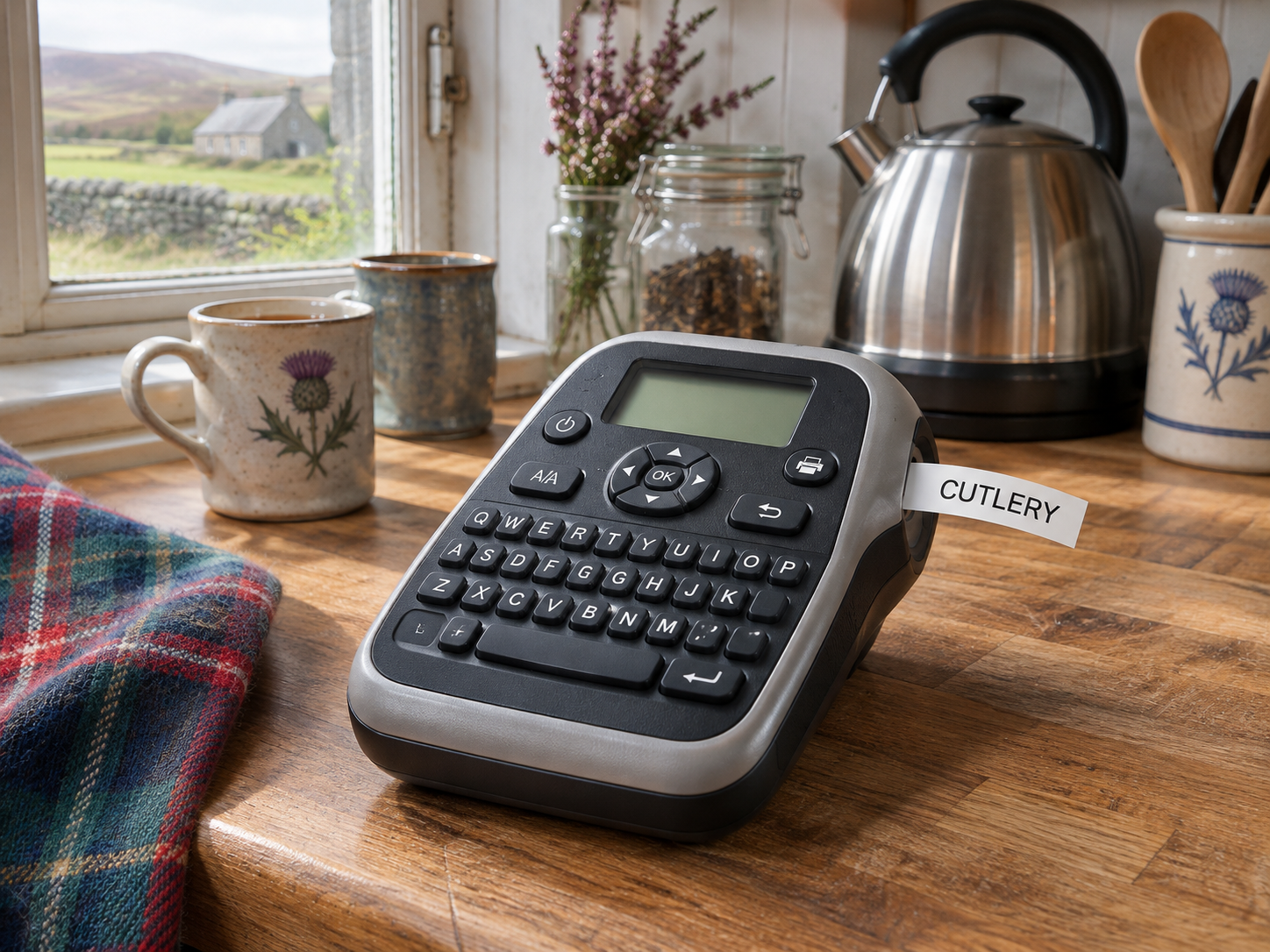
A label maker.
Not a little one. A professional contraption with a screen, a keyboard and several rolls of coloured tape.
She plugged it in.
Within seconds, the cutlery drawer had a label.
CUTLERY
The next drawer became:
UTENSILS
And the cupboard over the kettle was now:
HOT BEVERAGE SUPPLIES
Mr Gunn stared at it.
“That’s the tea cupboard.”
“Yes,” said Paige.
“Then why doesn’t it say tea?”
“Because we’re categorising by function.”
“Tea is its function.”
She printed another label.
By ten o’clock, the kitchen resembled the storage department of a government laboratory.
The bread bin was labelled BREAD.
The fridge was labelled REFRIGERATED FOOD.
A cupboard containing our tins was now LONG-TERM FOOD STORAGE.
Mr Gunn opened it.
“It’s beans,” he said.
“Pardon?”
“Beans. There’s beans in there. And soup.”
“Yes. We’re bringing structure to your storage.”
He closed the cupboard.
I could see that he was considering bringing structure to Paige’s departure.
Then she moved the sugar.
“Where’s the sugar?” I asked.
“Top cupboard. Sweeteners and condiments.”
“It’s been beside the kettle for thirty-seven years.”
“I’ve grouped it with similar items.”
I opened the cupboard.
There was the sugar, beside the honey, mustard and vinegar.
“Why is the vinegar with the sugar?”
“It’s a condiment.”
“So is horseradish. Would you like some in your tea?”
Paige made another note.
I don’t know what she wrote.
Possibly resistant to change.
Then she started on the sitting room.
I had no intention of allowing a stranger to rearrange forty years of family photographs, but Paige was faster than I was.
By the time I’d fetched another cup of tea, she’d gathered all the remote controls into a little basket.
ENTERTAINMENT DEVICES
She put Mr Gunn’s reading glasses in a tray.
PERSONAL ACCESSORIES
She collected the newspapers from beside his chair and divided them into two piles.
CURRENT READING
RECYCLING
Mr Gunn picked up a newspaper from the recycling pile.
“I’m still reading that.”
“It was dated three weeks ago.”
“I’m a slow reader.”
She placed a small label on the side of his armchair.
RELAXATION AREA
He stared at it.
“That’s my chair.”
“Yes.”
“I’ve been relaxing in it since 2008.”
“Wonderful. Now the space has a defined purpose.”
He went outside.
I think he needed to stand somewhere that hadn’t yet been given a defined purpose.
At eleven o’clock, Agnes arrived with a loaf she’d baked that morning.
She came through the kitchen door, stopped and looked around.
“Good God. Have you been burgled by a stationery shop?”
I explained about Susan’s present.
Agnes examined the label on the biscuit tin.
SWEET SNACKS
“Are we not allowed biscuits any more?”
“Apparently they’re a category.”
She opened the tin.
There were three digestives and half a custard cream.
“That’s a very small category.”
Paige appeared.
“Good morning. I’m helping establish a more organised household.”
Agnes nodded politely.
“Well, that’s lovely.”
Then she noticed the label on the cupboard where the kettle lived.
“What’s a hot beverage supply?”
“Tea,” I said.
“Oh.”
She looked at me.
“You’ve had tea since before I knew you. I didn’t think you needed instructions.”
Morag arrived twenty minutes later.
She’d come to return a book.
At least, that was her official explanation. Agnes had already telephoned her.
Morag stepped into the kitchen and stopped dead.
“What’s happened?”
“Christmas,” I said.
She looked at the labels.
Then at the cupboards.
Then at Agnes.
“Has somebody died?”
I explained everything.
Morag listened carefully.
“So this Susan, whom you haven’t really seen since university, gave you a woman to come here and put labels on your belongings?”
“Yes.”
“Didn’t she get a divorce recently?”
“Last year, apparently.”
Morag thought about that.
“What on earth was her house like?”
“That’s what I’d like to know,” I said.
Agnes lowered her voice.
“Perhaps they had to label everything in order to separate his boxes and her boxes.”
We were laughing when Paige returned from the hallway.
She was carrying Mr Gunn’s walking boots.
“Are these used regularly?”
“Yes,” I said.
“How frequently?”
“Whenever he goes walking.”
“Would you say weekly?”
“I’d say he wears them when he walks.”
She looked at her clipboard.
“And where should they live?”
“Usually by the back door.”
“Shoes should ideally be kept in a designated footwear zone.”
Morag leaned towards Agnes.
“Perhaps she could put a label on his feet.”
Agnes had to put down her tea.
Paige carried the boots into the hallway.
We heard the machine printing again.
At half-past eleven, Mr Gunn came back inside.
He stood in the kitchen doorway and examined the room.
“Where’s my mug?”
Paige looked pleased.
“I’ve created a designated mug area.”
“It’s usually on the draining board.”
“Now they’re all together.”
“They were all together before.”
“Where?”
“In the cupboard.”
There was a silence.
Then Paige said, “Yes, but now the cupboard is labelled.”
Mr Gunn stared at her.
I thought for a moment he might actually explode.
Instead he said, very quietly, “Marvellous.”
He went to the labelled cupboard, took out his mug, filled it with tea and disappeared into the garden.
Paige turned to me.
“Your husband seems a little overwhelmed.”
“It’s the excitement,” I said.
At twelve o’clock precisely, our three hours were up.
Paige packed away her machine, presented me with a laminated sheet explaining the new household system and asked whether I’d like to book a follow-up session.
I declined.
She assured me that we were off to an excellent start.
“We’ve made tremendous progress,” she said. “The important thing now is to maintain the system.”
Then she left.
We watched through the window as she drove away.
Nobody spoke until her car disappeared around the bend.
Then Agnes said, “Right. Where are your fingernails?”
“What?”
“We’re taking these bloody things off.”
Morag had already started on the bread bin.
She picked at the corner of the label.
It wouldn’t move.
She tried again.
The label split in half and left a strip of glue behind.
“Oh, she’s used the good stuff.”
Agnes attacked the cutlery drawer.
I went for the tea cupboard.
For ten minutes, the three of us stood around the kitchen scraping labels off things we had successfully identified without assistance for most of our adult lives.
Morag fetched a damp cloth.
Agnes found some cooking oil.
I found the hairdryer.
“Why have you got the hairdryer?” Agnes asked.
“Heat loosens adhesive.”
“How do you know that?”
“I watched a programme about removing stickers from car windows.”
“Did it work?”
“I don’t remember. They stole the car afterwards.”
At that point Mr Gunn returned.
He stood in the doorway, mug in hand, and watched three women attacking his kitchen cupboards with a hairdryer, a butter knife and a bottle of sunflower oil.
“I thought this was supposed to save us time.”
“Don’t start,” I said.
He looked at the half-removed label on the fridge.
“Perhaps we should have kept that one. I’ve often wondered what the big white thing was.”
Morag laughed so hard she slid down into a chair.
It took us nearly two hours.
The labels came off the drawers.
They came off the biscuit tin.
They came off the bookshelves and the television cabinet.
The one on Mr Gunn’s armchair was particularly stubborn, but Agnes eventually removed it while he stood watching and asking whether she was authorised to interfere with his relaxation area.
By the time we’d finished, there were little curls of plastic tape all over the kitchen table.
Morag had sticky fingers.
Agnes had broken a nail.
And I had a house that looked exactly as it had looked before Paige arrived, except that nobody could find anything.
We eventually located the salt in a cupboard beside the vinegar.
Mr Gunn’s boots were in a basket marked SEASONAL FOOTWEAR.
And the biscuit tin had been moved to a shelf so high that I needed a chair to reach it.
That evening, after the girls had gone, I found one label we’d missed.
It was on the inside of the cupboard beneath the sink.
GENERAL HOUSEHOLD WASTE — DISPOSAL
I looked at it for a long moment.
Then I took out my phone and photographed it.
I sent the picture to Susan.
Dear Susan,
Thank you so much for your thoughtful Christmas present. Paige came today, and we have certainly had an unforgettable experience. I thought you might like to see one of the results.
Love,
Mrs Gunn
Susan replied almost immediately.
Oh, wonderful! Isn’t she amazing? I’m so glad you finally used the voucher. She really did change my life. She got rid of absolutely everything I didn’t need!
I showed the message to Mr Gunn.
He read it.
Then he looked at the photograph.
“Everything she didn’t need?”
“Apparently.”
He considered this for a moment.
“I wonder how her husband lives like this.”
“She’s divorced, dear.”
“Did he leave of his own accord, or did Paige put him in a box?”
“And label it!” I said.
“Damaged goods?”
We both laughed so hard I spilled my tea.