
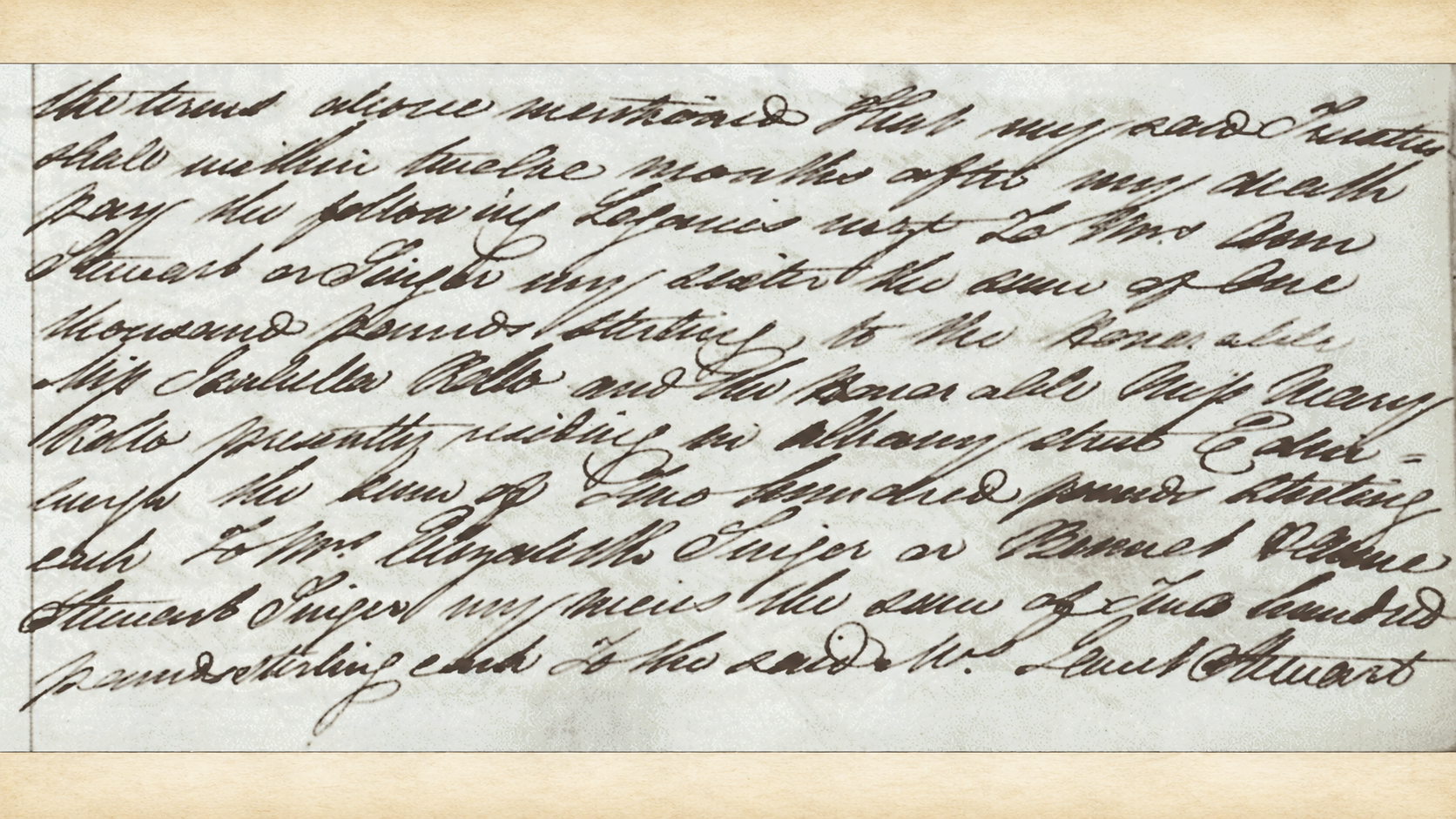
Scottish Handwriting has a long history as an independent educational resource, although its original website is no longer in operation. In May 2024, the National Records of Scotland transferred its extensive collection of tutorials, manuscript examples and transcription exercises to Scotland’s People, where the material remains freely accessible. Far from being a dormant archive, Scottish Handwriting continues as an active online learning resource, preserving specialist knowledge of Scotland’s historical manuscripts while making it available to a new generation of readers and researchers.
There is something deeply absorbing about an old Scottish manuscript. The sweep of a clerk’s pen, the carefully formed signature of a merchant, the closely written pages of a family testament: each carries the unmistakable presence of someone who lived centuries before us.
For those fortunate enough to inherit family papers, or who have spent time among Scotland’s historical collections, there is a particular pleasure in discovering a document that has survived almost untouched by time.
Reading it, however, can be quite another matter.
The elegant, sometimes extravagant handwriting of earlier centuries bears little resemblance to the script familiar today. Letters appear in unfamiliar forms, words are contracted almost beyond recognition, and an entire page may be written in a mixture of Scots, English and Latin.
Even a beautifully preserved document can prove remarkably difficult to decipher.
Fortunately, the National Records of Scotland has preserved an exceptional online resource devoted to the art of reading these manuscripts.
Called Scottish Handwriting, it offers free tuition in palaeography, the study and interpretation of historical handwriting, through a collection of original Scottish documents, carefully structured lessons and practical transcription exercises.
It is one of those quietly accomplished websites that rewards an unhurried afternoon.
The Art of the Written Word
The surviving manuscripts of Scotland’s sixteenth, seventeenth and eighteenth centuries provide an intimate record of the country’s affairs.
Among them are the legal transactions of great estates, the correspondence of merchant families, the proceedings of burgh courts and the inventories drawn up following a death.
Alongside matters of property and government are the ordinary concerns of domestic life: household possessions, debts, disputes between neighbours, marriages, inheritances and the circumstances of people who otherwise left little trace in the historical record.
The difficulty lies in the handwriting.
During the early modern period, Scottish clerks and educated writers frequently employed a script known as secretary hand, which had developed across Europe and was widely used for administrative, commercial and personal correspondence.
Its letterforms could be quite unlike their modern equivalents.
Individual writers also used abbreviations, contractions and flourishes that were perfectly intelligible to contemporaries but can appear impenetrable to a modern reader.
Spelling was far less standardised than it is today, and the same word might appear in several forms, even within a single document.
Understanding these manuscripts requires more than recognising old letters. It involves becoming familiar with the vocabulary, customs, legal practices and conventions of the society that produced them.
Scottish Handwriting approaches the subject with admirable patience.
Rather than attempting to impress visitors with the complexity of palaeography, it begins by teaching the reader how to recognise individual characters and gradually introduces more challenging material.
The lessons are based on images of genuine archival documents, allowing students to work directly from the handwriting they are learning to interpret.
The result is a practical introduction to a scholarly skill that once depended heavily upon access to specialist instruction.
A Young Merchant’s Letters From the 1680s
Among the most engaging features of the collection is a tutorial devoted to the correspondence of William Dunlop, a young man from a Lanarkshire merchant family who travelled to northern Europe during the 1680s to further his commercial education.
His surviving letters form part of the Dunlop of Garnkirk papers, preserved at Glasgow’s Mitchell Library.
The tutorial follows Dunlop’s handwriting as it changes after he leaves the supervision of his writing master.
At first, his script reflects the discipline of formal instruction. As his letters continue, different styles become mixed together, and the writing grows increasingly individual.
Secretary hand and italic forms begin to appear alongside one another, while the careful regularity of his earlier writing gradually gives way to more personal habits.
It is a fascinating example of how handwriting can reveal something of the writer beyond the words themselves.
The letters also offer a glimpse into the education of a young Scottish merchant at a time when commercial families maintained connections across northern Europe.
Dunlop’s correspondence was preserved because of the family’s papers. Today, it provides both historical evidence and a lesson in the gradual development of a personal hand.
The original documents are reproduced with permission from Glasgow City Council and the Mitchell Library.
Inside Glasgow’s Seventeenth-Century Courts
Another tutorial introduces the minute books of Glasgow’s burgh justices of the peace.
These surviving records concern the less ceremonious side of urban life: slander, quarrels, disorderly behaviour, common assault and the many disagreements that found their way before the local authorities.
The original volume is held by the Mitchell Library.
Its contents present a more demanding exercise than the introductory lessons, combining secretary hand with Scots vocabulary and the legal expressions commonly employed by court clerks.
The records are particularly appealing because their subject matter is so recognisably human.
However much the language and handwriting have changed, the affairs brought before seventeenth-century magistrates often concern problems that would not be entirely unfamiliar to a modern court.
Learning to read the proceedings also provides an introduction to the administration of justice within Scotland’s historic burghs, where local officials exercised responsibilities that extended into many aspects of everyday life.
For those interested in Scottish social history, these documents offer access to voices and circumstances that seldom appear in the more formal narratives of the period.
What a Scottish Testament Can Reveal
The website’s tutorial on eighteenth-century testaments is especially well suited to anyone researching family history, estates or the material circumstances of earlier generations.
The examples come from the Commissary Court of the Isles and were recorded between 1760 and 1790.
They include documents relating to people from different positions in society, among them tenant farmers, fishermen, servants and sailors.
Scottish testaments frequently contain inventories of moveable possessions, outstanding debts and other financial matters relating to the deceased.
Such records can establish far more than the identity of the person whose estate was being administered.
An inventory may reveal the contents of a household, the equipment required for an occupation, the livestock belonging to a family or the obligations owed between neighbours and relatives.
For historians of domestic life, these details are often as revealing as the more celebrated records of landed estates.
The tutorial explains how testamentary documents were structured, introduces the terminology used by court clerks and demonstrates the calculation of monetary values.
It also teaches the reader how to transcribe abbreviated expressions without obscuring the original text.
One of the examples concerns the testament of Archibald McDonald, recorded in 1762.
Other exercises include material from the testament of Robert Duncan, dated 1784.
The lessons are substantial, generally requiring two or three hours to complete, although individual sections can be studied separately.
They are particularly useful for understanding why an apparently simple historical document may require knowledge of law, language and contemporary financial practice before its contents can be interpreted accurately.
The Hearth Tax and Scotland’s Households
A further section is devoted to the hearth tax records of the 1690s.
These documents were produced in connection with a tax assessed on domestic fireplaces and provide evidence of households across Scotland towards the end of the seventeenth century.
They are valuable to historians and genealogists, although the surviving records vary considerably in the information they contain.
Some list householders by name. Others record the number of hearths within a parish or estate without identifying the individual occupants.
The Scottish Handwriting tutorial introduces five principal forms of hearth tax record, using examples from Arran, Maybole, Kildrummy, Lanark and Inverness-shire.
The exercises demonstrate how the arrangement of a document can affect its interpretation.
A list of householders may provide useful evidence of the people living within an area, while a summary of taxable hearths may be more revealing about settlement patterns and the distribution of households.
Understanding what a particular record was intended to measure is therefore as necessary as reading its handwriting.
The tutorial also introduces visitors to the wider collection of hearth tax material available through the separate ScotlandsPlaces website.
Learning at One’s Own Pace
The particular attraction of Scottish Handwriting is the freedom it gives visitors to develop their skills without formal enrolment or a prescribed course of study.
A beginner may start with the introductory lesson on secretary hand, practising the forms of individual letters before attempting complete passages.
Those with greater experience can proceed directly to legal records, correspondence, tax rolls or testaments.
The website also maintains a collection of exercises known as palaeography posers.
These are arranged by period and record type, allowing visitors to practise transcribing unfamiliar documents and compare their efforts with the supplied answers.
The subjects range from parish registers and church court proceedings to State and Privy Council papers, legal registers, burgh records and taxation documents.
It is an excellent way to maintain a skill that improves considerably through regular use.
There is also a carefully developed coaching manual, which contains a letter finder, guidance on historical numerals and dates, a bibliography and a practical problem-solving section.
The latter is particularly useful when an otherwise comprehensible passage contains one stubborn word.
Sometimes the solution lies in recognising an unfamiliar letterform. At other times, it requires examining the surrounding words, consulting a Scots dictionary or identifying an abbreviation used in a particular class of record.
The manual encourages precisely this kind of patient, methodical reading.
For those who prefer to work with printed reference material, the National Records of Scotland also provides Scottish Handwriting 1500–1700: A Self-Help Pack.
Originally developed in partnership with the Scottish Records Association, the pack was revised in 2022 with improved colour reproductions, updated references and additional online resources.
It includes facsimiles of wills, testaments, personal letters, bonds, burgh records and High Court minute books.
A digital edition is available free of charge, while a printed version can be purchased through the Scotland’s People shop.
A Collection Preserved for Scotland
Scottish Handwriting was once maintained as a separate website.
In May 2024, the National Records of Scotland incorporated the resource into Scotland’s People, preserving its tutorials, exercises and supporting material within the wider national family history service.
The content has been prepared by Scottish archivists and researchers who work with the country’s historical records.
Its principal focus remains manuscripts written between approximately 1500 and 1750, although some guidance extends into the nineteenth century.
Access to the handwriting tutorials is free. Charges may still apply when obtaining particular historical records through other parts of Scotland’s People.
There is an appealing generosity in this arrangement.
A specialist discipline, developed through generations of archival scholarship, has been made accessible to anyone willing to devote time to the subject.
One need not possess an ancestral estate, a private collection of family papers or formal academic qualifications to benefit from it.
The person tracing a family in the Western Isles, the historian studying a seventeenth-century burgh, the owner of an old Scottish house examining its title deeds and the collector attempting to decipher a manuscript letter may all find something of use.
The exercises also invite a more leisurely form of historical inquiry.
A document can be examined closely, set aside and returned to later. A troublesome phrase may become legible after consulting a glossary or studying another example of the same writer’s hand.
There is no algorithm attempting to anticipate what one wishes to discover, and no abbreviated account supplied in place of the original.
The pleasure lies in the gradual acquisition of understanding.
Scotland possesses an extraordinary written inheritance, much of it preserved in the handwriting of people whose names are otherwise absent from the historical record.
Their words survive in court books, registers, letters and inventories, but the passage of centuries has made many of them difficult to read.
Scottish Handwriting provides the means to approach those records on their own terms.
It is a fine resource for anyone who values the history of Scotland not merely as a sequence of celebrated events, but as the accumulated record of the people who lived here.
And few accomplishments in historical research are more satisfying than opening a manuscript that once seemed entirely illegible and finding, at last, that its writer can be understood.
Visit the website at: Scottish Handwriting — National Records of Scotland