
Scotland is two years into a £400 million programme to protect its railway from heavier rainfall, landslips, flooding, coastal weather and higher temperatures. The work reaches back through almost two centuries of railway engineering and through the lessons of Carmont, where extreme rainfall exposed how failures in drainage and earthworks can become failures of the railway itself.
Network Rail disclosed on 2 September that £130 million has been spent during the first two years of a five-year programme intended to make Scotland’s railway more resilient to extreme weather.
The programme runs from 2024 to 2029 and has a total value of approximately £400 million.
Of the £130 million spent so far, £73 million has gone into earthworks and £37 million into drainage.
Another £20 million has been spent on the West Coast Main Line improving soil slopes, rock slopes and drainage systems intended to reduce landslips, rockfalls and flooding.
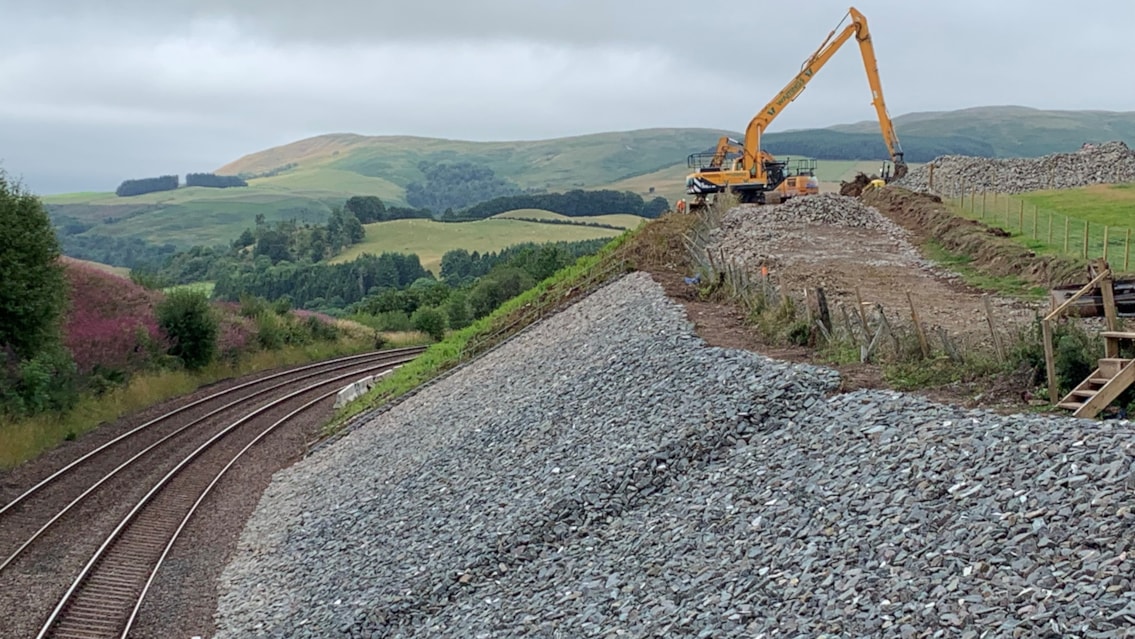
The Highland Main Line has received £2.85 million for drainage and earthworks. Approximately £2 million has been spent stabilising the steep rock face beside the Edinburgh to Glasgow railway at Ratho. £3 million has gone into strengthening the hillside above the West Highland Line at Falls of Cruachan following a landslip. Another £850,000 has been spent between Aberdeen and Inverness to improve the railway’s ability to cope with heavier rainfall.
Much of the work is taking place away from stations and trains.
It is happening in drains, culverts, cuttings, embankments, rock faces and slopes: parts of the railway that passengers may never see but which determine whether the track remains physically secure when large quantities of water move through the landscape.
A railway inherited from the nineteenth century
Large parts of Scotland’s railway geography were established during the nineteenth century.
The Edinburgh and Glasgow Railway opened in 1842. The Caledonian Railway reached Glasgow from Carlisle in the 1840s. The Highland Main Line developed through a sequence of Victorian railways and reached Inverness from Perth in 1863. The West Highland Line opened to Fort William in 1894 and was extended to Mallaig in 1901.
Those routes required engineers to cut railways through hillsides, build embankments across valleys, cross rivers and burns, construct coastal sections and control water around thousands of structures.
Many of those railway corridors remain in use.
The rails, signalling and structures have been repeatedly renewed, but the underlying geography often remains the geography chosen by Victorian engineers.
A cutting remains a cutting. An embankment remains an embankment. A railway following a loch, river valley or coastline remains exposed to the surrounding terrain.
Modern climate adaptation therefore involves modifying infrastructure whose original alignment was determined long before contemporary climate projections existed.
Water is one of the railway’s oldest engineering problems
Railways require controlled drainage because water changes the physical properties of the ground supporting them.
Rain falling on higher land can travel towards a railway through soil, rock, streams, ditches and drainage systems.
If water cannot escape effectively, it can saturate an embankment, erode material beneath track, overwhelm a culvert, destabilise a cutting or carry debris onto the railway.
Drainage assets themselves can fail through blockage, deterioration, inadequate capacity or changes in the surrounding landscape.
Scotland’s railway contains thousands of drainage assets distributed across a network passing through mountains, agricultural land, cities, forests, river valleys and coastal areas.
Climate change alters the assumptions under which those systems are maintained.
Network Rail’s Scotland Climate Ready Plan identifies increasing temperatures, changing rainfall patterns and more frequent severe-weather events as long-term risks to railway infrastructure.
The engineering response is no longer limited to repairing damage after an event.
The current programme increasingly attempts to identify where failure could occur before it happens.
Carmont changed the railway’s understanding of rainfall risk
On 12 August 2020, the 06:38 Aberdeen to Glasgow Queen Street service was returning towards Aberdeen after a blockage was reported ahead.
Near Carmont, south-west of Stonehaven, the train struck debris that had been washed onto the railway and derailed.
Three people died: driver Brett McCullough, conductor Donald Dinnie and passenger Christopher Stuchbury. Six other people on the train were injured.
The Rail Accident Investigation Branch subsequently reconstructed what had happened on the hillside above the railway.
Near-continuous heavy rain had fallen between approximately 6am and 9am.
RAIB calculated that 51.5mm of rain fell at the accident site during those three hours, close to the average rainfall for the entire month of August in that part of Scotland.
The train struck material washed from a drainage trench.
The drainage system had been constructed in 2011 and 2012 as part of work intended to address drainage and slope stability.
RAIB found that the drainage system and associated earthworks had not been constructed in accordance with the original design.
A low earth bank had also altered the movement of water across the slope.
During the extreme rainfall, concentrated water flow entered a steep section of the drainage trench and washed out gravel and surrounding ground. Debris reached the track.
RAIB made 20 recommendations following its investigation.
They included changes to the management of civil-engineering work, drainage design, the railway’s operational response to extreme rainfall, weather information, route control and the way lessons from previous incidents are implemented.
The response went beyond Carmont
Network Rail commissioned two independent reviews after the derailment.
Dame Julia Slingo, the former chief scientist at the Met Office, examined weather forecasting and how the railway could make better use of information about extreme rainfall.
Professor Lord Robert Mair of Cambridge University examined earthworks and drainage.
Further reviews followed the extreme heat of July 2022, examining heat forecasting, track and overhead-line engineering, operational weather management and communication during disruptive events.
Scotland’s railway subsequently established a Weather Risk Taskforce involving Network Rail, ScotRail and Transport Scotland.
The changes have altered both engineering and operations.
A weather desk staffed by trained meteorologists now operates within Scotland’s Railway Integrated Control.
Network Rail has expanded aerial inspection capability and maintains a dedicated helicopter at Cumbernauld for earthworks inspections and surveys.
A Slope Safety Review Group meets regularly.
Wireless tiltmeters have been deployed at 130 locations to provide live detection of ground movement.
Drainage inspection resources have increased.
Geotechnical teams have been expanded.
The railway is also making greater use of remote monitoring so that changes in infrastructure condition can be detected before a visible failure occurs.
The £400 million is not one construction project
Unlike a new railway, station or bridge, climate resilience is distributed across the existing network.
The current programme contains many individual interventions.
Some involve drainage.
Others involve stabilising soil slopes or rock cuttings, strengthening embankments, installing monitoring equipment or changing how vegetation and water are managed around railway land.
At Falls of Cruachan on the West Highland Line, Network Rail has been strengthening the hillside following a landslip.
At Ratho, engineers have worked on a steep rock face beside one of Scotland’s busiest railway corridors.
On the Highland Main Line, investment is being directed into drainage and earthworks.
On the West Coast Main Line, the programme combines work on soil slopes, rock slopes and water management.
The geographic spread reflects the different ways weather affects the network.
A railway through the Highlands faces different terrain from an urban railway through Glasgow.
A coastal section faces different exposure from an inland cutting.
The engineering programme therefore depends increasingly on location-specific risk rather than a single national solution.
Scotland recorded more than 127,000 minutes of weather-related railway delay last year
The Scottish Government’s latest National Adaptation Plan annual report records 127,565 minutes of weather-related train delay during 2025-26.
That was an increase on the previous year.
The Government cautions that annual figures are strongly influenced by the number and severity of storms during a particular year and says a longer time series will be required before a reliable trend can be established.
The Office of Rail and Road has separately identified weather as one of the major causes of Network Rail-attributable delay in Scotland during 2025-26.
The financial cost of weather therefore extends beyond damaged infrastructure.
A blocked railway affects passenger journeys, train crew and rolling-stock movements, freight, timetable recovery and connections elsewhere on the network.
Where a route has limited alternatives, disruption can have a larger geographic effect.
That is particularly relevant in parts of rural Scotland where a single railway corridor provides the principal rail connection over long distances.
Extreme rainfall is only one climate risk
Higher temperatures create different engineering problems.
Steel rail expands in heat.
Overhead electrical equipment can respond to temperature changes.
Structures, buildings and signalling equipment have operating tolerances.
Vegetation conditions change during prolonged dry weather, increasing fire risk beside railway infrastructure.
Storms can bring trees and other debris onto the railway.
Coastal infrastructure can be exposed to wave action, erosion and rising sea levels.
Cold weather remains part of the Scottish operating environment even as average temperatures increase.
The railway therefore has to become more resilient to a wider range of conditions rather than simply becoming a railway designed for warmer weather.
The regulator says long-term adaptation still needs work
The Office of Rail and Road continues to scrutinise Network Rail’s climate adaptation.
Its 2025-26 assessment says weather resilience and climate-change adaptation remain a high priority across the railway.
The regulator reports continued installation of earthworks monitoring equipment, trials of new flood-detection technology and development of natural flood-management approaches.
It has also identified weaknesses.
ORR’s wider asset-management assessment says some Network Rail strategies remain too short-term and reactive and need to develop into longer-term asset-sustainability planning.
A separate ORR-commissioned review published in May 2026 examined climate adaptation for Network Rail’s operational buildings.
That review found a strong overarching framework but variable application to individual buildings, with limited building-specific climate-risk assessment and adaptation measures in some areas.
The railway’s climate problem therefore extends beyond track and earthworks to stations, depots, signalling buildings and other operational property.
Engineering standards are changing because the past is no longer a sufficient guide
Traditional infrastructure design frequently uses historical records to estimate the probability of future events.
A drainage system might be designed around a rainfall event expected statistically once in a specified number of years.
Climate change complicates that method because the future frequency and intensity of rainfall may not match the historical record.
One of the recommendations following Carmont required Network Rail to reconsider drainage procedures so designs account for appropriate water-flow return periods and climate-change allowances.
The regulator subsequently reported that Network Rail had overhauled its approach to the lifecycle of water management, including design, installation and maintenance.
Modern survey technology is also changing the available evidence.
LiDAR can produce detailed three-dimensional information about terrain.
Remote sensors can detect ground movement.
Weather forecasting can be connected more directly to operational decisions.
Aerial surveys can examine large areas after heavy rainfall.
Those systems allow the railway to treat weather increasingly as a measurable infrastructure risk rather than an external event that begins only when damage occurs.
Some of the future railway budget will be spent protecting what Scotland already has
Infrastructure investment is usually associated with expansion: new lines, electrification, stations, faster journeys or additional capacity.
Climate adaptation creates another category of expenditure.
Money is required to preserve the reliability and safety of infrastructure that already exists.
The £400 million Scottish resilience programme illustrates the scale at which that is beginning to occur.
The expenditure does not create 400 miles of new railway or a new intercity route.
It strengthens the network against environmental conditions that are changing around it.
That creates a different calculation for long-term infrastructure planning.
If more capital has to be allocated to drainage, earthworks, coastal protection, monitoring and recovery from severe weather, those costs become part of maintaining the existing railway before decisions are made about expansion.
The railway is also part of Scotland’s climate policy
Rail occupies an unusual position in climate policy. Government wants more passenger and freight movement to use lower-carbon transport. At the same time, the railway intended to carry that traffic is itself exposed to the physical effects of climate change.
Scotland’s National Adaptation Plan therefore treats transport resilience as part of climate adaptation rather than as a separate railway-maintenance issue.
Network Rail has also been working with other infrastructure operators through Climate Ready Infrastructure Scotland, a forum established in 2025 involving organisations responsible for critical infrastructure. Infrastructure systems are connected. A railway can depend on electricity networks, telecommunications, roads, drainage and emergency access. Severe weather can affect several systems at the same time. Planning for a railway in isolation becomes less effective when the same storm affects power, roads and communications across the surrounding area.
SOURCES
£130m invested to strengthen Scotland’s railway against extreme weather — Network Rail — 2 September 2026 — https://www.networkrailmediacentre.co.uk/news/gbp-130m-invested-to-strengthen-scotlands-railway-against-extreme-weather
Scotland’s Railway CP7 Climate Ready Plan — Network Rail — April 2024 — https://www.networkrail.co.uk/wp-content/uploads/2024/04/Scotlands-Railway-CP7-Climate-Ready-WRCCA-Plan.pdf
Derailment of a passenger train at Carmont, Aberdeenshire, 12 August 2020 — Rail Accident Investigation Branch — 10 March 2022, updated 11 January 2024 — https://www.gov.uk/government/news/report-022022-derailment-of-a-passenger-train-at-carmont
Derailment of a passenger train at Carmont, Aberdeenshire on 12 August 2020 — ORR letter to RAIB — Office of Rail and Road — 23 October 2025 — https://www.orr.gov.uk/sites/default/files/2025-10/raib-carmont-derailment-2025-10-23.pdf
ORR’s annual assessment of Network Rail Scotland 2025 to 2026 — Office of Rail and Road — August 2026 — https://www.orr.gov.uk/orrs-annual-assessment-network-rail-scotland-2025-2026