
Artificial football turf in Scotland may be losing between 443 and 1,772 tonnes of microplastic into the environment every year.
The estimate comes from work cited by Environmental Standards Scotland. It is not a measured national total. The regulator says Scottish field evidence remains limited and that many estimates of loss from artificial turf have not been verified empirically.
The material being lost is nevertheless known.
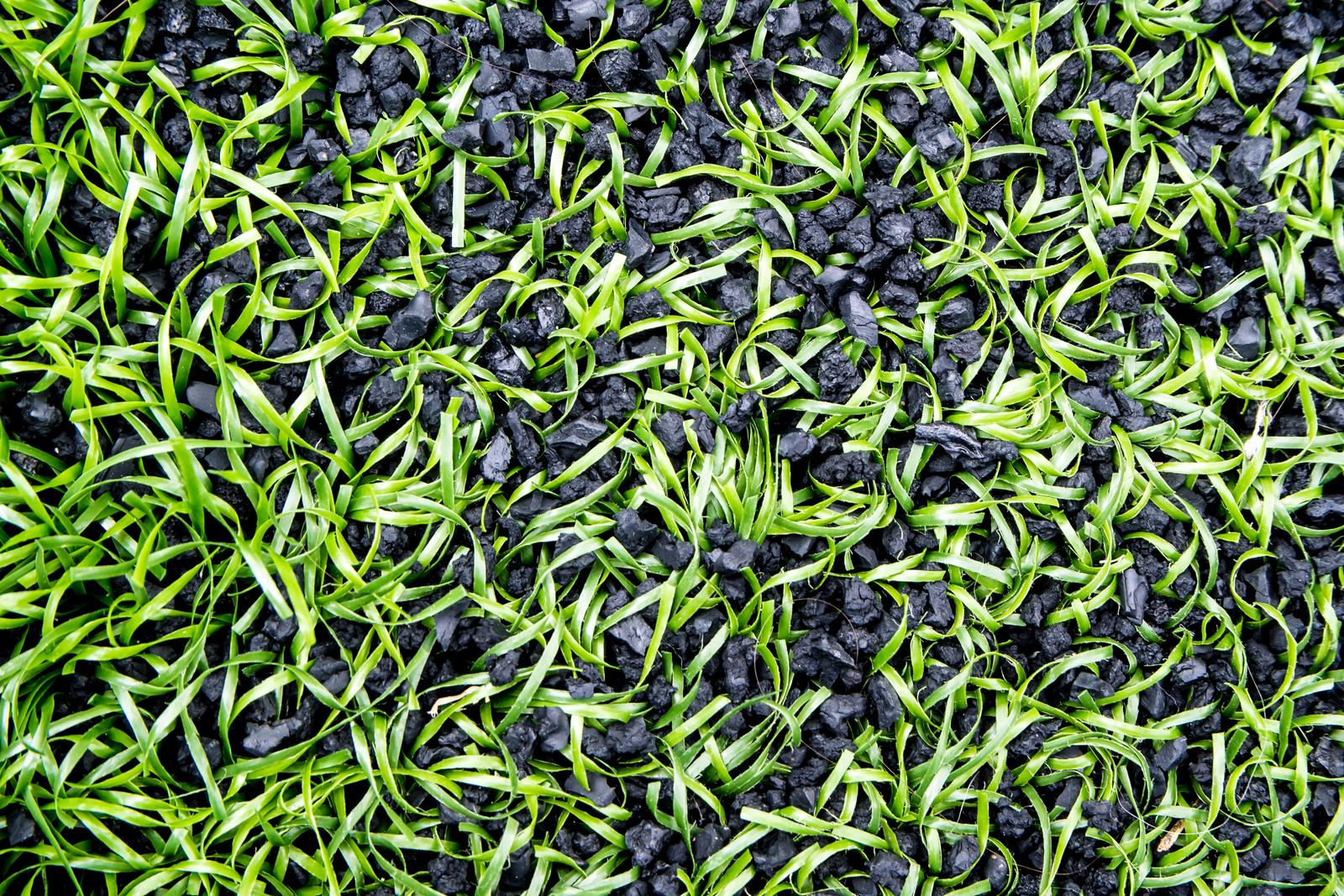
Many third-generation artificial pitches use loose rubber granules between synthetic grass fibres. The granules are commonly manufactured from shredded end-of-life vehicle tyres. They keep the plastic blades upright, alter ball behaviour and provide cushioning underfoot.
They also leave the pitch.
Environmental Standards Scotland records estimates that as much as half of artificial-turf infill may ultimately be lost to the wider environment. It also cites estimates suggesting that between five and ten per cent of the synthetic grass fibres themselves may be lost through wear and tear.
The same pitches have become an important part of Scotland’s sporting infrastructure.
The Scottish FA reported approximately 300 full-size 3G pitches by 2018, almost three times the number recorded seven years earlier. Its current £50 million Pitching In programme aims to upgrade as many as 50 existing 3G pitches and construct up to 40 new ones by 2030.
In September 2026, sportscotland announced another £5 million for sports facilities, doubling the amount available through its fund over two years to £10 million. Several of the projects receiving support include new 3G pitches.
Not every artificial pitch uses tyre-derived rubber, and the funding announcements do not establish that every new Scottish facility will use it.
There is, however, no Scottish prohibition on the continued use of rubber crumb.
The European Union has already established one. From 17 October 2031, granular polymeric infill for synthetic sports surfaces will no longer be permitted to be placed on the EU market under the restriction on intentionally added microplastics.
Scotland is outside that system.
Great Britain now operates under UK REACH rather than EU REACH. Had Scotland remained subject to EU REACH, the 2031 restriction would apply here. Under the current Great Britain system, no equivalent phase-out date has yet been adopted.
Where the rubber goes
A modern 3G football pitch can contain tens of tonnes of loose infill, and some full-size systems contain more than 100 tonnes.
The material does not remain permanently between the synthetic grass fibres.
Granules can be carried from the playing surface on boots, socks, clothing and maintenance machinery. They can accumulate around entrances and pitch edges, move into adjoining soil, enter drains during rainfall, be displaced during cleaning or snow removal, and escape when infill is stored, replenished or removed.
Operators periodically add new infill because material is lost from the playing surface during its working life.
Scottish environmental research has examined these pathways for years. A Scottish Government study published in 2020 identified artificial grass pitches as part of Scotland’s marine-plastic value chain and described microplastic loss during use, maintenance and end-of-life handling.
Environmental Standards Scotland later reported that artificial turf infill can move through soils and sewer systems and into receiving surface waters.
The national estimate of 443 to 1,772 tonnes a year remains a modelled range rather than a measured total. Environmental Standards Scotland has said that very little Scottish evidence exists to establish precisely how much artificial-turf material reaches the marine environment.
Scotland therefore has estimates of annual loss but no national measurement programme recording the mass leaving individual pitches.
The plastic does not stop with the black granules
Changing the infill does not remove all microplastic generation from artificial turf.
The grass itself is synthetic.
Repeated contact with footwear, maintenance machinery, sunlight and weather abrades the fibres. Environmental Standards Scotland cites estimates that approximately five to ten per cent of those fibres may be lost over the life of a surface.
A pitch using cork, corn cob or another non-plastic infill therefore avoids one large source of deliberately added microplastic while retaining a synthetic carpet capable of shedding plastic fibres.
Artificial turf consequently presents two separate material-loss problems: loose infill and the gradual wear of the synthetic surface itself.
What tyre crumb contains
Rubber crumb made from vehicle tyres is chemically more complicated than an inert piece of plastic.
Tyres are manufactured to withstand friction, heat, oxygen, ozone, sunlight and mechanical stress. Their formulation includes antioxidants, vulcanisation compounds, fillers, oils, metals and other additives.
Scientific studies of recycled tyre rubber used on sports fields and playgrounds have identified polycyclic aromatic hydrocarbons, metals, benzothiazoles, vulcanisation chemicals and other tyre-derived substances.
A 2024 study published in Science of the Total Environment analysed recycled tyre rubber taken from playing surfaces. It found emerging tyre-related compounds across the rubber surfaces examined, including the antioxidant 6PPD.
In new synthetic-field material, 6PPD reached concentrations of up to 0.2 per cent by weight.
The study also detected 6PPD-quinone, a transformation product formed when 6PPD reacts with oxidants such as ozone. Alternative infill materials examined in the same research contained substantially fewer of the target tyre-derived compounds.
6PPD-quinone has attracted extensive scientific attention because some salmonid species are exceptionally sensitive to it.
The presence of the chemical in tyre crumb does not establish that Scottish football pitches are causing fish deaths. Scotland does not currently operate a national monitoring programme measuring 6PPD-quinone in drainage from artificial sports pitches.
Research published in 2026 has, however, demonstrated that the compound can leave artificial turf fields in stormwater.
Tyre chemicals in pitch drainage
Researchers at the University of British Columbia collected stormwater directly from drainage systems beneath artificial turf fields and analysed tyre-derived contaminants leaving the surfaces during rainfall.
The study found that crumb-rubber infill released 6PPD-quinone, zinc and copper at higher concentrations than alternative infill materials.
The maximum 6PPD-quinone concentration measured in stormwater draining one artificial field was 130.2 nanograms per litre. The researchers reported that this was more than three times the published median lethal concentration for juvenile coho salmon.
The study was conducted in Canada, not Scotland, and species sensitivity differs between fish. It does not establish equivalent concentrations in Scottish waters.
It does demonstrate that an artificial pitch can act as a continuing point source of tyre-derived chemicals through its drainage system.
The researchers found that release could continue from older material. They estimated that only a small fraction of the total 6PPD within a pitch would be removed through annual stormwater leaching, leaving a large reservoir available for continuing release during the working life of the surface.
They also identified drainage treatment as a potential intervention because artificial pitches are discrete sites with engineered water systems.
What children and players are exposed to
The evidence concerning human health is less settled than the evidence concerning environmental release.
There is no reliable evidence showing that children playing on Scottish 3G pitches are developing cancer or another specific disease because of tyre-derived crumb.
The limited epidemiological research available has not demonstrated an increased incidence of leukaemia or lymphoma associated with playing on synthetic turf.
A 2025 review of rubber crumb and health outcomes identified only two epidemiological studies directly examining major disease outcomes. Neither found a statistically significant association with leukaemia, non-Hodgkin lymphoma or Hodgkin lymphoma.
The same review found that the epidemiological evidence base remains very small relative to the widespread use of artificial turf and called for longitudinal studies and stronger exposure measurements.
The material itself contains substances to which exposure can occur.
The US Environmental Protection Agency and the Centers for Disease Control and Prevention have carried out one of the largest investigations of recycled tyre crumb used on playing fields.
Their work identified chemicals and metals within the material and examined exposure through inhalation, ingestion and skin contact. The agencies describe the work as exposure characterisation rather than a complete health-risk assessment.
The research therefore establishes routes of human contact without establishing that ordinary use of compliant fields produces a particular disease.
Particles in the air
Rubber crumb and synthetic turf are also capable of producing airborne particles.
A 2023 study measured crumb-rubber particles in ambient air around artificial turf fields at concentrations ranging from 2.8 to 51.4 micrograms per cubic metre. The researchers subsequently identified particles carrying environmentally persistent free radicals in saliva samples from participants using the surfaces.
The study reported that the abundance of airborne particles tended to increase with the operating age of the playing fields.
A 2026 review in Environmental Geochemistry and Health examined airborne microplastic emissions from synthetic sports surfaces in school environments.
It identified children as a population requiring particular attention because of their physiology and levels of physical activity. The review describes potential exposure to airborne microplastics together with substances including polycyclic aromatic hydrocarbons, metals and endocrine-active compounds.
It also records substantial limitations in the evidence available for child-specific exposure and long-term health outcomes.
Scotland does not routinely monitor airborne microplastic concentrations around school and community artificial pitches.
Artificial surfaces can also become considerably hotter
Temperature produces another measurable difference between synthetic and natural playing surfaces.
A 2024 systematic review examined 23 studies comparing synthetic sports surfaces with natural grass.
Synthetic surfaces were consistently hotter.
Surface temperatures were between 9.4°C and 33.7°C higher than natural grass in the studies reviewed, while air immediately above synthetic surfaces was generally between 0.5°C and 1.2°C warmer.
The researchers found insufficient evidence to determine whether those differences consistently create a materially greater heat-stress risk for athletes.
Scotland’s own 2026 ClimateXChange research on grassroots sport identifies heat stress and dehydration as increasing climate-related concerns while also recording artificial turf as one response to waterlogged natural pitches.
The same Scottish study identifies microplastic pollution, waste generation, reduced biodiversity and soil impacts among the environmental disadvantages associated with artificial surfaces.
Europe has set a 2031 date
The European Union adopted a restriction on intentionally added microplastics in September 2023.
The measure covers granular infill used on synthetic sports surfaces.
Sales of qualifying polymeric infill will cease from 17 October 2031.
The eight-year transition period allows existing installations to continue operating while pitches approach replacement age and sports bodies move towards other infill systems.
The restriction does not require every existing artificial pitch to be removed in 2031.
It prevents the relevant microplastic infill from continuing to be placed on the market after the transition period.
Scotland is not covered because Great Britain left the EU chemicals regime and now operates UK REACH.
The Scottish Government, UK Government and Welsh Government participate in the Great Britain chemicals system, with the Health and Safety Executive acting as the UK REACH agency.
The UK REACH work programme for 2025–26 states that no new restriction workstreams are being initiated during that period.
There is currently no Great Britain date equivalent to the EU’s October 2031 restriction on artificial-pitch microplastic infill.
The UK evidence Scotland said it was waiting for has now been published
The issue was raised directly in the Scottish Parliament in March 2024.
Then First Minister Humza Yousaf said the Scottish Government would consider research commissioned by the Department for Environment, Food and Rural Affairs into the wider impacts of microplastics. He said the results would help shape future regulation.
He also referred to the European Union’s decision to phase out rubber crumb in 2031 and said sportscotland was exploring alternative artificial-pitch systems and infill products.
The Defra-commissioned research was published in 2025.
It identified synthetic sports surfaces as the largest source of intentionally added microplastic emissions among the UK applications examined.
A peer-reviewed analysis published in 2026 estimated future releases and modelled different regulatory responses. Synthetic sports surfaces remained the largest overall emissions source among the intentionally added microplastic sectors studied.
The modelling found that broad restrictions produced the largest overall reductions in emissions and environmental exposure. Targeted containment around sports surfaces produced smaller total reductions but substantially reduced losses to particular environmental compartments.
The UK research examined intentionally added microplastics. It did not establish that sports pitches are the largest source of all microplastic pollution in Britain. Secondary sources such as tyre wear from road traffic fall outside that comparison.
New Scottish 3G pitches are still being planned and funded
Scotland’s artificial-pitch estate is still expanding.
The Scottish FA’s Pitching In programme aims to raise £50 million by 2030 for football facilities. Its targets include upgrading as many as 50 existing 3G pitches and increasing the national football footprint by up to 40 new 3G pitches.
The programme combines football funding with government money, philanthropy and other investment.
Sportscotland separately announced another £5 million for sports facilities in September 2026, taking the available fund to £10 million over two years. The awards include projects involving new 3G surfaces.
The announcements do not specify tyre-derived rubber infill for every new pitch.
Scottish public procurement still permits artificial systems using microplastic infill where the relevant specifications and regulations are met.
Some current contracts also involve replenishing existing rubber-crumb surfaces.
Scotland therefore has an established estate requiring maintenance at the same time as public and football-sector programmes are financing additional artificial capacity.
Different timetables for different pollutants
Scotland’s Climate Change Plan for 2026–2040 contains more than 150 actions aimed at reducing greenhouse-gas emissions.
The plan includes a policy outcome to phase out the need for new petrol and diesel cars and vans by 2030 and aims for all road vehicles to be zero-emission by 2040.
Vehicle policy and artificial-turf pollution concern different pollutants, environmental pathways and regulatory systems.
Carbon dioxide accumulates globally and drives climate change. Rubber crumb and synthetic fibres create local and regional plastic pollution and can carry other chemical contaminants.
The regulatory timetables are nevertheless different.
Scotland has established dated transitions for road-transport emissions.
It has not established a Scottish phase-out date for loose polymeric infill on artificial sports pitches.
The EU has.
Natural turf remains one available option
Natural grass cannot provide the same intensity of use as an artificial sports surface.
Sportscotland technical guidance indicates that a well-constructed and maintained natural-turf pitch may typically sustain around six to eight hours of use each week.
Artificial surfaces can support many times that level of activity. Scottish climate research cites figures of up to around 80 hours a week.
The difference explains much of the demand for 3G facilities, particularly at schools, football hubs and community sites with large numbers of teams sharing limited space.
Natural turf nevertheless remains an available engineering and procurement option where usage levels, land and drainage permit it.
Natural grass allows infiltration through living soil and does not shed polyethylene grass fibres or require loose polymeric infill.
It has its own environmental costs. Maintenance may involve mowing machinery, fertilisers, irrigation, reseeding, drainage work and, in some cases, pesticides.
Scotland’s 2026 ClimateXChange study concludes that artificial surfaces are not necessarily the most appropriate adaptation in every location and records improved natural-turf management as one option for dealing with increasingly wet conditions.
Decisions can therefore involve natural grass, multiple grass pitches, hybrid systems, artificial surfaces with alternative infill and conventional 3G systems.
Scotland already has artificial pitches without tyre crumb
Removing tyre-derived rubber does not require removing artificial football altogether.
Shetland Islands Council commissioned a full-size 3G pitch at Clickimin using biodegradable infill made from sweetcorn cob instead of conventional rubber crumb.
The project cost around £1.46 million and involved funding from Shetland Islands Council, sportscotland, the Scottish FA, Scottish Rugby and local sporting organisations.
The surface was designed for football and rugby and was subsequently tested against the relevant playing standards.
Cork is also used as an infill material on artificial sports surfaces, including at the University of St Andrews.
Other systems use olive-derived material, thermoplastic alternatives or no loose infill.
Alternative materials have different performance, maintenance, durability, water and whole-life cost characteristics. Replacing crumb rubber with another polymeric infill would also not remove the problem of intentionally added plastic.
Organic infill avoids the deliberate placement of tyre-derived microplastic, while the synthetic carpet remains.
Existing rubber pitches can be contained
Replacing Scotland’s artificial-pitch estate immediately would create a large waste stream and impose substantial capital costs.
Containment systems are already available for existing facilities.
European technical guidance includes solid perimeter barriers, entrance grates, boot-cleaning systems, controlled maintenance equipment, drainage filters, silt traps, designated snow-storage areas and procedures for recovering displaced infill.
Changing-room collection systems and filters can also reduce the quantity carried away in footwear and clothing.
Norway introduced national controls for pitches using loose plastic infill in 2021. The regulations require physical barriers, systems capable of capturing granules in drainage and surface water, measures to prevent users and machinery carrying material away, controlled handling of snow and arrangements for collected infill.
Norwegian authorities estimated that full implementation could reduce releases substantially, although subsequent inspections found that compliance at some facilities remained incomplete.
The 2025 UK modelling also found that containment of synthetic sports surfaces could materially reduce intentionally added microplastic emissions and environmental exposure.
Public procurement can operate before a national ban
Scottish public authorities do not need a UK REACH prohibition before environmental impacts can be included in purchasing decisions.
The Procurement Reform (Scotland) Act 2014 places a Sustainable Procurement Duty on contracting authorities carrying out regulated procurement.
Authorities must consider how procurement can improve economic, social and environmental wellbeing.
Scottish Government procurement guidance also provides for life-cycle assessment, including raw materials, manufacturing, use, waste and final disposal.
A public funding specification for a sports pitch could therefore include requirements relating to infill material, loss containment, drainage treatment, annual top-up, fibre shedding, maintenance and end-of-life disposal.
No national Scottish procurement rule currently prohibits public money from purchasing artificial sports surfaces that use loose polymeric infill.
Scotland can map its pitches, but not yet their pollution pathways
Scotland does have national pitch and sports-facility data.
Sportscotland provides a national Sports Facilities dataset through Spatial Hub Scotland. The dataset includes pitches and records attributes including pitch size, sport and type. It can be downloaded in CSV, GeoJSON, shapefile and web-service formats and is intended to provide a national picture of sports facilities across Scotland.
Search and download Sportscotland’s national Sports Facilities dataset
The dataset is supplied by Sportscotland and published through the Improvement Service’s Spatial Hub. It was last updated in July 2024 on the version currently published. The site cautions that some information comes from third parties and cannot be guaranteed to be completely accurate, although it describes the data as the most up-to-date information held.
There is also a public-facing searchable map built from the Sportscotland dataset. ScotSport allows users to search Scottish sporting facilities by council area and town, view locations on a map and filter the underlying records by facility type and address.
Search Scotland’s sports facilities on the ScotSport map
Another searchable service, TurfScout, also includes Scottish football pitches using Sportscotland and Spatial Hub Scotland data. It allows searches by town or postcode and includes filters for surface, pitch format, floodlights and other characteristics where those details are available.
Search Scottish football pitches on TurfScout
These services mean it would be inaccurate to say Scotland has no national information showing where pitches are located.
What is not contained in the published national dataset is the full environmental record needed to calculate microplastic loss from every artificial surface.
A national pollution inventory would require additional information for each synthetic pitch: whether it is 2G, 3G or another construction; the exact infill material; the quantity originally installed; annual quantities of replacement infill; whether perimeter barriers and boot-cleaning systems are fitted; whether drains contain microplastic traps; where surface water ultimately discharges; the age of the carpet; expected replacement date; and how the surface and residual infill will be treated when the pitch is removed.
Those details are held, where they exist, across councils, schools, leisure trusts, football clubs, universities, contractors and other individual operators rather than being assembled into one published Scottish environmental register.
The distinction becomes important when assessing risk. Two pitches recorded simply as artificial football surfaces may have entirely different environmental pathways. One may use biodegradable infill and drain into a contained wastewater system. Another may contain tyre-derived rubber and discharge surface water towards a nearby burn.
Scotland can therefore locate many of its pitches already. What it cannot currently do from one national public dataset is show which of them contain loose tyre-derived microplastic, how much each loses, and where that material can travel after leaving the playing surface.
The national loss estimate has not been tested pitch by pitch
Environmental Standards Scotland has already identified the weakness in the evidence.
The 443-to-1,772-tonne estimate is not based on directly measuring every Scottish facility.
Scottish empirical evidence is limited.
Direct monitoring could measure granules and synthetic fibres in pitch drainage, surrounding soils, storm drains, sediments and receiving waters. Chemical monitoring could include 6PPD, 6PPD-quinone, zinc and other tyre-derived substances.
Air sampling could measure particles around heavily used school and community pitches.
Measurements from new and older pitches could also establish whether age, surface construction, maintenance and containment alter emissions.
No national Scottish programme currently publishes those measurements across the pitch estate.
The pitch remains a waste problem after play ends
Artificial surfaces have finite working lives.
Scottish climate research uses approximately ten years as a typical replacement interval, although individual pitches can last longer.
Replacement produces a mixture of synthetic carpet, backing material, shock pads, sand and remaining infill.
Scotland’s 2020 artificial-grass research identified end-of-life management as another potential source of microplastic loss, including concerns around old turf being stored outdoors.
Residual infill can continue leaving a surface after the pitch has stopped being used for sport if rolls are stored, transported or processed without adequate containment.
Public procurement contracts can specify removal, transport, separation, recycling, reuse and final disposal. Scotland does not currently operate a single public national record following every artificial surface from installation to final treatment.
The position in Scotland in 2026
Environmental Standards Scotland records artificial-turf infill as a source of microplastic pollution and cites an estimated annual Scottish loss of between 443 and 1,772 tonnes.
The Scottish Government has possessed research identifying leakage and end-of-life problems since 2020.
The EU adopted its microplastics restriction in 2023 and will end sales of qualifying granular infill from October 2031.
The Scottish Government told Parliament in 2024 that forthcoming Defra research would help shape regulation.
That UK research was published in 2025 and identified synthetic sports surfaces as the largest source of intentionally added microplastic emissions among the sectors examined.
A peer-reviewed analysis published in 2026 reached the same conclusion and modelled reductions available through restriction and containment.
The current UK REACH work programme contains no new restriction workstream covering the material.
The Scottish FA plans up to 40 additional 3G pitches by 2030 and upgrades to as many as 50 existing surfaces.
Sportscotland continues to fund artificial sports infrastructure.
Scotland has artificial pitches using alternative biodegradable infill, including the full-size surface at Clickimin in Shetland.
Natural turf remains in use and can be improved through drainage and management where site capacity allows it.
Containment systems are available for existing rubber-filled surfaces.
There is no Scottish phase-out date for loose microplastic infill, no complete published national register of pitch infill and drainage systems, and no national field-monitoring programme measuring the quantity of synthetic material leaving each site.
Sources
Environmental Standards Scotland, Marine Litter — An Assessment of Sources, Controls and Progress in Scottish Seas, 2024.
Environmental Standards Scotland
Scottish Government, Mapping Economic, Behavioural and Social Factors within the Marine Plastic Value Chain in Scotland: Artificial Grass Pitch, 2020.
Scottish Government report
Economics for the Environment Consultancy and UK Centre for Ecology & Hydrology, Options to Reduce Intentionally Added Microplastics Emissions, commissioned by Defra, 2025.
eFTEC research
Integrated Environmental Assessment and Management, Beyond Source Restrictions: Combined Mitigation Strategies Substantially Reduce Emissions and Exposure of Intentionally Added Microplastics in the United Kingdom, June 2026.
Oxford Academic
European Chemicals Agency, Granules and Mulches on Sports Pitches and Playgrounds, current guidance on the EU restriction on intentionally added microplastics.
European Chemicals Agency
Scottish Parliament, Artificial Pitches (Infill), First Minister’s Questions, 28 March 2024.
Scottish Parliament Official Report
UK Government, Scottish Government and Welsh Government, Rationale for Prioritising Substances in the UK REACH Work Programme: 2025 to 2026, 31 July 2025.
UK REACH work programme
Scottish FA, Pitching In — Frequently Asked Questions, current programme information.
Scottish FA
Sportscotland, Scottish Sport Facilities to Benefit from £5m of Additional Funding, 11 September 2026.
Sportscotland
Shetland Islands Council, New 3G Synthetic Pitch Construction to Get Underway, current project information.
Shetland Islands Council
ClimateXChange, A Scoping Study of the Impact of Climate Change on Grassroots Sport in Scotland, 12 June 2026.
ClimateXChange
Sportscotland, Natural Turf Datasheet, technical guidance.
Sportscotland technical guidance
Scottish Government, Sustainable Procurement Duty, current public-sector procurement guidance.
Scottish Government procurement guidance
Scottish Government, Scotland’s Climate Change Plan 2026–2040, 24 March 2026.
Scottish Government Climate Change Plan
U.S. Environmental Protection Agency and CDC/ATSDR, Synthetic Turf Field Recycled Tire Crumb Rubber Research — Exposure Characterization, April 2024.
US EPA
Karatela, S. et al., Rubber Crumb Infill in Synthetic Turf and Health Outcomes: A Review of the Literature on Polycyclic Aromatic Hydrocarbons and Metalloids, Epidemiologia, 2025.
PubMed
Fu, N. et al., Airborne Microplastic Emissions from Synthetic Sports Surfaces and Associated Health Risks to Children, Environmental Geochemistry and Health, February 2026.
PubMed
Singh, G., Peterson, B., Jay, O. and Stevens, C.J., The Effect of Synthetic Grass Sports Surfaces on the Thermal Environment: A Systematic Review, International Journal of Biometeorology, July 2024.
PubMed
Recycled Tire Rubber Materials in the Spotlight: Determination of Hazardous and Lethal Substances, Science of the Total Environment, 15 June 2024.
ScienceDirect
Moloney, K.J., Rodgers, T.F.M. and Scholes, R.C., Artificial Turf Fields Act as Recurring Point Sources of Metals and Emerging Tire-Derived Contaminants in Stormwater, Environmental Science: Processes & Impacts, 12 March 2026.
Royal Society of Chemistry
Emerging Health Risks of Crumb Rubber: Inhalation of Environmentally Persistent Free Radicals via Saliva During Artificial Turf Activities, 2023.
PubMed