
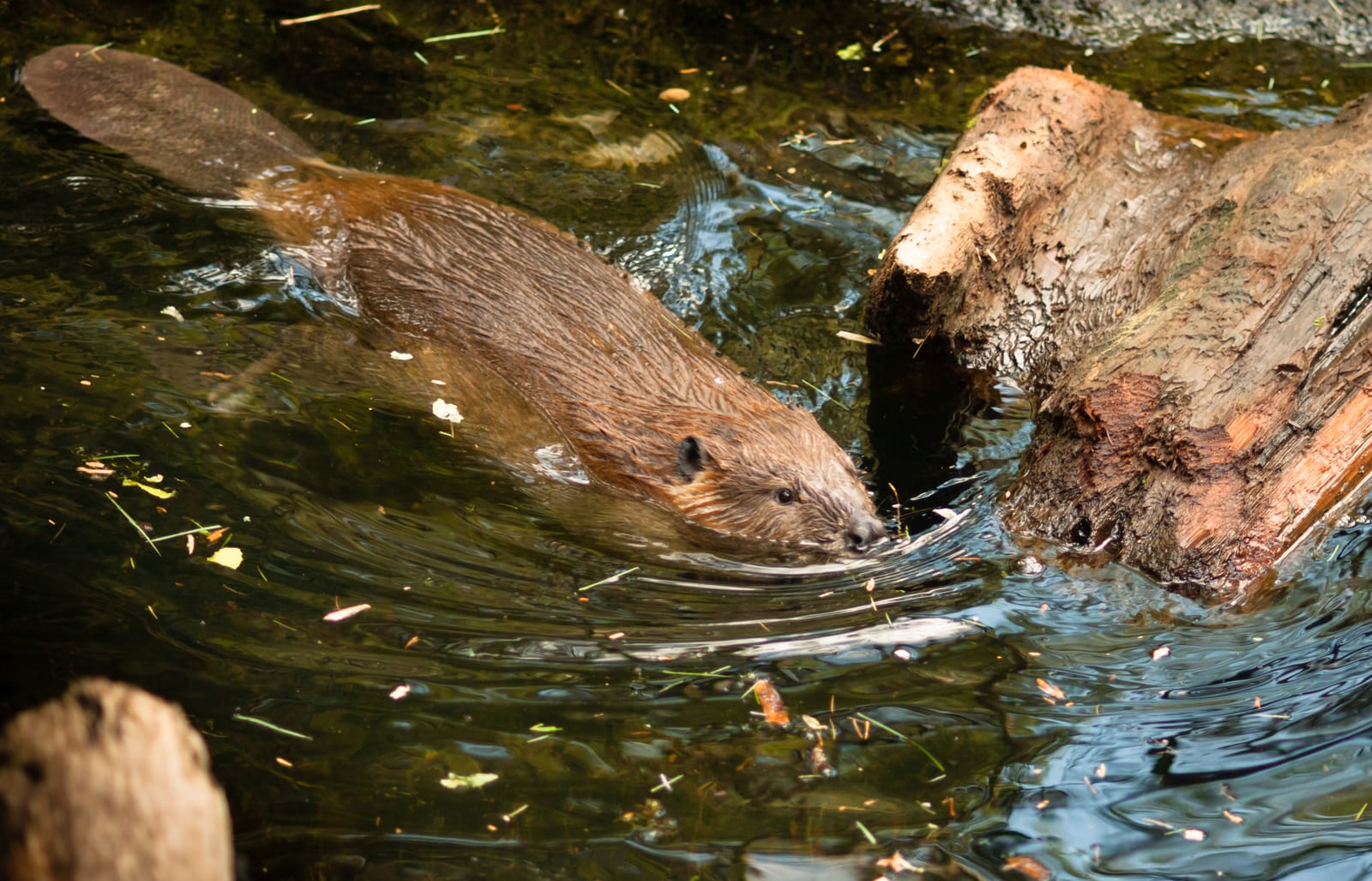
Scotland is deliberately expanding its beaver population into new Highland catchments while continuing to remove animals from farmland and other conflict sites. NatureScot’s latest figures record 84 beavers removed in a year, 35 released elsewhere in Scotland and 22 killed under licence.
Thirty-five beavers were moved into new parts of Scotland during the latest year of the country’s reintroduction programme, extending the species farther into the Highlands while another 22 animals were killed under licence where their presence was judged to be causing serious problems.
The figures are contained in NatureScot’s Beaver Management Report for the 12 months from April 2025 to March 2026. They describe a species that is continuing to expand after centuries of absence from Scotland, but which is also now subject to an increasingly organised system of trapping, relocation, dam management and lethal control.
A total of 84 beavers were removed from 22 conflict sites during the year. Sixty-two were trapped rather than killed, representing almost three-quarters of all removals. NatureScot says most of the trapping took place on prime agricultural land where beaver activity had the potential to cause serious impacts.
Of the trapped animals, 35 were released into new or developing Scottish populations. Seven went to the Cairngorms National Park, 11 to Forestry and Land Scotland land at Glen Affric, two to Tay Forest Park and 15 to Abriachan Forest in the Beauly catchment.
A further 24 animals were transferred to licensed projects elsewhere in Britain.
The movement of the animals represents a significant change from the early years of formal beaver management in Scotland, when lethal control accounted for a much larger share of removals. NatureScot recorded 87 beavers killed under licence in 2021. The latest 12-month report records 22, almost unchanged from 23 in the preceding year.
The change follows a deliberate shift in government policy towards moving beavers rather than killing them where suitable alternatives are available.
Beavers have held European Protected Species status in Scotland since May 2019. Two years later, ministers announced that translocation would be used more actively to expand the population beyond areas it would be likely to reach through natural spread alone. Scotland’s Beaver Strategy, published in 2022 and running to 2045, subsequently placed accommodation and mitigation ahead of translocation and lethal control in the hierarchy for dealing with conflict.
That policy has turned animals removed from one part of the country into the founding members of populations elsewhere.
The process is not simply a matter of catching an animal beside one river and releasing it beside another. NatureScot says trapped beavers are taken into a dedicated quarantine facility, examined by veterinary staff and screened for disease. Family groups are kept together where possible and captivity is intended to be as short as practicable.
The report says there were no deaths during trapping or transport during the year. One male kit died while in captive care following recovery from anaesthesia. A post-mortem did not establish a significant cause beyond congested or consolidated lungs. Two further kits remained in captive care at Five Sisters Zoo and had been paired together until they were old enough for release.
Health screening found no cases of Giardia, Cryptosporidium, Salmonella or Yersinia among the animals examined, although eight showed evidence of previous exposure to Leptospira.
Monitoring of released animals is also beginning to provide a clearer indication of whether translocation is working. NatureScot estimates one-year survival at about 86 per cent overall and 90 per cent for adults. It reports successful breeding, good body condition and continued establishment around release areas, while acknowledging that following individual animals over long periods remains difficult.
Natural mortality is also occurring. Monitoring has identified cases including apparent predation of beaver kits by otters.
The expansion is occurring against the background of a much larger population than existed when Scotland began formally experimenting with beaver restoration.
The first licensed Scottish Beaver Trial began at Knapdale in Argyll in 2009. By the winter of 2020-21, a survey of Tayside and surrounding catchments identified 251 active territories and produced an estimated population of about 954 animals, within a wide estimated range of 602 to 1,381.
At that point the number of territories had more than doubled from the 114 identified in 2017-18.
A new survey was completed during 2025 and is expected to be published this autumn. NatureScot says the results will confirm that the population is continuing to increase and expand its range, although not at the annual rate of about 30 per cent suggested by the previous survey.
That expanding population creates more opportunities for beavers to occupy suitable wetlands, rivers and woodland, but also increases the number of places where they meet farming, roads, drainage systems and other human infrastructure.
The latest report records 105 beaver dams being removed or modified under licence during the year. Sixteen flow devices were installed and two culverts were cleared. Five burrows were destroyed.
Those figures show another side of beaver restoration that is less visible than releases into Highland forests.
Beavers alter water systems. They build dams, raise local water levels, cut trees, excavate channels and create wetland. Those changes can provide habitat, slow water movement and alter river systems in ways valued by conservationists. The same activity can flood productive land, obstruct drainage or affect infrastructure when it occurs in the wrong place.
The national strategy was designed around that tension. Its long-term objective is not simply to increase beaver numbers, but to establish populations in suitable catchments while maintaining systems for intervention where their activity causes unacceptable damage.
One family trapped during the latest reporting period illustrates how closely conservation and infrastructure can meet.
NatureScot extended trapping into April in connection with the A9 dualling programme because habitat within a beaver territory was due to be destroyed by ongoing works. The adult female had already been caught before the end of March, and trapping continued so the rest of the family group could be removed together.
The report does not present every intervention as a success.
NatureScot acknowledges weaknesses in the records returned by people authorised to carry out lethal control. Only four carcasses from licensed control were submitted for post-mortem examination. The regulator says some other animals could not safely be collected, while a number of shot beavers were not reported until licence returns were submitted later.
Information supplied about control operations was described as good in some cases but largely absent in others, including details such as locations, ages of animals and shot placement.
NatureScot says a planned Wildlife Management App should improve reporting by allowing controllers to record where and when animals are killed. The required development work has been delayed because developer time was prioritised for deer applications.
The regulator therefore remains dependent on existing return forms for information about some of the most consequential actions authorised under the management system.
Alongside the removals, interest in establishing beavers elsewhere is continuing to grow.
NatureScot invited expressions of interest from potential new catchments between October and November last year. Interest was recorded across 24 catchments, providing a pool of areas that can now be considered for future translocation proposals.
The Ness Beaver Project has separately carried out community consultation around the River Ness catchment and submitted an application for potential releases.
Scotland has therefore moved beyond the question that dominated the early reintroduction debate: whether beavers should be present at all.
They are already established, reproducing and spreading. The current task is increasingly one of deciding where that expanding population should be allowed or helped to establish, where its effects can be accommodated, and what should happen when the same animal that creates a wetland in one catchment floods productive ground in another.
During the latest year, Scotland’s answer involved moving 35 beavers to new Scottish homes, sending another 24 to projects elsewhere in Britain, modifying or removing more than 100 dams and killing 22 animals under licence.
The population continued to grow through all of it.
Sources
NatureScot — Beaver Management Report 2025/26.
Read the full NatureScot report
NatureScot — Another 35 beavers moved to new Highland homes, 15 September 2026.
NatureScot announcement
NatureScot — Survey of the Tayside Area Beaver Population 2020-2021.
Tayside population survey
NatureScot — Management Framework for Beavers in Scotland.
Beaver management framework
NatureScot — Scotland’s Beaver Strategy 2022-2045.
Scotland’s Beaver Strategy
Scottish Government — Protecting Scotland’s beaver population, 24 November 2021.
Scottish Government policy announcement
Scottish Government — Scottish Animal Welfare Commission review, background to beavers in Scotland.
Government beaver welfare review