
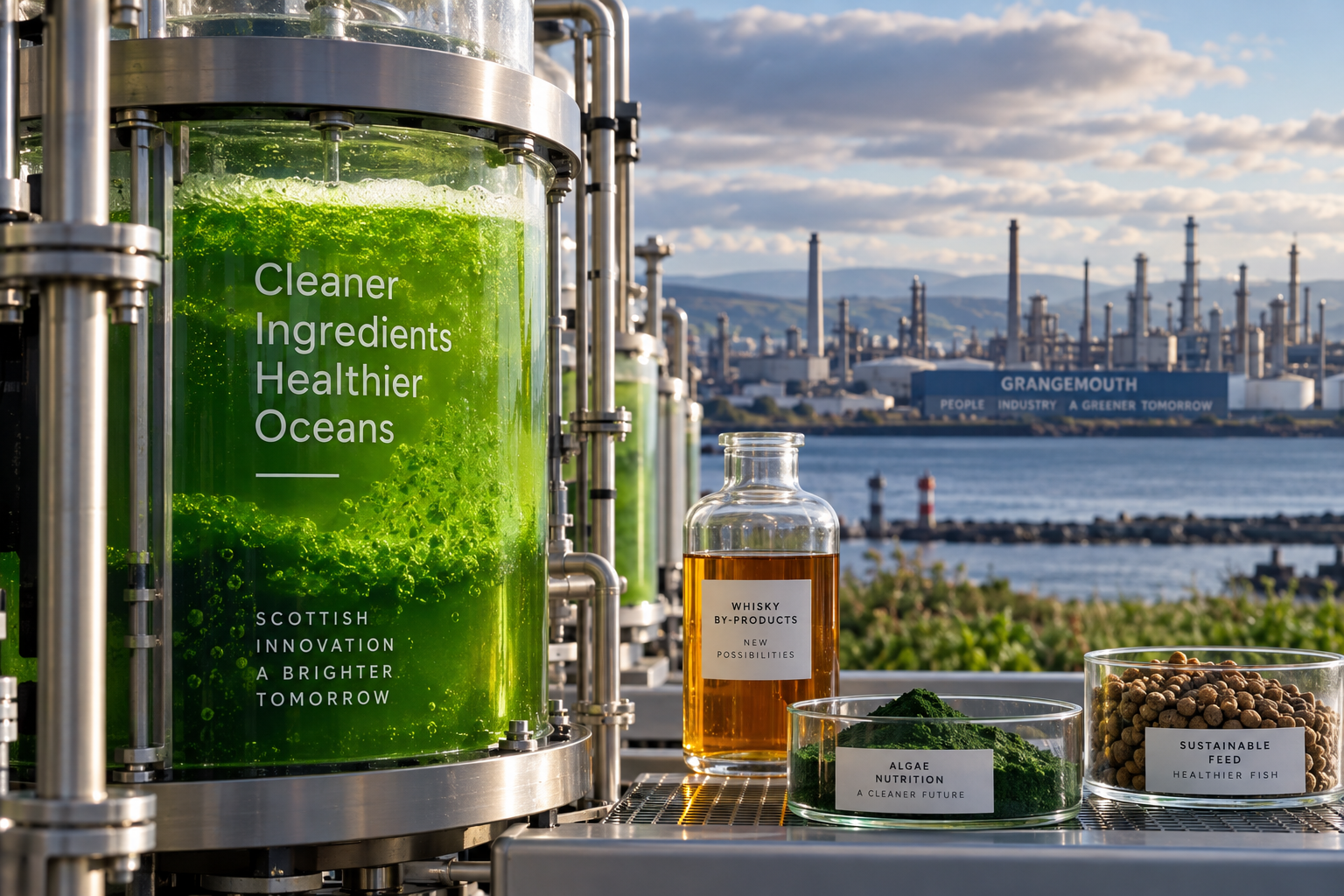
SEPA is considering a permit for a new industrial process at Earls Road in Grangemouth that would produce omega-3-rich material from microalgae grown using by-products from Scotland’s whisky industry. The company behind it, MiAlgae, says the process can replace marine-derived omega-3 used in pet food and aquaculture while recycling millions of litres of distilling by-product. The project has already received public funding and is part of the attempt to rebuild Grangemouth’s industrial economy after the refinery era. The environmental regulator is now deciding the conditions under which it can operate.
On 3 September, the Scottish Environment Protection Agency opened a 28-day consultation on its draft decision for a new industrial authorisation at Earls Road in Grangemouth. The applicant is MiAlgae Ltd, an Edinburgh biotechnology company established in 2016. The activity for which permission is sought is described in regulatory language as the production of organic chemical omega-3 fatty acids.
The production method begins somewhere less obvious: Scotland’s whisky industry.
MiAlgae uses nutrient-rich co-products from whisky distillation as feedstock for microalgae grown inside fermentation vessels. The algae accumulate docosahexaenoic acid, or DHA, one of the principal long-chain omega-3 fatty acids normally associated with marine food chains. The resulting material can then be dried and sold as an ingredient for pet food and aquaculture feed.
The industrial logic is circular. One Scottish industry produces large volumes of organic material after distillation. Another industry requires omega-3-rich feed ingredients that have traditionally depended in part on fish caught at sea. MiAlgae is attempting to connect the two.
The permit is about industrial production, not a laboratory experiment
MiAlgae has been developing the process for nearly a decade, but the Grangemouth facility represents a move towards commercial-scale production.
The company broke ground on the site in December 2025. It said the new plant would increase its omega-3 production by more than ten times and process 33.1 million litres of whisky-industry by-products annually when operating at full scale. The company also said the expansion could replace enough marine-derived omega-3 to avoid the use of billions of wild fish each year.
Those figures are company estimates rather than measurements produced by SEPA. The regulator’s role is different. It is assessing whether the industrial activity can be authorised under the Environmental Authorisations (Scotland) Regulations 2018 and what operating conditions should apply.
SEPA says such authorisations are intended to prevent or minimise environmental harm, reduce the consequences of accidents and require sustainable use of resources. Its current consultation concerns the proposed permit conditions and draft decision rather than the commercial case for the plant.
Omega-3 does not originate in fish
The project depends on a biological fact that is often hidden by the way omega-3 products are marketed.
Marine omega-3 ultimately originates lower down the food chain. Certain microalgae naturally produce long-chain omega-3 fatty acids. Small marine organisms consume the algae; fish consume those organisms or other fish; omega-3 then accumulates through the food web.
Industrial fish oil traditionally shortens that process by harvesting oily fish such as anchovies, sardines and other small pelagic species and extracting the oil from them.
Fermentation offers another route. Instead of allowing the fatty acids to move through the marine food chain before they are harvested, microalgae can be cultivated directly under controlled industrial conditions.
That principle is not unique to MiAlgae. Algal omega-3 is already produced internationally for supplements, infant nutrition, animal feed and aquaculture. The unusual Scottish element lies in the feedstock used to grow the algae.
Whisky leaves behind far more than spirit
Distilling converts only part of the raw material entering a whisky plant into alcohol. The process also produces large volumes of liquid and solid co-products containing organic material and nutrients.
Some of those materials already have established uses. Distillers’ grains can be used in animal feed, while other residues may enter energy, agricultural or waste-treatment systems.
MiAlgae’s process uses liquid whisky co-products as a nutrient source for fermentation. The company says the material supports microalgal growth without requiring the same quantities of refined ingredients that would otherwise have to be produced specifically for the process.
The company also says that water emerging from the system can be cleaned and returned to the watercourse.
The environmental calculation therefore extends beyond the algae themselves. It includes what happens to the whisky co-product if MiAlgae does not use it, what energy the fermentation process consumes, how the water is treated, what emissions arise from industrial operation and how the final ingredient compares with conventional fish-derived omega-3 over its full life cycle.
The claimed reduction in fish use is very large
MiAlgae has previously estimated that one tonne of its algal product can displace the use of up to 30 tonnes of wild-caught fish.
That estimate has appeared repeatedly in public statements from both the company and Scottish Enterprise. The proposed Grangemouth expansion has consequently been presented as a way of reducing fishing pressure while producing an ingredient required by another important Scottish industry: aquaculture.
Salmon farming depends upon feeds containing proteins, oils, vitamins and minerals. Historically, fishmeal and fish oil formed a much larger proportion of those feeds than they do today. Vegetable proteins and oils have increasingly replaced marine ingredients, but long-chain omega-3 remains nutritionally important in salmon production and in the final nutritional composition of farmed fish.
That creates a continuing demand for DHA and related fatty acids even as the industry attempts to reduce dependence on wild fisheries.
Algal production is one possible answer because it removes the need to obtain those fatty acids through harvested fish.
Grangemouth is part of the story
The location is not incidental.
Grangemouth is undergoing one of the most consequential industrial transitions in modern Scotland. The closure of conventional oil refining at the site removed a major part of an industrial system that had developed over generations around petroleum, chemicals, port infrastructure and processing.
The Scottish and UK governments are now directing public money towards new industries capable of using the skills, land and infrastructure concentrated around the town.
MiAlgae is one of those projects.
In December 2025, Scottish Enterprise announced £1.5 million from the Scottish Government’s Grangemouth Just Transition Fund for the company, matched by a further £1.5 million from the UK Government. The funding was intended to support construction of the commercial-scale bioreactor facility.
Scottish Enterprise said the project could create up to 130 direct jobs in Grangemouth during the following five years and another 180 elsewhere in Scotland.
The Scottish Government has separately presented MiAlgae as part of the diversification of the Grangemouth industrial cluster beyond its traditional dependence on oil refining and petrochemicals.
The business began as a university project
MiAlgae was founded by Douglas Martin while he was studying at the University of Edinburgh in 2015–16. The company was incorporated in September 2016.
Its early development received backing from investors including Equity Gap, the Scottish Investment Bank and the University of Edinburgh’s Old College Capital. A £500,000 investment announced in 2018 helped fund a pilot plant, while a further £1 million investment announced in 2020 supported commercialisation and expansion.
The company subsequently developed larger-scale facilities in East Lothian before moving towards the Grangemouth project.
Companies House records show continued capital raising. Share allotments were filed in March and April 2026, with the company remaining active and registered in Edinburgh.
The development path therefore follows a familiar Scottish biotechnology model: university research or student entrepreneurship, early public and private investment, pilot-scale development and then an attempt to move into commercial manufacturing.
The environmental case is more complicated than “waste into food”
The basic proposition is attractive because it joins two existing industrial streams. Whisky co-products become feedstock for algae, and algae become an alternative source of omega-3.
Industrial biotechnology, however, still requires physical infrastructure.
Fermentation vessels require energy to operate, control temperature and move material. Biomass must be separated and processed. Water has to be managed. Cleaning chemicals may be required. Organic material can create biological oxygen demand if released untreated. Industrial sites also carry risks associated with storage, accidental discharge, odour and waste handling.
That is why the Grangemouth plant falls within SEPA’s environmental authorisation regime.
The regulator is not being asked to certify the company as sustainable. It is deciding whether the proposed industrial process can operate within environmental limits and, if authorised, the conditions required to control its emissions and resource use.
SEPA’s draft decision therefore provides a different kind of evidence from company announcements. It establishes that MiAlgae has reached the point at which its technology must be considered as an industrial chemical-production activity rather than solely as a biotechnology innovation.
Replacing fish oil does not automatically remove pressure from fisheries
The environmental effect also depends upon how the product is used.
If algal omega-3 directly replaces fish oil derived from wild-caught fish, the substitution can reduce demand for that marine resource. If it instead allows total feed production to grow while fish-oil demand remains unchanged, the effect is different.
Markets for fishmeal and fish oil are also interconnected. Many fisheries produce both products from the same catch, and trimmings from seafood processing are increasingly used alongside whole fish as raw material.
The relationship between one tonne of algal product and an avoided quantity of wild fish therefore depends upon assumptions about oil yield, species, alternative uses and market response.
MiAlgae’s frequently cited estimate of 30 tonnes of fish saved for each tonne of algae is its own conversion estimate. It provides a measure of the scale the company believes its technology can reach, but the actual environmental effect will depend upon substitution in the market.
The plant connects whisky to salmon farming without either industry meeting physically
The arrangement is economically unusual because the two ends of the system are geographically separate.
Whisky production is distributed across Scotland, including Speyside, the Highlands, the islands, the Central Belt and the south. Salmon farming is concentrated mainly along the west coast, Highlands and islands. Grangemouth sits between them as an industrial processing location with established road, port, chemical and logistics infrastructure.
Whisky-derived material can therefore be transported to a central biotechnology plant, converted into a high-value ingredient and then supplied into feed chains serving aquaculture or pet-food markets.
The value of the original material changes substantially along that route. A low-value industrial co-product becomes feedstock for fermentation. Fermentation produces specialised biomass containing DHA. That biomass becomes a commercial nutritional ingredient.
The process is an example of the kind of industrial transformation policymakers have sought when discussing a Scottish circular economy: retaining material within productive use while increasing its economic value.
The next question is whether the process works at industrial scale
Many biotechnology companies succeed technically at laboratory and pilot scale but encounter different problems when production increases.
Fermentation has to remain biologically consistent across much larger vessels. Inputs have to arrive in predictable quantities and quality. Contamination has to be controlled. Energy, water and processing costs can change the economics. Customers require consistent nutritional specifications across large volumes.
The Grangemouth plant is intended to address that transition.
MiAlgae has said the facility will increase output more than tenfold. It has also designed the technology as a modular system capable, in principle, of being reproduced near other sources of distilling co-products.
If that model works commercially, Grangemouth could become the first large installation in a network rather than a single unusual factory.
Scotland already produces both ends of the chain
The project also exposes an unusual feature of Scotland’s industrial geography.
Scotland is one of the world’s largest whisky-producing countries and one of Europe’s principal producers of farmed Atlantic salmon. One industry generates a nutrient-rich co-product. The other requires large quantities of nutritionally specialised feed.
Those industries have developed largely separately.
MiAlgae’s Grangemouth plant attempts to create a commercial link between them by inserting biotechnology between the distillery and the feed manufacturer.
That does not mean every whisky co-product can or should be diverted to algae production. Existing markets already use distillery residues, and the economics of collection and transport vary considerably by location.
The scale claimed for the Grangemouth facility nevertheless provides a first indication of what such a link could look like commercially. The company says 33.1 million litres of whisky co-products could pass through the plant each year.
SEPA’s decision will come before the technology’s larger claims can be tested
The current environmental consultation closes on 1 October 2026.
SEPA has already drafted proposed permit conditions and a decision document. Comments received during the consultation will be considered before the regulator reaches its final decision.
If authorisation is granted, the company will be required to operate within those conditions. SEPA can subsequently review the permit where necessary.
The larger claims surrounding the project will take longer to establish.
Whether the plant creates the projected jobs will depend upon commercial growth. Whether it processes the stated volume of whisky co-products will depend upon production. Whether algal omega-3 displaces large quantities of fish oil will depend upon customers buying and substituting it at scale.
The environmental authorisation marks the point at which those claims begin to move from development plans into industrial operation.
Grangemouth was built around industries that transformed raw materials at enormous scale. For much of the twentieth century those materials were crude oil and petrochemical feedstocks.
The proposed MiAlgae operation starts with something considerably less valuable: liquid left behind by whisky production.
The company’s commercial proposition is that fermentation can turn that material into an ingredient valuable enough to compete with oil extracted from fish caught at sea.
SEPA is now deciding under what environmental conditions that proposition can be tested at industrial scale.
Sources
Draft Decision Consultation: EAS/P/6101812 — MIALGAE Limited, Earls Road, Grangemouth
Scottish Environment Protection Agency — 3 September 2026
https://consultation.sepa.org.uk/permits/eas-p-6101812-mialgae-ltd-earls-road-grangemouth/
MiAlgae Ltd: MiAlgae Grangemouth Facility, Earls Road — Environmental Authorisation Application
Scottish Environment Protection Agency — 2026
https://consultation.sepa.org.uk/permits/app2026-00000447-mialgae-ltd-mialgae-grangemouth-f/
MiAlgae Breaks Ground on Major Sustainable Algal Omega 3 Facility at Grangemouth
MiAlgae — 12 December 2025
https://mialgae.com/news/mialgae-breaks-ground-on-major-sustainable-algal-omega-3-facility-at-grangemouth/
Funding to Support Up to 460 New Jobs at Grangemouth
Scottish Enterprise — 11 December 2025
https://www.scottish-enterprise-mediacentre.com/news/funding-to-support-up-to-460-new-jobs-at-grangemouth
MiAlgae Breaks Ground on Major Sustainable Algal Omega 3 Facility at Grangemouth
Scottish Enterprise — 12 December 2025
https://www.scottish-enterprise-mediacentre.com/news/mialgae-breaks-ground-on-major-sustainable-algal-omega-3-facility-at-grangemouth
Technology
MiAlgae — accessed September 2026
https://mialgae.com/technology/
MIALGAE LTD — Company Overview
Companies House — accessed September 2026
https://find-and-update.company-information.service.gov.uk/company/SC544670
MIALGAE LTD — Filing History
Companies House — accessed September 2026
https://find-and-update.company-information.service.gov.uk/company/SC544670/filing-history
MiAlgae Secures £1 Million to Drive Commercialisation and Scale Up
Scottish Enterprise — 8 January 2020
https://www.scottish-enterprise-mediacentre.com/news/mialgae-secures-gbp-1-million-to-drive-commercialisation-and-scale-up-2
MiAlgae on Track to Shake Up Food Industry After £500,000 Investment
Scottish Enterprise — 6 June 2018
https://www.scottish-enterprise-mediacentre.com/news/mialgae-on-track-to-shake-up-food-industry-after-gbp-500-000-investment
Grangemouth Future Industry Board Programme Board Minutes: March 2026
Scottish Government — March 2026
https://www.gov.scot/publications/grangemouth-future-industry-board-programme-board-minutes-march-2026/
Protecting Grangemouth’s Future
Scottish Government — 19 March 2026
https://www.gov.scot/news/protecting-grangemouths-future/