
The national figure cited during a Scottish Parliament examination of railway accessibility this month can be traced to analysis carried out six years ago. Transport Scotland counted 133 of Scotland’s 360 stations as having step-free access to every platform in 2020. Network Rail has now told MSPs that funding is tighter in the present control period and only Bellgrove is committed to full Access for All treatment, with Falkirk Grahamston funded for detailed design.
Scotland’s frequently cited figure that 37 per cent of railway stations have step-free access to all platforms is based on a count undertaken in 2020, before six stations received full Access for All improvements during the following rail control period and before several new Scottish stations opened.
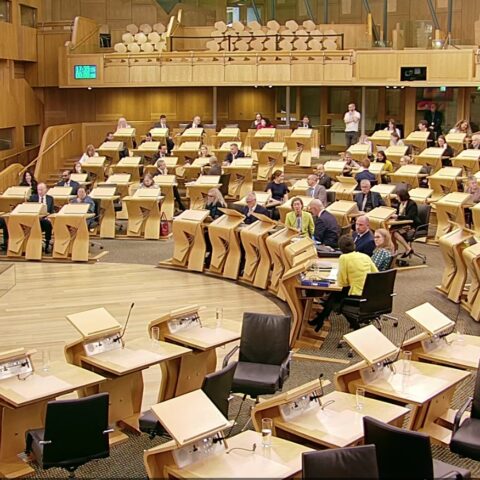
The age of the figure emerged from a comparison of Transport Scotland’s original Strategic Transport Projects Review evidence with testimony given to the Scottish Parliament on 16 September.
Transport Scotland’s 2020 analysis examined 360 stations using the Office of Rail and Road accessibility classification system. It found that 133 stations, or 37 per cent, had step-free access to all platforms. A further 184, or 51 per cent, had some degree of step-free access, while 43 stations, 12 per cent, had no step-free route to any platform.
That 37 per cent figure was again cited during Parliament’s examination of the rail network this month. Modern Scot found no later official national percentage replacing the 2020 calculation in the sources examined, although more recent station-by-station accessibility information is available.
The railway has not stood still during the intervening period.
Six stations improved in the last control period
Network Rail told the Parliament that six Scottish stations received improvements under the Department for Transport’s Access for All programme during Control Period 6, which ran to 2024.
Those works included projects at Croy, Johnstone, Port Glasgow, Dumfries, Anniesland and Uddingston. Port Glasgow’s £5 million project, for example, installed two lifts and a new footbridge to provide step-free access between the platforms.
Other changes have occurred outside the Access for All programme. New stations have opened, existing stations have been rebuilt as part of wider railway projects, and accessibility improvements have been incorporated into electrification and route works.
The denominator used in the 2020 calculation — 360 stations — consequently belongs to a network at a particular point in time. East Linton opened in 2023, and Cameron Bridge and Leven opened with the Levenmouth railway in 2024. Other station projects have altered accessibility without necessarily appearing as standalone Access for All schemes.
A current national measure would therefore require the station classifications to be counted again rather than continuing to apply the old percentage to a changed network.
The present programme is smaller
The more immediate development concerns what is happening now.
During evidence to Parliament on 16 September, Network Rail Scotland route director Liam Sumpter said there is less Access for All funding available in the current Control Period 7 than in the previous five-year period.
He told MSPs that Bellgrove in Glasgow is, at present, the only Scottish station committed to receiving the full Access for All treatment during CP7. Funding is also available for detailed design work at Falkirk Grahamston.
That current position is narrower than a Department for Transport announcement in May 2024, which named Bellgrove, Dumbarton Central, Falkirk Grahamston and Inverurie among Scottish stations selected within the next Access for All programme. Selection for programme development does not necessarily mean that a complete station reconstruction is immediately funded. Network Rail’s September 2026 evidence provides the later statement of what is presently committed for full delivery in the control period.
Sumpter also described a separate Railway for Everyone programme intended to deliver smaller interventions at Scottish stations. Those schemes can address accessibility without the scale or cost of installing new bridges and lifts.
What “accessible” means in the station records
The national 37 per cent figure describes one characteristic: whether passengers have step-free access to all platforms.
Current railway records use categories that provide more detail. A Category A station has step-free access to all platforms at the times trains are running. Category B stations have some degree of step-free access but may contain barriers, difficult routes or platforms that cannot all be reached step-free. Category C stations have no step-free access to any platform.
That classification is useful because a station can be described as having some step-free access while still being impractical for a passenger whose train departs from an inaccessible platform. Conversely, full step-free access does not by itself describe every element of an accessible journey.
Accessible toilets, ticket facilities, staff availability, passenger assistance, tactile surfaces, platform height, the horizontal and vertical gap between train and platform, onward transport and the reliability of lifts can all affect whether a journey can actually be completed.
The Office of Rail and Road now publishes station attributes data correct to 31 March 2026, while ScotRail’s own station accessibility information provides current classifications for individual stations. Those records make a contemporary station-by-station examination possible even though the national 37 per cent headline still traces back to Transport Scotland’s 2020 exercise.
Two governments, several funding routes
The funding structure is divided.
Railway accessibility is a reserved matter and the Department for Transport controls the main Access for All programme. Transport Scotland bids for Scottish projects within that programme. Transport Scotland can, however, fund accessibility improvements through its own railway investment, and wider Scottish projects can include station reconstruction as part of electrification, route enhancement or new-station work.
Network Rail pointed to the East Kilbride enhancement programme as an example. A new Hairmyres station and redevelopment at East Kilbride have incorporated accessibility into a broader railway investment rather than waiting solely for the national Access for All programme.
This mixed system makes a simple count of Access for All projects an incomplete measure of progress, but it also makes an up-to-date national station inventory more useful. Without one published headline calculation, improvements delivered through different programmes are difficult to compare with stations where major physical barriers remain.
A six-year-old baseline
The 2020 study was explicit about the scale of the problem it found: 227 of the 360 stations examined did not have unrestricted step-free access to every platform. Of those, 43 had none at all.
Some of those stations have since changed. Six received Access for All improvements in CP6. Other works were delivered through separate projects. New stations have entered the network. Current station-level data now extends beyond the information on which the original percentage was calculated.
Yet during a parliamentary examination in September 2026, the 37 per cent national figure remained the available reference point.
The immediate capital programme is also now clearer. Network Rail says CP7 has less Access for All funding than its predecessor. Bellgrove is presently the sole Scottish station committed to full treatment under the programme, while Falkirk Grahamston has detailed-design funding and smaller interventions are being pursued separately.
The next useful national measure would not require a new definition. The classification system already exists, and current information is recorded station by station. What is missing from the public record examined by Modern Scot is a new national calculation replacing the one made in 2020.
Sources
Strategic Transport Projects Review 2: Infrastructure to Provide Access for All at Rail Stations
Transport Scotland, 3 February 2021; station analysis undertaken in 2020
https://www.transport.gov.scot/media/49064/stpr2-phase-1-ast-project-12-infrastructure-to-support-access-to-rail-3-feb-2021.pdf
Official Report: Scottish Parliament, 16 September 2026
Scottish Parliament, 16 September 2026
https://www.parliament.scot/chamber-and-committees/official-report/search-what-was-said-in-parliament/meeting-of-parliament-16-09-2026?iob=225827&meeting=20236
Railway stations awarded Access for All accessibility funding
Department for Transport, 24 May 2024
https://www.gov.uk/government/publications/railway-stations-awarded-access-for-all-accessibility-funding/railway-stations-awarded-access-for-all-accessibility-funding
Station attributes for all mainline stations
Office of Rail and Road, data correct to 31 March 2026
https://dataportal.orr.gov.uk/statistics/infrastructure-and-environment/rail-infrastructure-and-assets/table-6329-station-attributes-for-all-mainline-stations/
Station Accessibility Information
ScotRail, January 2026
https://www.scotrail.co.uk/media/83850/download?inline=
Port Glasgow Access for All — One Year On
Network Rail, 6 December 2024
https://www.networkrailmediacentre.co.uk/news/port-glasgow-access-for-all-one-year-on