
Almost one in five secondary-age pupils across Mull, Iona and Ulva attend school on the mainland. Many live in an Oban hostel from Monday to Friday. The system can be traced to the closure of Bunessan’s secondary department in 1968, while the proposed £46.8 million Tobermory campus would leave it substantially unchanged. Scotland already possesses the technology and teaching network required to give younger pupils another choice.
On Monday mornings, children from southern Mull leave their family homes to attend secondary school across the sea.
Their school is Oban High School on the Scottish mainland. Those who cannot reasonably travel each day can be accommodated at Glencruitten Hostel, where most pupils from Mull, Iona and several other remote communities stay from Monday until Friday and return home for the weekend.
Oban High School is not formally a boarding school. The hostel is a separate council-run establishment described as school care accommodation. For the children involved, the distinction is largely administrative. They pack for the week, leave their homes and live under the care of other adults until Friday.
Argyll and Bute Council’s transport review identified 193 secondary-age pupils across Mull, Iona and Ulva during the 2024–25 school year. Of those, 157 attended Tobermory High School on Mull and 36 children living on Mull or Iona attended Oban High School on the mainland.
Almost one secondary-age child in every five was therefore being educated off-island.
The same report found that 22 per cent of the wider pupil population lived within the Oban High School catchment: eight per cent around Bunessan, seven per cent around Fionnphort and seven per cent on Iona. The figure of 36 does not prove that every one of those children stays in the hostel, but it establishes the scale of the population for whom the island’s existing secondary school is not the designated school.
Scotland is now preparing to spend an estimated £46.8 million on a new school campus on Mull. Yet the project, as presently constituted, would not bring secondary education any closer to the children of southern Mull. It would replace the existing school in Tobermory while preserving the catchment system that sends them to Oban.
The country is preparing to build for the next generation without resolving an arrangement inherited from the last century.
A Decision Made In 1968
Bunessan, in the Ross of Mull, once provided secondary education.
Its secondary department closed in 1968, when only six pupils remained. A Highlands and Islands Development Board study published in 1975 recorded that the department had provided a limited curriculum, consisting principally of craft and homecraft subjects.
The same report said that discussion in Argyll had already begun about creating a larger secondary school on Mull where all island pupils could complete at least their first four secondary years. The problem now being presented as an unfortunate but settled consequence of geography was therefore recognised more than half a century ago.
After Bunessan lost its secondary department, Oban became the established destination for children from the south-west of Mull. Hostel provision made the system operationally possible. Over time, an arrangement created when remote teaching barely extended beyond correspondence courses became accepted as the ordinary provision for generations of children.
The present pupils did not choose that history. Their parents did not design it. It is the accumulated result of school consolidation, limited local provision and a funding system that has treated hostel accommodation as an adequate answer to distance.
The technology available in 1968 could not bring a mathematics teacher, a Gaelic specialist or a modern-languages lesson into a small island classroom. The technology available in 2026 can.
Understanding The Islands
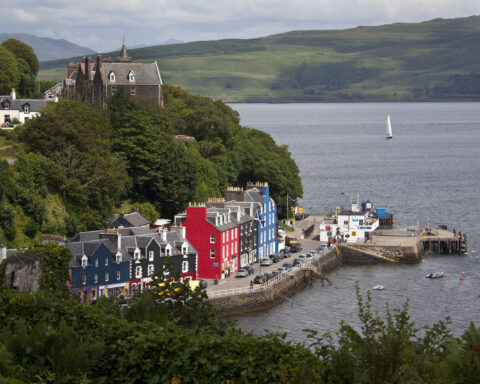
Tobermory is in the north of Mull and is the island’s largest settlement. Its existing campus provides nursery, primary and secondary education.
Craignure lies nearer the centre of Mull and contains the principal ferry terminal for Oban. Bunessan and Fionnphort are in the Ross of Mull, considerably farther south-west.
Iona is a separate island beyond Fionnphort. A child travelling from Iona to Oban must cross by ferry to Fionnphort, travel by road across Mull to Craignure and take another ferry to the mainland.
Children do not ordinarily undertake that entire journey in both directions every school day. The number of stages, distance, weather exposure and dependence on connecting services help explain why hostel accommodation exists.
The position of Iona is also different from that of southern Mull. When councillors decided in December 2024 to proceed with a single campus, they recorded the unanimous view of the Iona community that it should be removed from the scope of the project. In practice, Iona wished to retain its established connection with Oban rather than send pupils on a long daily journey to a school elsewhere on Mull.
That decision should be respected. Some Iona families value the breadth of education and activities available in Oban and prefer weekly residence there to a demanding daily journey involving a ferry and a long road crossing.
Respecting Iona’s choice does not require the same arrangement to be imposed upon Bunessan and Fionnphort. Their geography is different. Their children are already on Mull. A local or central provision could allow at least some of them to return home every afternoon.
There need not be one compulsory solution for every island child. A sound rural education system should be capable of accommodating more than one route.
What The New Campus Will Provide
The existing Tobermory campus needs replacement. It has been rated category C, or poor, for suitability, with identified shortcomings including accessibility, restricted specialist classrooms, inadequate social areas and constrained drop-off space. A modern building would provide substantial benefits to the children who attend it.
The project was admitted to the Scottish Government’s Learning Estate Investment Programme as a replacement for the existing Tobermory 2–18 campus. That means nursery, primary and secondary provision are being treated as one establishment.
Argyll and Bute Council selected Tobermory South as its preferred location in March 2025. The council says 84 per cent of secondary-age children on Mull live within the existing Tobermory High School catchment and estimates that retaining the campus in Mull’s largest settlement would produce £3.1 million more economic benefit than locating it centrally.
Those are legitimate considerations. Tobermory’s nursery and primary pupils should not be casually displaced from their own community, and a major school is an important source of employment and activity.
The financial position has become increasingly difficult. The project budget agreed in April 2024 was £42.9 million. The council set aside another £7 million in February 2026 for future school provision on Mull, while the current forecast for the campus has reached £46.8 million. The council attributes more than £946,000 in additional inflationary pressure to the pause associated with the judicial review. Subject to further approvals, the campus is projected to open in late 2030.
A statutory consultation is scheduled to run from 24 August until 2 October 2026. Its formal subject is the relocation of the existing Tobermory 2–18 campus to a new building at Tobermory South. It is not a consultation on whether Bunessan should regain secondary provision, whether the Oban catchment should change or whether a smaller southern facility should be established.
The process may refine the building. It does not, by itself, reconsider the education system around it.
How The Choice Became Narrower
Many residents supported a split-site approach: nursery and primary education would remain in Tobermory, while the secondary school would be placed nearer the centre of Mull.
The council rejected that model in December 2024 after considering educational benefits, funding conditions and advice from its chief financial officer that a two-site project would be unaffordable. From that point, the project proceeded on the basis of one combined 2–18 campus on one site.
That decision shaped everything that followed. Later appraisals were chiefly concerned with selecting a location for the combined campus. They were not an unrestricted examination of every possible way of educating children across the island.
Mull Community Council conducted a survey in early 2025 that received 665 responses, equivalent to about one fifth of Mull’s population, although approximately ten per cent came from people who did not live on Mull or its surrounding islands. Sixty-three per cent supported some form of split-site arrangement. Where only one combined campus was available, Tobermory was preferred.
The survey was self-selecting and was not a binding referendum. It does, however, show that many islanders favoured an option that had already fallen outside the council’s agreed project structure.
The Mull Campus Working Group later challenged the site-selection process in the Court of Session. Lord Cubie dismissed the petition on 18 February 2026, finding no legal basis to overturn the council’s decision on the grounds presented.
The ruling did not establish that Tobermory was the best educational solution. Lord Cubie stated at the beginning of his judgment that judicial review examines the lawfulness of a decision, rather than whether it was “right or wrong”. The case also did not challenge the earlier December 2024 decision to proceed with a single campus.
By 18 March 2026, the council had spent £118,698 on legal fees connected with the case, according to figures obtained by the Local Democracy Reporting Service. That expenditure settled whether the site decision had been lawfully made. It did not create another classroom or give southern Mull children a new educational choice.
What Scottish Law Permits
Scottish law does not guarantee every child a school within a particular distance of home.
The Education (Scotland) Act 1980 allows an education authority to overcome distance through transport, boarding-school accommodation, a hostel or other board-and-lodging arrangements. The law can therefore regard education as having been provided even where a child cannot attend it daily from the family home.
That statutory structure helps explain how the Mull arrangement has survived for decades. The availability of hostel accommodation makes it possible for the authority to meet its educational duties without operating a secondary school in southern Mull.
Parents may home educate in Scotland. Where a child already attends a council school, the parent normally requires the authority’s consent to remove the child from the roll, and that consent must not be unreasonably withheld. Consent is not normally required where a child has completed primary school but has not yet begun secondary school.
Home education could allow an individual child to remain with their family. It does not amount to publicly provided local secondary education. Once the child is withdrawn, the parent assumes responsibility for delivering the education, and the authority is not legally required to provide teaching resources, examination arrangements or funding.
A legal escape route for parents is not an adequate island education policy. Families should not have to choose between sending an 11-year-old away during the week and personally reconstructing a secondary school at the kitchen table.
The Human-Rights Warning
Documents released by the Scottish Government on 27 July 2026 show that Professor Katie Boyle, Chair of Human Rights Law and Social Justice at the University of Strathclyde, wrote to officials in December 2025 about the Mull arrangements.
Professor Boyle described what she believed to be a live issue involving the right to education and private and family life. She raised possible implications under the United Nations Convention on the Rights of the Child, the European Convention on Human Rights and equality duties, including children’s rights to be heard, to participate in cultural life and to maintain family relationships. She described her most pressing concern as the “constructed nature” of boarding outside the family home.
Her intervention was an expert legal warning, not a judgment that Argyll and Bute Council had acted unlawfully. She expressly stated that the factual account supplied to her came from the Mull Campus Working Group and had not been independently determined or tested against every party’s evidence.
The Court of Session did not decide those wider human-rights questions. They were not among the grounds argued in the judicial review.
The Scottish Government says its officials have taken appropriate legal advice on the wider matter, although that advice has not been published. It also says the human-rights explainer connected with the dispute has been discussed internally, and that lessons from Mull and other island projects will inform the successor to the Learning Estate Investment Programme. The former education secretary also wrote to the council encouraging stronger engagement with the Mull community.
There is no evidence that Glencruitten Hostel staff created this policy or that they systematically mistreat the pupils in their care. Staff may provide a safe, compassionate and professionally run environment.
A well-run hostel is still not a family home.
The question is not whether adults at the hostel work hard. It is whether weekly separation should remain the state’s ordinary educational provision for children from one part of Mull when a less intrusive local model may now be possible.
Gaelic Is More Than A School Subject
The published records do not state how many of the 36 Mull and Iona pupils attending Oban High School speak Gaelic or have received Gaelic-medium education. It would be inaccurate to describe them all as Gaelic speakers.
There is, however, an established Gaelic educational community in the affected area. Bunessan Primary provides Gaelic-medium education for southern Mull and Iona, while Salen provides Gaelic-medium education in the north. Oban High School offers Gaelic-medium secondary provision and qualifications through to Advanced Higher.
Argyll and Bute Council’s own integrated impact assessment concluded that opportunities for Gaelic could be enhanced by bringing together Gaelic-speaking cohorts from Bunessan and Salen in a central secondary school. The same assessment recorded concerns that children boarding in Oban can have less opportunity to participate in cultural, sporting and community activities on Mull during the week.
The availability of Gaelic lessons in Oban is valuable. It does not entirely answer the cultural question.
Gaelic survives through its use between generations, within families and during the ordinary life of a community. It lives in conversation, music, place names, local work, worship, sport and social gatherings. A language cannot be protected solely by ensuring that it appears on a timetable after its young speakers have left the community for most of the week.
No evidence presently establishes that boarding has caused a measurable decline in Gaelic use among these particular children. The absence of a published language breakdown makes the effect difficult to assess. That information should have been part of the public evidence from the beginning.
If Scotland is serious about maintaining Gaelic as a living community language, its education planning must consider where Gaelic-speaking children spend their lives, not merely where they sit their examinations.
The Smaller Alternative Raised And Then Overlooked
The public debate has been framed chiefly as a choice between a large combined campus at Tobermory and an expensive split-campus development.
A third option was visible in the council’s records as early as 2022.
During pre-engagement, someone asked whether a junior secondary school could help very young pupils who otherwise had to leave home at 11. The recorded council response was simply that the funding application had been made for a 2–18 campus.
Children also asked whether a school could be provided on Mull that they could attend each day and whether they could study without leaving their brothers and sisters. Elsewhere in the same engagement, a participant asked whether a hybrid model could allow secondary pupils to be educated in the Ross of Mull. The council acknowledged that digital technology could deliver teaching to different sites.
The public record reviewed for this article contains no separate feasibility study for a small S1–S2 centre at Bunessan. There is no published staffing plan, capital estimate, curriculum model or comparison with the continuing costs of pupil transport and hostel accommodation.
The suggestion appears to have been absorbed into a project whose funding and scope had already been defined around replacing the Tobermory campus.
That omission now deserves particular scrutiny because Scotland already operates the teaching system that could make such a centre viable.
Scotland Has Already Built The Digital School
E-Sgoil was established in the Western Isles to help small and remote schools obtain specialist teaching that could not always be recruited locally.
It now provides live, interactive lessons delivered by General Teaching Council for Scotland-registered specialist teachers. Its programmes cover the 3–18 curriculum and include Gaelic-medium education. During 2024–25, E-Sgoil delivered specialist supply teaching into three of the Western Isles’ four secondary schools, while most of the area’s primary schools received online teaching in Gaelic and English.
This is not a collection of children left alone with laptops. It is live teaching by qualified subject specialists, integrated into the work of local schools.
The Scottish Government’s 2026 review of online education recognised that face-to-face education has social, emotional and collaborative benefits that cannot be replaced. It also found that well-designed online learning can widen access, improve resilience and complement provision in schools, particularly where geography or staffing restricts subject choice.
That is precisely the balance required in southern Mull: a real local school environment supported by remote specialist teaching, rather than either a full conventional secondary school or education conducted entirely from home.
A Bunessan Junior Secondary Learning Centre
A workable proposal would be a Bunessan Junior Secondary Learning Centre, providing S1 and S2 education for children in southern Mull who wished to remain at home.
It would not need to reproduce every facility and department of a six-year high school. Nor would it be a literal one-room schoolhouse with one teacher expected to know French, physics, Gaelic, algebra and the proper maintenance of a Bunsen burner before lunch.
The centre could operate from an extension to Bunessan Primary, a small neighbouring building or a purpose-designed modular facility. It would have a locally based, GTCS-registered teacher responsible for daily learning, pastoral care and coordination, supported by appropriate classroom and pupil-support staff.
Specialist subjects could be taught live through E-Sgoil by qualified teachers elsewhere in Scotland. Visiting teachers could provide practical instruction, while planned blocks at Tobermory or Oban could give pupils access to laboratories, technical workshops, larger sports facilities and other equipment that would be disproportionate to reproduce for a small cohort.
The centre could preserve continuity for children who have received Gaelic-medium primary education. Gaelic-speaking pupils from Bunessan could remain together, with remote and visiting specialists helping to extend the language into secondary subjects rather than forcing the cohort to disperse at the end of primary school.
The arrangement need not be compulsory. Families who prefer Oban High School and hostel accommodation could retain that option. Iona could remain connected to Oban, as its community requested. Children from southern Mull who wished to stay locally could attend Bunessan for the broad general education provided during S1 and S2.
At S3, when subject specialisation and preparation for national qualifications become more demanding, pupils could transfer to Tobermory, Oban or another agreed pathway. By then, they would be older, their educational needs clearer and their families able to make a more informed choice.
The model would require proper examination. Pupil numbers, staffing, additional-support provision, safeguarding, broadband resilience, school meals, transport within the Ross of Mull, practical subjects, peer contact and costs would all need to be assessed.
Those are reasons to conduct a feasibility study. They are not reasons to refuse to conduct one.
A small centre may prove too expensive, although that cannot be known without costing it. It may suit some children and not others. It may require a partnership among Argyll and Bute Council, E-Sgoil, the Scottish Government and the principal secondary school.
Public authorities routinely resolve more complicated matters when they decide the matter deserves resolution.
Before The Future Is Set In Concrete
The proposed Tobermory campus can provide an excellent new school for the children it is designed to serve. Southern Mull should not be required to oppose a good school in Tobermory merely to secure an education for its own children.
The mistake lies in treating the two needs as though one must cancel the other.
A modern campus can be built at Tobermory while a modest junior secondary centre is established at Bunessan. Iona can retain its chosen route to Oban. E-Sgoil can provide specialist teaching that a small centre could never recruit alone. Gaelic pupils can remain within their community during the first years of secondary school. Families can be given genuine choices rather than administrative alternatives that are technically available but practically impossible.
The technology exists. The qualified teaching network exists. The local primary school and Gaelic cohort exist. The proposal itself has appeared in the council’s engagement records.
What is missing is a published assessment bringing those pieces together.
Scotland is considering £46.8 million for the principal campus. Argyll and Bute Council has already spent almost £119,000 defending its site-selection process. Before a system inherited from 1968 is embedded for further generations, a small fraction of that attention should be directed towards determining what it would cost to keep the youngest southern Mull pupils at home.
Children should not have to demonstrate exceptional resilience merely to make an education funding formula function neatly.
Gaelic should not be preserved as a classroom subject while the young people who may carry it forward are dispersed from the communities in which it lives.
A Bunessan junior secondary centre may not answer every difficulty created by the geography of Mull and Iona. It is, however, a credible Scottish solution built from methods Scotland already uses.
It deserves to be designed, costed and judged on evidence before another generation is told that leaving home is simply the price of growing up on an island.
Sources
Argyll and Bute Council — Mull Educational Campus Transport Considerations
https://www.argyll-bute.gov.uk/sites/default/files/2025-02/Mull%20Education%20Campus%20Transport%20Review_290125.pdf
Argyll and Bute Council — Mull Campus Pre-Engagement Feedback
https://www.argyll-bute.gov.uk/education-and-learning/schools/mull-campus-pre-engagement-feedback
Argyll and Bute Council — Mull Campus Pre-Engagement Feedback, August and September 2022
https://www.argyll-bute.gov.uk/sites/default/files/2024-07/summary_of_feedback_and_questions_002.pdf
Argyll and Bute Council — Mull Campus Integrated Impact Assessment
https://www.argyll-bute.gov.uk/sites/default/files/2025-02/332612224%20Mull%20Campus%20-%20Integrated%20Impact%20Assessment_Report_V4_Final.pdf
Argyll and Bute Council — Next Phase Agreed For Tobermory Campus
https://www.argyll-bute.gov.uk/news/2026/apr/next-phase-agreed-tobermory-campus
Argyll and Bute Council — Key Milestone As Tobermory Campus Plans Move To Public Consultation
https://www.argyll-bute.gov.uk/news/2026/jun/key-milestone-tobermory-campus-plans-move-public-consultation
Scottish Courts and Tribunals Service — Mull Campus Working Group Limited For Judicial Review [2026] CSOH 11
https://www.scotcourts.gov.uk/media/lx4pxthe/2026csoh11-mull-campus-working-group-limited-for-judicial-review.pdf
Highlands and Islands Development Board — Education And Migration, 1975
https://timeline.hie.co.uk/media/4w4m5hix/education-and-migration_-a-study-of-the-migration-and-job-expectations-of-young-people-and-their-parents-in-the-highlands-and-islands-of-scotland-a110296.pdf
Scottish Government — Highlands And Islands School Infrastructure Information: FOI 202600516882
https://www.gov.scot/publications/foi-202600516882/
Scottish Government — FOI 202600516882, Released Documents
https://www.gov.scot/binaries/content/documents/govscot/publications/foi-eir-release/2026/07-b/foi-202600516882/documents/foi-202600516882—information-released—documents/foi-202600516882—information-released—documents/govscot%3Adocument/FOI%2B202600516882%2B-%2BInformation%2BReleased%2B-%2BDocuments.pdf
Comhairle nan Eilean Siar — E-Sgoil Evidence Of Impact Report 2024–25
https://www.cne-siar.gov.uk/sites/default/files/imce/Committees/Education%20Sport%20and%20Childrens%20Services/2025/September/C-3A-e-Sgoil-Evidence-of-Impact-Report.pdf
Scottish Government — Online Learning Provision Review: Discussion Paper And Next Steps
https://www.gov.scot/publications/online-learning-review-discussion-paper-next-steps/
Scottish Government — Home Education Guidance
https://www.gov.scot/publications/home-education-guidance-2/
Education (Scotland) Act 1980
https://www.legislation.gov.uk/ukpga/1980/44
Oban High School — Glencruitten Hostel
https://www.obanhigh.argyll-bute.sch.uk/our-school/hostel
Oban High School — Gaelic-Medium Education
https://www.obanhigh.argyll-bute.sch.uk/g%C3%A0idhlig/gaelic-medium-education
STV News and Local Democracy Reporting Service — Council Spent Nearly £120,000 On Legal Fees Over Mull School Campus
https://news.stv.tv/west-central/argyll-and-bute-council-spent-nearly-120000-on-legal-fees-over-mull-school-campus