

Aberdeenshire Council is preparing to switch off streetlights along part of the A952 near Mintlaw on Friday, 30 October 2026, replacing conventional illumination with solar-powered road studs, reflective signs and movement-activated pedestrian lighting in an £89,500 experiment that will use artificial intelligence to monitor how drivers respond.
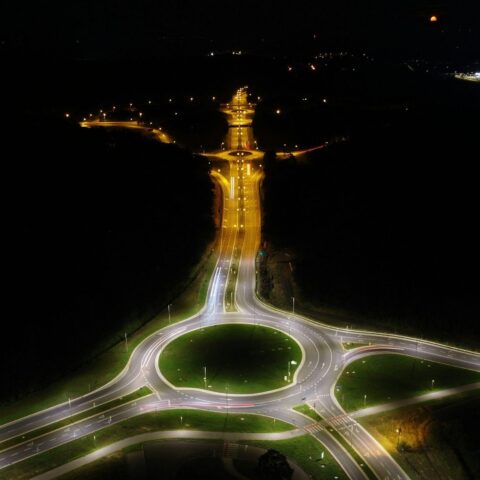
The trial will take place around Balring Roundabout on the southern edge of Mintlaw, extending along the A952 towards the entrance to a local garden centre. Artificial intelligence will analyse optical and thermal camera footage to examine changes in vehicle speeds, braking, road positioning and potentially dangerous interactions.
The experiment is part of a £30 million UK Government-funded highways research programme involving three established commercial businesses: Canadian-controlled Transoft Solutions, British-owned Clearview Intelligence and Hull-based engineering consultancy Local Transport Projects.
Each company has previous experience in transport infrastructure and road-safety research. Clearview has supplied technology for major Scottish roads, including the A1, A75 and the M8, M73 and M74 motorway network. Transoft develops software for analysing traffic behaviour, while Local Transport Projects has received a £500,000 consultancy contract from the English council leading the national programme.
Aberdeenshire Council has not publicly identified which of those businesses holds a direct contract for the Mintlaw installation or how the £89,500 grant will be distributed among individual suppliers. Their participation in the wider research programme is documented, but the specific commercial arrangements for the Scottish site remain unconfirmed.
The development comes as Aberdeenshire Council confronts increasing streetlighting costs despite investing approximately £6 million in more energy-efficient lighting over the past decade. It also follows a separate council decision to seek £750,000 in savings by switching off selected residential streetlights overnight.
Although the Mintlaw experiment is separately funded and has a research purpose, its results could influence how roads are illuminated elsewhere in Aberdeenshire and potentially across Scotland.
Which Streetlights Will Be Switched Off?
The council announced the experiment on 23 October, identifying the wider test area as a section of the A952 between the East Mains of Pitfour roundabout and the pavilion on North Street.
Road improvements are being installed along the route, including highly reflective signs, new road markings and solar-powered studs designed to make the carriageway easier to follow after dark.
The streetlighting switch-off will specifically affect Balring Roundabout and its approaches, together with the A952 southwards to a point just north of the garden centre access.
Aberdeenshire Council describes the location as lying at the edge of the village, where pedestrian activity after dark is relatively limited.
However, the route also contains a pedestrian refuge island near bus stops. The council has identified this location as requiring additional measures before conventional streetlighting is removed.
These include passive infrared sensor-controlled lighting that activates when movement is detected near the pedestrian area.
The intention is to provide lighting where people need it without continuously illuminating the entire road.
Whether that approach provides sufficient visibility under different weather and traffic conditions is one of the questions the experiment is intended to answer.
How Will the Road Be Illuminated?
Solar-powered road studs will provide guidance along the carriageway and around the junction.
Unlike ordinary reflective studs, which depend on vehicle headlights, illuminated studs contain small light sources powered by energy collected during daylight hours.
The equipment is intended to make bends, lane boundaries, junction approaches and other road features more visible in darkness.
Highly reflective road markings and signs will provide additional guidance using light from approaching vehicles.
However, illuminated studs and reflective materials do not perform every function of conventional overhead streetlighting.
Streetlights illuminate the road surface and surrounding areas, potentially helping drivers identify pedestrians, cyclists, animals and obstacles beyond the immediate path of their headlights.
Road studs principally identify the layout of the route rather than illuminating the entire surrounding environment.
The Mintlaw experiment must therefore establish whether the combination of different technologies provides acceptable visibility and safety at this particular location.
Clearview Intelligence Has Already Installed Similar Technology Across Scotland
One of the commercial partners in the national programme is Clearview Intelligence, a road technology company based in Milton Keynes.
Clearview supplies solar-powered road studs, vehicle-detection equipment, traffic-monitoring systems and other intelligent highway technologies.
The company operates through Clearview Intelligence Ltd, registered in England under company number 02135788. Its controlling parent is Clearview Intelligence Group Ltd, company number 03131861.
Companies House identifies British businessman Sir John Robert Madejski as the controlling shareholder of the parent company, with ownership of at least 75% of its shares.
Clearview’s work in Scotland is well established.
On the A1 through the Scottish Borders and East Lothian, the company supplied more than 4,100 solar-powered road studs across nine junctions along approximately 14 miles of road. The installation, completed in early 2016, was intended to improve visibility and help drivers identify junctions in darkness.
The project was undertaken for Amey on behalf of Transport Scotland.
Clearview also supplied solar-powered vehicle-detection and speed-warning systems at six locations along the A75 between Stranraer and Gretna Green. The equipment identifies the type and speed of approaching vehicles and activates warnings appropriate to their circumstances.
Along the M8, M73 and M74 motorway network, the company supplied wireless vehicle-detection technology at 14 locations to assist traffic-signal operation and improve traffic movement.
Its work has extended beyond major roads.
Approximately 3,000 illuminated road studs were installed along 13 kilometres of the Union Canal towpath around Falkirk, providing guidance for pedestrians and cyclists in darkness. More than 600 additional studs were installed along a wooded section of the South Ayrshire Coast Cycleway.
These installations demonstrate that the type of illuminated guidance technology being examined at Mintlaw has already been deployed in Scotland.
However, the council has not identified the precise manufacturer and model of every road stud being installed on the A952. Clearview’s participation in the national research programme does not alone establish that it is the supplier for the Mintlaw site.
Artificial Intelligence Will Examine Driver Behaviour
The second significant commercial partner is Transoft Solutions, a Canadian transportation software business with operations in the United Kingdom.
Its UK company, Transoft Solutions (UK) Ltd, is registered in Birmingham under company number 03472486.
Companies House identifies Canadian businessman Milton Santano Elias Carrasco, a co-founder of Transoft, as the company’s person with significant control. The register records that he holds at least 75% of the shares and voting rights and has the right to appoint or remove directors.
Transoft develops specialist transport engineering and road-safety software. Its products are used to assess road layouts, vehicle movement, safety risks and traffic operations.
Its artificial intelligence platform, VERALYTIX, combines computer vision with traffic analysis to identify patterns of road-user behaviour and potential collision risks.
The software can analyse recorded video or continuous camera feeds, measuring vehicle movements and interactions involving pedestrians, cyclists and other road users.
In August 2025, Transoft formally launched VERALYTIX as a wider road-safety analytics platform following its acquisition of transportation video-analysis specialist AMAG in 2024.
The technology has already been used in the East Riding of Yorkshire streetlighting project, which began testing reduced lighting on approximately eight kilometres of the A164 and A1079 in April 2025.
There, conventional lighting was switched off and replaced with alternative guidance systems. Transoft’s software used thermal imaging and artificial intelligence to compare road-user behaviour under illuminated and dark conditions.
The company states that the system allows researchers to assess traffic speeds, near misses, braking and other safety indicators, including during periods when ordinary video cameras may struggle with limited visibility.
According to Transoft, the earlier English trial recorded no night-time collisions or complaints from residents during its initial monitored period. Those are findings reported by a project partner, rather than an independent safety evaluation of the proposed Scottish site.
The project received an Environmental Sustainability Award at the 2025 Highways Awards and a further AI Innovation in Local Government award in 2026.
Transoft identifies VERALYTIX as the technology used in that national project, but Aberdeenshire Council’s announcement does not explicitly confirm which configuration of the platform will be used at Mintlaw.
It does confirm that artificial intelligence will analyse optical and thermal video streams to assess the effects of switching off streetlighting.
What Information Will the Cameras Collect?
The council says the monitoring is intended to examine changes in driver behaviour and evaluate road safety.
Transoft describes its VERALYTIX technology as a traffic-analysis system capable of classifying vehicles and other road users, measuring movements and identifying situations associated with increased collision risk.
The company’s published information describes privacy-focused processing arrangements, including versions capable of analysing camera footage locally and transmitting aggregated information.
However, those general product capabilities do not establish the specific data-handling arrangements for Mintlaw.
The council’s public announcement does not identify where the Scottish camera recordings will be processed or stored, how long any identifiable footage might be retained or precisely which organisations will have access to the information.
Those arrangements will depend on the system installed and the agreements between the authorities and technology providers.
The available evidence does not establish that footage will be sent to Canada or accessed by overseas personnel merely because Transoft has Canadian ownership.
Nor has the council described the experiment as a speed-camera enforcement scheme.
The stated purpose is research into road-user behaviour and safety, rather than the automatic identification and prosecution of individual motorists.
A British Transport Consultancy Has a £500,000 Contract With the Programme Leader
The third company identified in the national partnership is Local Transport Projects Ltd, a transport planning and engineering consultancy based in East Yorkshire.
The company was established in 2004 and is registered under number 05295328.
It operates through a parent company, Local Transport Projects Group Ltd, established in 2024. Companies House identifies British transport consultant Antony John Kirby as the group’s controlling shareholder, holding at least 75% of its shares and voting rights.
The consultancy works on transport strategies, road-safety schemes, traffic engineering, cycling and walking infrastructure and assessments associated with public and private developments.
Its previous public-sector work includes consultancy associated with Hull’s cycling and walking infrastructure planning, road-safety programmes for East Riding of Yorkshire Council and technical support for traffic signals in Derbyshire.
Local Transport Projects has a particularly direct commercial relationship with the council overseeing the national streetlighting research.
Public procurement records show that East Riding of Yorkshire Council awarded the company a consultancy contract valued at £500,000 in February 2024 for support associated with Live Labs 2.
The published contract period ran from March 2024 to July 2026.
The £500,000 is the recorded contract award value, not a verified total of payments received by the company.
It is also separate from the £89,500 allocated to the Mintlaw installation.
Local Transport Projects is therefore a documented commercial participant in the wider government-funded programme, although the public records examined do not establish a separate consultancy fee paid directly by Aberdeenshire Council for the Scottish experiment.
Who Is Running the National Experiment?
Aberdeenshire Council is participating in the Decarbonising Street Lighting project, one of seven initiatives within the wider Live Labs 2 programme.
Live Labs 2 was developed by the Association of Directors of Environment, Economy, Planning and Transport, known as ADEPT, with £30 million in funding from the UK Department for Transport.
The programme investigates methods of reducing the carbon emissions associated with constructing, maintaining and operating local roads.
East Riding of Yorkshire Council leads the streetlighting research, supported by other local authorities, universities, engineering specialists and technology companies.
The council has already introduced alternative lighting arrangements on sections of the A164 and A1079, using solar road studs, reflective markings, targeted pedestrian lighting and video-based safety monitoring.
Transoft Solutions, Clearview Intelligence and Local Transport Projects are explicitly identified as partners in the national project.
The three businesses differ in their ownership and areas of expertise. Transoft is Canadian-controlled but operates a registered UK company. Clearview Intelligence and Local Transport Projects are British-controlled companies registered in England.
Their involvement is not, by itself, evidence of any improper financial arrangement or conflict of interest.
Equally, identifying the commercial partners does not establish which company will own, maintain or operate each component of the Mintlaw installation. Those responsibilities depend on the actual project contracts and technical arrangements.
Aberdeenshire Has Already Invested £6 Million in Energy-Efficient Streetlighting
The experiment comes after a decade of investment intended to reduce the council’s streetlighting electricity consumption.
Aberdeenshire Council says it has spent approximately £6 million replacing more than 90% of conventional streetlighting lanterns with LED equipment.
The conversion has reduced electricity consumption by approximately 60%.
However, increases in electricity prices have resulted in higher overall expenditure despite the reduction in energy used.
The council states that further substantial savings now depend on reducing lighting levels, shortening operating hours or decreasing the number of locations illuminated.
The Mintlaw research is intended to establish whether such reductions can be achieved safely through a different combination of equipment.
Its £89,500 installation grant is therefore not simply replacing old streetlights with newer models. It is funding an experiment in whether conventional overhead illumination is required at all along a particular section of road.
A Separate Plan Already Sought £750,000 in Streetlighting Savings
The Mintlaw experiment is being introduced against the background of an earlier council-wide decision to reduce streetlighting costs.
In February 2025, Aberdeenshire councillors approved budget measures including a proposed £750,000 saving from switching off public streetlighting overnight in selected residential areas.
The planned reduction involved extinguishing lights for part of the night, generally between approximately 1am and 5am.
That programme was intended to reduce recurring operating expenditure, rather than research the particular low-carbon technologies being tested at Mintlaw.
The two initiatives should therefore be treated separately.
The earlier £750,000 figure represents a budget savings measure, while the £89,500 is a grant financing a specific research installation.
Nevertheless, both reflect pressure to reduce expenditure on streetlighting.
Concerns about the effects of reduced illumination have also been raised during council committee discussions, including questions about local safety, the removal or replacement of lighting equipment and how communities will be consulted.
These issues become more significant if the findings from Mintlaw are eventually used to support changes across a wider area.
How Will the Council Know Whether the Road Is Safe?
Aberdeenshire Council says comprehensive risk assessments have been completed by East Riding of Yorkshire Council before the planned switch-off.
A further road safety audit will be carried out after the streetlights are extinguished.
The AI-assisted monitoring will compare driver behaviour under different conditions, examining whether the new equipment changes vehicle speeds, braking patterns, road positioning or the frequency of potentially dangerous interactions.
This approach can identify risks without waiting for an actual collision, although the relationship between measured near misses and future accident rates requires careful interpretation.
The earlier English experiments provide relevant experience, but their results cannot automatically establish that the same arrangements will work in northern Scotland.
Mintlaw experiences longer winter nights and conditions involving frost, rain, fog and reduced visibility.
The performance of solar-powered studs will also depend on their design, battery capacity, maintenance and ability to recharge during periods of limited daylight.
The passive infrared lighting at the pedestrian island must operate reliably when people approach or wait near the crossing.
The assessment will therefore need to examine not only traffic movement but the performance of the equipment under the local conditions in which it will be used.
Could Other Roads Lose Their Streetlights?
Aberdeenshire Council has not announced a programme for removing conventional streetlighting from additional roads as a direct consequence of the Mintlaw experiment.
However, Councillor Alan Turner, chair of the council’s Infrastructure Services Committee, has confirmed that a wider rollout will be considered if the trial is successful.
The national programme is also intended to provide evidence that other highways authorities can use when assessing alternatives to conventional lighting.
That creates potential implications beyond Mintlaw.
A trial demonstrating acceptable safety outcomes at one village-edge roundabout could encourage authorities to consider similar changes on other roads with comparable characteristics.
It would not automatically establish that the same approach was suitable for residential streets, town centres, busy pedestrian routes or locations with different traffic patterns.
Each site would require its own assessment of visibility, road use, equipment performance and safety.
Road Closures Scheduled for 29 and 30 October
The immediate practical impact will be a temporary road closure during installation of the solar-powered studs.
North Street will be closed between the A952 and the C4B road from 9.30am to 4.30pm on Thursday, 29 October and Friday, 30 October.
A signed diversion will operate using the A952 and A90.
Drivers travelling through Mintlaw or using surrounding routes should follow the diversion signs during the works.
The council intends to switch off the selected streetlights on 30 October.
The research team will then be able to compare conditions before and after the change, using the information collected through the video-analysis system and other safety assessments.
The Test Will Be Whether Less Lighting Provides the Same Protection
The Mintlaw experiment brings together several different technologies: solar-powered road studs, high-performance reflective materials, movement-controlled pedestrian lighting and AI-assisted video analysis.
Each has been used in existing transport projects, but the combination is intended to test whether a conventional streetlighting installation can be reduced without an unacceptable effect on safety.
The commercial partners have documented experience in relevant fields, including previous Scottish road installations and road-safety monitoring elsewhere in the United Kingdom.
Yet their participation in the national programme does not establish the precise costs, contractual responsibilities or technology configurations for the Mintlaw site, which have not been fully disclosed in the council’s announcement.
Nor are the claimed potential financial and environmental benefits of the national programme established outcomes for this particular section of the A952.
The experiment will need to demonstrate that the reduction in electricity use and maintenance requirements is accompanied by acceptable road safety, reliable equipment performance and manageable long-term costs.
The installation is scheduled to begin operating without its existing overhead streetlighting on 30 October. The evidence needed to determine whether the approach should be used elsewhere will emerge only after the subsequent monitoring and safety assessments have been completed.
Sources
Aberdeenshire Council to Trial Lower Carbon Roads Infrastructure Options on A952 Near Mintlaw, Aberdeenshire Council, 23 October 2026.
Live Labs 2: Decarbonising Street Lighting, East Riding of Yorkshire Council, programme information.
East Riding of Yorkshire: High Visual Efficiency for Low Carbon Streetlighting, ADEPT Live Labs 2, project information.
How a Streetlight Reduction Project Led to Safer Streets, Transoft Solutions, 2026.
Transoft Solutions Launches VERALYTIX, Transoft Solutions, 11 August 2025.
VERALYTIX: AI-Powered Traffic Safety Analysis, Transoft Solutions, technical product information.
Transoft Solutions (UK) Ltd: Persons With Significant Control, Companies House, company number 03472486, accessed 26 October 2026.
Enhanced Delineation on the A1, Scotland, Clearview Intelligence, project case study.
Vehicle-Activated Dynamic Speed Warning on the A75, Clearview Intelligence, project case study.
Vehicle Detection Across the M8, M73 and M74 Motorway Network, Clearview Intelligence, project case study.
Falkirk Towpath Delineation, Clearview Intelligence, project case study.
SolarLite Road Studs in South Ayrshire, Clearview Intelligence, project case study.
Clearview Intelligence Ltd: Persons With Significant Control, Companies House, company number 02135788, accessed 26 October 2026.
Clearview Intelligence Group Ltd: Sir John Madejski Ownership Record, Companies House, company number 03131861, accessed 26 October 2026.
Live Labs 2 Consultancy Support Contract, Awarded to Local Transport Projects Ltd, East Riding of Yorkshire Council, Contracts Finder, February 2024.
Local Transport Projects Group Ltd: Antony John Kirby Ownership Record, Companies House, company number 15733931, accessed 26 October 2026.
Council Budgets Set for the Coming Year: Streetlighting Savings, Aberdeenshire Council, 27 February 2025.
Economic, Environmental and Social Impacts of Changes in Maintenance Spend on Local Roads in Scotland, Transport Scotland, streetlighting evidence review.