
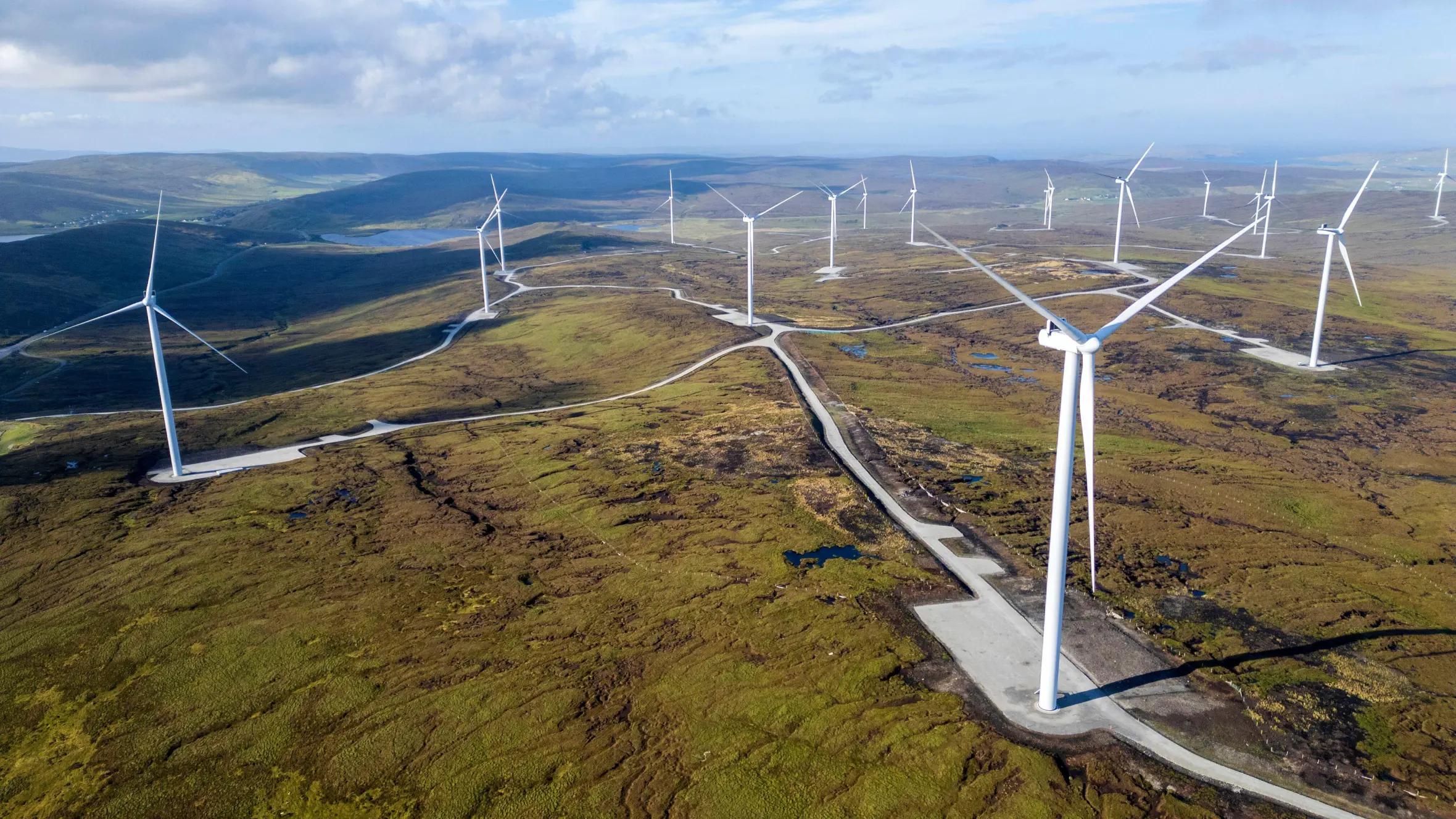
Shetland Islands Council is developing a plan to use surplus wind electricity to reduce the cost of energy for households and businesses, raising a fundamental question about Scotland’s renewable energy expansion: why can a community hosting one of Britain’s largest wind farms still face some of the country’s highest electricity-related hardship?
The Shetland Community Power Project, outlined on 11 November, brings together organisations responsible for electricity generation, transmission, regulation, housing and energy research. Its objective is to identify ways of using renewable electricity locally when transmission restrictions prevent all available power from being exported to mainland Britain.
The council is exploring the possibility of a special local electricity tariff, alongside battery storage, direct electricity connections and heating networks that could use power during periods of surplus generation.
No discounted tariff has yet been agreed. The initial work is intended to produce a costed plan and viable business models, with possible local trials beginning from 2028.
The proposed intervention comes against an uncomfortable economic reality. Official Scottish Government statistics show that 40% of Shetland households experienced fuel poverty during the 2022–2024 survey period, compared with 31% across Scotland. Extreme fuel poverty affected 29% of Shetland households, against a Scottish average of 17%.
These are three-year survey estimates rather than a count of households in November 2026, but they establish the scale of the problem.
A Wind Farm Capable of Producing Far More Electricity Than the Islands Consume
Shetland’s Viking Wind Farm became fully operational in 2024 following an investment of approximately £580 million.
Owned by SSE Renewables, the development has 103 turbines and an installed generating capacity of 443 megawatts. Its projected annual production is approximately 1.8 terawatt-hours.
For comparison, Shetland Islands Council records total local electricity consumption of approximately 176.5 gigawatt-hours in 2024, including domestic and non-domestic demand.
Viking’s projected annual generation is therefore roughly ten times that recorded local annual consumption. The comparison illustrates the scale of the development, although actual production varies with wind conditions and the figures do not mean that all electricity generated at Viking is available for unrestricted local use.
The wind farm is connected to the wider British electricity network through a 600MW high-voltage direct-current link between Shetland and mainland Scotland.
The 260-kilometre subsea connection, brought into service in 2024, was a major change for the islands, which had previously operated a largely separate electricity system.
Yet a connection to mainland Britain does not eliminate restrictions elsewhere in the transmission network.
When electricity flows encounter congestion on transmission routes further south, electricity system operators can instruct wind farms to reduce their output. Generators may then receive payments associated with those restrictions, while electricity users continue to face the wider costs of operating the system.
It is this unused potential generation that Shetland now wants to examine as an economic resource.
What Is the Shetland Community Power Project?
The initiative is being led initially by Shetland Islands Council, whose future energy and climate change manager, Claire Ferguson, outlined the proposals during the November announcement.
The working group includes organisations with different responsibilities across the electricity industry, including SSEN’s transmission and distribution businesses, the National Energy System Operator, regulator Ofgem, Great British Energy, SSE, Highlands and Islands Enterprise, the University of Strathclyde and Hjaltland Housing Association.
Their involvement matters because delivering cheaper electricity locally requires more than the agreement of a wind farm operator.
Electricity suppliers, network companies, regulators and government all influence how power is bought, sold, transported and charged for.
The council’s first task is to determine which technical and commercial arrangements could allow Shetland to use electricity that would otherwise be curtailed.
One possibility is to offer lower prices at particular times, encouraging consumers to use electricity when local wind output is high and the wider network cannot carry all of it away.
Another is to install storage that can absorb electricity when it is available and release it later.
A third is to connect suitable energy users directly to generation or develop heating networks that can take advantage of periods of abundant renewable electricity.
Each option has different costs and regulatory requirements.
The council expects its feasibility work to establish which projects are commercially realistic before it seeks to move towards implementation.
Why Electricity Bills Do Not Automatically Fall Near Wind Farms
Electricity generated in a community is not necessarily sold directly to households living nearby.
Most households obtain electricity through licensed suppliers under national market arrangements. Their bills include the wholesale cost of energy, network charges, operating costs and policy-related charges, subject to the terms of their tariff.
The electricity delivered through the network is also part of a wider interconnected system rather than a separate supply reserved for the community where the generator is located.
Consequently, the presence of a large wind farm does not automatically give nearby residents a lower electricity price.
A local discount scheme would require arrangements identifying when surplus energy is available, which consumers qualify, how they receive a reduction and who funds or forgoes the revenue associated with the discount.
It would also need to establish whether the additional local consumption genuinely reduces transmission constraint costs.
Those questions become particularly important where a proposal is intended to deliver lasting reductions in household bills rather than a limited trial or occasional periods of cheaper electricity.
The UK Government Has Already Announced a £20 Million Trial
In March 2026, the UK Government announced a national trial intended to make use of wind electricity that would otherwise be wasted because of transmission congestion.
The programme, funded by up to £20 million and delivered by UK Research and Innovation together with the Department for Energy Security and Net Zero, is designed to test discounted electricity offers for households and businesses in suitable locations.
The trial is expected to operate from winter 2026 until spring 2028.
Participating energy suppliers and other flexibility providers could offer cheaper electricity during particular periods by testing changes to policy charges known as Final Consumption Levies.
The Government envisages locations principally in Scotland and the east of England, where wind generation and network restrictions can coincide.
In October, engineering consultancy Arup announced that it had been selected to lead delivery of the trial, working with the Carbon Trust, Ipsos and Technopolis.
Shetland’s local project was prompted by this national policy development, but the two programmes should not be treated as a single approved scheme.
The national trial is preparing to test consumer offers under UK Government arrangements. Shetland’s council-led project is examining a wider collection of local energy possibilities, with potential trials from 2028.
Neither announcement guarantees a permanently reduced electricity tariff for every island household.
Why Shetland’s Heating Costs Are Particularly Important
The scale of Shetland’s electricity consumption reflects more than its population.
Homes face long heating seasons, and many properties are not connected to a mains gas network. Electricity and delivered fuels play an important role in domestic heating.
Shetland Islands Council reports that average domestic electricity consumption in 2024 reached 8,434 kilowatt-hours per household, compared with a Scottish average of 3,448 kilowatt-hours.
This means that even when the unit price of electricity is the same as elsewhere, many Shetland households may face substantially higher annual expenditure because they use more energy.
The islands’ climate, older housing, building efficiency and the cost of transporting goods and services can add to the financial burden.
A successful tariff proposal would therefore need to consider the pattern of demand in homes, not merely the volume of electricity generated in the islands.
For example, discounted power on very windy afternoons may be of limited value to a household unable to shift heating or other electricity use to those hours.
Homes equipped with suitable storage heaters, hot-water systems or other flexible equipment could potentially make greater use of time-limited discounts.
That raises another issue for the project: whether households already struggling with energy costs would need to purchase additional equipment to benefit fully.
Local Businesses Could Also Benefit
The council’s proposals extend beyond domestic electricity bills.
Lower-cost power could be economically important to businesses able to adjust the timing of electricity-intensive activities, including heating, refrigeration, processing and some industrial operations.
Shetland has significant fishing, aquaculture, marine engineering and energy-related industries, while further developments are being considered around the Sullom Voe Terminal and elsewhere.
The ability to use more electricity locally could create opportunities for new activities, but such benefits would depend on their actual energy requirements, grid connections and the prices ultimately available.
There is also a policy question about how a limited quantity of discounted electricity would be shared.
If major industrial consumers can respond more flexibly to price signals than households, a scheme designed only to maximise electricity consumption during constraint periods might deliver a greater financial benefit to businesses than to vulnerable domestic consumers.
Any local tariff would therefore need clearly defined objectives and eligibility arrangements if fuel poverty reduction is to remain a central purpose.
Does the Existing Wind Farm Community Fund Solve the Problem?
Viking already provides substantial community benefits.
Its operator says the development supports an annual community benefit fund of approximately £2.2 million and maintains local employment and supply-chain spending.
SSE Renewables has also reported approximately £80 million of expenditure with local suppliers during construction.
These commitments represent economic contributions to the islands, but community benefit funding is not the same as a reduction in household electricity prices.
Funds distributed to community projects may improve facilities and support local organisations without lowering the amount an individual household must pay its electricity supplier.
The council’s proposed tariff would attempt to address the electricity bill itself.
Shetland’s draft energy strategy, published in October 2025, had already identified affordable energy, local ownership, community benefits and the retention of economic value as priorities.
The latest project therefore builds on a longer debate about how the islands should benefit from hosting major energy infrastructure.
What Happens Next?
The Shetland Community Power Project remains at the investigation and feasibility stage.
Its immediate work is to examine the technical options, establish commercial models and identify any regulatory or funding changes needed before projects can proceed.
Possible trials from 2028 would depend on that work producing practical proposals.
There is no announced tariff price, estimated annual household saving, confirmed participant list or approved implementation budget for a local scheme.
Those details will determine whether the initiative delivers measurable relief to residents or remains an examination of what might be possible.
For Scotland’s other renewable-energy-producing communities, the Shetland project raises a question that extends well beyond one island group.
As renewable electricity production grows, will the communities hosting the infrastructure obtain direct financial benefits from the energy around them, or will those benefits continue to depend principally on national market rules and voluntary community funds?
Shetland is now attempting to turn that question into a workable commercial proposition.
Sources
Shetland Islands Council. Draft Shetland Energy Strategy. 6 October 2025. https://www.shetland.gov.uk/downloads/file/10996/draft-shetland-energy-strategy
Scottish Government. Scottish House Condition Survey: Local Authority Tables, 2022–2024 — Fuel Poverty and Extreme Fuel Poverty. 2026. https://www.gov.scot/publications/scottish-house-condition-survey-local-authority-tables-2022-2024/pages/fuel-poverty/
Scottish Government. Extreme Fuel Poverty, Local Authority Tables 2022–2024. 2026. https://www.gov.scot/publications/scottish-house-condition-survey-local-authority-tables-2022-2024/pages/extreme-fuel-poverty/
Shetland Islands Council. Energy Statistics. https://www.shetland.gov.uk/shetland-statistics/energy
UK Parliament. Solar and Wind to Cut Bills and Boost Clean Energy — Written Ministerial Statement HCWS1444. 24 March 2026. https://questions-statements.parliament.uk/written-statements/detail/2026-03-24/hcws1444
UK Research and Innovation. Electricity Demand Turn Up Trial: Expression of Interest for Flexibility Providers. 2026. https://apply-for-innovation-funding.service.gov.uk/competition/2557/overview/07ff6bbf-0eaf-4798-9fb3-5f2004211893
Arup. Arup, the Carbon Trust, Ipsos, and Technopolis to Lead Major UK Trial Helping Consumers Make Better Use of Surplus Renewable Energy. 27 October 2026. https://www.arup.com/en-us/news/arup-the-carbon-trust-ipsos-and-technopolis-to-lead-major-uk-trial-helping-consumers-make-better-use-of-surplus-renewable-energy/
SSE Renewables. Landmark Moment as SSE Powers Up Viking Wind Farm on Shetland. 29 August 2024. https://www.sserenewables.com/news-and-views/2024/08/landmark-moment-as-sse-powers-up-viking-wind-farm-on-shetland/
Shetland Islands Council, Claire Ferguson. Shetland Community Power Project briefing and interview, reported by Shetland News. 11 November 2026. https://www.shetnews.co.uk/2026/11/11/work-underway-explore-providing-discounted/