Tom Rendall and Neil Leask will explore farming words, weather, poetry and Norse-rooted place names during a free event at one of Orkney’s oldest surviving farm buildings.
The changing language of everyday Orkney life will be heard in its spoken form at Kirbuster Farm Museum this Saturday, as two local voices examine the words, sounds and place names that continue to distinguish the islands.
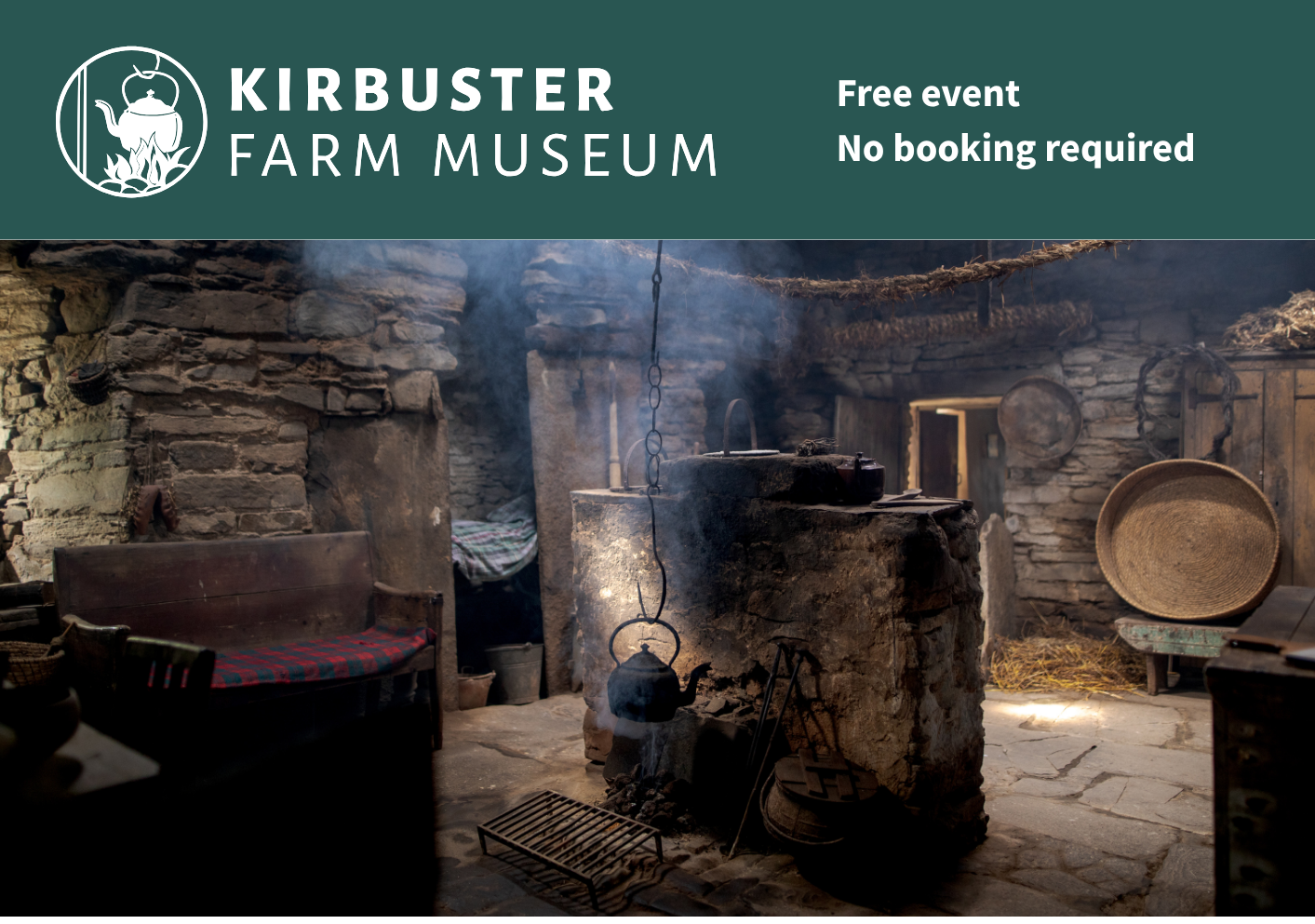
The Wey Wae Spaek will bring together dialect researcher Dr Tom Rendall and Kirbuster visitor services officer Neil Leask for an informal conversation from 2pm to 3.30pm on Saturday 25 July.
The free event will explore vocabulary connected with farming and weather, words that have disappeared from ordinary use, and expressions that have survived despite changes in education, work, communications and population.
Rendall and Leask will also consider the Norse inheritance still visible in Orkney place names and recite dialect poetry by Chrissie Costie and Robert Rendall.
The setting is closely connected with the language being discussed. Kirbuster Farm Museum, on Orkney’s West Mainland, preserves a traditional farmstead whose oldest recorded section dates from at least 1595. Its central firehoose is described by the council as the last unrestored example of its kind in Northern Europe.
Objects, rooms and working practices preserved at the museum carry their own local terminology. Farming language developed around particular tools, livestock, weather conditions, buildings and methods of working the land. As those practices changed, some of the words associated with them became less common.
Rendall said dialect had shaped much of his life and academic work.
“Dialect his played a big pairt o me life for a lot o years noo,” he said.
“I wis lucky enough tae get the chance tae dae me PhD thesis on the wey wae spaek. It is important that wae let folk hear the dialect words while Neil and me his a yarn aboot ferming and place neems along wae some poetry fae Chrissie Costie and Robert Rendall.”
Rendall completed his doctoral research in 2013 after examining the social and cultural influences affecting dialect use in Orkney. His work drew on interviews across 13 locations and 100 questionnaires, looking at migration, attitudes towards dialect and the ways demographic change had affected everyday speech.
His research described many Orcadians as effectively using two forms of speech: an Orcadian-influenced version of Scottish Standard English and a more recognisable local dialect containing vocabulary inherited from Norn.
Norn was a form of Old Norse brought to the Northern Isles by Norwegian settlement. It gradually gave way to Scots, but left a substantial linguistic inheritance in Orkney speech and place names.
Rendall has previously explained that Norn remained in Orkney for centuries and that many residents were probably bilingual during the period in which Scots increasingly displaced it. Although its full grammar was lost, words relating to work, landscape and ordinary domestic life remained embedded in Orcadian speech.
The dialect that followed was never entirely uniform across the islands. Oral-history work in the North Isles has recorded how speakers could once identify whether someone came from Westray, Papay, Sanday, Stronsay or Eday simply by hearing them speak.
Those distinctions have become less pronounced as travel, schooling, television, social media and migration have brought communities into closer linguistic contact.
That does not mean Orcadian speech has disappeared. Dialects change rather than remain fixed, and many local words continue to be used alongside forms more widely understood across Scotland and the UK.
The question is whether less frequently heard vocabulary can remain part of a living language rather than becoming something encountered mainly in archives, poems and museum displays.
Events such as The Wey Wae Spaek allow dialect to be heard rather than treated solely as written heritage. That distinction is particularly relevant because spelling cannot fully reproduce rhythm, vowel sounds, emphasis and the recognisable musical quality of spoken Orcadian.
Poetry has provided one means of preserving those qualities. Robert Rendall, born in Glasgow to Orcadian parents and raised in Orkney, wrote poetry in both English and the local vernacular. Chrissie Costie’s work likewise recorded Orcadian speech and experience through the language in which people lived and worked.
Their poems allow dialect to carry description, memory and humour rather than appearing as a collection of isolated old words.
Kirbuster also offers more than a historical backdrop. The farm first appears in surviving records in 1595, when its rental value was recorded partly in butter and poultry. Its name has been traced to the Old Norse kirkju-bolstadr, meaning a church farm settlement.
The property remained occupied into the 1960s. It was later preserved by the Argo family and donated to Orkney Islands Council, which opened it as a museum in 1987.
The firehoose contains a central hearth and peat fire, while the wider site includes domestic rooms, farming objects, an implement shed and Victorian gardens. These physical remains help explain why language developed as it did: words were attached to particular places, materials and forms of work.
A single afternoon cannot reverse the wider forces changing dialect use. Long-term survival depends upon families, schools, writers, broadcasters and younger speakers continuing to treat Orcadian as something that can be used, rather than merely remembered.
Rendall’s previous research found that attitudes towards dialect varied according to setting and generation. Speakers may use stronger dialect among family or within their home island while moving towards more standard speech in formal situations or when speaking to people from elsewhere.
That ability to shift between forms can help communication, but it may also leave distinctive words with fewer opportunities to be passed on.
The event at Kirbuster will place those words back into conversation, using the subjects from which much of the dialect grew: farming, weather, landscape and place.
The Wey Wae Spaek takes place at Kirbuster Farm Museum on Saturday 25 July from 2pm until 3.30pm. Admission is free and no booking requirement has been announced.
The museum is open during summer from 10.30am to 5pm from Monday to Saturday, closing between 1pm and 2pm. Sunday opening is from 1pm to 5pm.
Sources
Orkney Islands Council — The Wey Wae Spaek: dialect event at Kirbuster Farm Museum
https://www.orkney.gov.uk/latest-news/the-wey-wae-spaek-dialect-event-at-kirbuster-farm-museum/
Orkney Islands Council — Kirbuster Museum turns 30
https://www.orkney.gov.uk/latest-news/kirbuster-museum-turns-30/
Orkney Islands Council — Kirbuster Farm Museum heritage food open day
https://www.orkney.gov.uk/latest-news/kirbuster-farm-museum-to-host-a-heritage-food-open-day/
University of the Highlands and Islands — Tom Rendall: postgraduate research
https://www.uhi.ac.uk/en/research-enterprise/cultural/institute-for-northern-studies/research/postgraduate-research/past-pgr-students/
University of the Highlands and Islands — Perceptions of the Social and Cultural Factors Which Have Influenced the Use of Dialect in Orkney
https://pure.uhi.ac.uk/en/studentTheses/perceptions-of-the-social-and-cultural-factors-which-have-influen/
Open Research Online — Tom Rendall doctoral thesis
https://oro.open.ac.uk/61867/
Orkney Islands Council — Aspects of Orkney Dialect: a talk by Dr Tom Rendall
https://www.orkney.gov.uk/latest-news/aspects-of-orkney-dialect-a-talk-by-dr-tom-rendall/
Archaeology Orkney — The Orkney Dialect
https://archaeologyorkney.com/gaan-nort/the-orkney-dialect/