
In a traditional Scottish household, the preparation of a fine black bun begins in November, a full month before the festivities for which it is intended. This is not because the cake is particularly difficult to make, but because its character develops during the weeks following baking. The currants and raisins gradually settle into the surrounding mixture, the spices become more harmonious, and the rich fruit filling develops the close, dense texture for which a properly matured black bun is known.
Unlike an ordinary cake, intended to be enjoyed soon after leaving the oven, the traditional fruit-rich black bun benefits from being made in advance. Once completely cooled, it is carefully wrapped and allowed to rest. Three or four weeks is customary for those who favour a mature Hogmanay bun, although the precise period is a matter of household preference rather than an absolute requirement.
The pastry casing serves a purpose beyond appearance. It encloses the substantial fruit mixture, helps the bun retain its shape and provides a firm exterior that protects the filling during baking and subsequent handling.
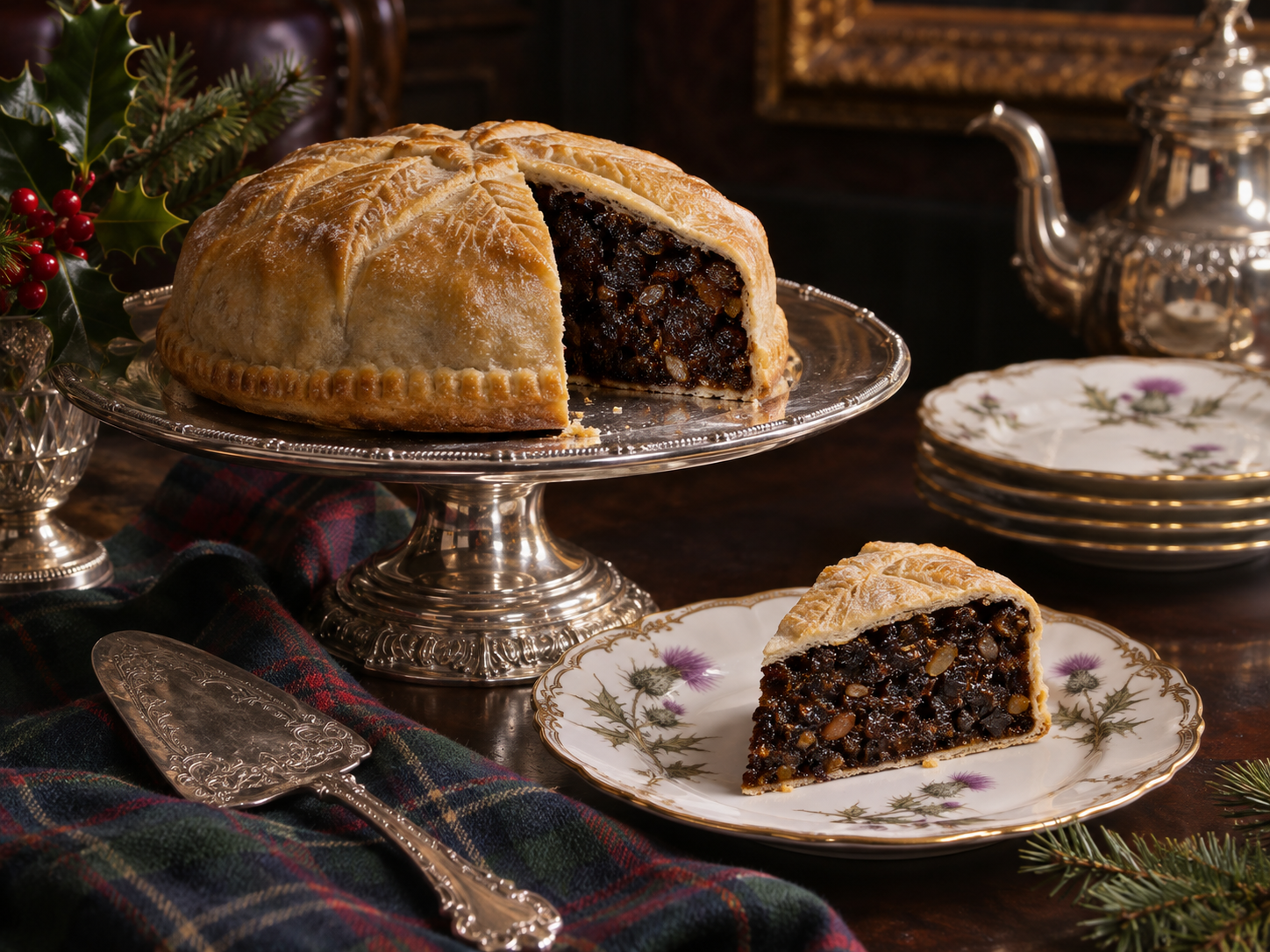
A good black bun is cut into thin, handsome slices. Its interior should be dark, richly fruited and fragrant with ginger, cinnamon, allspice and the occasional suggestion of pepper. The pastry should remain discreet, providing a delicate contrast to the weight and richness within.
Presented on a silver cake stand or a fine porcelain plate, accompanied by Scottish shortbread, good cheese and a dram of single malt, it is among the most characteristic offerings of a traditional Scottish Hogmanay table.
Its preparation belongs to an older domestic calendar, when festive baking was undertaken well before guests arrived, and the contents of the household pantry were as carefully considered as the dining table itself.
An Older Scottish Tradition
Long before the name black bun became commonplace, Scotland had a tradition of baking substantial fruit-filled buns for the Christmas and New Year season.
Eighteenth-century Scottish cookery books contain recipes for rich plum cakes and buns made with dried fruit, butter, spices and enriched bread dough. Some were encased in a separate layer of plain dough, anticipating the construction of the modern black bun.
In 1826, the Scottish writer Christian Isobel Johnstone, publishing under the name Meg Dods, included a recipe for Scotch Christmas Bun in The Cook and Housewife’s Manual.
The recipe belonged to an established Edinburgh baking tradition. Johnstone described festive buns weighing as much as sixteen pounds or more, prepared by leading Edinburgh bakers and dispatched to customers elsewhere in Britain.
These were not modest afternoon cakes. They were substantial festive provisions, designed for households expecting callers throughout the holiday period.
The earlier bun differed from the one familiar today. Its filling was made from enriched bread dough heavily laden with raisins, currants, spices and candied peel, while the outer covering was formed from plain dough rather than shortcrust pastry.
During the nineteenth century, the recipe evolved. The proportion of fruit increased, the flour and bread-like character of the filling became less prominent, and a thin pastry casing gradually replaced the original bread-dough covering.
By the turn of the twentieth century, recipes closely resembling the present-day black bun were firmly established.
The Scottish National Dictionary records the modern name through twentieth-century sources, including F. Marian McNeill’s The Scots Kitchen, published in 1929.
McNeill associated the bun with Scotland’s older Twelfth Night celebrations and its subsequent prominence at Hogmanay. That historical connection has been widely repeated, although surviving records do not establish precisely when or why the custom moved from one occasion to the other.
What is beyond doubt is that the richly fruited bun had become a recognised feature of Scotland’s winter festivities long before the twentieth century.
From the Edinburgh Bakers to the Family Table
The finest black buns were once substantial productions.
Their ingredients reflected both the wealth of the household and Scotland’s long-standing participation in international trade.
Currants, raisins, almonds, candied citrus peel and imported spices were prized ingredients, particularly when combined in the quantities required for festive baking.
Some recipes called for cloves, cinnamon, ginger, allspice and black pepper. Others used brandy or whisky to enrich the fruit mixture.
The precise balance varied between households and bakers.
A black bun made with generous quantities of pepper and ginger could be surprisingly assertive. A more restrained version might emphasise the sweetness of currants and the fragrance of candied citrus.
By the late nineteenth century, the bun had become a fixture of Scottish New Year hospitality.
It was brought out when neighbours called, offered to first-footers after midnight and served during the quieter gatherings that followed the celebrations.
The practice of first-footing gave black bun a particular place in the domestic rituals of Hogmanay. Visitors traditionally arrived with gifts representing good fortune and prosperity, while their hosts provided food and drink.
Scottish baking writer Sue Lawrence recalls black bun appearing alongside shortbread and other New Year provisions during childhood celebrations, when families visited neighbours in the early hours of New Year’s Day.
Its extraordinary richness made it well suited to such hospitality. A single substantial bun could provide many servings, while its firm texture allowed it to be cut into neat, narrow slices.
An Authentic Scotch Bun Recipe From 1902
A particularly valuable historical recipe survives in The Galt Cook Book, published in Ontario, Canada, in 1902.
The book includes a recipe entitled Scotch Bun, contributed by Mrs D. Goldie of Ayr.
Although the volume was published in Canada, the contributor’s recorded connection to Ayr gives the recipe a direct Scottish provenance.
Its ingredients and method closely resemble the traditional pastry-covered black bun. It includes large raisins, currants, candied peel, almonds, ginger, Jamaica pepper and black pepper, bound with flour and milk before being enclosed in a thin pastry casing.
Notably, the recipe contains no whisky, brandy or cinnamon. These ingredients appear in other historical versions, but adding them here would alter Mrs Goldie’s recorded recipe.
The following reconstruction preserves her original ingredients and proportions. Metric weights and approximate modern American cup measurements have been supplied for practical use. The original recipe uses pounds, teaspoons and the old-fashioned breakfast cup, which was not a standardised modern measure.
Mrs D. Goldie’s Scotch Bun — 1902
A substantial celebration bun, approximately 20–24 thin servings
The Original Fruit Filling
- 454g / 3¾ US cups plain flour
- 227g / 1⅛ US cups sugar
- 454g / approximately 3 US cups large raisins, preferably stoned
- 907g / approximately 6⅓ US cups currants
- 113g / approximately 1 US cup finely chopped mixed candied peel
- 113g / approximately ¾ US cup chopped almonds
- 14g / approximately 2 tablespoons plus 1 teaspoon ground ginger
- 14g / approximately 2 tablespoons plus 1 teaspoon ground Jamaica pepper (allspice)
- ½ teaspoon / ½ US teaspoon ground black pepper
- 1 small teaspoon / approximately 1 US teaspoon bicarbonate of soda (baking soda)
- 1 teaspoon / 1 US teaspoon cream of tartar
- Approximately 180–240ml / ¾–1 US cup milk, added only as required
Mrs Goldie’s original instruction specifies one small breakfast cupful of milk, or sufficient to mix the ingredients thoroughly by hand. Because historical breakfast cups varied in capacity, the modern quantity is an approximation.
The Original Pastry Casing
- Approximately 210g / 1¾ US cups plain flour, a practical approximation of the original 1½ breakfast cupfuls
- 113g / ½ US cup butter or lard
- ½ teaspoon / ½ US teaspoon baking powder
- Cold water, approximately 45–75ml / 3–5 US tablespoons, or sufficient to form a firm pastry
- 1 egg white, lightly beaten, for glazing
Preparing the Historical Bun
Begin by examining the dried fruit carefully, removing any remaining stalks or stones. The raisins used in older recipes were frequently large, seeded varieties, and the cook was expected to prepare them before use.
Place the flour, sugar, raisins, currants, candied peel and almonds in a large mixing bowl.
Add the ginger, Jamaica pepper, black pepper, bicarbonate of soda and cream of tartar.
Mix thoroughly, ensuring that the spices are distributed throughout the fruit.
Add the milk gradually, working the mixture together by hand or with a sturdy wooden spoon.
The result should be exceptionally dense. There should be no loose liquid or resemblance to an ordinary cake batter.
For the pastry, rub the butter or lard into the flour, add the baking powder and introduce sufficient cold water to make a firm dough.
Roll the pastry thinly and use it to line a generously greased, deep cake tin, reserving sufficient dough to cover the top.
The original does not specify a tin size. For a modern kitchen, use a deep tin large enough to hold the substantial mixture without compressing it above the rim; alternatively, divide it between two smaller deep tins.
Press the fruit filling firmly into the lined tin, smoothing the surface.
Moisten the pastry edges, place the reserved pastry over the top and seal carefully.
Brush with beaten egg white.
Mrs Goldie’s instructions specify baking for approximately two and a half hours. They do not state an oven temperature.
For a modern oven, a low setting of approximately 150°C / 300°F, or 135°C fan, provides a cautious starting point. The actual baking time may be longer, particularly in a deep tin. The bun must be fully baked through the centre before cooling.
Allow the finished bun to cool completely before removing and wrapping it.
This is a reconstruction of the documented 1902 recipe, not a claim that its original author used modern ovens, standardised cups or today’s storage methods.
The Modern Black Bun: A Refined Recipe for Hogmanay
The traditional recipe is magnificent in scale, but a modern household may prefer a slightly smaller bun with a more delicate balance of fruit, spice and pastry.
This version preserves the character of the Scottish original while introducing whisky and a little cinnamon. Its filling remains generously fruited, and the pastry casing is deliberately thin.
The recipe makes one large bun suitable for a deep 20cm / 8-inch square cake tin, serving approximately sixteen people.
Ingredients for the Pastry
- 300g / 2½ US cups plain flour
- 150g / approximately ⅔ US cup cold unsalted butter
- ½ teaspoon / ½ US teaspoon baking powder
- A small pinch of salt
- 75–90ml / 5–6 US tablespoons cold water
- 1 beaten egg for glazing
Ingredients for the Fruit Filling
- 450g / approximately 3¼ US cups currants
- 300g / approximately 2 US cups raisins
- 100g / approximately 1 US cup mixed candied orange and lemon peel
- 75g / approximately ½ US cup roughly chopped blanched almonds
- 120g / 1 US cup plain flour
- 100g / approximately ½ US cup packed soft brown sugar
- 1 teaspoon / 1 US teaspoon ground cinnamon
- ½ teaspoon / ½ US teaspoon ground ginger
- ½ teaspoon / ½ US teaspoon ground allspice
- ¼ teaspoon / ¼ US teaspoon freshly ground black pepper
- ½ teaspoon / ½ US teaspoon bicarbonate of soda
- ½ teaspoon / ½ US teaspoon cream of tartar
- 30ml / 2 US tablespoons good Scotch whisky
- 60ml / ¼ US cup milk, with a little more if required
Preparing the Modern Bun
1. Prepare the pastry
Sift the flour, baking powder and salt into a large bowl.
Add the cold butter, cut into small cubes, and rub it into the flour until the mixture resembles fine breadcrumbs.
Introduce the cold water gradually, bringing the dough together without excessive kneading.
Divide into two portions, allowing approximately two-thirds for the base and sides and one-third for the lid.
Wrap and refrigerate for at least thirty minutes.
2. Prepare the fruit
Place the currants, raisins, candied peel and almonds in a large bowl.
In a separate bowl, combine the flour, brown sugar, spices, bicarbonate of soda and cream of tartar.
Stir the dry ingredients thoroughly into the fruit.
Add the whisky and milk, mixing until the ingredients form a dense, moist mixture.
The filling should hold together when pressed. Add a little additional milk only if necessary.
3. Line the tin
Grease a deep 20cm / 8-inch square cake tin and line its base with baking parchment.
Roll out the larger portion of pastry and fit it carefully into the tin, allowing the dough to cover the base and sides.
Press it gently into the corners without stretching.
4. Fill and seal
Pack the fruit mixture firmly into the pastry case.
Smooth the surface, ensuring that no substantial air pockets remain.
Roll out the remaining pastry for the lid.
Moisten the edges, place the lid over the filling and seal securely.
Trim excess pastry neatly.
Prick the surface several times with a fork and make a few deeper holes with a fine skewer to allow steam to escape.
Brush with beaten egg.
5. Bake slowly
Preheat the oven to 150°C / 300°F, or approximately 135°C fan.
Bake for around two to two and a half hours, checking during the later stages. A particularly deep bun may require longer.
If the pastry begins to colour too quickly, protect it loosely with baking parchment or foil.
The centre should be fully baked and firm, without uncooked flour mixture adhering to a skewer inserted for testing.
6. Cool and mature
Allow the bun to cool completely in its tin.
Remove it carefully and leave it until no residual warmth remains.
Wrap first in baking parchment, then securely in foil, and place it in an airtight container.
A traditionally prepared, dense fruit bun is often matured for three or four weeks in a consistently cool, dry place. Home storage conditions vary, and a modern recipe containing milk should not automatically be assumed to have the shelf life of a commercially produced fruit cake.
For advance preparation, refrigeration at 5°C / 41°F or below provides a more controlled environment. For longer storage, freeze the fully cooled, wrapped bun and thaw it in its wrapping before serving. Freezing preserves the cake but does not produce the same continuing maturation as resting it unfrozen.
A mature bun should remain firm and fragrant, with no signs of mould, fermentation or spoilage. Any bun showing such signs should be discarded.
A Smaller Contemporary Black Bun for Gifts
For households preparing several small Hogmanay gifts, the recipe can be reduced to produce two modest loaves.
Each can be wrapped individually in parchment and presented in a decorative tin.
Ingredients
Pastry
- 200g / approximately 1⅔ US cups plain flour
- 100g / 7 US tablespoons cold butter
- ¼ teaspoon / ¼ US teaspoon baking powder
- Approximately 45ml / 3 US tablespoons cold water, plus a little more if necessary
- Beaten egg for glazing
Fruit Filling
- 225g / approximately 1⅔ US cups currants
- 150g / approximately 1 US cup raisins
- 50g / approximately ½ US cup candied mixed peel
- 40g / approximately ¼ US cup chopped almonds
- 70g / approximately ½ US cup plus 1 tablespoon plain flour
- 60g / approximately ¼ US cup packed soft brown sugar
- ½ teaspoon / ½ US teaspoon ground cinnamon
- ¼ teaspoon / ¼ US teaspoon ground ginger
- ¼ teaspoon / ¼ US teaspoon allspice
- A pinch of ground black pepper
- ¼ teaspoon / ¼ US teaspoon bicarbonate of soda
- ¼ teaspoon / ¼ US teaspoon cream of tartar
- 15ml / 1 US tablespoon Scotch whisky
- Approximately 30–45ml / 2–3 US tablespoons milk
Prepare the pastry and filling using the same methods as the larger modern recipe.
Divide between two small, deep loaf tins, approximately 15 × 8cm / 6 × 3 inches, leaving sufficient room for the pastry lid.
Bake at 150°C / 300°F, or 135°C fan, for approximately 75–105 minutes, checking that the filling is fully baked before removing the loaves.
Cool completely before wrapping.
These smaller buns are particularly suitable for presenting as New Year gifts. For preparation well in advance, refrigerate under suitable storage conditions or freeze until required.
Serving Black Bun at Hogmanay
The most elegant presentation is often the simplest.
Black bun is best brought to the table whole, allowing guests to appreciate the fine pastry casing before it is cut.
Use a long, sharp knife and slice sparingly. The richness of the fruit and spices calls for smaller portions than an ordinary sponge cake.
Arrange the slices on a porcelain or silver serving plate, with traditional Scottish shortbread nearby.
A fine malt whisky is a natural accompaniment. Strong tea is equally appropriate, particularly during a quiet afternoon when the New Year celebrations have subsided.
There is no need for icing or elaborate decoration. Black bun belongs to a tradition in which generosity was expressed through the quality of the ingredients, the care of the preparation and the readiness of the household to receive visitors.
Its place on the Hogmanay table has survived considerable changes in Scottish domestic life.
The recipes have evolved, the quantities have become more modest, and the old household ovens have given way to modern appliances. Yet the familiar combination of dark fruit, warm spices and a close pastry casing remains.
In a household observing the older custom, the bun prepared in late November will emerge from its wrapping as the year draws to a close, ready to be sliced for the first visitors of January.
Sources
The Galt Cook Book, Scotch Bun, page 300
Contributed by Mrs D. Goldie, Ayr; published by the Galt Publishing Company, Ontario, 1902
https://www.culinaryhistorians.ca/wordpress/wp-content/uploads/2023/12/Galt-Cook-Book-1902.pdf
The Cook and Housewife’s Manual
Christian Isobel Johnstone, writing as Meg Dods; Edinburgh, 1826; Wellcome Collection
https://wellcomecollection.org/works/v9335wy2
Scottish National Dictionary: Black Bun
Dictionaries of the Scots Language
https://dsl.ac.uk/entry/snd/black_bun
A Hogmanay Tradition: Black Bun Recipe
Birlinn, 21 December 2020
https://birlinn.co.uk/2020/12/21/a-hogmanay-tradition-black-bun-recipe/
Ingredient Weight Chart
King Arthur Baking
https://www.kingarthurbaking.com/learn/ingredient-weight-chart
Fruit Cake Storage
Clemson University Cooperative Extension
https://hgic.clemson.edu/q-a-of-the-week-fruit-cake-storage/